
You’ve probably never thought much about who analyzes your blood work or identifies the bacteria causing your infection. Behind every medical diagnosis, there’s a clinical laboratory scientist working with precision and expertise. These healthcare professionals operate at the intersection of biology, chemistry, and medicine, making them essential to patient care. If you’re drawn to science but want a career with direct impact on people’s lives, this path might be exactly what you’re looking for.
Becoming a clinical laboratory scientist requires earning a bachelor’s degree in medical laboratory science or a related field, completing clinical rotations, and passing a national certification exam. The process typically takes four years, with starting salaries around $60,000 and strong job growth projected through 2032. This career combines analytical thinking with healthcare impact, offering stability and advancement opportunities.
What Clinical Laboratory Scientists Actually Do
Clinical laboratory scientists perform complex tests that help doctors diagnose diseases, monitor treatments, and save lives.
You’ll analyze blood, tissue, and body fluids using sophisticated equipment. One day you might be identifying cancer cells under a microscope. The next, you’re running tests to match blood for a transfusion or detecting antibiotic-resistant bacteria.
The work happens in different settings. Hospitals employ the largest number of these professionals. You might also work in private diagnostic labs, research facilities, pharmaceutical companies, or public health agencies.
Your results directly influence patient treatment. When a doctor orders a complete blood count, you’re the one ensuring those numbers are accurate. When someone needs emergency surgery, you’re verifying their blood type.
The role requires attention to detail that borders on obsessive. A single decimal point error could lead to a misdiagnosis. You’ll follow strict protocols, maintain quality control standards, and document everything meticulously.
Educational Requirements for This Career Path
The foundation starts with your bachelor’s degree. You need a program accredited by the National Accrediting Agency for Clinical Laboratory Sciences (NAACLS).
Most students choose a medical laboratory science major. Some schools call it clinical laboratory science. Both prepare you for the same career.
Your coursework will include:
- General chemistry and organic chemistry
- Microbiology and immunology
- Hematology and clinical chemistry
- Molecular diagnostics
- Statistics and laboratory mathematics
The science load is heavy. You’ll need strong performance in chemistry fundamentals and biological sciences. These courses aren’t just memorization. They build the critical thinking skills you’ll use every day in the lab.
Clinical rotations happen during your final year. You’ll work in actual hospital and diagnostic laboratories under supervision. This hands-on training covers all major departments: chemistry, hematology, microbiology, immunohematology, and immunology.
Some students start with an associate degree to become a medical laboratory technician first. This lets you work in the field while completing your bachelor’s degree. Many employers offer tuition assistance for this pathway.
If you already have a bachelor’s degree in biology, chemistry, or a related field, you can enter a post-baccalaureate certificate program. These condensed programs typically take 12 to 18 months.
The Step-by-Step Path to Certification
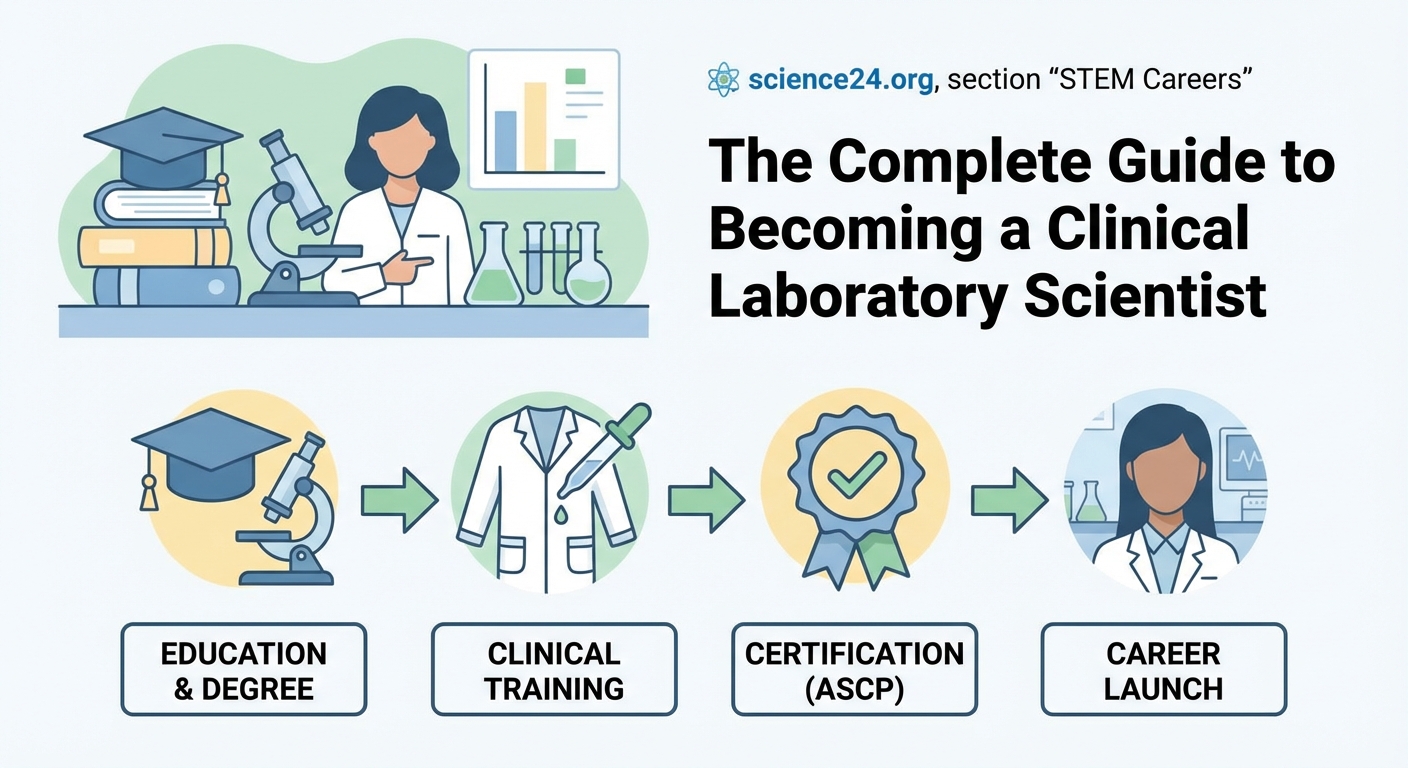
Certification isn’t legally required in every state, but most employers won’t hire you without it. Here’s how the process works:
-
Complete your bachelor’s degree from a NAACLS-accredited program with clinical rotations included.
-
Apply for the certification exam through the American Society for Clinical Pathology (ASCP) Board of Certification. This is the most widely recognized credential.
-
Prepare for the exam using study guides, practice tests, and review courses. The exam covers all laboratory departments you studied.
-
Take the MLS(ASCP) exam at an authorized testing center. You’ll have three hours to answer 100 multiple-choice questions covering clinical chemistry, hematology, immunology, microbiology, and laboratory operations.
-
Maintain your certification through continuing education. You’ll need 36 contact hours every three years to stay current.
The exam isn’t easy. It tests both theoretical knowledge and practical application. You might see a lab result and need to identify what disease it indicates. Or you’ll troubleshoot equipment problems based on quality control data.
Pass rates hover around 80% for first-time test takers from accredited programs. If you don’t pass initially, you can retake it after a waiting period.
Alternative certifying agencies exist. The American Medical Technologists (AMT) offers the MT(AMT) credential. Some states have their own licensing requirements on top of national certification.
Essential Skills Beyond the Textbook
Technical knowledge gets you through the door. These skills keep you there and help you advance.
Analytical thinking tops the list. You’ll constantly evaluate test results for accuracy. When something looks off, you need to figure out why. Is it a true patient result, a specimen problem, or equipment malfunction?
Manual dexterity matters more than you’d think. You’ll pipette tiny volumes of liquid, prepare microscope slides, and handle delicate specimens. Shaky hands make this work difficult.
Technology aptitude is non-negotiable. Modern labs use automated analyzers, laboratory information systems, and electronic health records. You’ll learn new software regularly as technology advances.
Communication skills bridge the gap between the lab and clinical staff. You’ll explain complex results to nurses and physicians. Sometimes you’ll need to recommend additional testing based on what you find.
Time management becomes critical during busy shifts. You might have 50 samples waiting, a stat order from the emergency room, and quality control that needs attention. Prioritizing correctly can be the difference between life and death for a patient.
Problem-solving under pressure separates good laboratory scientists from great ones. Equipment breaks. Reagents expire. Specimens arrive unlabeled. You need to think clearly when things go wrong.
Understanding the Certification Exam
The ASCP Board of Certification exam tests your readiness to practice safely and competently. Understanding its structure helps you prepare effectively.
| Exam Section | Number of Questions | Key Topics |
|---|---|---|
| Clinical Chemistry | 19 | Enzymes, electrolytes, proteins, endocrinology |
| Hematology | 18 | Blood cell identification, coagulation, anemia |
| Immunology | 14 | Antibody-antigen reactions, autoimmune diseases |
| Microbiology | 19 | Bacterial identification, parasitology, mycology |
| Blood Banking | 18 | Blood typing, crossmatching, transfusion reactions |
| Laboratory Operations | 12 | Quality control, safety, instrumentation |
Each question presents a clinical scenario. You’ll need to apply your knowledge, not just recall facts.
The exam uses computer adaptive testing. Questions get harder or easier based on your previous answers. This means you can’t skip questions and return to them later.
Budget three to six months for serious preparation. Study strategies that work for chemistry exams often translate well to this certification test.
Many candidates use multiple resources. Official ASCP practice exams show you the question format. Review books organize content by topic. Study groups help you discuss difficult concepts.
“The certification exam tests your ability to think like a clinical laboratory scientist, not just memorize facts. Focus on understanding why results occur, not just what they mean.” – ASCP Board of Certification
Salary Expectations and Job Outlook
Clinical laboratory scientists earn competitive salaries with room for growth.
Entry-level positions typically start between $55,000 and $65,000 annually. Your exact starting salary depends on location, facility type, and shift.
With five years of experience, you’ll likely earn $65,000 to $80,000. Specialized positions in molecular diagnostics or flow cytometry often pay more.
Leadership roles bring higher compensation. Laboratory supervisors earn $75,000 to $95,000. Laboratory directors with advanced degrees can exceed $120,000.
Geographic location significantly impacts pay. Clinical laboratory scientists in California, New York, and Massachusetts earn 20 to 30% more than the national average. Rural areas typically pay less but often have lower living costs.
Shift differentials add to base pay. Evening, night, and weekend shifts usually include extra compensation. Some hospitals offer sign-on bonuses for hard-to-fill positions.
The job market looks strong. The Bureau of Labor Statistics projects 7% growth through 2032, faster than average for all occupations. Several factors drive this demand:
- Aging population requiring more medical testing
- Advances in laboratory medicine creating new tests
- Retiring laboratory professionals creating openings
- Increased focus on preventive medicine
Healthcare systems consistently report difficulty finding qualified clinical laboratory scientists. This shortage gives you negotiating power for salary and benefits.
Specialization Opportunities Within the Field
After gaining experience, you can specialize in specific areas of laboratory medicine.
Molecular diagnostics involves genetic testing, cancer markers, and infectious disease detection at the DNA level. This rapidly growing field requires additional training but offers cutting-edge work.
Blood banking specialists focus exclusively on transfusion medicine. You’ll perform complex antibody investigations and ensure safe blood transfusions. This specialization requires meticulous attention to detail.
Microbiology specialists identify bacteria, fungi, viruses, and parasites causing infections. You’ll work with antibiotic susceptibility testing and help combat antimicrobial resistance.
Hematology specialists analyze blood cells and diagnose blood disorders. You’ll identify abnormal cells that indicate leukemia, anemia, and clotting disorders.
Clinical chemistry specialists run tests for organ function, drug levels, and metabolic disorders. This broad specialty touches nearly every patient case.
Immunology specialists study immune system function, autoimmune diseases, and allergies. The work often involves complex antibody testing.
Each specialization requires additional certification. The ASCP offers categorical certifications in these areas. You’ll need specific experience and pass another exam.
Some clinical laboratory scientists move into research positions. Pharmaceutical companies, biotechnology firms, and academic medical centers employ laboratory scientists to develop new diagnostic tests.
Others transition into sales or applications specialist roles for laboratory equipment manufacturers. Your technical knowledge helps hospitals implement new technology.
Common Challenges and How to Handle Them
Every career has obstacles. Knowing them ahead of time helps you prepare mentally.
Repetitive work can feel monotonous. You might run the same test hundreds of times. Finding meaning in accuracy and patient impact helps maintain motivation.
Irregular schedules are standard in hospital labs. You’ll work holidays, weekends, and possibly nights. The 24/7 nature of healthcare doesn’t pause for your personal life.
Limited patient interaction disappoints some people. You’ll rarely meet the patients whose samples you test. If you need direct patient contact to feel fulfilled, consider other healthcare careers.
Continuing education requirements never end. You’ll attend workshops, complete online courses, and stay current with new testing methods throughout your career.
Exposure to biohazards requires constant vigilance. You’ll work with infectious specimens daily. Following safety protocols protects you, but the risk never completely disappears.
Technology changes happen rapidly. Equipment you learned in school might be obsolete five years later. You need to embrace lifelong learning.
Stress during critical situations tests your composure. When the emergency room needs a stat result for a trauma patient, you’ll feel the pressure.
Building resilience helps. Connect with colleagues who understand the unique challenges. Take advantage of employee assistance programs if your workplace offers them. Remember that your work directly saves lives, even if you don’t see patients face to face.
Alternative Entry Points to Consider
The traditional four-year degree isn’t the only path into this career.
Military training programs prepare laboratory specialists for the armed forces. After your service, you can often obtain civilian certification through experience-based pathways.
International medical graduates with laboratory training can pursue certification through credential evaluation. Additional coursework might be required depending on your background.
Clinical laboratory technician advancement lets you work while studying. Many hospitals support MLT to MLS degree completion programs with flexible scheduling and tuition reimbursement.
Online degree programs offer flexibility for working adults. Several NAACLS-accredited programs provide didactic coursework online, with clinical rotations arranged near your location.
Accelerated programs condense the curriculum for students with strong science backgrounds. These intensive programs might take 18 to 24 months instead of four years.
Each pathway has tradeoffs. Online programs offer convenience but require self-discipline. Military training provides structure and financial support but includes service obligations. Evaluate your circumstances honestly before choosing.
Making the Final Decision About This Career
Clinical laboratory science offers a stable, well-compensated career in healthcare without requiring medical or nursing school.
You’ll need genuine interest in science. If chemistry and biology courses felt like torture, this probably isn’t your path. But if you found yourself fascinated by how cells work or chemical reactions, you’ll likely enjoy the work.
Consider your personality. Do you prefer working independently or as part of a team? Laboratory scientists do both. Are you comfortable with routine, or do you need constant variety? The work has elements of both.
Shadow a clinical laboratory scientist before committing. Most hospitals allow students to observe for a day. You’ll see the actual work environment, equipment, and pace.
Talk to practicing professionals about their experiences. Ask about aspects they didn’t expect. Find out what they wish they’d known before entering the field.
Research programs carefully. Accreditation matters for certification eligibility. Visit campuses if possible. Ask about clinical rotation sites and job placement rates.
Calculate the financial investment. Compare tuition costs, potential debt, and expected starting salary. Clinical laboratory science offers good return on investment compared to many healthcare careers requiring similar education.
Your Next Steps Start Today
The path to becoming a clinical laboratory scientist is straightforward once you understand the requirements.
Start by researching NAACLS-accredited programs in your area. Request information, review admission requirements, and note application deadlines. Most programs admit students once yearly, so timing matters.
Strengthen your science foundation now. If you’re still in high school, take advanced biology, chemistry, and mathematics courses. College students should maintain strong grades in prerequisite science courses.
Gain relevant experience through volunteering or part-time work in healthcare settings. While not required, it demonstrates commitment and helps you understand the healthcare environment.
Connect with academic advisors at schools offering medical laboratory science programs. They can answer specific questions about their curriculum, clinical sites, and graduation requirements.
Join student chapters of professional organizations like ASCLS. You’ll network with future colleagues, learn about the profession, and access career resources.
The healthcare system needs skilled laboratory professionals. Your decision to pursue this career means you’ll play a vital role in patient care, even if most people never know your name. That combination of scientific challenge and meaningful impact makes clinical laboratory science worth serious consideration.