
You spent years pipetting, optimizing protocols, and troubleshooting experiments that refused to cooperate. Your dissertation defense is behind you, or maybe you’re deep in your postdoc, staring down another grant rejection. The academic job market feels like a lottery you didn’t ask to play. You’re not alone in wondering what else your science training can unlock.
Scientists with advanced degrees in chemistry and life sciences possess valuable skills that translate into numerous non-academic careers. Patent law, regulatory affairs, medical writing, consulting, and industry research positions offer competitive salaries, better work-life balance, and opportunities to apply technical expertise without the uncertainty of tenure-track positions. Successful transitions require strategic networking, targeted skill development, and understanding how to communicate your research experience to non-academic employers.
Why Scientists Leave the Bench
Academic positions represent less than 15% of available jobs for PhD holders in life sciences. The rest of us need to look elsewhere.
Postdoc salaries barely cover rent in most university towns. You’re in your thirties, watching college friends buy homes while you’re on your third temporary contract. Grant funding rates hover around 20% at NIH. Even stellar researchers face rejection after rejection.
The pressure never stops. Publish or perish isn’t just a saying. It’s your performance review, your job security, and your reputation all wrapped into one metric.
But here’s the good news. Your technical training, analytical thinking, and problem-solving abilities are exactly what many industries desperately need. You just need to know where to look and how to position yourself.
Patent Law for Scientists
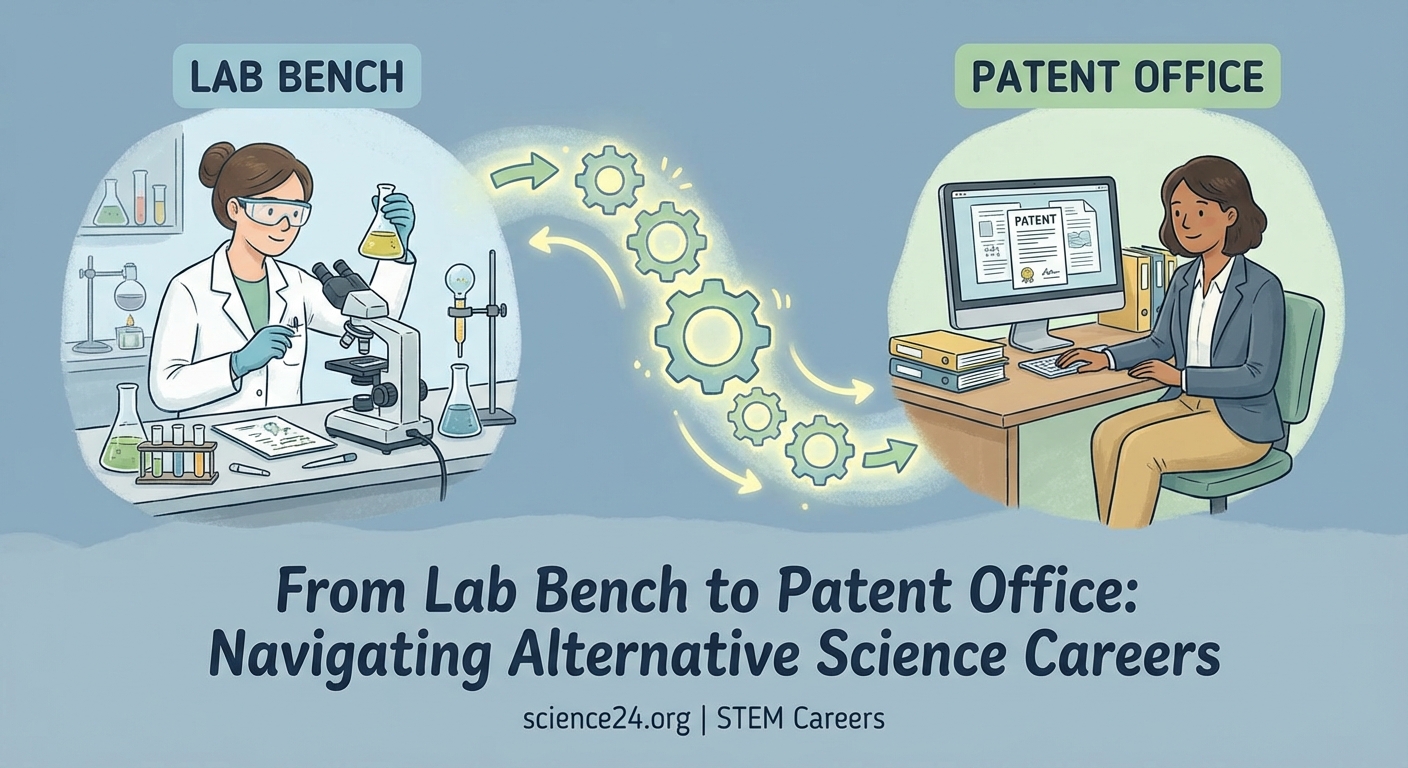
Patent attorneys with science PhDs earn between $150,000 and $300,000 annually. That’s not a typo.
You don’t need to go to law school immediately. Many scientists start as patent agents, which only requires passing the Patent Bar exam. This exam tests your understanding of patent law and procedures, not your ability to argue in court.
The Patent Agent Route
Patent agents can file patent applications, respond to office actions, and represent clients before the United States Patent and Trademark Office. You cannot litigate cases in court, but most patent work happens at a desk, not a courtroom.
The exam costs around $400 and requires about 200 hours of study. Most people prepare while working full-time. Pass rates hover around 50%, which is actually better than many professional licensing exams.
Your science background becomes your competitive advantage. Law firms actively recruit scientists with expertise in molecular biology, organic chemistry, immunology, and drug development. They need people who can read a research paper and actually understand what it says.
Transitioning to Patent Attorney
If you want the full attorney title and courtroom capabilities, you’ll need a law degree. Many patent agents work for a few years, get their employer to sponsor part-time law school, and earn their JD while maintaining their salary.
Evening and part-time law programs typically take four years. It’s a grind, but you’re already familiar with long hours and delayed gratification from your PhD.
Patent litigation attorneys can earn even more than prosecution attorneys, especially at large firms in Boston, San Francisco, or New York. But the work-life balance often suffers.
Regulatory Affairs Positions
Regulatory affairs professionals guide drugs, devices, and biologics through FDA approval. They’re the translators between scientists who develop products and government agencies that approve them.
Entry-level positions start around $75,000. Senior regulatory affairs directors at pharmaceutical companies can earn $200,000 or more.
The job involves:
- Writing and compiling FDA submissions
- Interpreting regulatory guidance documents
- Coordinating with clinical, manufacturing, and quality teams
- Responding to FDA questions and requests
- Tracking global regulatory requirements
You need attention to detail, excellent writing skills, and the ability to manage multiple deadlines. Sound familiar? That’s literally what you did managing your dissertation and multiple experiments.
Getting Your Foot in the Door
Most companies prefer candidates with industry experience, which creates a frustrating catch-22 for academics. Here’s how to break in:
- Target contract research organizations (CROs) rather than big pharma initially. They hire more frequently and value fresh PhDs.
- Attend Regulatory Affairs Professionals Society (RAPS) meetings and certification courses. The certification itself matters less than the networking opportunities.
- Emphasize any interaction you had with institutional review boards, animal care committees, or biosafety protocols. These demonstrate regulatory thinking.
- Consider a temporary or contract position to gain experience. Many convert to permanent roles.
The work itself is less creative than research but more predictable. You have clear deliverables, defined timelines, and weekends that actually feel like weekends.
Medical and Science Writing
If you enjoyed writing your papers more than running the experiments, science writing might be your path.
Medical writers create clinical trial documents, regulatory submissions, and scientific publications for pharmaceutical companies. Salaries range from $70,000 for entry-level positions to $150,000 for senior medical writers.
Science journalists and communicators work for magazines, websites, universities, and research institutes. Pay varies wildly, from $40,000 at small nonprofits to $100,000+ at major publications or corporate communications departments.
Types of Science Writing Careers
| Career Path | Typical Employers | Salary Range | Key Skills |
|---|---|---|---|
| Medical Writer | Pharma, CROs, medical communications agencies | $70K – $150K | Regulatory writing, clinical trial protocols |
| Science Journalist | Magazines, newspapers, online publications | $40K – $90K | Storytelling, interviewing, tight deadlines |
| Technical Writer | Biotech, medical device companies | $60K – $110K | User manuals, SOPs, training materials |
| Grant Writer | Universities, research institutes, nonprofits | $50K – $85K | Persuasive writing, budget development |
| Communications Specialist | Academic medical centers, biotech companies | $55K – $95K | Press releases, social media, public engagement |
The American Medical Writers Association (AMWA) offers training and certification programs. Their annual conference is where most hiring happens.
Start building a portfolio now. Write blog posts about your research for general audiences. Pitch article ideas to publications. Offer to write content for your university’s website or alumni magazine.
Consulting Opportunities
Management consulting firms hire scientists to advise pharmaceutical, biotech, and healthcare companies on strategy, operations, and scientific decisions.
Entry-level consultants at top firms (McKinsey, BCG, Bain) earn $90,000 to $110,000 plus bonuses. The hours are brutal, think 60 to 80 hour weeks, but the exit opportunities are excellent.
Boutique life science consulting firms offer better work-life balance and still pay $80,000 to $120,000 for early-career consultants. These firms focus exclusively on healthcare and biotech clients.
You’ll analyze market opportunities, evaluate drug development pipelines, assess manufacturing strategies, and present recommendations to C-suite executives. The work requires the same analytical rigor as research but applied to business problems.
“The transition from bench scientist to consultant taught me that my ability to design experiments, interpret data, and draw conclusions was exactly what clients needed. I just had to learn to present findings in PowerPoint instead of papers.” – Former MIT postdoc, now senior consultant at a life sciences advisory firm
Skills That Transfer
Your research background provides immediate credibility with scientific clients. When you present market analysis for a gene therapy company, they trust you understand the science.
The learning curve involves business concepts like competitive analysis, financial modeling, and strategic planning. Most firms provide training, but taking a basic business course or reading case studies beforehand helps.
Networking matters more in consulting than almost any other field. Attend industry conferences. Connect with consultants on LinkedIn. Ask for informational interviews. Most consultants are surprisingly willing to chat with potential candidates.
Industry Research Positions
Not everyone wants to leave the bench entirely. Industry research positions let you continue hands-on science without the grant writing treadmill.
Research scientists at biotech and pharmaceutical companies earn $85,000 to $140,000 depending on experience and location. Senior scientists and principal investigators can exceed $180,000.
The work differs from academia in important ways:
- Projects have defined endpoints and business objectives
- You work on teams with clear roles and responsibilities
- Success means advancing a drug candidate, not publishing papers
- Timelines are measured in quarters, not years
- You have access to resources that would make academic labs jealous
Finding Industry Research Jobs
Most positions aren’t advertised publicly. Companies recruit through:
- Employee referrals (the most common path)
- Recruiters who specialize in life sciences
- LinkedIn messages from hiring managers
- Scientific conferences and poster sessions
Your publication record matters, but industry cares more about technical skills and collaboration abilities. Highlight any work with cross-functional teams, technology transfer, or applied research goals.
Location matters significantly. Biotech hubs like Boston, San Francisco, San Diego, and Research Triangle Park offer far more opportunities than most cities. Remote research positions are rare since the work requires lab access.
Data Science and Bioinformatics
If you spent your PhD analyzing sequencing data, running statistical tests, or building computational models, data science might be your highest-paying exit.
Data scientists in biotech earn $100,000 to $180,000. Machine learning engineers can exceed $200,000 at top companies.
The field rewards programming skills more than wet lab experience. If you can code in Python or R, understand statistics, and communicate findings clearly, you’re already competitive.
Building Technical Skills
Most academic scientists have data analysis experience but lack software engineering fundamentals. Fill these gaps:
- Version control with Git and GitHub
- Cloud computing platforms (AWS, Google Cloud)
- Database management (SQL)
- Machine learning frameworks (scikit-learn, TensorFlow)
- Data visualization tools beyond Excel
Free online courses from Coursera, edX, and DataCamp can build these skills in six months of part-time study. The investment pays off quickly.
Bioinformatics positions offer a middle ground between pure data science and biology. These roles focus on genomic analysis, protein structure prediction, and biological database management. They value your biology knowledge alongside computational skills.
Making the Transition Successfully
Career changes feel risky after investing a decade in specialized training. These steps reduce that risk:
- Start networking six months before you need a job. Attend industry conferences, join professional associations, and schedule informational interviews. Most positions are filled through connections, not applications.
- Translate your CV into a resume. Industry hiring managers don’t care about your third-author papers. They want to see skills, accomplishments, and impact. Focus on what you achieved, not what you studied.
- Practice talking about your research for non-scientists. If you can’t explain your work to your parents, you’ll struggle in interviews. Industry values communication as much as technical expertise.
- Consider a transitional role. Postdoc positions at companies, temporary contracts, or part-time consulting gigs let you test the waters while maintaining some security.
- Address the timing question honestly. Employers worry that academics will flee back to the bench at the first faculty opening. Explain why you’re genuinely interested in leaving academia, not just unable to find a professorship.
Common Mistakes to Avoid
| Mistake | Why It Hurts | Better Approach |
|---|---|---|
| Applying only through online portals | Applications disappear into automated systems | Network directly with hiring managers and employees |
| Listing every technique you’ve ever used | Looks unfocused and desperate | Highlight skills relevant to the specific position |
| Waiting until your funding runs out | Rushed job searches lead to poor fits | Start exploring options 6-12 months early |
| Assuming your PhD speaks for itself | Industry values different skills than academia | Explicitly connect your experience to job requirements |
| Neglecting to research company culture | You’ll be miserable in the wrong environment | Talk to current employees before accepting offers |
The biggest mistake is staying in academia because you don’t know what else to do. Inertia is not a career strategy.
Building Your Professional Network
Academic conferences focus on science. Industry networking events focus on people. You need to attend both.
Join professional organizations in your target field. RAPS for regulatory affairs. AMWA for medical writing. American Association of Pharmaceutical Scientists for industry research. Membership costs $200 to $400 annually but provides access to job boards, training, and networking events.
LinkedIn becomes your primary professional tool outside academia. Update your profile to highlight transferable skills, not just publications. Connect with people in roles you want. Comment thoughtfully on posts in your field. Recruiters search LinkedIn constantly for candidates with science PhDs.
Informational interviews work better than you’d expect. Most people enjoy talking about their career path and offering advice. Reach out with specific questions, respect their time, and follow up with a thank-you note. One conversation often leads to three more introductions.
Understanding Compensation and Benefits
Industry compensation packages differ significantly from academic positions. Base salary is just the starting point.
Most companies offer:
- Annual bonuses (10% to 30% of base salary)
- Stock options or equity grants
- 401(k) matching (often 50% to 100% of your contributions)
- Health insurance with lower premiums than academic plans
- Three to four weeks paid vacation
- Professional development budgets
Total compensation can exceed your base salary by 30% to 50%. A $100,000 position might actually provide $130,000 to $150,000 in total value.
Negotiate your starting salary. Industry expects it. Academic conditioning makes scientists uncomfortable discussing money, but leaving $10,000 on the table because you didn’t ask is just bad math. Research typical salaries for your role and location. Ask for 10% to 15% more than their initial offer. The worst they can say is no.
Geographic Considerations
Your location options narrow significantly outside academia. Universities exist everywhere. Biotech companies cluster in specific regions.
Major biotech hubs ranked by opportunity:
- Boston/Cambridge (largest biotech cluster globally)
- San Francisco Bay Area (highest salaries, highest cost of living)
- San Diego (best weather, strong biotech presence)
- Research Triangle Park, NC (lower cost of living, growing market)
- Seattle (emerging hub, tech crossover opportunities)
- Philadelphia (pharma legacy, academic medical centers)
Smaller markets exist in New Jersey, Maryland, and scattered throughout the Midwest, but opportunities are limited. Remote positions are increasing but remain rare for lab-based roles.
If you’re tied to a specific location without a biotech presence, focus on careers with geographic flexibility like medical writing, consulting, or data science. These roles increasingly allow remote work.
When Academia Still Makes Sense
Not everyone should leave. Academic careers work well for people who:
- Genuinely love teaching and mentoring
- Have strong publication records and grant funding success
- Can handle uncertainty and financial instability
- Value research autonomy over salary
- Have partners with stable incomes and benefits
- Secured tenure-track positions at institutions they actually want to stay at
If you’re reading this article, you’re probably not that person. That’s completely fine.
The academic career path worked for a different era with different funding levels and job markets. Adapting to current realities isn’t failure. It’s smart decision-making based on available information.
Some scientists maintain academic connections through adjunct teaching, collaborative research projects, or consulting relationships. You can leave the tenure track without abandoning science entirely.
Your Science Training Still Matters
Your PhD taught you to identify problems, design experiments, analyze data, and draw conclusions. Those skills apply everywhere.
You learned to handle failure. Most experiments don’t work. Most hypotheses are wrong. You developed resilience that most people never build.
You can read complex technical information and extract key insights. You can explain difficult concepts to different audiences. You can work independently and manage long-term projects.
These capabilities are valuable. Industry needs them. You just need to learn how to talk about them in language that resonates outside the ivory tower.
Resources for Career Exploration
Professional associations worth joining:
- Regulatory Affairs Professionals Society (RAPS)
- American Medical Writers Association (AMWA)
- American Association of Pharmaceutical Scientists (AAPS)
- Society of Chemical Industry (SCI)
- Association of Clinical Research Professionals (ACRP)
Websites and communities:
- Science Careers (published by Science magazine)
- Nature Careers (job listings and advice)
- LinkedIn groups for PhD career transitions
- Reddit communities like r/biotech and r/AskAcademia
- Cheeky Scientist (career coaching specifically for PhDs)
Books that actually help:
- “What Can You Do With a Major in Biology?” by Bart Astor
- “Alternative Careers in Science” edited by Cynthia Robbins-Roth
- “Put Your Science to Work” by Peter Fiske
- “Career Opportunities in Biotechnology and Drug Development” by Toby Freedman
Many universities offer career counseling for PhDs and postdocs. These services are often underutilized. Schedule an appointment. They can review your resume, conduct mock interviews, and connect you with alumni in industry.
Taking the First Step
Career transitions don’t happen overnight. You spent years building research expertise. Give yourself months, not weeks, to explore alternatives.
Start small. Attend one industry conference. Schedule one informational interview. Update your LinkedIn profile. Read job descriptions for roles that interest you.
Pay attention to which conversations energize you and which feel like obligations. Your gut reaction to different career paths provides useful data.
You don’t need to have everything figured out before taking action. Most successful career changers describe their path as iterative. They tried something, learned from it, adjusted, and tried again.
The scientists who thrive outside academia aren’t necessarily the ones with the most publications or the most prestigious postdocs. They’re the ones who recognized when it was time for something different and had the courage to pursue it.
Your career belongs to you, not to your PI, your department, or the academic system. You get to decide what success looks like. For many scientists, that decision leads away from the bench and toward opportunities that better match their skills, values, and life goals.
If you’re considering alternative career paths after your science degree, you’re already ahead of peers who haven’t started thinking about options beyond the next grant cycle.
Finding Your Path Forward
The best career decision is the informed one. You’ve spent your entire academic life gathering data before drawing conclusions. Apply that same rigor to your career.
Talk to people in roles that interest you. Ask about their typical day, not just their job title. Understand what they actually do between 9 AM and 5 PM.
Test your assumptions. Shadow someone for a day. Take on a small consulting project. Volunteer to write an article.
Your science training prepared you for more than you realize. The analytical thinking, attention to detail, and persistence that got you through your PhD are exactly what employers in patent law, regulatory affairs, consulting, and industry research are desperately seeking.
The question isn’t whether you’re qualified for these roles. You are. The question is which path aligns with what you want from your career and your life. Only you can answer that, but at least now you know what options exist beyond the academic track.