You’re standing in line at the coffee shop, splitting a bill with friends, or helping your child with homework. The numbers are simple enough, but reaching for your phone feels awkward. What if you could calculate answers in your head, confidently and correctly, in just a few seconds?
Mental calculation isn’t about being a math genius. It’s about learning a few strategic shortcuts that make numbers easier to work with. These techniques have helped students ace tests, professionals impress colleagues, and everyday people handle daily math without second-guessing themselves.
Mental math tricks simplify calculations by breaking numbers into manageable parts, using patterns, and applying strategic shortcuts. These seven techniques cover multiplication, addition, subtraction, percentages, and squaring numbers. Practice each method with real-world examples like splitting bills, calculating discounts, or checking receipts. With consistent use, you’ll build speed and confidence in everyday math situations without relying on calculators or apps.
Breaking down numbers makes everything easier
The foundation of fast mental math is understanding that you don’t have to work with numbers as they appear. You can split them, round them, or reorganize them to make calculations simpler.
Take 47 + 38. Instead of struggling with the traditional method, think of 38 as 40 minus 2. Now you’re solving 47 + 40, which gives you 87, then subtracting 2 for a final answer of 85. This approach, called compensation, turns awkward numbers into friendly ones.
The same principle works for subtraction. To calculate 82 minus 47, add 3 to both numbers. Now you’re solving 85 minus 50, which is obviously 35. You’ve made the problem easier without changing the answer.
Your brain processes round numbers faster than irregular ones. Use this to your advantage whenever possible.
Multiply by 11 without writing anything down
Multiplying two-digit numbers by 11 sounds complicated, but there’s a pattern that makes it almost instant.
Here’s how it works:
- Take your two-digit number, like 34.
- Add the two digits together (3 + 4 = 7).
- Place that sum between the original digits.
- Your answer is 374.
The process works for any two-digit number where the digits add up to less than 10. Try 52 times 11. Add 5 + 2 to get 7, then sandwich it between the 5 and 2. Answer: 572.
What if the digits add up to 10 or more? Use 78 as an example. Adding 7 + 8 gives you 15. Write down the 5 between the digits (7_5_8), then add the 1 to the first digit. Your answer becomes 858.
This trick impresses people at parties and saves time on homework. Practice with random two-digit numbers until it becomes automatic.
Turn percentages into simple fractions
Calculating percentages in your head feels intimidating until you realize most common percentages have fraction equivalents that are easier to work with.
| Percentage | Fraction | Mental Shortcut |
|---|---|---|
| 10% | 1/10 | Move decimal one place left |
| 20% | 1/5 | Find 10%, then double it |
| 25% | 1/4 | Divide by 4 or halve twice |
| 50% | 1/2 | Divide by 2 |
| 75% | 3/4 | Find 25%, then multiply by 3 |
Want to find 15% for a restaurant tip? Calculate 10% by moving the decimal point, then add half of that amount. For a $40 bill, 10% is $4, half of that is $2, so 15% equals $6.
The 25% trick works beautifully for discounts. A $60 jacket at 25% off? Divide 60 by 4 to get $15 off, making the sale price $45.
These fraction shortcuts work because your brain handles division by small numbers faster than percentage formulas.
Square numbers ending in 5 with a simple pattern
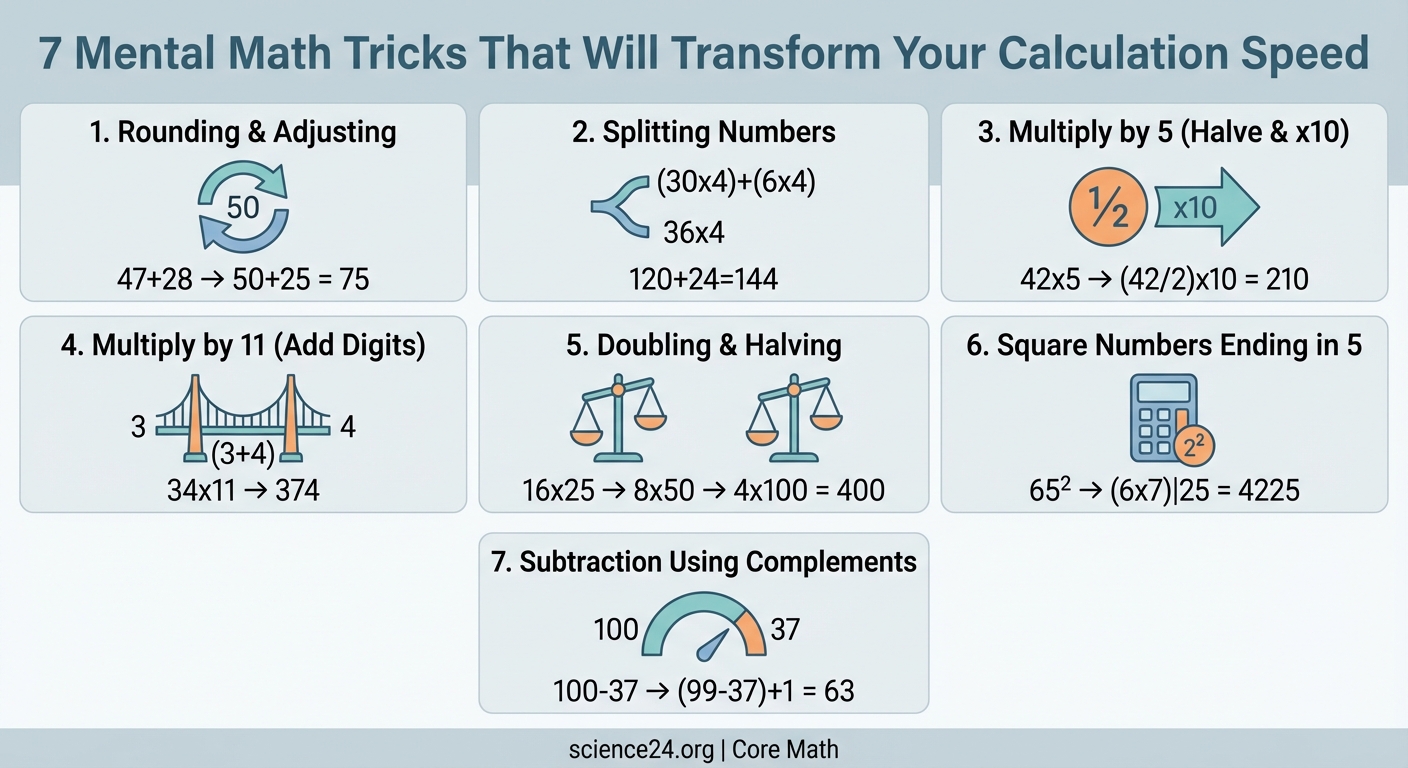
Squaring numbers like 25, 35, or 85 follows a predictable pattern that makes mental calculation straightforward.
The rule: Take the first digit, multiply it by the next consecutive number, then add 25 to the end.
For 35 squared, the first digit is 3. Multiply 3 by 4 (the next number) to get 12. Attach 25 to the end. Answer: 1,225.
Try 85 squared. The first digit is 8, and 8 times 9 equals 72. Add 25 to the end for 7,225.
This pattern works because of how algebra distributes when you square numbers in the form (10a + 5). The math simplifies into a × (a + 1) × 100 + 25, but you don’t need to understand the proof to use the shortcut.
Practice with 15, 25, 35, 45, 55, 65, 75, 85, and 95 until you can answer without hesitation.
Multiply by 9 using your fingers or a subtraction trick
Nine times tables intimidate students, but two methods make them manageable.
The finger method works for 9 times any number from 1 to 10. Hold both hands in front of you. To multiply 9 by 7, fold down your seventh finger from the left. Count the fingers to the left of the folded finger (6) and to the right (3). Your answer is 63.
The subtraction method works for larger numbers. To multiply 9 by any number, multiply that number by 10, then subtract the original number. For 9 times 14, calculate 10 times 14 (140), then subtract 14. Answer: 126.
Why does this work? Because 9 is one less than 10, you’re essentially multiplying by 10 and removing one set of the original number.
Both methods give you the same correct answer. Choose whichever feels more natural.
“Mental math isn’t about speed alone. It’s about building number sense so you can estimate, check your work, and catch errors before they become problems. The confidence you gain from these skills extends far beyond arithmetic.”
Add left to right instead of right to left
Traditional addition starts with the ones place and works toward larger digits. Mental math reverses this.
Adding 347 + 286 left to right means starting with the hundreds: 300 + 200 = 500. Then the tens: 40 + 80 = 120. Finally the ones: 7 + 6 = 13. Now add your parts: 500 + 120 + 13 = 633.
This method feels more natural because you’re building your answer from the most significant digits. You get a sense of the approximate answer immediately, and you can adjust as you go.
The same approach works for subtraction. For 534 minus 278, start with 500 minus 200 (300), then 30 minus 70 (negative 40), then 4 minus 8 (negative 4). Combine them: 300 minus 40 minus 4 equals 256.
Left-to-right calculation matches how we read and speak numbers. It reduces the cognitive load of carrying and borrowing.
Double and halve to simplify multiplication
Some multiplication problems become easier when you double one number and halve the other.
Take 16 times 25. Doubling 16 gives you 32, and halving 25 gives you 12.5. But let’s try the other direction: halve 16 to get 8, and double 25 to get 50. Now you’re solving 8 times 50, which equals 400.
This technique works because multiplication is commutative. The order doesn’t matter, and adjusting the numbers doesn’t change the product.
Try 14 times 50. Halve 14 to get 7, and double 50 to get 100. Now it’s 7 times 100, which is obviously 700.
Look for opportunities to create multiples of 10, 100, or other friendly numbers. The goal is to transform difficult multiplication into something your brain can handle instantly.
Common situations where this helps:
- Calculating area when one dimension is even
- Figuring out total costs when buying multiple items
- Converting between units that have even conversion factors
- Checking if answers on homework or receipts make sense
Estimate before you calculate exact answers
Before applying any mental math trick, take one second to estimate. This habit catches mistakes and builds number intuition.
Round both numbers to the nearest ten or hundred, then perform a rough calculation. For 347 times 8, round 347 to 350. You know 350 times 8 is 2,800, so your exact answer should be close to that number.
Estimation helps in several ways:
- You’ll know immediately if you make a calculation error
- You can decide if an exact answer is even necessary
- You build confidence in your number sense
- You can work faster because you’re not second-guessing every step
Restaurant math benefits enormously from estimation. A bill of $47.82 is basically $48. Four people splitting it means roughly $12 each. You can calculate exact amounts if needed, but the estimate gets you 95% of the way there.
Understanding mathematical concepts like why dividing by zero breaks mathematics also strengthens your overall number sense and helps you recognize when calculations don’t make sense.
Common mistakes and how to avoid them
Learning mental math tricks means understanding where people typically go wrong. This table shows frequent errors and their solutions.
| Mistake | Why It Happens | Solution |
|---|---|---|
| Forgetting to add back what you rounded | You simplified the problem but lost track of the adjustment | Write down the adjustment amount or say it aloud |
| Mixing up the order in compensation | Adding to one number but also adding to the other | Remember: what you add to one, you subtract from the answer |
| Rushing through left-to-right addition | Trying to go too fast before the method is automatic | Practice with three-digit numbers until it feels natural |
| Applying the 11 trick incorrectly | Not carrying the 1 when digits sum to 10 or more | Always check if the digit sum exceeds 9 |
| Using the wrong percentage shortcut | Confusing which fraction matches which percentage | Memorize the five most common conversions first |
The best way to avoid these mistakes is practicing one trick at a time. Master the compensation method before moving to the 11 multiplication trick. Build confidence with each technique individually.
Practice with real numbers from your daily life
Mental math becomes useful when you apply it to actual situations you encounter regularly.
Try these practice scenarios:
- Calculate 15% and 20% tips on restaurant bills
- Figure out unit prices at the grocery store
- Determine sale prices during shopping
- Split costs when sharing expenses with friends
- Calculate how much time remains until an appointment
- Figure out gas mileage on road trips
- Estimate project costs before committing
Start with easier numbers, then gradually increase difficulty. A $30 restaurant bill is simpler than $47.83, but both use the same techniques.
Keep a small notebook or use your phone to track problems you encounter. Write down the numbers, try solving them mentally, then check with a calculator. Over time, you’ll notice your accuracy and speed improving.
Children benefit from practicing with their allowance, counting toys, or calculating video game scores. Adults can practice while budgeting, cooking (doubling recipes), or planning travel.
The key is consistency. Five minutes of daily practice beats an hour once a week.
Building speed without sacrificing accuracy
Speed comes naturally after accuracy. Don’t rush the learning process.
When you first try these techniques, you’ll feel slow and awkward. That’s normal. Your brain is building new neural pathways for processing numbers.
Focus on getting the right answer first. Once a method feels comfortable, gradually increase your pace. Time yourself solving ten problems, then try to beat your previous time while maintaining accuracy.
Some techniques will click immediately. Others might take weeks of practice. The 11 multiplication trick usually feels natural within a few tries. Left-to-right addition might take longer if you’ve spent years doing it the traditional way.
Be patient with yourself. Professional mental calculators spent years developing their skills. You’re learning practical shortcuts for everyday use, not training for competitions.
Celebrate small wins. The first time you calculate a tip without reaching for your phone, that’s progress. The moment you catch a cashier’s mistake because you estimated the total, that’s your number sense working.
Making mental math stick for the long term
These techniques only help if you remember and use them. Build them into your routine.
Choose one trick per week to focus on. Use it whenever the opportunity arises. By the end of the week, it should feel automatic.
Teach someone else. Explaining these methods to a friend, child, or coworker reinforces your own understanding. You’ll also discover which aspects you need to practice more.
Create challenges for yourself. Before checking out at the store, estimate your total. Before splitting a bill, calculate each person’s share mentally. Before your calculator app opens, try solving the problem in your head.
Remove easy access to calculators when practicing. Put your phone in another room while doing homework or paying bills. This forced inconvenience pushes you to use mental methods.
Join online communities focused on mental math. Share your progress, learn new techniques, and stay motivated by seeing others improve.
Your brain is better at math than you think
Mental calculation isn’t a talent you’re born with or without. It’s a skill you build through practice and smart techniques.
These seven tricks give you a foundation for handling most everyday math situations. You won’t need to memorize multiplication tables or perform complex algorithms. You just need to recognize patterns and apply simple shortcuts.
Start with the techniques that feel most useful for your life. Master those, then add more to your toolkit. Within a few weeks, you’ll notice yourself calculating faster and with more confidence.
The best part? These skills compound over time. The more you practice, the more number patterns you’ll recognize, and the easier all math becomes. Your brain will start seeing shortcuts you never noticed before.
Grab a piece of paper and try each technique with a few practice problems. Then put them to use the next time you’re splitting a bill, calculating a discount, or helping someone with their homework. You might surprise yourself with how capable you really are.