Your smartphone charges wirelessly on your desk. Your electric car accelerates silently down the street. Your induction cooktop heats a pan without flames. All these modern conveniences share a common invisible force at work: electromagnetic induction. This fundamental physics principle transforms how we generate electricity, transmit power, and build the devices we depend on daily.
Electromagnetic induction occurs when a changing magnetic field creates electric current in a conductor. This principle powers transformers that deliver electricity to homes, wireless chargers for phones, electric vehicle motors, induction cooktops, metal detectors, and countless other devices. Understanding electromagnetic induction everyday life applications reveals how invisible magnetic fields shape modern technology and make our connected world possible.
What Makes Electromagnetic Induction Work
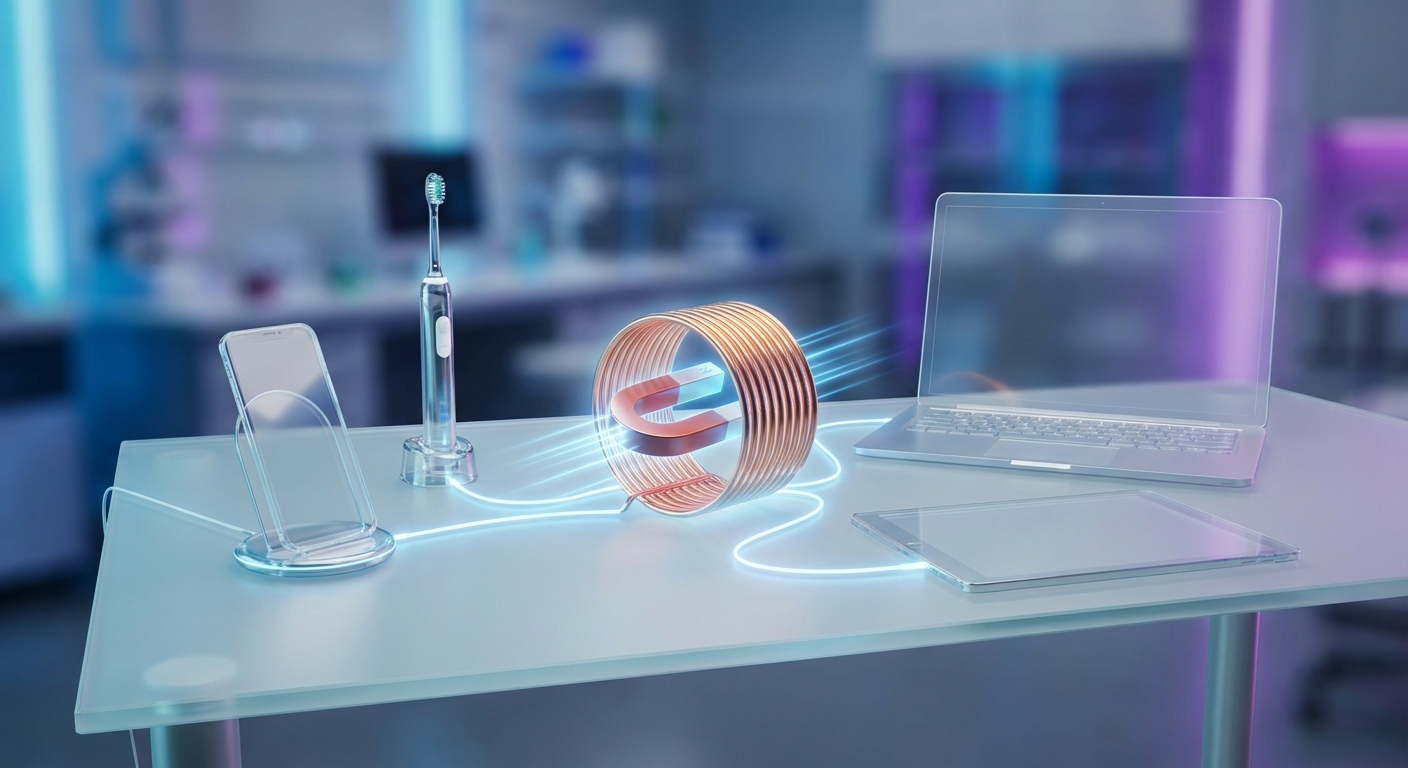
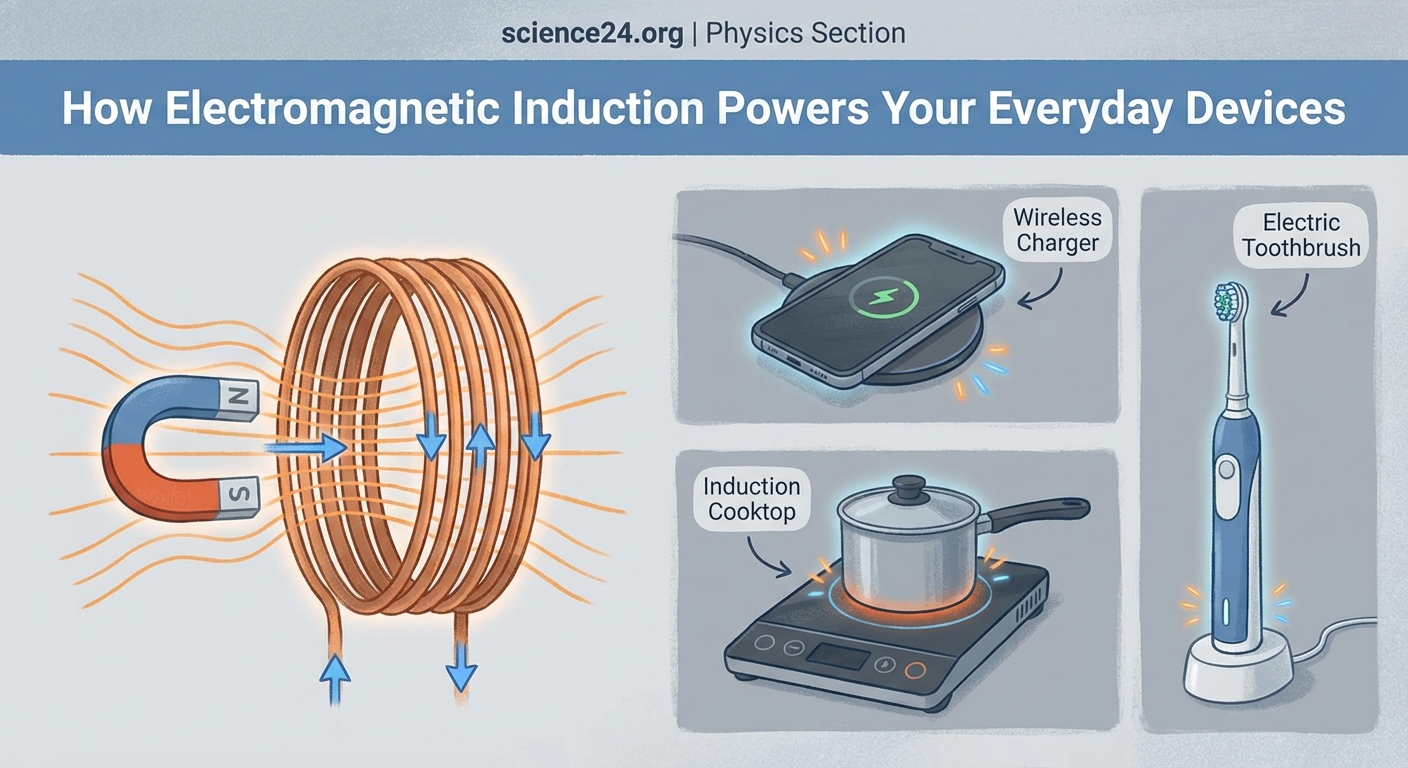
Electromagnetic induction happens when you move a magnet near a coil of wire, or move a coil near a magnet. The changing magnetic field creates voltage in the wire. If the wire forms a complete circuit, current flows.
Michael Faraday discovered this phenomenon in 1831. He noticed that moving a magnet through a coil produced electrical current, even though no battery connected to the circuit. The faster the magnet moved, the stronger the current became.
Three factors control how much voltage gets induced:
- The strength of the magnetic field
- The speed of movement between magnet and conductor
- The number of wire loops in the coil
More loops mean more voltage. Stronger magnets produce more voltage. Faster movement generates more power. These simple relationships govern everything from power plants to your electric toothbrush.
Power Generation and Distribution
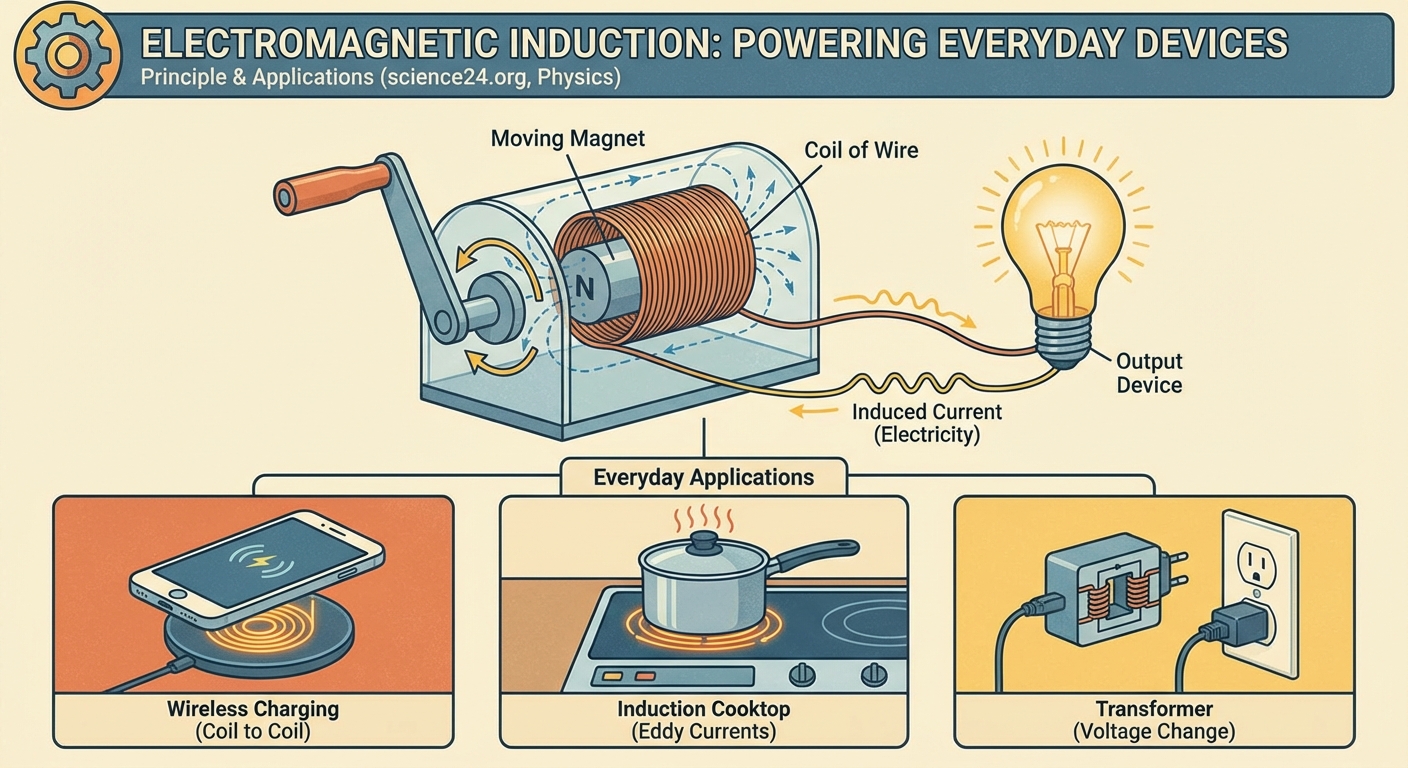
Every power plant on Earth uses electromagnetic induction to generate electricity. Turbines spin massive coils inside powerful magnetic fields. Water, steam, wind, or gas turns the turbines. The spinning motion creates the changing magnetic field needed for induction.
A typical power plant generator contains thousands of wire coils wrapped around a rotating shaft. Giant magnets surround these coils. As the shaft spins at 3,600 revolutions per minute, it produces alternating current at 60 Hz in North America or 50 Hz in most other regions.
The electricity then travels through transformers before reaching your home. Transformers use electromagnetic induction to change voltage levels. Step-up transformers increase voltage for long-distance transmission. Step-down transformers reduce voltage for safe household use.
Here’s how transformers accomplish this voltage conversion:
- Alternating current flows through the primary coil
- This creates a changing magnetic field in an iron core
- The changing field induces voltage in the secondary coil
- The ratio of coil turns determines the voltage change
A transformer with 1,000 turns on the primary side and 100 turns on the secondary side reduces voltage by a factor of ten. This elegant design contains no moving parts and operates with minimal energy loss.
Wireless Charging Technology
Your smartphone likely supports wireless charging. You place it on a charging pad, and power flows without any cable connection. Electromagnetic induction makes this possible.
The charging pad contains a flat coil that carries alternating current. This creates an oscillating magnetic field above the pad. Your phone contains a receiving coil on its back surface. When you place the phone on the pad, the changing magnetic field induces current in the receiving coil.
This induced current charges the battery. The system typically operates at frequencies between 110 and 205 kHz. Higher frequencies allow faster charging but generate more heat.
Wireless charging works over short distances only. The magnetic field weakens rapidly as distance increases. Most systems require direct contact or a gap of just a few millimeters.
Electric toothbrushes pioneered this technology decades ago. The charging base contains a coil that induces current in a coil inside the waterproof toothbrush handle. No electrical contacts means water cannot cause short circuits.
Electric Vehicles and Regenerative Braking
Electric motors and generators are essentially the same device operating in reverse. Feed electricity into a motor, and it spins. Spin a generator, and it produces electricity. Electric vehicles exploit this reversibility through regenerative braking.
When you press the accelerator, electricity from the battery flows through motor coils. These coils sit inside a magnetic field. The interaction between the current and the field creates rotational force that turns the wheels.
When you release the accelerator or press the brake pedal, the system reverses. The spinning wheels now turn the motor, which acts as a generator. The motion creates a changing magnetic field that induces current in the coils. This current flows back to recharge the battery.
Regenerative braking recovers energy that would otherwise dissipate as heat in traditional friction brakes. This extends driving range by 10 to 25 percent depending on driving conditions and style.
The same principle appears in hybrid vehicles, electric trains, and even some elevators. Any system with rotating components can potentially recover energy through electromagnetic induction.
Induction Cooking
An induction cooktop looks like a smooth glass surface. Place a steel or iron pan on it, and the pan heats up within seconds. Remove the pan, and the surface stays cool to the touch.
Beneath the glass sits a copper coil carrying high-frequency alternating current, typically 20 to 100 kHz. This creates a rapidly changing magnetic field above the cooktop. When you place a ferromagnetic pan in this field, the changing magnetism induces electric currents within the metal pan itself.
These currents, called eddy currents, flow in circular patterns through the pan. The electrical resistance of the metal converts this current into heat. The pan becomes the heating element.
Induction cooking transfers energy directly to the cookware rather than heating the cooktop surface first. This makes it more efficient than gas or traditional electric ranges, with energy efficiency often exceeding 85 percent compared to 40 percent for gas.
Only magnetic materials respond to induction heating. Steel and cast iron work perfectly. Aluminum, copper, and glass do not. Some manufacturers add a magnetic base layer to aluminum cookware to make it induction-compatible.
Metal Detectors and Security Screening
Airport security gates and handheld metal detectors rely on electromagnetic induction to find concealed metal objects. The detector contains a transmitter coil that generates a pulsing magnetic field.
When this field encounters metal, it induces eddy currents in the metal object. These currents create their own magnetic field that opposes the original field. A receiver coil in the detector senses this opposing field and triggers an alert.
Different metals respond differently based on their conductivity and magnetic properties. Advanced detectors can distinguish between harmless items like belt buckles and potential threats. They analyze the strength, duration, and frequency response of the induced signal.
Beach treasure hunters use similar technology. Their metal detectors can locate coins buried in sand by detecting the tiny magnetic fields created by induced currents in the metal.
Common Applications Compared
| Application | Primary Function | Typical Frequency | Key Advantage |
|---|---|---|---|
| Power transformers | Voltage conversion | 50-60 Hz | High efficiency, no moving parts |
| Wireless chargers | Energy transfer | 110-205 kHz | Convenience, waterproofing |
| Induction cooktops | Heating | 20-100 kHz | Speed, safety, efficiency |
| Electric motors | Motion generation | Variable DC or AC | Reversible for regeneration |
| Metal detectors | Object detection | 5-100 kHz | Non-contact sensing |
Credit Card Readers and RFID Tags
When you tap your credit card or phone to pay, electromagnetic induction handles the transaction. The payment terminal contains a coil that generates a magnetic field. Your card or phone contains a tiny antenna coil and a microchip.
The changing magnetic field from the terminal induces a small current in the card’s antenna. This current powers the chip, which then transmits your payment information back to the terminal through the same magnetic coupling.
The entire exchange happens in milliseconds. No battery powers the card. The induced current provides all the energy needed for the transaction.
RFID tags in inventory systems, library books, and access cards work identically. A reader generates a magnetic field. The tag harvests energy from this field and responds with stored data.
Guitar Pickups and Audio Equipment
Electric guitars produce sound through electromagnetic induction. Metal strings vibrate above magnetic pickups mounted in the guitar body. Each pickup contains a coil wrapped around a permanent magnet.
As the steel string vibrates, it disturbs the magnetic field around the pickup. This changing field induces a small alternating current in the coil. The frequency of this current matches the vibration frequency of the string.
An amplifier boosts this tiny signal and sends it to speakers. Different pickup designs and positions create distinctive tones. Musicians choose guitars partly based on how their pickups respond to string vibrations.
Similar principles appear in dynamic microphones, which use a vibrating diaphragm attached to a coil moving within a magnetic field. Sound waves move the diaphragm, inducing current that represents the audio signal.
Avoiding Common Misconceptions
Many people misunderstand how electromagnetic induction works in practical devices. Here are the most frequent errors:
- Assuming static magnets produce continuous current: Induction requires changing magnetic fields, not just the presence of a magnet
- Thinking wireless charging works at any distance: The magnetic field weakens with the cube of distance, limiting range to millimeters
- Believing all cookware works on induction cooktops: Only ferromagnetic materials respond to the induced currents
- Expecting perfect efficiency: Even the best transformers lose 1-2 percent of energy to heat and magnetic losses
- Confusing electromagnetic induction with static electricity: These are separate phenomena with different underlying physics
Understanding these distinctions helps you recognize when electromagnetic induction applies and when other principles govern device operation. The physics behind what happens to energy during elastic and inelastic collisions differs fundamentally from energy transfer through changing magnetic fields.
Practical Steps to Observe Induction at Home
You can demonstrate electromagnetic induction with simple household items:
-
Magnet and coil test: Wind 50 turns of insulated wire around a cardboard tube, connect the ends to an LED, and thrust a strong magnet through the coil. The LED briefly lights as the changing field induces current.
-
Wireless charging experiment: Place a compass near your phone’s wireless charger while charging. The needle deflects, revealing the magnetic field created by the charging coil.
-
Induction cooktop check: Turn on an induction burner without cookware and hold a steel spoon just above the surface. The spoon warms from induced currents, while the glass stays cool.
-
Transformer observation: Listen closely to a phone charger or laptop power adapter while it operates. The faint hum comes from mechanical vibrations caused by alternating magnetic forces in the transformer core.
These experiments make abstract physics concepts tangible and memorable.
Future Applications on the Horizon
Electromagnetic induction continues driving innovation in emerging technologies. Wireless electric vehicle charging systems now embed induction coils in parking spaces and roadways. Cars park over these coils and charge automatically without plugging in cables.
Some cities test dynamic charging, where electric buses receive power from coils embedded in roadways while driving. This could eliminate the need for large batteries and lengthy charging stops.
Medical devices increasingly use wireless power transfer through induction. Pacemakers and implanted sensors can recharge without surgery to replace batteries. The patient wears an external charging device that induces current in an implanted coil.
Research into long-range wireless power transmission continues, though physics fundamentally limits how far magnetic induction can efficiently transfer energy. Alternative approaches like focused microwaves may eventually complement induction for specific applications.
Making Physics Work for You
Electromagnetic induction surrounds you constantly, powering devices and enabling conveniences you likely take for granted. Every time you charge your phone wirelessly, cook dinner on an induction range, or ride in an electric vehicle, you benefit from principles Faraday discovered nearly two centuries ago.
The elegance of electromagnetic induction lies in its simplicity. Moving magnets and coils create electricity. Electricity through coils creates motion. This reciprocal relationship powers our modern world more completely than most people realize. Recognizing these principles in action transforms ordinary devices into demonstrations of fundamental physics, making science feel less abstract and more connected to daily experience.