Author: chris

  • Why Do Atoms Form Bonds? Understanding Chemical Bonding from Scratch

    Atoms don’t exist in isolation by choice. They actively seek partners, forming bonds that create everything from the water you drink to the proteins in your cells. This fundamental behavior drives all of chemistry, yet the reason behind it comes down to a simple principle: atoms form bonds because doing so lowers their energy and increases their stability.

    Key Takeaway

    Atoms form bonds to achieve lower energy states and greater stability. By sharing, transferring, or pooling electrons, atoms fill their outer electron shells, mimicking the stable configuration of noble gases. This process releases energy, making bonded atoms more stable than isolated ones. Understanding electron behavior and energy minimization explains why chemical reactions occur and how matter assembles into everything around us.

    The Energy Story Behind Chemical Bonds

    Every atom carries potential energy based on its electron configuration. Isolated atoms often sit in higher energy states, which makes them reactive and unstable. When atoms come together and form bonds, they release energy and drop to a lower, more stable state.

    Think of it like a ball rolling down a hill. The ball naturally moves toward the lowest point because that position requires the least energy. Atoms behave similarly. They rearrange their electrons to reach configurations that minimize their overall energy.

    This energy release during bond formation is measurable and real. When hydrogen atoms bond to form H₂ molecules, they release 436 kilojoules per mole. That released energy represents the difference between the higher energy state of two separate hydrogen atoms and the lower energy state of the bonded molecule.

    The universe favors low energy states. Systems naturally move toward configurations that require less energy to maintain. Chemical bonding follows this fundamental principle, which appears throughout physics and chemistry.

    Electron Configuration and the Octet Rule

    Atoms consist of a nucleus surrounded by electrons arranged in shells or energy levels. The outermost shell, called the valence shell, determines how an atom will interact with others.

    Noble gases like helium, neon, and argon rarely form bonds. Why? Their valence shells are already full. Helium has two electrons filling its first shell. Neon has eight electrons filling its second shell. These complete configurations represent the most stable electron arrangements.

    Other atoms want to achieve this same stability. The octet rule states that atoms tend to gain, lose, or share electrons to obtain eight electrons in their valence shell. Hydrogen is an exception, seeking only two electrons to match helium’s configuration.

    Consider sodium, which has one electron in its outermost shell. It can either gain seven electrons to fill that shell or lose one electron to reveal a filled shell underneath. Losing one electron is far easier, so sodium readily gives up that single valence electron.

    Chlorine sits on the opposite end. It has seven valence electrons and needs just one more to complete its octet. Chlorine aggressively accepts electrons from other atoms.

    When sodium meets chlorine, sodium donates its single valence electron to chlorine. Both atoms achieve filled outer shells. Both reach more stable, lower energy states. The result is sodium chloride, common table salt.

    Three Main Types of Chemical Bonds

    Chemical bonds fall into three primary categories based on how atoms share or transfer electrons.

    Ionic Bonds

    Ionic bonds form when one atom transfers electrons completely to another atom. This creates oppositely charged ions that attract each other through electrostatic forces.

    Metals typically lose electrons and become positively charged cations. Nonmetals gain those electrons and become negatively charged anions. The attraction between opposite charges holds the compound together.

    Sodium chloride provides the classic example. Sodium loses one electron and becomes Na⁺. Chlorine gains that electron and becomes Cl⁻. The positive and negative ions attract, forming a strong ionic bond.

    Ionic compounds typically form crystalline structures. They have high melting points and conduct electricity when dissolved in water because the ions can move freely.

    Covalent Bonds

    Covalent bonds form when atoms share electrons rather than transferring them completely. Both atoms gain access to the shared electrons, allowing each to fill its valence shell.

    Hydrogen gas (H₂) demonstrates the simplest covalent bond. Each hydrogen atom has one electron. By sharing their electrons, both atoms effectively have two electrons, matching helium’s stable configuration.

    Water (H₂O) shows a more complex example. Oxygen has six valence electrons and needs two more to complete its octet. Each hydrogen atom needs one electron. Oxygen shares electrons with two hydrogen atoms, forming two covalent bonds. All three atoms achieve stable configurations.

    Covalent bonds can be single, double, or triple depending on how many electron pairs the atoms share. Oxygen gas (O₂) contains a double bond. Nitrogen gas (N₂) contains a triple bond.

    Metallic Bonds

    Metallic bonds occur in metals where atoms share a “sea” of delocalized electrons. Rather than electrons belonging to specific atoms, they move freely throughout the metal structure.

    This electron mobility explains why metals conduct electricity and heat so well. The shared electrons can carry charge and energy throughout the material.

    Metallic bonding also explains metal malleability. When you bend metal, atoms can slide past each other while the electron sea maintains cohesion throughout the structure.

    The Role of Electronegativity

    Not all atoms pull on shared electrons with equal strength. Electronegativity measures an atom’s ability to attract electrons in a chemical bond.

    Fluorine has the highest electronegativity. It pulls shared electrons strongly toward itself. Francium has the lowest electronegativity. It barely holds onto its own electrons, let alone attracts others.

    When two atoms with different electronegativities form a bond, the shared electrons spend more time near the more electronegative atom. This creates polar covalent bonds where one end of the bond is slightly negative and the other slightly positive.

    Water molecules are polar. Oxygen is much more electronegative than hydrogen, so the shared electrons spend more time near the oxygen atom. This polarity gives water many of its unique properties, including its ability to dissolve many substances.

    When electronegativity differences become large enough, the bond transitions from polar covalent to ionic. The more electronegative atom essentially takes the electron completely rather than just pulling it closer.

    Visualizing Bond Formation Step by Step

    Understanding bond formation becomes clearer when you break it down into stages.

    1. Two atoms approach each other. Each atom has its own electron cloud and nuclear charge.

    2. Attractive forces begin. The nucleus of each atom attracts the electrons of the other atom. These attractive forces pull the atoms closer.

    3. Repulsive forces also increase. As atoms get closer, their electron clouds start to overlap. Electrons repel other electrons. Nuclei repel other nuclei.

    4. An optimal distance is reached. At a specific distance, attractive forces and repulsive forces balance. This distance represents the bond length.

    5. Energy is released. The bonded state has lower energy than the separated atoms. This energy difference is released, often as heat.

    6. A stable bond forms. The atoms maintain their optimal distance, held together by the balance of forces.

    Breaking a bond requires adding energy back into the system to overcome the attractive forces holding the atoms together. This is why chemical reactions that break bonds need energy input, while reactions that form bonds release energy.

    Common Bonding Patterns Across the Periodic Table

    The periodic table organizes elements by their electron configurations, which directly predicts their bonding behavior.

    • Group 1 metals (lithium, sodium, potassium) have one valence electron and readily form +1 ions
    • Group 2 metals (magnesium, calcium) have two valence electrons and form +2 ions
    • Group 17 halogens (fluorine, chlorine, bromine) have seven valence electrons and form -1 ions
    • Group 18 noble gases (helium, neon, argon) have full valence shells and rarely form bonds
    • Carbon (Group 14) has four valence electrons and typically forms four covalent bonds

    These patterns help predict how elements will interact. If you know an element’s group, you can predict its bonding behavior with reasonable accuracy.

    Transition metals complicate this pattern because they can lose different numbers of electrons, forming ions with various charges. Iron can form Fe²⁺ or Fe³⁺ ions depending on the situation.

    Energy Changes During Bond Formation

    Every chemical bond has an associated bond energy, the amount of energy required to break that bond or released when that bond forms.

    Bond Type Example Bond Energy (kJ/mol)
    Single C-C Ethane 347
    Double C=C Ethene 614
    Triple C≡C Ethyne 839
    O-H Water 463
    H-H Hydrogen gas 436

    Stronger bonds require more energy to break and release more energy when they form. Triple bonds are stronger than double bonds, which are stronger than single bonds.

    Chemical reactions involve breaking old bonds and forming new ones. If the new bonds release more energy than breaking the old bonds required, the reaction releases energy overall. These are exothermic reactions.

    If breaking old bonds requires more energy than forming new bonds releases, the reaction needs energy input. These are endothermic reactions.

    The difference between energy input and energy output determines whether a reaction occurs spontaneously or requires external energy.

    Why Some Atoms Don’t Form Bonds

    Noble gases demonstrate that not all atoms seek bonding partners. Their filled valence shells already represent the lowest energy configuration available to them.

    Forming bonds would actually increase their energy rather than decrease it. The energy cost of rearranging their stable electron configuration exceeds any potential energy gain from bonding.

    Helium never forms compounds under normal conditions. Its two electrons completely fill its first shell. Adding or removing electrons would destabilize this perfect arrangement.

    Other noble gases occasionally form compounds under extreme conditions. Xenon can form compounds with highly electronegative elements like fluorine. These rare exceptions require unusual circumstances that overcome the stability of the filled valence shell.

    The noble gases prove that bonding is about energy minimization. If an atom already sits at its lowest energy state, it has no reason to form bonds.

    Real World Applications of Bonding Principles

    Understanding why atoms form bonds has practical applications across science and technology.

    Pharmaceutical companies design drugs by predicting how molecules will bond with specific proteins in your body. They manipulate electron configurations to create compounds that bind to disease targets while avoiding healthy cells.

    Materials scientists create new substances by combining elements in ways that produce desired bonding patterns. Carbon fiber’s strength comes from extensive covalent bonding between carbon atoms arranged in specific patterns.

    Battery technology depends on controlling ionic bonds. Lithium-ion batteries work by moving lithium ions between different compounds, storing and releasing energy through bond formation and breaking.

    The principle that atoms seek lower energy states through bonding explains not just chemistry, but provides a framework for understanding molecular biology, materials science, and energy storage. Every chemical process, from photosynthesis to combustion, involves atoms rearranging their bonds to reach more stable configurations.

    Mistakes Students Make About Chemical Bonding

    Several misconceptions about bonding appear frequently in chemistry classes.

    Mistake Reality
    “Atoms want to be happy” Atoms don’t have desires; they follow energy minimization principles
    “The octet rule always applies” Hydrogen seeks two electrons; elements beyond period 2 can exceed eight
    “Ionic bonds only form between metals and nonmetals” While typical, some exceptions exist with complex molecules
    “Covalent bonds always share electrons equally” Only nonpolar covalent bonds share equally; polar bonds don’t
    “Bond formation always releases energy” True for stable bonds, but unstable molecules can form endothermically

    Avoiding these misconceptions helps build accurate mental models of chemical behavior. Atoms follow physical laws about energy, not emotional desires or rigid rules with no exceptions.

    Predicting Bond Types Between Elements

    You can predict what type of bond will form between two elements by examining their positions on the periodic table and their electronegativity difference.

    When electronegativity difference is less than 0.5, the bond is nonpolar covalent. Electrons are shared roughly equally. This occurs between identical atoms (H₂, O₂) or very similar atoms.

    When electronegativity difference is between 0.5 and 1.7, the bond is polar covalent. Electrons are shared but spend more time near the more electronegative atom. Water and ammonia contain polar covalent bonds.

    When electronegativity difference exceeds 1.7, the bond is ionic. The more electronegative atom essentially takes the electron completely. Sodium chloride and magnesium oxide are ionic compounds.

    These cutoffs aren’t absolute. Bonding exists on a continuum from purely covalent to purely ionic. Most bonds fall somewhere in between, showing characteristics of both types.

    How Bond Strength Affects Chemical Properties

    Bond strength directly influences how substances behave.

    Compounds with strong bonds are stable and unreactive. They require significant energy input to break apart. Diamond consists of carbon atoms connected by strong covalent bonds in all directions. This makes diamond incredibly hard and chemically inert.

    Compounds with weak bonds are reactive and unstable. They easily break apart and rearrange. Peroxides contain weak oxygen-oxygen bonds that readily break, making these compounds useful as bleaches and disinfectants.

    Bond strength also affects physical properties. Substances with strong bonds typically have higher melting points and boiling points. More energy is needed to overcome the bonds and separate the atoms or molecules.

    Ionic compounds generally have high melting points because breaking the lattice structure requires overcoming many strong electrostatic attractions simultaneously. Sodium chloride melts at 801°C.

    Molecular compounds with weak intermolecular forces have low melting points. Water is held together by strong O-H covalent bonds, but individual water molecules attract each other through weaker hydrogen bonds. Ice melts at 0°C.

    Connecting Bonding to Larger Chemistry Concepts

    Chemical bonding connects to virtually every other chemistry topic you’ll study.

    Reaction rates depend on bond strengths. Reactions that break strong bonds proceed slowly because they need more activation energy. Reactions that break weak bonds proceed faster.

    Thermodynamics examines energy changes during reactions, which ultimately comes down to differences between bond energies in reactants and products.

    Acid-base chemistry involves breaking and forming bonds with hydrogen ions. Strong acids have weak bonds that readily release H⁺ ions.

    Organic chemistry is essentially the study of carbon bonding. Carbon’s ability to form four covalent bonds, including bonds with other carbon atoms, creates the vast diversity of organic molecules.

    Biochemistry examines bonding in biological molecules. Protein structure depends on various bond types, from strong covalent bonds in the backbone to weak hydrogen bonds that determine three-dimensional shape.

    Even topics that seem unrelated connect back to bonding. Spectroscopy works because bonds absorb specific wavelengths of light. Electrochemistry involves breaking and forming bonds through electron transfer.

    Building Your Intuition About Atomic Behavior

    As you study more chemistry, you’ll develop intuition about how atoms will behave in different situations.

    Start by memorizing common bonding patterns for elements you encounter frequently. Carbon forms four bonds. Nitrogen forms three. Oxygen forms two. Hydrogen forms one. These patterns appear repeatedly.

    Practice drawing Lewis structures, which show valence electrons and how they’re shared in bonds. This visual representation makes electron behavior concrete rather than abstract.

    Look for patterns in the periodic table. Elements in the same group behave similarly because they have the same number of valence electrons.

    Remember that chemistry follows physical principles, not arbitrary rules. When you encounter an exception to a rule, there’s always an underlying physical reason. The octet rule has exceptions because some atoms can accommodate more than eight electrons in their valence shell, while others function well with fewer.

    The more you work with these concepts, the more natural they become. Chemical bonding stops feeling like memorized facts and starts feeling like logical consequences of atomic structure and energy principles.

    Why Understanding Bonding Transforms Your Chemistry Knowledge

    Grasping why atoms form bonds gives you a foundation for understanding all of chemistry. Every reaction, every compound, every material property traces back to how atoms share and transfer electrons.

    When you understand that atoms seek lower energy states through bonding, chemical reactions start making sense. You can predict products, understand why some reactions release heat while others absorb it, and explain why certain compounds exist while others don’t.

    This knowledge extends beyond the classroom. It explains why rust forms on iron, how soap cleans grease, why food spoils, and how your body extracts energy from food. The same principles govern chemical processes in stars, in Earth’s atmosphere, and in living cells.

    Chemistry becomes less about memorizing facts and more about applying principles. Instead of remembering that sodium and chlorine form sodium chloride, you understand why they must form it based on their electron configurations and the drive toward stability.

    Start applying these principles to compounds you encounter daily. Look at ingredient lists and think about what bonds hold those molecules together. Consider why some substances dissolve in water while others don’t. Ask yourself what electron configurations drive the reactions you observe.

    The more you connect bonding principles to real examples, the more chemistry transforms from an abstract subject into a practical tool for understanding the material world around you.

  • The Complete Guide to Solving Quadratic Equations Every Time

    Quadratic equations show up everywhere in high school and college math. They appear in physics problems, calculus courses, and standardized tests. If you’ve ever felt stuck staring at x² + 5x + 6 = 0, you’re not alone. The good news is that solving these equations becomes straightforward once you understand the core methods and when to use each one.

    Key Takeaway

    Quadratic equations can be solved through three main methods: factoring, the quadratic formula, and completing the square. Factoring works best for simple equations with integer solutions. The quadratic formula handles any quadratic equation reliably. Completing the square helps when you need to understand the vertex form or derive the quadratic formula itself. Each method has specific situations where it shines.

    What Makes an Equation Quadratic

    A quadratic equation follows the standard form ax² + bx + c = 0, where a, b, and c are numbers and a cannot equal zero. The x² term is what makes it quadratic. Without that squared term, you just have a linear equation.

    The coefficient a determines whether the parabola opens upward or downward. The coefficient b affects the position of the vertex along the x-axis. The constant c represents the y-intercept where the parabola crosses the vertical axis.

    Here’s what matters most: you need to recognize these equations in different forms. Sometimes they appear as 2x² = 8 or x² + 4x = 12. Your first step is always to rearrange them into standard form by moving all terms to one side.

    Three Core Methods for Solving Quadratics

    Each solving method has strengths and limitations. Knowing which one to choose saves time and reduces errors.

    Factoring

    Factoring works when you can break down the quadratic into two binomials. This method is fastest but only practical when the solutions are rational numbers.

    For the equation x² + 5x + 6 = 0, you need two numbers that multiply to 6 and add to 5. Those numbers are 2 and 3.

    1. Write the factored form: (x + 2)(x + 3) = 0
    2. Set each factor equal to zero: x + 2 = 0 or x + 3 = 0
    3. Solve for x: x = -2 or x = -3

    The zero product property makes this work. If two things multiply to zero, at least one of them must be zero. That’s why you can split the equation into two separate solutions.

    Not every quadratic factors neatly. When you encounter equations like x² + 2x – 1 = 0, factoring becomes impractical because the solutions involve irrational numbers.

    The Quadratic Formula

    The quadratic formula solves any quadratic equation, no matter how messy the coefficients look. This makes it the most reliable method in your toolkit.

    The formula is:

    x = (-b ± √(b² – 4ac)) / (2a)

    That ± symbol means you’ll get two solutions: one using addition and one using subtraction.

    Let’s solve 2x² + 7x + 3 = 0 using the formula.

    1. Identify a = 2, b = 7, c = 3
    2. Calculate the discriminant: b² – 4ac = 49 – 24 = 25
    3. Plug into the formula: x = (-7 ± √25) / 4
    4. Simplify: x = (-7 ± 5) / 4
    5. Find both solutions: x = -2/4 = -0.5 or x = -12/4 = -3

    The discriminant (b² – 4ac) tells you what type of solutions to expect. When it’s positive, you get two real solutions. When it equals zero, you get one repeated solution. When it’s negative, you get two complex solutions involving understanding imaginary numbers without the confusion.

    Completing the Square

    Completing the square transforms a quadratic into vertex form. This method helps you understand where the quadratic formula comes from and makes graphing easier.

    For x² + 6x + 2 = 0, follow these steps:

    1. Move the constant to the right side: x² + 6x = -2
    2. Take half of the b coefficient and square it: (6/2)² = 9
    3. Add this number to both sides: x² + 6x + 9 = -2 + 9
    4. Factor the left side as a perfect square: (x + 3)² = 7
    5. Take the square root of both sides: x + 3 = ±√7
    6. Solve for x: x = -3 ± √7

    This method always works but involves more steps than the other approaches. Students often use it to verify solutions or when working with vertex form for graphing problems.

    Choosing the Right Method

    Different equations call for different strategies. Here’s how to decide which method to use.

    Method Best For Avoid When
    Factoring Integer solutions, simple coefficients Irrational or complex solutions
    Quadratic Formula Any equation, especially with decimals You want to practice factoring
    Completing the Square Finding vertex, deriving formulas You need speed on a timed test

    Start by checking if the equation factors easily. Look for common factors first. If you can divide all terms by the same number, do that before anything else.

    The equation 4x² + 8x + 4 = 0 simplifies to x² + 2x + 1 = 0 after dividing by 4. Now it factors as (x + 1)² = 0, giving x = -1.

    When factoring seems difficult, move to the quadratic formula. This is especially true during tests where time matters. The formula might take a few extra seconds to write out, but it guarantees an answer.

    Always check your solutions by plugging them back into the original equation. This catches arithmetic errors and confirms you didn’t make a sign mistake.

    Common Mistakes and How to Avoid Them

    Many students make the same errors when solving quadratics. Recognizing these patterns helps you avoid them.

    Sign errors plague quadratic formula calculations. The -b in the formula trips people up. If b is already negative, -b becomes positive. For x² – 4x + 1 = 0, you have b = -4, so -b = 4.

    Forgetting to write the equation in standard form causes wrong answers. If you have 3x² = 5x + 2, you must rearrange it to 3x² – 5x – 2 = 0 before identifying a, b, and c.

    Dividing by zero creates undefined expressions. This connects to broader mathematical principles about why dividing by zero breaks mathematics. When solving quadratics, never divide both sides by x because x might equal zero.

    Losing track of the ± symbol in the quadratic formula means missing a solution. Both the positive and negative square roots matter. Write out both calculations separately to avoid confusion.

    Arithmetic errors multiply during completing the square. Double-check when you calculate (b/2)². For x² + 10x, half of 10 is 5, and 5² equals 25, not 10.

    Special Cases Worth Knowing

    Some quadratic equations have shortcuts that save time.

    Perfect square trinomials factor into identical binomials. The equation x² + 10x + 25 = 0 becomes (x + 5)² = 0, so x = -5. Recognizing the pattern a² + 2ab + b² = (a + b)² speeds up your work.

    Difference of squares appears when you have x² – 16 = 0. This factors as (x + 4)(x – 4) = 0, giving x = 4 or x = -4. The pattern a² – b² = (a + b)(a – b) is worth memorizing.

    Equations with b = 0 simplify dramatically. For 3x² – 12 = 0, just isolate x²:

    • 3x² = 12
    • x² = 4
    • x = ±2

    Equations with c = 0 always have zero as one solution. For x² + 7x = 0, factor out x to get x(x + 7) = 0. This gives x = 0 or x = -7.

    Practical Applications in Real Problems

    Quadratic equations model situations where something accelerates or decelerates. Physics problems about projectile motion use them constantly. If you throw a ball upward, its height follows a quadratic function over time.

    Area problems often create quadratic equations. Suppose you have 100 feet of fencing and want to build a rectangular pen against a barn. You only need fencing for three sides. If x represents the width, the length is 100 – 2x, and the area is x(100 – 2x) = 100x – 2x².

    To maximize area, you’d set this equal to a specific value and solve. These optimization problems show up in calculus but start with quadratic foundations.

    Business applications include profit modeling. Revenue minus cost often creates a quadratic function. Finding break-even points means solving where profit equals zero.

    Building Speed and Accuracy

    Getting comfortable with quadratics takes practice, but you can accelerate the process.

    Practice mental math for common patterns. Recognizing that 7 and 3 multiply to 21 and add to 10 makes factoring x² + 10x + 21 = 0 instant. These mental math tricks that will transform your calculation speed apply directly to factoring.

    Create a reference sheet with the quadratic formula and key patterns. Write it by hand several times. Muscle memory helps during tests when stress makes you forget formulas.

    Work backwards from solutions to build intuition. If x = 2 and x = 5 are solutions, the factored form is (x – 2)(x – 5) = 0. Expand this to get x² – 7x + 10 = 0. Understanding this connection makes factoring feel less mysterious.

    Time yourself on practice problems. Start with easier equations and gradually increase difficulty. Track which types give you trouble and focus extra practice there.

    Check solutions using substitution, not just by redoing the math. If you think x = 3 is a solution to x² – 5x + 6 = 0, plug it in: 9 – 15 + 6 = 0. This confirms the answer without repeating the same steps where you might make the same mistake twice.

    Connecting Quadratics to Other Math Topics

    Quadratic equations form a foundation for more advanced mathematics. Understanding them deeply makes later topics easier.

    Parabolas in coordinate geometry come from quadratic functions. Every quadratic equation corresponds to a parabola crossing the x-axis at the solution points.

    Complex numbers emerge when the discriminant is negative. The equation x² + 4 = 0 has no real solutions, but it does have solutions involving i, the imaginary unit. This opens the door to a whole new number system.

    Polynomial division and synthetic division extend the factoring techniques you use on quadratics to higher-degree polynomials. The logic stays the same even as the algebra gets more involved.

    Calculus uses quadratics everywhere. Derivatives of cubic functions are quadratic. Optimization problems often reduce to solving quadratic equations after taking derivatives.

    The skills you build here transfer directly to mastering trigonometric identities in simple steps and other algebraic manipulations throughout higher math.

    Your Action Plan for Mastery

    Here’s a concrete study approach that works:

    • Solve 10 equations by factoring
    • Solve 10 equations using the quadratic formula
    • Solve 5 equations by completing the square
    • Mix 15 random quadratics and choose the best method for each
    • Work 5 word problems that create quadratic equations

    This progression builds confidence with each method before asking you to make strategic choices. The word problems force you to translate real situations into mathematical equations, which is where many students struggle.

    Focus on understanding why each method works, not just memorizing steps. When you know that factoring relies on the zero product property, you won’t forget to set each factor equal to zero. When you understand that the quadratic formula comes from completing the square on the general form, the formula becomes less mysterious.

    Making Quadratics Second Nature

    Solving quadratic equations becomes automatic with enough practice. You stop thinking about which method to use and just see the answer path immediately. That fluency frees your brain to handle more complex problems where quadratics are just one small step.

    The three core methods each have a place in your mathematical toolkit. Factoring gives you speed on simple problems. The quadratic formula provides reliability on any equation. Completing the square offers insight into the structure of parabolas and the origin of the formula itself.

    Start with the method that feels most comfortable, then gradually expand your skills. Before long, you’ll recognize which approach fits each problem at a glance. That confidence transforms quadratics from a source of stress into a routine part of solving bigger mathematical challenges.

  • What Makes Prime Numbers So Special in Mathematics?

    Prime numbers appear simple at first glance. They’re just numbers divisible only by 1 and themselves. Yet these mathematical building blocks drive modern encryption, secure online transactions, and form the foundation of entire branches of mathematics. Their importance stretches far beyond classroom exercises into real-world applications that shape our digital lives.

    Key Takeaway

    Prime numbers serve as the fundamental building blocks of all integers through unique factorization. They secure digital communications through encryption algorithms, drive advances in number theory, and create patterns that mathematicians still work to understand. Their unpredictable distribution makes them essential for cryptography while their mathematical properties continue revealing new insights about the nature of numbers themselves.

    Building Blocks of All Numbers

    Every whole number greater than 1 breaks down into prime factors in exactly one way. This property, called the Fundamental Theorem of Arithmetic, makes primes the atoms of mathematics.

    Consider the number 60. You can factor it as 2 × 2 × 3 × 5. No other combination of primes multiplies to give 60. This uniqueness matters because it means primes provide a universal language for describing all integers.

    Think of primes like chemical elements. Just as water always consists of hydrogen and oxygen in the same ratio, composite numbers always factor into the same primes. This consistency allows mathematicians to study number properties by examining their prime components.

    The number 1 doesn’t count as prime for this exact reason. If 1 were prime, factorization wouldn’t be unique anymore. You could write 6 as 2 × 3, or 1 × 2 × 3, or 1 × 1 × 2 × 3, breaking the system.

    Securing Your Digital Life

    Every time you shop online, check your bank account, or send a private message, prime numbers protect your information. Modern encryption relies on the difficulty of factoring large numbers into their prime components.

    RSA encryption, used across the internet, works like this:

    1. Generate two massive prime numbers, each hundreds of digits long
    2. Multiply them together to create a public key
    3. Use the original primes as a private key for decryption
    4. Share the public key freely while keeping primes secret

    Breaking this encryption requires factoring that huge product back into its prime components. With current technology, this takes longer than the age of the universe for sufficiently large primes. The security of online banking, medical records, and government communications depends on this mathematical difficulty.

    Credit card transactions use prime-based encryption every second. Without primes, secure e-commerce wouldn’t exist. Your personal data would be vulnerable to anyone intercepting network traffic.

    Cryptocurrency systems also rely on prime-based cryptography. Bitcoin, Ethereum, and other digital currencies use elliptic curve cryptography, which builds on prime number mathematics to verify transactions and maintain blockchain security.

    Patterns That Refuse to Conform

    Primes follow no predictable pattern, which makes them fascinating to mathematicians. The gaps between consecutive primes vary wildly. Sometimes primes appear close together (like 11 and 13), other times huge gaps separate them.

    The Prime Number Theorem describes roughly how many primes exist below any given number. Yet predicting where the next prime appears remains impossible. This unpredictability serves both theoretical mathematics and practical applications.

    Consider these prime pairs:

    Prime Pair Gap Pattern Type
    3, 5 2 Twin primes
    11, 13 2 Twin primes
    89, 97 8 Cousin primes
    113, 127 14 Large gap

    Twin primes (pairs differing by 2) appear throughout the number line, but mathematicians haven’t proven whether infinitely many exist. This unsolved problem, the Twin Prime Conjecture, has challenged researchers for centuries.

    The Riemann Hypothesis, one of mathematics’ most famous unsolved problems, concerns the distribution of primes. Solving it would win a million-dollar prize and revolutionize our understanding of number theory.

    Testing and Finding Primes

    Determining whether a number is prime becomes harder as numbers grow larger. For small numbers, trial division works fine. Just check if any prime up to the square root divides the number evenly.

    For enormous numbers with thousands of digits, mathematicians use probabilistic tests. The Miller-Rabin test, for example, doesn’t guarantee a number is prime but makes the probability of error vanishingly small after repeated testing.

    Finding large primes matters for both cryptography and pure mathematics. The Great Internet Mersenne Prime Search (GIMPS) uses distributed computing to hunt for Mersenne primes, which take the form 2^p – 1 where p is prime.

    The largest known prime, discovered in 2018, contains over 24 million digits. Writing it out would fill thousands of pages. These discoveries push the boundaries of computational mathematics and test new algorithms.

    Understanding prime distribution helps us grasp fundamental questions about how numbers behave. Every advance in prime number theory ripples through multiple areas of mathematics, from algebra to analysis.

    Applications Beyond Encryption

    Prime numbers influence fields you might not expect. Computer scientists use them in hash tables, data structures that store and retrieve information efficiently. Choosing table sizes as primes reduces collisions and improves performance.

    Cicadas in North America emerge from underground in cycles of 13 or 17 years, both prime numbers. This timing helps them avoid predators that operate on shorter cycles. Using prime-year cycles means fewer overlaps with predator population peaks.

    Random number generators, essential for simulations and statistical sampling, often incorporate prime numbers in their algorithms. The unpredictability of primes helps create better randomness.

    Music theorists study rhythmic patterns based on prime numbers. Composers use prime-based time signatures to create complex, non-repeating patterns that challenge traditional musical structures.

    Error-correcting codes, which fix data corruption in CDs, DVDs, and digital transmissions, use prime-based mathematics. These codes detect and repair errors without retransmitting data.

    Common Misconceptions About Primes

    Many students think 1 is prime because it’s only divisible by itself. But the definition requires exactly two distinct divisors. The number 1 has only one divisor, disqualifying it from prime status.

    Some believe all prime numbers are odd. While true for all primes except 2, this exception matters. The number 2 stands as the only even prime and plays a special role in number theory.

    People sometimes assume mathematicians have found all primes up to some limit. Actually, Euclid proved over 2,000 years ago that infinitely many primes exist. No matter how high you count, more primes await discovery.

    The idea that primes become increasingly rare is partially true but misleading. While the density of primes decreases as numbers grow, the absolute count of primes in any range still increases. Between 1 and 100, there are 25 primes. Between 1 and 1,000, there are 168 primes.

    Learning to Work With Primes

    Students often struggle with prime factorization at first. The process becomes easier with practice and systematic approaches.

    Start by testing divisibility rules:

    • Check if the number is even (divisible by 2)
    • Sum digits to test for divisibility by 3
    • Check if it ends in 0 or 5 (divisible by 5)
    • Apply other divisibility tests as needed

    Build a mental list of small primes: 2, 3, 5, 7, 11, 13, 17, 19, 23, 29. Knowing these by heart speeds up factorization and problem-solving.

    Practice recognizing prime-related patterns. Perfect squares always have an odd number of factors. Prime powers (like 8 = 2³) have factors that are all powers of a single prime.

    Understanding why dividing by zero breaks mathematics helps clarify why certain operations with primes work while others don’t. Both concepts reveal fundamental mathematical structures.

    Historical Significance and Future Research

    Ancient Greek mathematicians studied primes 2,300 years ago. Euclid’s proof that infinitely many primes exist remains elegant and accessible. His method assumes a finite list of primes, multiplies them together, adds 1, and shows the result must be divisible by a new prime not on the list.

    The Sieve of Eratosthenes, another ancient algorithm, systematically eliminates composite numbers to reveal primes. This method still teaches the concept effectively today.

    Modern research tackles questions about prime gaps, prime patterns, and connections between primes and other mathematical structures. Advances in computational power let researchers test hypotheses on scales impossible a generation ago.

    Quantum computing threatens current encryption methods but also opens new possibilities. Post-quantum cryptography develops new prime-based systems resistant to quantum attacks.

    The Goldbach Conjecture states that every even number greater than 2 is the sum of two primes. Verified for numbers up to astronomical values, it remains unproven in general. Solving it would deepen our understanding of additive properties of primes.

    Primes in Education and Problem Solving

    Teachers introduce primes early because they build foundational number sense. Recognizing primes helps students understand factors, multiples, and divisibility.

    Competition mathematics frequently features prime problems. Students learn to spot prime patterns, apply theorems, and construct proofs. These skills transfer to other mathematical areas.

    Developing mental math tricks that will transform your calculation speed often involves recognizing prime factors. Quick factorization helps simplify fractions, find common denominators, and solve algebraic equations.

    Real-world problem solving benefits from prime number knowledge. Scheduling problems, resource allocation, and optimization sometimes find elegant solutions through prime-based approaches.

    Why Mathematicians Stay Fascinated

    Prime numbers combine accessibility with depth. A child can understand the definition, yet the world’s best mathematicians still can’t answer basic questions about their distribution.

    This combination of simplicity and mystery drives research forward. Each discovery about primes potentially unlocks new mathematical tools and applications.

    The connection between primes and other mathematical areas keeps expanding. Number theory links to complex analysis through the Riemann zeta function. Primes appear in algebraic geometry, topology, and even physics.

    Unsolved problems about primes motivate entire careers. Researchers spend decades pursuing answers, sometimes achieving breakthroughs that reshape mathematics.

    The practical applications provide additional motivation. Advances in prime number theory directly improve cryptographic security, benefiting everyone who uses digital technology.

    The Lasting Impact of Prime Numbers

    Prime numbers matter because they sit at the intersection of pure mathematics and practical application. They protect your digital privacy while challenging our deepest understanding of numbers.

    Their importance extends from ancient Greek geometry to modern quantum computing. Every online transaction, every encrypted message, every secure database relies on the mathematical properties of primes.

    For students, understanding why primes matter transforms them from abstract concepts into powerful tools. Whether you’re factoring polynomials, analyzing algorithms, or simply appreciating mathematical beauty, primes provide essential insights.

    The next time you enter a password, send an email, or make an online purchase, remember that prime numbers work behind the scenes to keep your information secure. These simple mathematical objects, defined by what they can’t be divided by, have become indispensable to modern life.

  • How to Master Trigonometric Identities in 5 Simple Steps

    Trigonometric identities feel like a foreign language when you first encounter them. You stare at sin²θ + cos²θ = 1 and wonder why anyone decided this was important. But here’s the truth: these identities aren’t just random formulas to memorize. They’re tools that simplify complex problems and reveal patterns in mathematics.

    The real challenge isn’t that trig identities are impossibly hard. It’s that most students try to cram them all at once without understanding the connections between them.

    Key Takeaway

    Learning trigonometric identities requires understanding their relationships rather than blind memorization. Start with fundamental identities like Pythagorean and reciprocal formulas, build visual connections through the unit circle, practice active derivation, and apply them to real problems. Regular spaced repetition and pattern recognition turn these formulas from confusing equations into reliable problem-solving tools you can use confidently during exams.

    Start With the Foundation Identities

    You can’t build a house without a solid foundation. The same applies to trig identities.

    Three core identity families form the basis for everything else:

    Reciprocal identities show how trig functions relate to their reciprocals. sin θ = 1/csc θ, cos θ = 1/sec θ, and tan θ = 1/cot θ. These are straightforward because they’re just flips.

    Pythagorean identities stem from the Pythagorean theorem applied to the unit circle. The main one is sin²θ + cos²θ = 1. From this, you can derive 1 + tan²θ = sec²θ and 1 + cot²θ = csc²θ by dividing through by cos²θ or sin²θ.

    Quotient identities define tangent and cotangent in terms of sine and cosine. tan θ = sin θ/cos θ and cot θ = cos θ/sin θ.

    Master these nine identities first. Write them on flashcards. Test yourself daily. Don’t move forward until you can recall them without hesitation.

    Here’s why this matters: every other identity you’ll encounter is either a combination or transformation of these basics. When you see a sum formula or double angle identity, it’s built from these foundation pieces.

    Use the Unit Circle as Your Visual Anchor

    Abstract formulas become concrete when you attach them to something visual.

    The unit circle is that visual anchor for trigonometry. It’s a circle with radius 1 centered at the origin. Any point on this circle has coordinates (cos θ, sin θ) where θ is the angle from the positive x-axis.

    This simple fact explains the Pythagorean identity instantly. Since the point is on a circle with radius 1, the distance formula gives us x² + y² = 1². Substitute x = cos θ and y = sin θ, and you get sin²θ + cos²θ = 1.

    Draw the unit circle repeatedly. Mark the special angles: 0°, 30°, 45°, 60°, 90°, and their equivalents in other quadrants. Label the coordinates.

    When you see cos(90° – θ) = sin θ, picture it on the circle. A 90° rotation transforms the x-coordinate into the y-coordinate. The formula isn’t random. It’s geometry.

    This visual approach works especially well for cofunction identities and negative angle identities. Instead of memorizing that sin(-θ) = -sin θ, look at the circle. Flipping an angle across the x-axis flips the y-coordinate but keeps the x-coordinate the same.

    Practice Active Derivation Instead of Passive Memorization

    Memorization fails under pressure. Derivation builds understanding that lasts.

    Here’s the difference: memorizing means repeating “cos 2θ = cos²θ – sin²θ” until it sticks. Deriving means starting from cos(A + B) = cos A cos B – sin A sin B, setting A = B = θ, and arriving at the double angle formula yourself.

    The derivation process creates mental pathways. When you forget a formula during a test, you can rebuild it from pieces you do remember.

    Try this approach with sum and difference formulas. Start with the angle addition formulas for sine and cosine. Then derive the double angle formulas. Then use those to find half angle formulas. Each step reinforces the previous one.

    Technique Retention After 1 Week Retention After 1 Month
    Reading formulas 20% 5%
    Copying formulas 35% 15%
    Deriving formulas 70% 50%
    Teaching formulas 85% 75%

    These aren’t exact statistics, but the pattern holds true. Active engagement beats passive review every time.

    Work through derivations on paper. Write out every step. Explain each line to yourself or a study partner. The effort feels harder initially, but it pays off when formulas stick without constant review.

    Group Identities by Purpose and Pattern

    Your brain loves patterns and categories. Use that to your advantage.

    Instead of seeing 20+ random identities, organize them into functional groups:

    Simplification identities help you reduce complex expressions. The Pythagorean identities fall here. When you see sin²θ, you know you can replace it with 1 – cos²θ if that helps.

    Angle transformation identities change the angle itself. Sum formulas, difference formulas, double angle formulas, and half angle formulas all belong here. They let you break down or combine angles.

    Product-to-sum and sum-to-product identities convert between multiplication and addition. These show up less frequently but are powerful for integration and solving equations.

    Cofunction identities relate trig functions of complementary angles. sin θ = cos(90° – θ) and tan θ = cot(90° – θ) fit here.

    Create a reference sheet organized by these categories. Color code them. Draw arrows showing how identities within a group relate to each other.

    When you encounter a problem, ask yourself what you need to accomplish. Are you simplifying? Changing the angle? Converting a product? The answer tells you which identity group to reach for.

    This organizational system also helps with mental math tricks that will transform your calculation speed because you’ll recognize patterns faster.

    Apply Identities to Real Problems Immediately

    Theory without practice is useless. You need to get your hands dirty.

    Grab your textbook or find practice problems online. Work through identity verification problems where you prove one side equals the other. These force you to think creatively about which identities to apply and in what order.

    Start with simpler verifications:

    Prove that tan θ cos θ = sin θ.

    You know tan θ = sin θ/cos θ, so substituting gives you (sin θ/cos θ) × cos θ. The cosines cancel, leaving sin θ. Done.

    Move to harder ones:

    Prove that (1 – cos 2θ)/(sin 2θ) = tan θ.

    This requires multiple identities. Use the double angle formulas: 1 – (1 – 2sin²θ) = 2sin²θ on top, and 2sin θ cos θ on the bottom. Simplify to get 2sin²θ/(2sin θ cos θ) = sin θ/cos θ = tan θ.

    Each problem you solve reinforces the identities and shows you how they work together. You start recognizing common substitution patterns.

    The best way to learn any mathematical concept is to use it in context. Identities become second nature when you’ve applied them to solve 50 problems, not when you’ve read them 50 times.

    Also practice simplification problems. Take an expression like (sec²θ – 1)/sec²θ and reduce it. Recognize that sec²θ – 1 = tan²θ, so you get tan²θ/sec²θ = (sin²θ/cos²θ)/(1/cos²θ) = sin²θ.

    The more problems you work, the faster you’ll spot which identity to use.

    Build a Spaced Repetition Schedule

    Your memory needs reinforcement at specific intervals. That’s where spaced repetition comes in.

    After you learn an identity, review it the next day. Then three days later. Then a week later. Then two weeks later. Each successful recall strengthens the memory and extends the time until the next review.

    Create a simple tracking system. List each identity or identity group. Mark when you last reviewed it and when the next review is due.

    This prevents the common mistake of cramming everything the night before a test. By then, it’s too late for information to move into long-term memory.

    Here’s a practical schedule for learning all major trig identities over four weeks:

    1. Week 1: Learn and review reciprocal, quotient, and Pythagorean identities daily. Practice derivations.
    2. Week 2: Add sum and difference formulas. Review week 1 identities every other day. Work 10 practice problems.
    3. Week 3: Add double angle and half angle formulas. Review all previous identities twice this week. Work 15 practice problems.
    4. Week 4: Add product-to-sum identities. Review everything once. Work 20 mixed problems that require multiple identities.

    Adjust the timeline based on your schedule, but keep the spacing principle. Multiple short sessions beat one marathon session.

    Use downtime effectively. Review flashcards while waiting for class to start. Quiz yourself during lunch. These small moments add up.

    Connect Identities to Their Applications

    Abstract formulas make more sense when you see why they exist.

    Trig identities aren’t just academic exercises. They solve real problems in physics, engineering, and computer graphics.

    The double angle formula for cosine shows up in physics when analyzing wave interference. If two waves with the same frequency combine, the resulting amplitude depends on cos 2θ where θ is the phase difference.

    Sum and difference formulas help calculate exact values for angles that aren’t on the unit circle. Want sin 15°? Use sin(45° – 30°) and apply the difference formula.

    Product-to-sum identities simplify integration in calculus. Converting sin A cos B into a sum makes the integral manageable.

    Even if you’re not in a physics or engineering class yet, knowing these applications gives you motivation. You’re not just memorizing for a test. You’re learning tools that mathematicians and scientists actually use.

    Look for problems that connect to real scenarios. Calculate the height of a building using angle of elevation. Model sound waves. Analyze periodic motion.

    These applications also reinforce the identities because you use them in varied contexts. The formula becomes a tool, not just a fact to recall.

    Recognize Common Mistakes and How to Avoid Them

    Certain errors trip up nearly every student. Knowing them in advance helps you sidestep these traps.

    Mistake 1: Treating sin²θ as (sin θ)² without understanding what it means. This leads to errors when simplifying. Always remember that sin²θ means you square the value of sin θ, not the angle.

    Mistake 2: Forgetting that identities work both ways. If sin²θ + cos²θ = 1, then sin²θ = 1 – cos²θ AND cos²θ = 1 – sin²θ. You can substitute in either direction.

    Mistake 3: Mixing up similar formulas. The double angle formula for cosine has three forms: cos 2θ = cos²θ – sin²θ = 2cos²θ – 1 = 1 – 2sin²θ. Students often grab the wrong form for the problem at hand.

    Mistake 4: Skipping steps when verifying identities. Always work with one side of the equation and transform it into the other side. Don’t manipulate both sides simultaneously, as that can lead to circular reasoning.

    Mistake 5: Ignoring domain restrictions. Some identities only work for certain angle values. The half angle formulas have plus/minus signs that depend on which quadrant the angle falls in.

    Create an error log. When you make a mistake on a practice problem or test, write it down. Note what you did wrong and what the correct approach was. Review this log before exams.

    This is similar to how understanding why dividing by zero breaks mathematics helps you avoid undefined expressions in your work.

    Test Yourself Under Realistic Conditions

    Practice under test conditions builds confidence and reveals gaps in your knowledge.

    Set a timer. Close your notes. Work through a set of problems as if you’re taking an actual exam. This simulates the pressure you’ll feel during the real thing.

    After the timed session, review your work carefully. Which identities did you forget? Which problems took too long? Where did you make careless errors?

    Focus your next study session on those weak areas. If you consistently forget the half angle formulas, spend extra time deriving and applying them.

    Also practice different problem types:

    • Multiple choice questions where you identify equivalent expressions
    • Verification problems where you prove identities
    • Simplification problems where you reduce complex expressions
    • Application problems where you use identities to solve equations

    Each type requires slightly different skills. Multiple choice rewards quick pattern recognition. Verification requires systematic transformation. Application demands strategic thinking about which identity helps.

    Vary your practice to build all these skills. Don’t just do the problems you find easy. Challenge yourself with harder ones.

    Form a study group if possible. Explain identities to each other. Quiz one another. Teaching someone else forces you to understand the material at a deeper level.

    Your Path From Confusion to Confidence

    Learning trigonometric identities transforms from overwhelming to manageable when you approach it systematically.

    Start with the foundation. Build visual connections. Practice derivation. Organize by patterns. Apply to real problems. Review with spacing. Understand applications. Learn from mistakes. Test yourself realistically.

    Each step reinforces the others. The visual anchor makes derivation easier. Derivation makes memorization unnecessary. Application makes the formulas meaningful. Spaced repetition makes everything permanent.

    You won’t master every identity overnight. That’s okay. Progress comes from consistent effort over weeks, not cramming over hours.

    The moment when trig identities click is satisfying. You’ll look at a complex expression and immediately see which identity simplifies it. You’ll verify an identity in three steps instead of ten. You’ll solve a physics problem because you recognized the double angle formula hiding in the equation.

    That confidence carries over to other areas of math too. The same learning strategies work for understanding imaginary numbers without the confusion or any other challenging topic.

    Start today with just the three core identity families. Master those before moving on. Build your foundation solid, and everything else will follow naturally.

  • Understanding Imaginary Numbers Without the Confusion

    You probably learned that you can’t take the square root of a negative number. Your calculator throws an error. Your teacher said it’s impossible. Then suddenly, in algebra or precalculus, someone introduces i = √-1 and calls it an “imaginary number.”

    Wait, what?

    The name alone makes it sound fake, like mathematicians just made something up to solve problems they couldn’t handle. But imaginary numbers are as real as negative numbers, and they solve actual problems in engineering, physics, and signal processing. The confusion comes from terrible naming and the way most textbooks present them.

    Key Takeaway

    Imaginary numbers aren’t fake or mysterious. They extend our number system to solve equations like x² + 1 = 0, which have no real solutions. The unit i represents √-1, and when combined with real numbers, creates complex numbers that describe rotations, waves, and countless real-world phenomena. Understanding them requires seeing numbers as tools we invent to solve problems, not discoveries with inherent “realness.”

    Why we needed to invent new numbers before

    Numbers have always been invented to solve problems we couldn’t handle with existing tools.

    Ancient mathematicians only used counting numbers: 1, 2, 3, and so on. These worked fine for tracking sheep or measuring grain. But what happens when you owe someone 5 coins and only have 3? You need negative numbers.

    For centuries, mathematicians rejected negative numbers as “absurd” or “fictitious.” How can you have less than nothing? The concept seemed philosophically impossible. Eventually, people realized negative numbers were incredibly useful for describing debt, temperature below zero, and directions.

    The same pattern happened with fractions. You can’t divide 3 apples among 4 people using only whole numbers. Fractions filled that gap.

    Then came irrational numbers like √2 and π. Ancient Greeks were disturbed by numbers that couldn’t be written as simple fractions. They seemed messy and infinite. But geometry demanded them.

    Each time, mathematicians expanded the number system because the old system couldn’t solve certain equations. Imaginary numbers follow this exact pattern.

    The problem that required imaginary numbers

    Consider this simple equation: x² = 4

    You get two solutions: x = 2 or x = -2. Both work because 2² = 4 and (-2)² = 4.

    Now try this one: x² = -1

    What number, when multiplied by itself, gives -1? A positive times a positive gives a positive. A negative times a negative also gives a positive. There’s no real number solution.

    For a long time, mathematicians just said “no solution” and moved on. But in the 1500s, Italian mathematicians working on cubic equations kept running into square roots of negative numbers in their formulas. Even weirder, if they kept calculating with these “impossible” numbers, they sometimes got correct real number answers at the end.

    Something useful was hiding in these impossible expressions.

    Defining i and building from there

    Mathematicians decided to simply define a new number to solve x² = -1.

    They called it i, where i² = -1, or equivalently, i = √-1.

    This isn’t cheating. It’s the same process we use for any number system expansion. We define what we need, then work out the rules consistently.

    Once you have i, you can build other imaginary numbers by multiplying i by real numbers:

    • 2i means 2 × i
    • -5i means -5 × i
    • 0.5i means 0.5 × i

    These are called pure imaginary numbers. They live on a number line perpendicular to the real number line, creating a two-dimensional number plane.

    How to work with imaginary numbers

    Arithmetic with imaginary numbers follows the same rules as regular algebra, with one key fact: i² = -1.

    Adding and subtracting:

    • 3i + 2i = 5i (just like 3x + 2x = 5x)
    • 7i – 4i = 3i

    Multiplying:

    • 2i × 3i = 6i² = 6(-1) = -6
    • 4i × -2i = -8i² = -8(-1) = 8

    Notice how multiplying two imaginary numbers gives a real number. That’s because of the i² = -1 property.

    Powers of i:

    This creates a repeating pattern:

    1. i¹ = i
    2. i² = -1
    3. i³ = i² × i = -1 × i = -i
    4. i⁴ = i² × i² = (-1)(-1) = 1
    5. i⁵ = i⁴ × i = 1 × i = i

    The pattern repeats every four powers. To find i to any power, divide the exponent by 4 and use the remainder.

    For example, i²⁷: 27 ÷ 4 = 6 remainder 3, so i²⁷ = i³ = -i.

    Complex numbers combine both worlds

    Adding real and imaginary numbers creates complex numbers.

    A complex number looks like this: a + bi

    • a is the real part
    • b is the imaginary part (the coefficient of i)

    Examples:

    • 3 + 4i
    • -2 + 7i
    • 5 – 2i (which is the same as 5 + (-2)i)

    You can think of complex numbers as coordinates on a plane. The number 3 + 4i sits at position (3, 4), where 3 is the horizontal real axis and 4 is the vertical imaginary axis.

    This plane is called the complex plane or Argand diagram.

    Adding complex numbers:

    Add real parts together and imaginary parts together separately.

    (3 + 4i) + (2 + 5i) = (3 + 2) + (4 + 5)i = 5 + 9i

    Multiplying complex numbers:

    Use FOIL (First, Outer, Inner, Last) like multiplying binomials.

    (3 + 2i)(1 + 4i) = 3(1) + 3(4i) + 2i(1) + 2i(4i)
    = 3 + 12i + 2i + 8i²
    = 3 + 14i + 8(-1)
    = 3 + 14i – 8
    = -5 + 14i

    Visualizing imaginary numbers as rotations

    Here’s where imaginary numbers become truly intuitive.

    Multiplying by -1 flips a number to the opposite side of zero on the number line. If you start at 2 and multiply by -1, you get -2. That’s a 180-degree rotation.

    Multiplying by i performs a 90-degree counterclockwise rotation in the complex plane.

    Start with 1 (a real number). Multiply by i: you get i (pure imaginary, 90 degrees up).

    Multiply i by i again: you get i² = -1 (180 degrees total, opposite side of the real axis).

    Multiply -1 by i: you get -i (270 degrees, or 90 degrees clockwise from start).

    Multiply -i by i: you get -i² = 1 (360 degrees, back where you started).

    This rotation property makes imaginary numbers essential for describing anything that rotates or oscillates: electrical circuits, sound waves, quantum mechanics, and signal processing.

    Common mistakes and how to avoid them

    Mistake Why it’s wrong Correct approach
    Treating √-4 as √4 × √-1 = 2i The rule √(ab) = √a × √b only works for positive numbers Write as √(4 × -1) = √4 × √-1 = 2i carefully, remembering the restriction
    Thinking i = √-1 means i² = -1 is wrong This is actually the definition i² = -1 is the fundamental property; embrace it
    Canceling i incorrectly in fractions i isn’t a variable to cancel Multiply by the conjugate to remove i from denominators
    Assuming imaginary numbers are “less real” All numbers are human constructs Imaginary numbers are as valid as negative numbers

    To simplify fractions with i in the denominator, multiply by the conjugate. The conjugate of a + bi is a – bi.

    Example: 1/i

    Multiply top and bottom by -i:

    (1)(-i) / (i)(-i) = -i / (-i²) = -i / (-(-1)) = -i / 1 = -i

    Where imaginary numbers show up in real life

    Electrical engineering:

    AC circuits use complex numbers to represent voltage and current. The imaginary part captures the phase shift between voltage and current in capacitors and inductors. Every electrical engineer uses complex numbers daily.

    Quantum mechanics:

    The Schrödinger equation, which describes how particles behave at atomic scales, requires complex numbers. The wave function that predicts where electrons might be found is inherently complex.

    Signal processing:

    Audio engineers, telecommunications experts, and anyone working with waves use Fourier transforms, which convert signals into frequency components using complex numbers. Your phone, WiFi, and streaming music all rely on complex number calculations.

    Fluid dynamics:

    Aerodynamic engineers use complex analysis to model airflow around wings. The math is simpler in the complex plane than trying to solve the same problems with only real numbers.

    Control systems:

    Robots, autopilots, and industrial machinery use control theory, which relies heavily on complex numbers to ensure stable, smooth operation.

    The “imaginary” label is unfortunate. These numbers solve tangible, practical problems every day.

    Building intuition step by step

    Understanding imaginary numbers takes time. Here’s how to build genuine comprehension:

    1. Accept that all numbers are invented tools. Negative numbers once seemed as weird as imaginary numbers do now. We created them because they’re useful.

    2. Master the basic definition: i² = -1. Everything else follows from this single fact and normal algebra rules.

    3. Practice arithmetic with i until the patterns become automatic. Work through powers of i, multiplication, and addition until they feel natural.

    4. Visualize complex numbers as points on a plane. Draw them. Plot operations. Seeing 3 + 4i as a location makes it concrete.

    5. Think about rotations. Multiplying by i rotates 90 degrees. This geometric interpretation makes complex multiplication intuitive.

    6. Study one real application that interests you. Whether it’s audio processing, electrical circuits, or quantum physics, seeing imaginary numbers solve actual problems cements their reality.

    “Imaginary numbers are no more imaginary than negative numbers. Both extend our mathematical tools to solve problems that simpler number systems couldn’t handle. The only difference is that we’ve had 2,000 more years to get comfortable with negatives.” — Paul Nahin, mathematician and engineer

    Connecting to broader mathematical ideas

    Imaginary numbers aren’t isolated. They connect to deep patterns across mathematics.

    The complex plane unifies algebra and geometry. Every algebraic operation has a geometric meaning, and every geometric transformation corresponds to algebraic operations.

    Complex numbers make certain theorems beautifully simple. The Fundamental Theorem of Algebra states that every polynomial equation has solutions in the complex numbers. Without complex numbers, we’d need endless exceptions and special cases.

    Euler’s identity, often called the most beautiful equation in mathematics, connects five fundamental constants: e^(iπ) + 1 = 0. This formula links exponential functions, trigonometry, and complex numbers in one elegant expression.

    Just like understanding why dividing by zero breaks mathematics, grasping imaginary numbers reveals how mathematical rules create consistent systems. Both topics show that mathematical “impossibilities” define boundaries that, when crossed carefully, open new territories.

    Practice problems to test understanding

    Work through these to solidify your grasp:

    Basic operations:

    • Simplify: (2 + 3i) + (4 – i)
    • Multiply: (1 + i)(1 – i)
    • Find: i¹⁸

    Intermediate:

    • Express in standard form: 2/(3 + i)
    • Solve: x² + 2x + 5 = 0 (Hint: use the quadratic formula)

    Conceptual:

    • Explain why (a + bi)(a – bi) always gives a real number
    • Describe geometrically what happens when you multiply any complex number by 2i

    Working through problems builds the muscle memory that makes complex numbers feel natural. Start simple, then gradually increase difficulty.

    Why the name “imaginary” stuck despite being misleading

    René Descartes coined “imaginary” in 1637 as a dismissive term. He thought these numbers were useless curiosities, not legitimate mathematics.

    The name stuck even after imaginary numbers proved essential. By the time mathematicians recognized their importance, “imaginary” was too embedded in the vocabulary to change.

    Some modern educators prefer “lateral numbers” (since they’re perpendicular to the real axis) or “orthogonal numbers.” These names better capture their geometric nature. But “imaginary” remains standard.

    Don’t let the name fool you. Imaginary numbers are as real as any other mathematical concept. They describe actual phenomena and solve practical problems. The name is historical baggage, nothing more.

    Making peace with abstraction

    Mathematics requires comfort with abstraction. Numbers aren’t physical objects you can touch. They’re concepts we use to describe quantities, relationships, and patterns.

    You can’t hold “three” in your hand. You can hold three apples, but “threeness” itself is abstract. Same with negative numbers. You can’t show someone -5 apples. You can describe a debt or a temperature, but the negative number itself is a mental tool.

    Imaginary numbers take this one step further. They’re abstract tools for working with two-dimensional quantities and rotations. The abstraction doesn’t make them less valid or useful.

    Getting comfortable with mathematical abstraction helps with more than just imaginary numbers. It builds the mental flexibility needed for advanced mathematics, physics, computer science, and engineering.

    If you’re working on building mathematical intuition, developing comfort with abstract concepts pairs well with practical skills like mental math tricks that transform your calculation speed. Both abstract understanding and computational fluency matter.

    From confusion to confidence

    Imaginary numbers seem bizarre at first because they challenge assumptions about what numbers should be.

    But every number system expansion felt strange initially. Fractions confused ancient mathematicians. Negative numbers seemed philosophically impossible for centuries. Irrational numbers disturbed the Greeks so much they allegedly killed the person who proved they existed.

    Each time, the new numbers became normal once people understood their purpose and practiced working with them.

    You’re experiencing the same process now. The confusion is temporary. With practice, i becomes as familiar as -1. Complex numbers become natural ways to think about rotations and oscillations.

    The key is patience and practice. Work problems. Draw diagrams. Connect imaginary numbers to applications that interest you. The understanding will come.

    Your next steps with complex numbers

    You now understand why imaginary numbers exist, how they work, and where they’re used.

    Start applying this knowledge. Try graphing complex numbers on paper. Practice multiplication and see the rotations happen. Look up one application in a field you care about, whether that’s music production, electrical engineering, or quantum computing.

    The more you work with imaginary numbers, the more intuitive they become. What seems impossible today will feel obvious in a few months. That’s how mathematical understanding grows: slowly, through practice and patience, until the abstract becomes concrete and the confusing becomes clear.

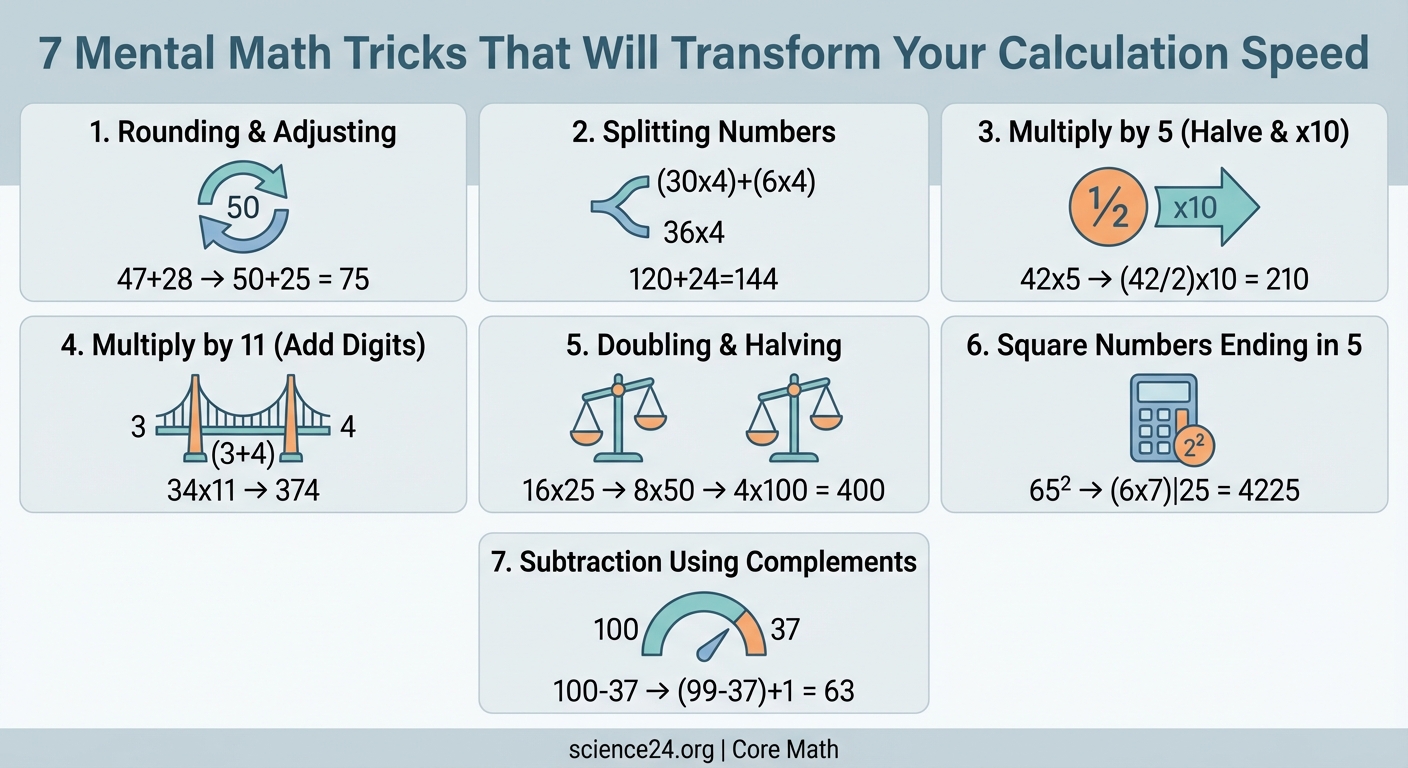
  • 7 Mental Math Tricks That Will Transform Your Calculation Speed

    7 Mental Math Tricks That Will Transform Your Calculation Speed

    You’re standing in line at the coffee shop, splitting a bill with friends, or helping your child with homework. The numbers are simple enough, but reaching for your phone feels awkward. What if you could calculate answers in your head, confidently and correctly, in just a few seconds?

    Mental calculation isn’t about being a math genius. It’s about learning a few strategic shortcuts that make numbers easier to work with. These techniques have helped students ace tests, professionals impress colleagues, and everyday people handle daily math without second-guessing themselves.

    Key Takeaway

    Mental math tricks simplify calculations by breaking numbers into manageable parts, using patterns, and applying strategic shortcuts. These seven techniques cover multiplication, addition, subtraction, percentages, and squaring numbers. Practice each method with real-world examples like splitting bills, calculating discounts, or checking receipts. With consistent use, you’ll build speed and confidence in everyday math situations without relying on calculators or apps.

    Breaking down numbers makes everything easier

    The foundation of fast mental math is understanding that you don’t have to work with numbers as they appear. You can split them, round them, or reorganize them to make calculations simpler.

    Take 47 + 38. Instead of struggling with the traditional method, think of 38 as 40 minus 2. Now you’re solving 47 + 40, which gives you 87, then subtracting 2 for a final answer of 85. This approach, called compensation, turns awkward numbers into friendly ones.

    The same principle works for subtraction. To calculate 82 minus 47, add 3 to both numbers. Now you’re solving 85 minus 50, which is obviously 35. You’ve made the problem easier without changing the answer.

    Your brain processes round numbers faster than irregular ones. Use this to your advantage whenever possible.

    Multiply by 11 without writing anything down

    7 Mental Math Tricks That Will Transform Your Calculation Speed - Illustration 1

    Multiplying two-digit numbers by 11 sounds complicated, but there’s a pattern that makes it almost instant.

    Here’s how it works:

    1. Take your two-digit number, like 34.
    2. Add the two digits together (3 + 4 = 7).
    3. Place that sum between the original digits.
    4. Your answer is 374.

    The process works for any two-digit number where the digits add up to less than 10. Try 52 times 11. Add 5 + 2 to get 7, then sandwich it between the 5 and 2. Answer: 572.

    What if the digits add up to 10 or more? Use 78 as an example. Adding 7 + 8 gives you 15. Write down the 5 between the digits (7_5_8), then add the 1 to the first digit. Your answer becomes 858.

    This trick impresses people at parties and saves time on homework. Practice with random two-digit numbers until it becomes automatic.

    Turn percentages into simple fractions

    Calculating percentages in your head feels intimidating until you realize most common percentages have fraction equivalents that are easier to work with.

    Percentage Fraction Mental Shortcut
    10% 1/10 Move decimal one place left
    20% 1/5 Find 10%, then double it
    25% 1/4 Divide by 4 or halve twice
    50% 1/2 Divide by 2
    75% 3/4 Find 25%, then multiply by 3

    Want to find 15% for a restaurant tip? Calculate 10% by moving the decimal point, then add half of that amount. For a $40 bill, 10% is $4, half of that is $2, so 15% equals $6.

    The 25% trick works beautifully for discounts. A $60 jacket at 25% off? Divide 60 by 4 to get $15 off, making the sale price $45.

    These fraction shortcuts work because your brain handles division by small numbers faster than percentage formulas.

    Square numbers ending in 5 with a simple pattern

    7 Mental Math Tricks That Will Transform Your Calculation Speed - Illustration 2

    Squaring numbers like 25, 35, or 85 follows a predictable pattern that makes mental calculation straightforward.

    The rule: Take the first digit, multiply it by the next consecutive number, then add 25 to the end.

    For 35 squared, the first digit is 3. Multiply 3 by 4 (the next number) to get 12. Attach 25 to the end. Answer: 1,225.

    Try 85 squared. The first digit is 8, and 8 times 9 equals 72. Add 25 to the end for 7,225.

    This pattern works because of how algebra distributes when you square numbers in the form (10a + 5). The math simplifies into a × (a + 1) × 100 + 25, but you don’t need to understand the proof to use the shortcut.

    Practice with 15, 25, 35, 45, 55, 65, 75, 85, and 95 until you can answer without hesitation.

    Multiply by 9 using your fingers or a subtraction trick

    Nine times tables intimidate students, but two methods make them manageable.

    The finger method works for 9 times any number from 1 to 10. Hold both hands in front of you. To multiply 9 by 7, fold down your seventh finger from the left. Count the fingers to the left of the folded finger (6) and to the right (3). Your answer is 63.

    The subtraction method works for larger numbers. To multiply 9 by any number, multiply that number by 10, then subtract the original number. For 9 times 14, calculate 10 times 14 (140), then subtract 14. Answer: 126.

    Why does this work? Because 9 is one less than 10, you’re essentially multiplying by 10 and removing one set of the original number.

    Both methods give you the same correct answer. Choose whichever feels more natural.

    “Mental math isn’t about speed alone. It’s about building number sense so you can estimate, check your work, and catch errors before they become problems. The confidence you gain from these skills extends far beyond arithmetic.”

    Add left to right instead of right to left

    Traditional addition starts with the ones place and works toward larger digits. Mental math reverses this.

    Adding 347 + 286 left to right means starting with the hundreds: 300 + 200 = 500. Then the tens: 40 + 80 = 120. Finally the ones: 7 + 6 = 13. Now add your parts: 500 + 120 + 13 = 633.

    This method feels more natural because you’re building your answer from the most significant digits. You get a sense of the approximate answer immediately, and you can adjust as you go.

    The same approach works for subtraction. For 534 minus 278, start with 500 minus 200 (300), then 30 minus 70 (negative 40), then 4 minus 8 (negative 4). Combine them: 300 minus 40 minus 4 equals 256.

    Left-to-right calculation matches how we read and speak numbers. It reduces the cognitive load of carrying and borrowing.

    Double and halve to simplify multiplication

    Some multiplication problems become easier when you double one number and halve the other.

    Take 16 times 25. Doubling 16 gives you 32, and halving 25 gives you 12.5. But let’s try the other direction: halve 16 to get 8, and double 25 to get 50. Now you’re solving 8 times 50, which equals 400.

    This technique works because multiplication is commutative. The order doesn’t matter, and adjusting the numbers doesn’t change the product.

    Try 14 times 50. Halve 14 to get 7, and double 50 to get 100. Now it’s 7 times 100, which is obviously 700.

    Look for opportunities to create multiples of 10, 100, or other friendly numbers. The goal is to transform difficult multiplication into something your brain can handle instantly.

    Common situations where this helps:

    • Calculating area when one dimension is even
    • Figuring out total costs when buying multiple items
    • Converting between units that have even conversion factors
    • Checking if answers on homework or receipts make sense

    Estimate before you calculate exact answers

    Before applying any mental math trick, take one second to estimate. This habit catches mistakes and builds number intuition.

    Round both numbers to the nearest ten or hundred, then perform a rough calculation. For 347 times 8, round 347 to 350. You know 350 times 8 is 2,800, so your exact answer should be close to that number.

    Estimation helps in several ways:

    • You’ll know immediately if you make a calculation error
    • You can decide if an exact answer is even necessary
    • You build confidence in your number sense
    • You can work faster because you’re not second-guessing every step

    Restaurant math benefits enormously from estimation. A bill of $47.82 is basically $48. Four people splitting it means roughly $12 each. You can calculate exact amounts if needed, but the estimate gets you 95% of the way there.

    Understanding mathematical concepts like why dividing by zero breaks mathematics also strengthens your overall number sense and helps you recognize when calculations don’t make sense.

    Common mistakes and how to avoid them

    Learning mental math tricks means understanding where people typically go wrong. This table shows frequent errors and their solutions.

    Mistake Why It Happens Solution
    Forgetting to add back what you rounded You simplified the problem but lost track of the adjustment Write down the adjustment amount or say it aloud
    Mixing up the order in compensation Adding to one number but also adding to the other Remember: what you add to one, you subtract from the answer
    Rushing through left-to-right addition Trying to go too fast before the method is automatic Practice with three-digit numbers until it feels natural
    Applying the 11 trick incorrectly Not carrying the 1 when digits sum to 10 or more Always check if the digit sum exceeds 9
    Using the wrong percentage shortcut Confusing which fraction matches which percentage Memorize the five most common conversions first

    The best way to avoid these mistakes is practicing one trick at a time. Master the compensation method before moving to the 11 multiplication trick. Build confidence with each technique individually.

    Practice with real numbers from your daily life

    Mental math becomes useful when you apply it to actual situations you encounter regularly.

    Try these practice scenarios:

    • Calculate 15% and 20% tips on restaurant bills
    • Figure out unit prices at the grocery store
    • Determine sale prices during shopping
    • Split costs when sharing expenses with friends
    • Calculate how much time remains until an appointment
    • Figure out gas mileage on road trips
    • Estimate project costs before committing

    Start with easier numbers, then gradually increase difficulty. A $30 restaurant bill is simpler than $47.83, but both use the same techniques.

    Keep a small notebook or use your phone to track problems you encounter. Write down the numbers, try solving them mentally, then check with a calculator. Over time, you’ll notice your accuracy and speed improving.

    Children benefit from practicing with their allowance, counting toys, or calculating video game scores. Adults can practice while budgeting, cooking (doubling recipes), or planning travel.

    The key is consistency. Five minutes of daily practice beats an hour once a week.

    Building speed without sacrificing accuracy

    Speed comes naturally after accuracy. Don’t rush the learning process.

    When you first try these techniques, you’ll feel slow and awkward. That’s normal. Your brain is building new neural pathways for processing numbers.

    Focus on getting the right answer first. Once a method feels comfortable, gradually increase your pace. Time yourself solving ten problems, then try to beat your previous time while maintaining accuracy.

    Some techniques will click immediately. Others might take weeks of practice. The 11 multiplication trick usually feels natural within a few tries. Left-to-right addition might take longer if you’ve spent years doing it the traditional way.

    Be patient with yourself. Professional mental calculators spent years developing their skills. You’re learning practical shortcuts for everyday use, not training for competitions.

    Celebrate small wins. The first time you calculate a tip without reaching for your phone, that’s progress. The moment you catch a cashier’s mistake because you estimated the total, that’s your number sense working.

    Making mental math stick for the long term

    These techniques only help if you remember and use them. Build them into your routine.

    Choose one trick per week to focus on. Use it whenever the opportunity arises. By the end of the week, it should feel automatic.

    Teach someone else. Explaining these methods to a friend, child, or coworker reinforces your own understanding. You’ll also discover which aspects you need to practice more.

    Create challenges for yourself. Before checking out at the store, estimate your total. Before splitting a bill, calculate each person’s share mentally. Before your calculator app opens, try solving the problem in your head.

    Remove easy access to calculators when practicing. Put your phone in another room while doing homework or paying bills. This forced inconvenience pushes you to use mental methods.

    Join online communities focused on mental math. Share your progress, learn new techniques, and stay motivated by seeing others improve.

    Your brain is better at math than you think

    Mental calculation isn’t a talent you’re born with or without. It’s a skill you build through practice and smart techniques.

    These seven tricks give you a foundation for handling most everyday math situations. You won’t need to memorize multiplication tables or perform complex algorithms. You just need to recognize patterns and apply simple shortcuts.

    Start with the techniques that feel most useful for your life. Master those, then add more to your toolkit. Within a few weeks, you’ll notice yourself calculating faster and with more confidence.

    The best part? These skills compound over time. The more you practice, the more number patterns you’ll recognize, and the easier all math becomes. Your brain will start seeing shortcuts you never noticed before.

    Grab a piece of paper and try each technique with a few practice problems. Then put them to use the next time you’re splitting a bill, calculating a discount, or helping someone with their homework. You might surprise yourself with how capable you really are.

  • Why Does Dividing by Zero Break Mathematics?

    Why Does Dividing by Zero Break Mathematics?

    Division by zero seems like it should work. After all, you can divide by one, by ten, by a million. But try dividing by zero on your calculator and you’ll get an error message. Some calculators say “undefined.” Others just refuse to compute. There’s a good reason for this mathematical roadblock.

    Key Takeaway

    Division by zero is undefined because it creates logical contradictions in mathematics. No number multiplied by zero equals a non-zero value, making the reverse operation impossible. Allowing division by zero would break fundamental arithmetic rules, create multiple conflicting answers, and make mathematical proofs unreliable. This isn’t a limitation but a necessary boundary that keeps math consistent and functional.

    What division actually means

    To understand why dividing by zero fails, you need to know what division really does.

    Division answers a specific question. When you calculate 12 ÷ 3, you’re asking: “What number times 3 equals 12?” The answer is 4, because 4 × 3 = 12.

    Every division problem works this way. The operation 20 ÷ 5 asks what number times 5 gives you 20. The answer is 4 again.

    Division is the inverse of multiplication. They undo each other. This relationship is the foundation of why division by zero creates problems.

    The zero multiplication problem

    Why Does Dividing by Zero Break Mathematics? - Illustration 1

    Zero has a unique property in multiplication. Any number multiplied by zero equals zero.

    • 5 × 0 = 0
    • 100 × 0 = 0
    • 1,000,000 × 0 = 0

    This property never changes. No exceptions exist.

    Now let’s try dividing by zero. Take the problem 5 ÷ 0. Using our definition of division, we’re asking: “What number times 0 equals 5?”

    There is no such number. No matter what you multiply by zero, you always get zero. You can never get 5. The question has no answer.

    This isn’t about finding a really big number or a special value. The answer simply doesn’t exist within our number system.

    Why infinity doesn’t solve the problem

    Some people suggest that dividing by zero should equal infinity. This seems intuitive at first.

    As you divide by smaller and smaller numbers, the result gets larger. For example:

    • 10 ÷ 2 = 5
    • 10 ÷ 1 = 10
    • 10 ÷ 0.5 = 20
    • 10 ÷ 0.1 = 100
    • 10 ÷ 0.01 = 1,000

    The pattern suggests that as the divisor approaches zero, the result grows without bound. But this doesn’t mean the answer at zero is infinity.

    Infinity isn’t a regular number. It doesn’t follow normal arithmetic rules. You can’t treat it like 5 or 100 or any other value.

    Even if we said 5 ÷ 0 = infinity, we’d need to verify it using multiplication. Does infinity × 0 = 5? No. Infinity times zero is still undefined. The relationship breaks down.

    The case of zero divided by zero

    Why Does Dividing by Zero Break Mathematics? - Illustration 2

    Zero divided by zero presents an even stranger problem.

    Using our division definition, 0 ÷ 0 asks: “What number times 0 equals 0?” Now we have too many answers instead of none.

    • 1 × 0 = 0
    • 2 × 0 = 0
    • 47 × 0 = 0
    • 1,000,000 × 0 = 0

    Every single number works. This creates an indeterminate form. When a problem has infinitely many correct answers, it’s mathematically useless. We can’t assign one specific value to 0 ÷ 0.

    How division by zero breaks mathematical rules

    Allowing division by zero would destroy the consistency of mathematics. Here’s a proof that shows the chaos it creates.

    Start with a simple true statement: 1 = 2. Wait, that’s not true. Let me show you how division by zero would make it “true.”

    1. Start with two equal expressions: 1 × 0 = 2 × 0
    2. Both sides equal zero, so this is valid: 0 = 0
    3. Now divide both sides by zero: (1 × 0) ÷ 0 = (2 × 0) ÷ 0
    4. If division by zero were allowed, we could cancel: 1 = 2

    We just “proved” that one equals two. This is obviously false. The error occurred when we divided by zero in step 3.

    This example shows why mathematicians define division by zero as undefined. It’s not that we haven’t figured it out yet. It’s that allowing it would let you prove anything, making all of mathematics meaningless.

    Common mistakes when thinking about division by zero

    Many people make similar errors when reasoning about division by zero. Here’s a table showing the mistake, why it happens, and the correction.

    Mistake Why It Seems Right The Correction
    “The answer is infinity” Dividing by smaller numbers gives bigger results Infinity isn’t a number and doesn’t follow arithmetic rules
    “My calculator is just limited” Technology has limitations All calculators correctly refuse this operation because no answer exists
    “There must be some answer” Every other division problem has an answer Not all operations produce valid results in every case
    “0 ÷ 0 should equal 1” Any number divided by itself equals 1 Zero is the exception because every number times zero equals zero
    “Math just hasn’t solved it yet” Math evolves over time This isn’t unsolved; it’s proven to be impossible within standard arithmetic

    Real world analogies

    Sometimes physical analogies help clarify abstract concepts.

    Imagine you have 12 cookies and want to divide them among your friends. If you have 3 friends, each gets 4 cookies (12 ÷ 3 = 4).

    Now try dividing 12 cookies among zero friends. How many cookies does each person get? The question doesn’t make sense. There are no people to receive cookies. You can’t perform the action.

    Here’s another example. Division asks how many groups of a certain size fit into a number. The problem 15 ÷ 5 asks how many groups of 5 fit into 15. The answer is 3 groups.

    Now ask: How many groups of zero fit into 15? You could fit infinitely many groups of nothing into any amount. Or you could argue that zero groups fit because you can’t make groups from nothing. The question has no meaningful answer.

    How mathematicians handle division by zero

    Professional mathematicians don’t avoid division by zero because they’re confused. They’ve carefully analyzed what happens and established clear rules.

    “In mathematics, we define operations to maintain consistency across all applications. Division by zero is undefined not as a failure of mathematics, but as a safeguard. It prevents logical contradictions that would invalidate proofs, equations, and the entire framework we’ve built over centuries.” – Standard mathematical principle

    In calculus, mathematicians work with limits. They can analyze what happens as a value approaches zero without ever actually reaching it. This lets them study the behavior near zero while respecting the boundary.

    For example, the limit of 1/x as x approaches zero from the positive side is infinity. From the negative side, it’s negative infinity. The two sides don’t agree, which is another reason why 1 ÷ 0 can’t have a single defined value.

    Steps to verify why division by zero fails

    You can test this yourself with any example. Here’s a systematic approach:

    1. Choose any division by zero problem, such as 8 ÷ 0
    2. Rewrite it as a multiplication question: “What number times 0 equals 8?”
    3. Try different values: 1 × 0 = 0, not 8. Try 100 × 0 = 0, still not 8. Try 1,000,000 × 0 = 0, still not 8.
    4. Recognize that no number works because anything times zero always equals zero
    5. Conclude that the division problem has no valid answer

    This process works for any number divided by zero. The multiplication check always fails.

    What your calculator does

    Modern calculators are programmed to recognize division by zero and refuse to compute it. This isn’t a bug or limitation.

    Different calculators display different messages:

    • “Error”
    • “Undefined”
    • “Cannot divide by zero”
    • “Math Error”

    Some graphing calculators will show a vertical asymptote on a graph where division by zero would occur. The line approaches but never touches the point where the denominator equals zero.

    Programming languages handle it differently. Some throw an error and stop the program. Others return a special “NaN” value, meaning “Not a Number.” Some return infinity as an approximation, though this can cause problems in calculations.

    Special cases in advanced mathematics

    In some advanced mathematical systems, mathematicians construct alternative frameworks. The Riemann sphere, used in complex analysis, includes a point at infinity where certain division operations can be defined differently.

    Wheel theory is an algebraic structure that attempts to give meaning to division by zero by introducing new elements and rules. These systems sacrifice some standard properties to gain others.

    But these specialized frameworks aren’t used in everyday mathematics. They’re tools for specific theoretical purposes. In standard arithmetic, algebra, and calculus, division by zero remains undefined.

    Teaching students about division by zero

    Students often encounter division by zero when learning fractions or algebra. Teachers face the challenge of explaining why something that seems possible isn’t allowed.

    The best approach starts with the multiplication relationship. Once students understand that division asks “what times this equals that,” the zero problem becomes clearer.

    Practical examples help. Sharing cookies among zero people. Measuring how many zero-length segments fit in a line. These concrete scenarios make the abstract concept tangible.

    Students sometimes feel frustrated that math has “rules” that seem arbitrary. It helps to explain that this isn’t a rule we invented. It’s a logical consequence of how numbers work. We discovered that division by zero creates contradictions, so we define it as undefined to keep mathematics reliable.

    Why this matters for problem solving

    Understanding why division by zero is undefined helps you avoid errors in calculations.

    When solving equations, you might need to divide both sides by a variable. If that variable could equal zero, you must handle it as a special case. Forgetting this leads to incorrect solutions or “extraneous” answers that don’t actually work.

    For example, solving x² = x by dividing both sides by x gives x = 1. But this misses the solution x = 0. You lost a solution by dividing by something that could be zero.

    The correct approach is to rearrange: x² – x = 0, then factor: x(x – 1) = 0. Now you see both solutions: x = 0 or x = 1.

    Computer programmers must also watch for division by zero. A program that divides by user input should check whether that input is zero first. Otherwise, the program crashes or produces nonsensical output.

    The beauty of mathematical boundaries

    Division by zero isn’t a flaw in mathematics. It’s a boundary that defines how our number system works.

    Mathematics is built on consistency. Every rule must work in harmony with every other rule. Division by zero would shatter that harmony, creating a system where you could prove anything and nothing would be reliable.

    By recognizing what’s undefined, mathematicians maintain a framework that’s both powerful and trustworthy. You can build bridges, launch spacecraft, and encrypt data because the math underlying these applications follows consistent rules.

    The next time you see “undefined” on your calculator, remember it’s not giving up. It’s protecting the logical foundation that makes all other calculations possible. That error message represents centuries of mathematical thought, ensuring that when you get an answer, you can trust it.