Quadratic equations show up everywhere in high school and college math. They appear in physics problems, calculus courses, and standardized tests. If you’ve ever felt stuck staring at x² + 5x + 6 = 0, you’re not alone. The good news is that solving these equations becomes straightforward once you understand the core methods and when to use each one.
Quadratic equations can be solved through three main methods: factoring, the quadratic formula, and completing the square. Factoring works best for simple equations with integer solutions. The quadratic formula handles any quadratic equation reliably. Completing the square helps when you need to understand the vertex form or derive the quadratic formula itself. Each method has specific situations where it shines.
What Makes an Equation Quadratic
A quadratic equation follows the standard form ax² + bx + c = 0, where a, b, and c are numbers and a cannot equal zero. The x² term is what makes it quadratic. Without that squared term, you just have a linear equation.
The coefficient a determines whether the parabola opens upward or downward. The coefficient b affects the position of the vertex along the x-axis. The constant c represents the y-intercept where the parabola crosses the vertical axis.
Here’s what matters most: you need to recognize these equations in different forms. Sometimes they appear as 2x² = 8 or x² + 4x = 12. Your first step is always to rearrange them into standard form by moving all terms to one side.
Three Core Methods for Solving Quadratics
Each solving method has strengths and limitations. Knowing which one to choose saves time and reduces errors.
Factoring
Factoring works when you can break down the quadratic into two binomials. This method is fastest but only practical when the solutions are rational numbers.
For the equation x² + 5x + 6 = 0, you need two numbers that multiply to 6 and add to 5. Those numbers are 2 and 3.
- Write the factored form: (x + 2)(x + 3) = 0
- Set each factor equal to zero: x + 2 = 0 or x + 3 = 0
- Solve for x: x = -2 or x = -3
The zero product property makes this work. If two things multiply to zero, at least one of them must be zero. That’s why you can split the equation into two separate solutions.
Not every quadratic factors neatly. When you encounter equations like x² + 2x – 1 = 0, factoring becomes impractical because the solutions involve irrational numbers.
The Quadratic Formula
The quadratic formula solves any quadratic equation, no matter how messy the coefficients look. This makes it the most reliable method in your toolkit.
The formula is:
x = (-b ± √(b² – 4ac)) / (2a)
That ± symbol means you’ll get two solutions: one using addition and one using subtraction.
Let’s solve 2x² + 7x + 3 = 0 using the formula.
- Identify a = 2, b = 7, c = 3
- Calculate the discriminant: b² – 4ac = 49 – 24 = 25
- Plug into the formula: x = (-7 ± √25) / 4
- Simplify: x = (-7 ± 5) / 4
- Find both solutions: x = -2/4 = -0.5 or x = -12/4 = -3
The discriminant (b² – 4ac) tells you what type of solutions to expect. When it’s positive, you get two real solutions. When it equals zero, you get one repeated solution. When it’s negative, you get two complex solutions involving understanding imaginary numbers without the confusion.
Completing the Square
Completing the square transforms a quadratic into vertex form. This method helps you understand where the quadratic formula comes from and makes graphing easier.
For x² + 6x + 2 = 0, follow these steps:
- Move the constant to the right side: x² + 6x = -2
- Take half of the b coefficient and square it: (6/2)² = 9
- Add this number to both sides: x² + 6x + 9 = -2 + 9
- Factor the left side as a perfect square: (x + 3)² = 7
- Take the square root of both sides: x + 3 = ±√7
- Solve for x: x = -3 ± √7
This method always works but involves more steps than the other approaches. Students often use it to verify solutions or when working with vertex form for graphing problems.
Choosing the Right Method
Different equations call for different strategies. Here’s how to decide which method to use.
| Method | Best For | Avoid When |
|---|---|---|
| Factoring | Integer solutions, simple coefficients | Irrational or complex solutions |
| Quadratic Formula | Any equation, especially with decimals | You want to practice factoring |
| Completing the Square | Finding vertex, deriving formulas | You need speed on a timed test |
Start by checking if the equation factors easily. Look for common factors first. If you can divide all terms by the same number, do that before anything else.
The equation 4x² + 8x + 4 = 0 simplifies to x² + 2x + 1 = 0 after dividing by 4. Now it factors as (x + 1)² = 0, giving x = -1.
When factoring seems difficult, move to the quadratic formula. This is especially true during tests where time matters. The formula might take a few extra seconds to write out, but it guarantees an answer.
Always check your solutions by plugging them back into the original equation. This catches arithmetic errors and confirms you didn’t make a sign mistake.
Common Mistakes and How to Avoid Them
Many students make the same errors when solving quadratics. Recognizing these patterns helps you avoid them.
Sign errors plague quadratic formula calculations. The -b in the formula trips people up. If b is already negative, -b becomes positive. For x² – 4x + 1 = 0, you have b = -4, so -b = 4.
Forgetting to write the equation in standard form causes wrong answers. If you have 3x² = 5x + 2, you must rearrange it to 3x² – 5x – 2 = 0 before identifying a, b, and c.
Dividing by zero creates undefined expressions. This connects to broader mathematical principles about why dividing by zero breaks mathematics. When solving quadratics, never divide both sides by x because x might equal zero.
Losing track of the ± symbol in the quadratic formula means missing a solution. Both the positive and negative square roots matter. Write out both calculations separately to avoid confusion.
Arithmetic errors multiply during completing the square. Double-check when you calculate (b/2)². For x² + 10x, half of 10 is 5, and 5² equals 25, not 10.
Special Cases Worth Knowing
Some quadratic equations have shortcuts that save time.
Perfect square trinomials factor into identical binomials. The equation x² + 10x + 25 = 0 becomes (x + 5)² = 0, so x = -5. Recognizing the pattern a² + 2ab + b² = (a + b)² speeds up your work.
Difference of squares appears when you have x² – 16 = 0. This factors as (x + 4)(x – 4) = 0, giving x = 4 or x = -4. The pattern a² – b² = (a + b)(a – b) is worth memorizing.
Equations with b = 0 simplify dramatically. For 3x² – 12 = 0, just isolate x²:
- 3x² = 12
- x² = 4
- x = ±2
Equations with c = 0 always have zero as one solution. For x² + 7x = 0, factor out x to get x(x + 7) = 0. This gives x = 0 or x = -7.
Practical Applications in Real Problems
Quadratic equations model situations where something accelerates or decelerates. Physics problems about projectile motion use them constantly. If you throw a ball upward, its height follows a quadratic function over time.
Area problems often create quadratic equations. Suppose you have 100 feet of fencing and want to build a rectangular pen against a barn. You only need fencing for three sides. If x represents the width, the length is 100 – 2x, and the area is x(100 – 2x) = 100x – 2x².
To maximize area, you’d set this equal to a specific value and solve. These optimization problems show up in calculus but start with quadratic foundations.
Business applications include profit modeling. Revenue minus cost often creates a quadratic function. Finding break-even points means solving where profit equals zero.
Building Speed and Accuracy
Getting comfortable with quadratics takes practice, but you can accelerate the process.
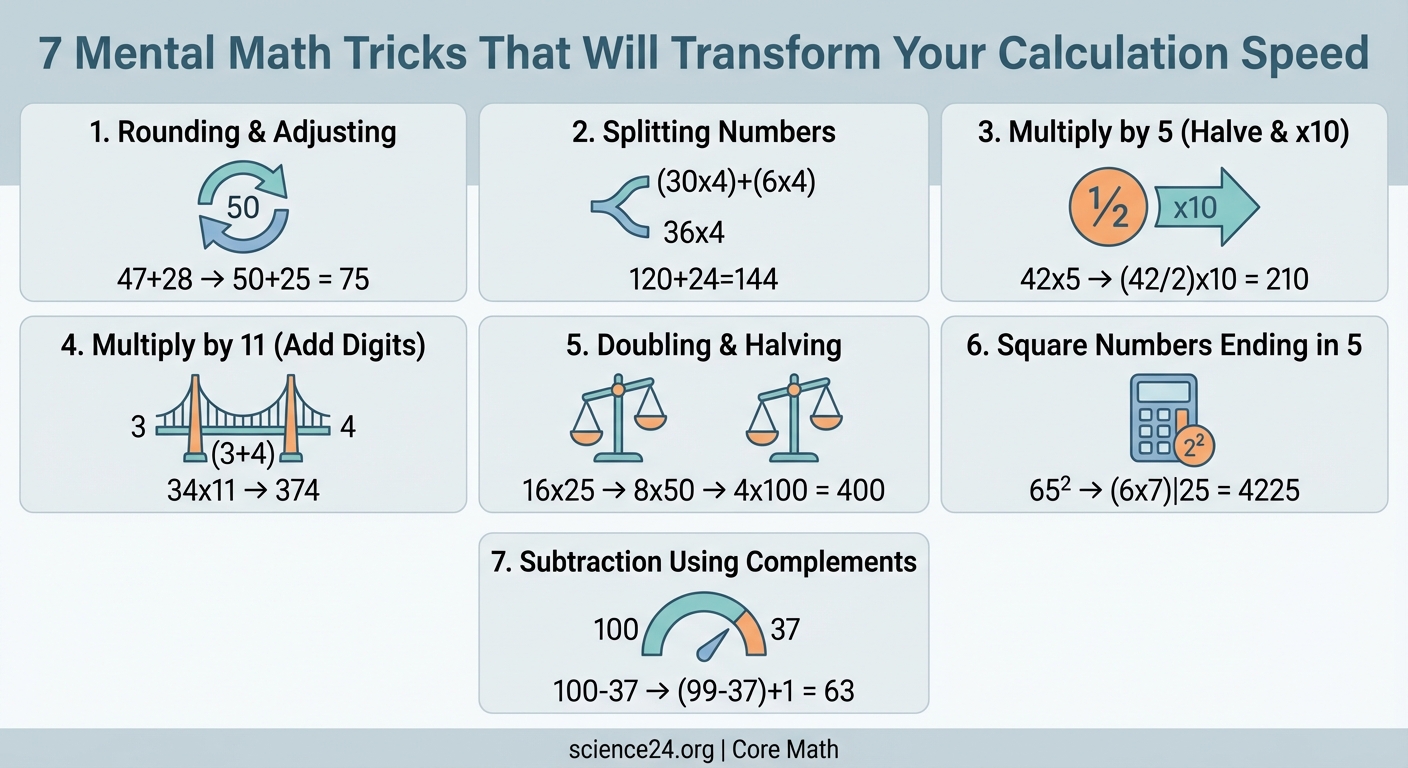
Practice mental math for common patterns. Recognizing that 7 and 3 multiply to 21 and add to 10 makes factoring x² + 10x + 21 = 0 instant. These mental math tricks that will transform your calculation speed apply directly to factoring.
Create a reference sheet with the quadratic formula and key patterns. Write it by hand several times. Muscle memory helps during tests when stress makes you forget formulas.
Work backwards from solutions to build intuition. If x = 2 and x = 5 are solutions, the factored form is (x – 2)(x – 5) = 0. Expand this to get x² – 7x + 10 = 0. Understanding this connection makes factoring feel less mysterious.
Time yourself on practice problems. Start with easier equations and gradually increase difficulty. Track which types give you trouble and focus extra practice there.
Check solutions using substitution, not just by redoing the math. If you think x = 3 is a solution to x² – 5x + 6 = 0, plug it in: 9 – 15 + 6 = 0. This confirms the answer without repeating the same steps where you might make the same mistake twice.
Connecting Quadratics to Other Math Topics
Quadratic equations form a foundation for more advanced mathematics. Understanding them deeply makes later topics easier.
Parabolas in coordinate geometry come from quadratic functions. Every quadratic equation corresponds to a parabola crossing the x-axis at the solution points.
Complex numbers emerge when the discriminant is negative. The equation x² + 4 = 0 has no real solutions, but it does have solutions involving i, the imaginary unit. This opens the door to a whole new number system.
Polynomial division and synthetic division extend the factoring techniques you use on quadratics to higher-degree polynomials. The logic stays the same even as the algebra gets more involved.
Calculus uses quadratics everywhere. Derivatives of cubic functions are quadratic. Optimization problems often reduce to solving quadratic equations after taking derivatives.
The skills you build here transfer directly to mastering trigonometric identities in simple steps and other algebraic manipulations throughout higher math.
Your Action Plan for Mastery
Here’s a concrete study approach that works:
- Solve 10 equations by factoring
- Solve 10 equations using the quadratic formula
- Solve 5 equations by completing the square
- Mix 15 random quadratics and choose the best method for each
- Work 5 word problems that create quadratic equations
This progression builds confidence with each method before asking you to make strategic choices. The word problems force you to translate real situations into mathematical equations, which is where many students struggle.
Focus on understanding why each method works, not just memorizing steps. When you know that factoring relies on the zero product property, you won’t forget to set each factor equal to zero. When you understand that the quadratic formula comes from completing the square on the general form, the formula becomes less mysterious.
Making Quadratics Second Nature
Solving quadratic equations becomes automatic with enough practice. You stop thinking about which method to use and just see the answer path immediately. That fluency frees your brain to handle more complex problems where quadratics are just one small step.
The three core methods each have a place in your mathematical toolkit. Factoring gives you speed on simple problems. The quadratic formula provides reliability on any equation. Completing the square offers insight into the structure of parabolas and the origin of the formula itself.
Start with the method that feels most comfortable, then gradually expand your skills. Before long, you’ll recognize which approach fits each problem at a glance. That confidence transforms quadratics from a source of stress into a routine part of solving bigger mathematical challenges.