
You’ve spent years mastering chemistry equations, physics problems, and biology concepts. Now you’re staring at two completely different doors. One leads to the university lab bench, where you might pursue groundbreaking research. The other opens into corporate offices, production facilities, or tech companies where your science skills solve real-world problems for profit.
This isn’t a choice you can make by flipping a coin.
The decision between academia vs industry after your science degree depends on your salary expectations, preferred work structure, intellectual freedom priorities, and long-term career goals. Academic positions offer research autonomy and teaching opportunities but require extended training periods and offer lower initial compensation. Industry roles provide higher starting salaries, faster career advancement, and applied problem-solving but may limit publication freedom and research direction. Evaluate both paths using concrete criteria rather than prestige assumptions.
Understanding what academia actually means for science graduates
Academia isn’t just about teaching undergraduates. Research universities expect faculty to secure grant funding, publish papers regularly, mentor graduate students, and serve on committees. Postdoctoral positions form the bridge between your PhD and a faculty role, typically lasting two to five years with salaries ranging from $45,000 to $65,000.
The path looks like this: PhD completion, one or more postdoc positions, then competing for tenure-track assistant professor roles. Only about 10% of science PhD graduates eventually secure tenure-track positions at research universities.
Teaching-focused colleges offer different opportunities. You’ll spend more time in classrooms and less time writing grants. Your research expectations decrease, but so does your access to expensive equipment and large research budgets.
National laboratories and research institutes occupy a middle ground. You conduct research without teaching duties, but your projects align with institutional priorities rather than pure curiosity.
What industry careers look like for science degree holders
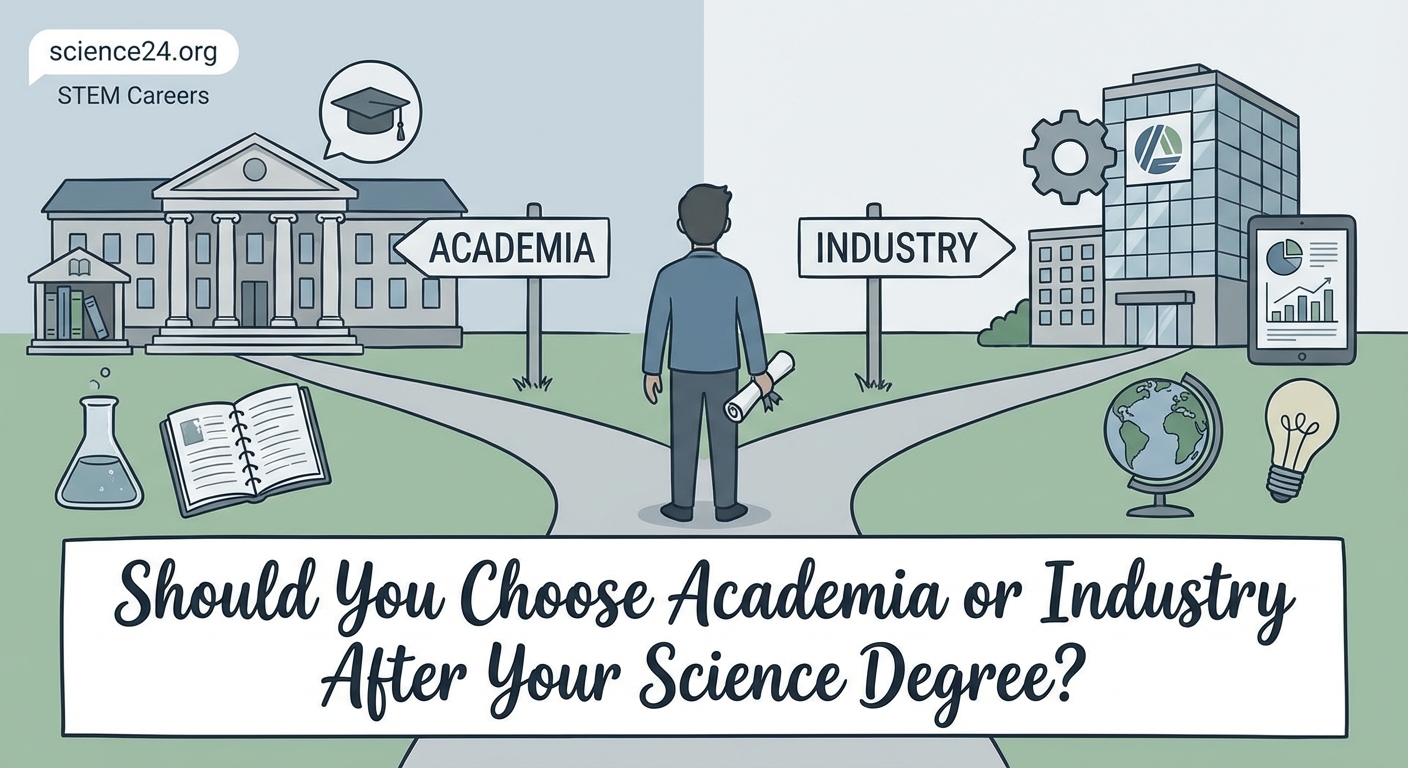
Industry encompasses pharmaceutical companies, biotech startups, chemical manufacturers, environmental consulting firms, food science companies, materials engineering firms, and technology companies needing scientific expertise.
Entry-level positions include research associate, quality control scientist, analytical chemist, process engineer, and applications scientist. Starting salaries typically range from $55,000 to $75,000, significantly higher than postdoc compensation.
Career progression moves faster than academia. You might reach senior scientist or principal investigator roles within five to eight years. Management tracks open up if you develop leadership skills beyond technical expertise.
Your work focuses on products, processes, or services that generate revenue. Research questions come from business needs rather than theoretical gaps in knowledge. Deadlines matter more than perfection. Teamwork across departments replaces individual investigator models.
Patent applications replace publications as career milestones. Proprietary information restrictions mean you can’t always share your discoveries at conferences or in journals.
Comparing compensation across both career paths
Money matters, especially when you’re considering student loan repayment and life planning.
| Career Stage | Academia Salary | Industry Salary | Time to Reach |
|---|---|---|---|
| Postdoc | $45,000-$65,000 | N/A | 0-5 years post-PhD |
| Entry scientist | N/A | $55,000-$85,000 | 0-2 years post-degree |
| Assistant professor | $65,000-$95,000 | N/A | 5-8 years post-PhD |
| Senior scientist | N/A | $90,000-$130,000 | 5-8 years post-degree |
| Associate professor | $75,000-$110,000 | N/A | 12-15 years post-PhD |
| Principal scientist | N/A | $120,000-$180,000 | 10-15 years post-degree |
Academic salaries vary dramatically by institution type and geographic location. A chemistry professor at a state university in the Midwest earns less than one at a private coastal research university.
Industry compensation includes bonuses, stock options, and profit-sharing that can add 10-30% to base salary. Benefits packages typically offer better health insurance and retirement matching than academic institutions.
Summer salary in academia provides additional income if you secure grant funding. Teaching summer courses adds another revenue stream but reduces research time.
Five steps to evaluate which path fits your priorities
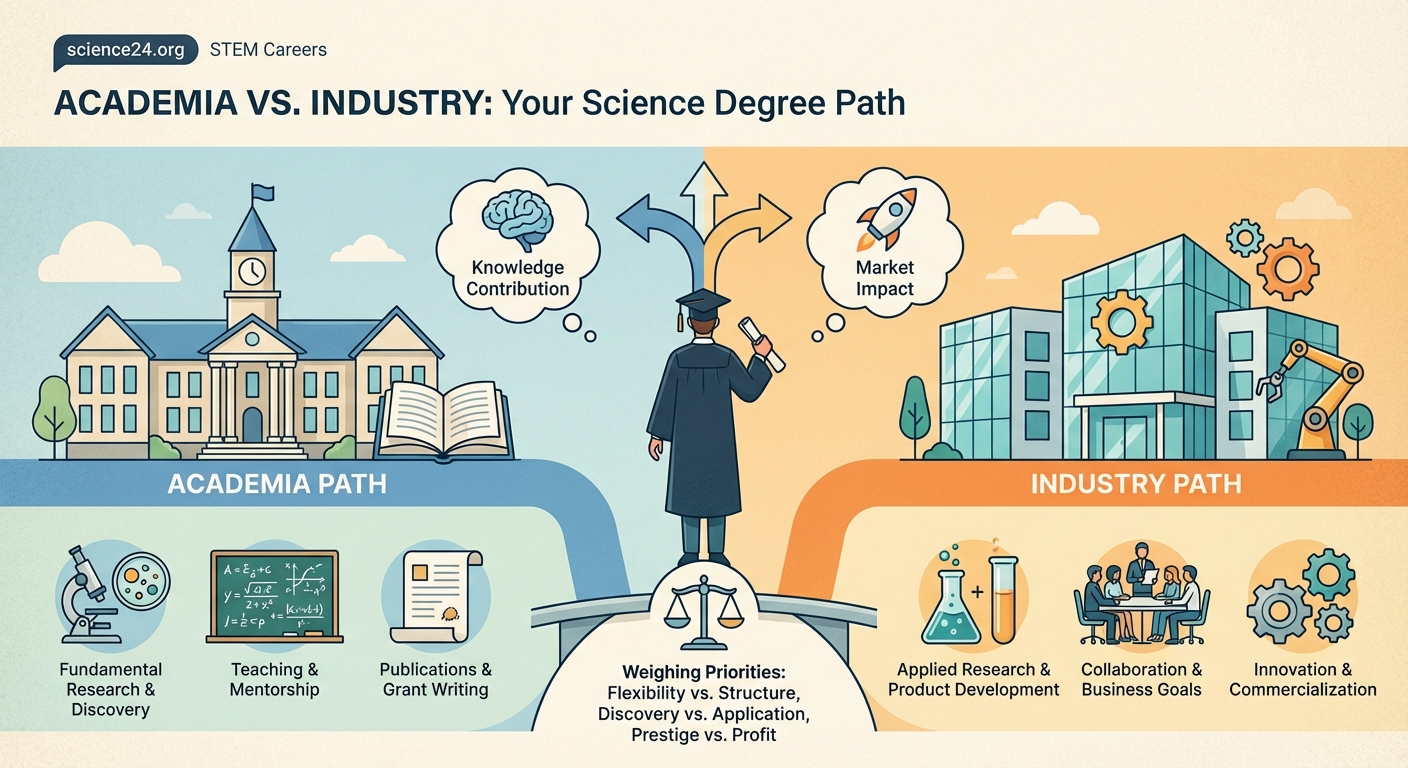
Making this decision requires honest self-assessment, not assumptions about which path sounds more impressive.
-
List your non-negotiable requirements. Do you need to stay in a specific city for family reasons? Does your partner’s career limit geographic flexibility? Can you afford several more years of training-level income? Write these constraints down before considering preferences.
-
Identify three scientists in each path whose careers you admire. Read their career histories. How long did transitions take? What trade-offs did they make? Email them with specific questions about their daily work reality.
-
Test your assumptions through direct experience. Arrange informational interviews with both academic researchers and industry scientists in your field. Ask about their typical Tuesday, not their highlight reel. Request to shadow them for a day if possible.
-
Evaluate your relationship with intellectual property and publication. Do you need to share your discoveries publicly to feel fulfilled? Or does solving proprietary problems for a company feel equally rewarding? This philosophical difference matters more than most graduates realize.
-
Consider your five-year and fifteen-year life vision. Where do you want to live? What work-life balance do you need? Do you want to start a family, and if so, which path offers better parental leave and flexibility? Academic tenure clocks and biological clocks sometimes conflict.
Work culture differences that affect your daily experience
Academic research labs operate with significant autonomy. Your advisor or department chair provides general direction, but you control experimental design, troubleshooting approaches, and analysis methods. Graduate students and postdocs work irregular hours, often evenings and weekends, driven by experiment timing rather than office schedules.
Collaboration happens through co-authorship on papers, conference networking, and informal relationships with colleagues at other institutions. Competition for funding and publications creates tension even among friendly collaborators.
Industry teams follow project management structures. You attend regular meetings, report progress to supervisors, and coordinate with other departments. Standard business hours predominate, though deadlines occasionally require overtime. Some companies offer flex time or remote work options that academic labs rarely provide.
Collaboration is mandatory and structured. Cross-functional teams include scientists, engineers, marketing staff, and business analysts. Your communication skills matter as much as your technical abilities.
“The biggest adjustment moving from academia to industry wasn’t the science. It was learning to present findings to non-scientists who make business decisions. You need to translate your results into cost savings, efficiency gains, or competitive advantages.” — Former academic researcher, now senior scientist at a pharmaceutical company
Intellectual freedom and research direction control
Academic researchers choose their questions. Curiosity drives investigation. You can pursue unexpected findings even if they diverge from your original grant proposal. Peer review and scientific merit determine what’s worth studying.
This freedom comes with constraints. Grant funding limits what’s feasible. You can’t study expensive problems without convincing funding agencies your approach will work. Tenure requirements pressure you toward publishable results rather than high-risk, high-reward projects.
Industry researchers address problems that support business objectives. Your company decides which diseases to target, which materials to develop, or which processes to optimize. You innovate within defined parameters.
Some scientists find this focus liberating. Clear goals and adequate resources let you solve problems efficiently rather than scrambling for funding. Others feel constrained by profit motives limiting their curiosity.
The reality is more nuanced than “academia equals freedom, industry equals restriction.” Academic researchers face funding politics, publication pressure, and tenure requirements. Industry researchers often influence project selection, especially as they advance to senior roles.
Job security and career stability considerations
Tenure offers exceptional job security once you earn it. Universities rarely fire tenured professors except for serious misconduct. You can pursue controversial research, publish unpopular findings, or take intellectual risks without fearing unemployment.
Getting to tenure requires six to eight years of probationary employment with no guarantee of success. Tenure denial means finding a new job, often requiring relocation. The process creates significant stress during your thirties, precisely when many people want to establish roots.
Industry positions offer no tenure equivalent. Companies restructure, eliminate positions, and lay off employees based on business conditions. Mergers and acquisitions can eliminate entire departments. Economic downturns hit industry harder than academia.
However, industry scientists with strong skills find new positions more easily than academics. Transferable skills matter across companies. Geographic flexibility helps, but major cities typically offer multiple industry opportunities. Academic job searches require national or international relocation because positions are scarce.
Making the decision when you’re genuinely torn
Some graduates feel clearly drawn to one path. Others see advantages in both and struggle to choose.
Consider these decision-making approaches:
-
Test industry first if you’re uncertain. Moving from industry to academia is harder than the reverse. A few years in industry won’t disqualify you from academic positions if you maintain research productivity and publications. Extended time away makes academic transitions difficult.
-
Evaluate your field’s industry landscape. Physics and chemistry graduates find robust industry opportunities. Certain biology specializations have fewer options outside academia and government research. Your specific subfield matters more than your general discipline.
-
Assess your risk tolerance honestly. Academic careers involve longer uncertainty periods but potentially greater autonomy. Industry offers faster stability but less control over research direction. Neither path guarantees success, but the risk profiles differ.
-
Talk to people who switched paths. Scientists who moved from academia to industry or vice versa provide valuable perspective on both cultures. They understand the trade-offs experientially rather than theoretically.
Remember that this isn’t a permanent, irreversible choice. Scientists change paths at various career stages. Some start in industry, then transition to teaching-focused academic positions. Others leave academia after denial of tenure and build successful industry careers. A few move back and forth multiple times.
Common mistakes that lead to career regret
Choosing based on prestige rather than fit causes problems. Some students pursue academic careers because they view industry as “selling out” or less intellectually rigorous. Others choose industry solely for higher salaries without considering whether the work culture suits their personality.
Your undergraduate professors succeeded in academia, so they naturally understand that path better than industry alternatives. Their advice, while well-intentioned, reflects survivorship bias. They can’t describe industry careers from experience.
Ignoring lifestyle factors creates dissatisfaction. Academic careers often require multiple relocations for postdoc positions and faculty jobs. Industry offers more geographic choice but may involve corporate travel or relocation for promotions. Consider what matters for your personal life, not just your professional identity.
Assuming you must decide immediately adds unnecessary pressure. You can start a PhD program without committing to academic careers. You can work in industry while keeping academic options open through part-time research or adjunct teaching.
Failing to develop transferable skills limits future flexibility. Academic researchers who learn project management, science communication, and team leadership can transition to industry more easily. Industry scientists who publish papers and attend conferences maintain academic connections.
Building skills that serve both pathways
Certain capabilities prove valuable regardless of which direction you choose.
Scientific communication matters everywhere. Academic researchers write grants and papers. Industry scientists prepare reports and presentations for non-technical audiences. Practice explaining your work to people outside your subfield. Learn to write clearly without jargon.
Project management helps you complete research efficiently. Academic labs operate with minimal structure, so self-management determines productivity. Industry projects have deadlines and deliverables. Understanding how to plan experiments, allocate time, and track progress serves you anywhere.
Collaboration skills extend beyond technical work. You’ll work with people who have different expertise, priorities, and communication styles. Learning to navigate disagreements, share credit, and build productive relationships matters in both academic departments and corporate teams.
Data analysis and statistical literacy underpin all scientific work. Strong quantitative skills let you extract meaningful conclusions from experiments and avoid common analytical errors that plague both academic publications and industry reports. Understanding when your sample size is too small or your controls are inadequate prevents wasted effort.
Technical writing differs from scientific writing. Industry roles often require standard operating procedures, technical specifications, and regulatory documentation. Academic positions need grant proposals and manuscript preparation. Both demand clarity and precision but follow different conventions.
Resources for gathering information before you commit
Professional societies in your field often host career panels at annual conferences. Attend sessions featuring both academic and industry speakers. Ask specific questions about daily work rather than general career advice.
Informational interviews provide direct insight. Reach out to alumni from your program working in both sectors. Most scientists are willing to spend 20 minutes on a video call with a student or recent graduate. Prepare specific questions about aspects you’re uncertain about.
Internships during graduate school let you test industry environments without leaving your program. Many companies offer summer positions for PhD students. The experience helps you evaluate whether you enjoy applied research and corporate culture.
Postdoc positions in national labs or research institutes offer a middle ground. You’ll conduct research without teaching duties but work on mission-driven projects rather than purely curiosity-driven science. This experience can clarify whether you need the full autonomy of academic positions or prefer more structured research environments.
Online communities and forums let you read discussions from scientists in both paths. Reddit’s science career subreddits, professional networking groups, and field-specific forums provide unfiltered perspectives on career realities.
Your decision timeline and when flexibility matters most
You don’t need to decide during your final undergraduate semester. Most science graduates work in industry or research positions before committing to graduate school. This experience clarifies your interests and strengthens graduate applications.
If you’re currently in a PhD program, you have until your third or fourth year before the decision becomes pressing. Use early graduate years to explore both options through internships, informational interviews, and networking.
Postdoc positions signal academic career intentions but don’t eliminate industry options. However, multiple postdocs make industry transitions harder because you’ll compete with younger candidates for entry-level positions.
Industry positions don’t prevent academic careers if you maintain research productivity. Publishing papers, presenting at conferences, and building your scientific reputation keep academic doors open. After five years in industry without publications, academic positions become unlikely.
The most flexible approach involves building skills and maintaining connections in both spheres while you gather information about which path suits you better.
Finding your answer in the work itself
The choice between academia vs industry after your science degree ultimately comes down to which type of work energizes you. Do you want to pose new questions that expand fundamental knowledge? Or do you want to apply existing knowledge to solve practical problems?
Neither answer is superior. Both paths need talented scientists. The world needs researchers pushing the boundaries of understanding and scientists translating discoveries into useful applications.
Pay attention to which aspects of your current work feel most satisfying. If designing experiments and analyzing unexpected results excites you more than anything else, academic research might fit better. If seeing your work implemented and used by others provides the greatest satisfaction, industry could be your place.
Talk to scientists who love their work in both sectors. You’ll notice they describe different sources of fulfillment. Academic researchers often emphasize intellectual freedom and mentoring students. Industry scientists frequently highlight seeing their work become products and solving real-world problems.
Your decision doesn’t define your worth as a scientist. Both paths offer opportunities to contribute meaningful work, continue learning, and build satisfying careers. Choose based on what fits your priorities, skills, and life circumstances rather than external expectations about which path is more prestigious or legitimate.
The right choice is the one that lets you do work you find meaningful while supporting the life you want to build.