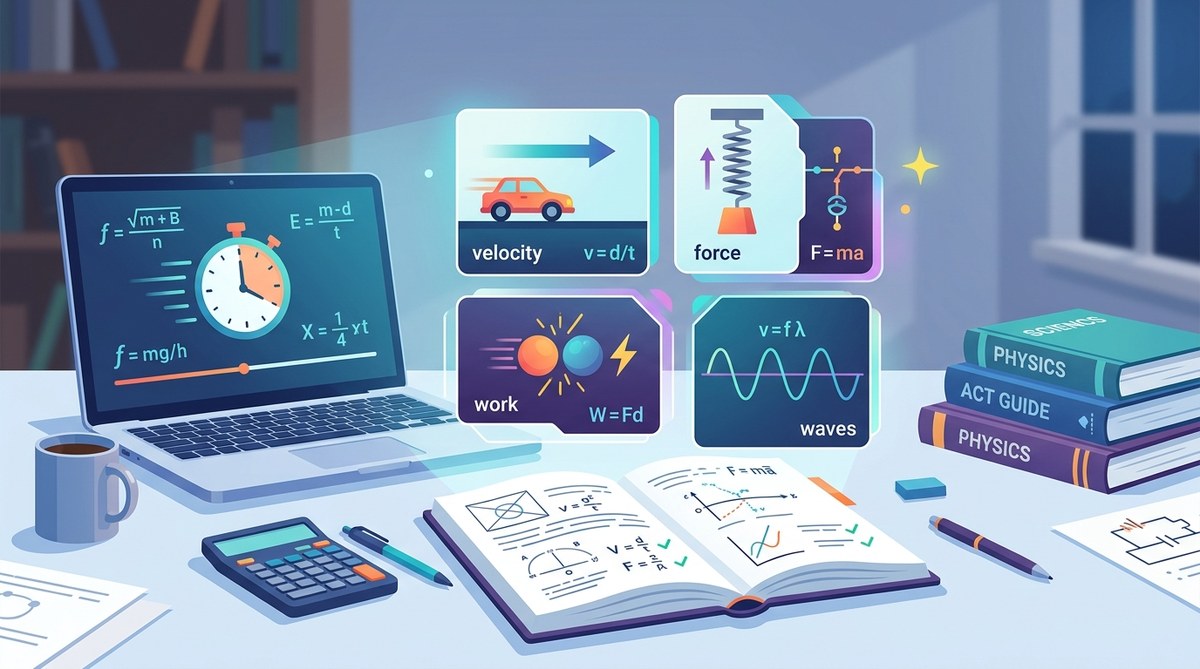
The ACT Science section doesn’t just test your ability to read graphs and interpret data. It also expects you to apply fundamental physics concepts under time pressure. When you’re staring at a question about velocity or force with only seconds to spare, having the right formulas locked in your memory makes all the difference.
The ACT Science section requires students to know five core physics formulas: velocity, acceleration, force, density, and work. Memorizing these equations and understanding when to apply them can save precious time on test day. This guide breaks down each formula with practical examples and common mistakes to avoid, plus a proven memorization strategy.
Understanding what the ACT actually tests
The ACT doesn’t hand you a formula sheet during the exam.
You need to walk in with these equations already stored in your brain. The test writers assume you’ve learned basic physics concepts in high school. They design questions that require you to recognize which formula applies, plug in the correct values, and solve under pressure.
Most students lose points not because they can’t do the math, but because they forget which formula to use. Others remember the equation but mix up the variables. Both mistakes are preventable with focused preparation.
The science section gives you 35 minutes to answer 40 questions. That’s roughly 52 seconds per question. You don’t have time to derive formulas from scratch or second guess yourself. Automatic recall is your advantage.
The five essential formulas you must know
Velocity formula
v = d/t
Velocity equals distance divided by time.
This formula appears in questions about motion, speed, and travel. The ACT loves to give you two of these variables and ask you to solve for the third.
Example: A car travels 150 miles in 3 hours. What is its velocity?
v = 150/3 = 50 miles per hour
Common mistake: Students confuse velocity with speed. For ACT purposes, treat them the same. The test rarely gets into vector directions at this level.
Acceleration formula
a = Δv/t
Acceleration equals the change in velocity divided by time.
The triangle symbol (Δ) means “change in.” You subtract the initial velocity from the final velocity to find this change.
Example: A bike goes from 0 to 20 meters per second in 4 seconds. What is its acceleration?
a = (20 – 0)/4 = 5 meters per second squared
The units matter here. Acceleration always involves velocity units divided by time, giving you something like m/s² or mph/s.
Force formula
F = ma
Force equals mass times acceleration.
This is Newton’s second law. It shows up in questions about pushing, pulling, or any situation where something changes its motion. Understanding how objects fall at the same rate regardless of mass can help you apply this formula correctly.
Example: A 10 kilogram object accelerates at 3 m/s². What force is applied?
F = 10 × 3 = 30 Newtons
Remember: Force is measured in Newtons (N), mass in kilograms (kg), and acceleration in m/s².
Density formula
ρ = m/V
Density equals mass divided by volume.
The Greek letter rho (ρ) represents density, though you might also see it written as D. This formula appears in chemistry and physics questions about materials, floating, and sinking.
Example: A rock has a mass of 50 grams and a volume of 10 cubic centimeters. What is its density?
ρ = 50/10 = 5 g/cm³
Water has a density of 1 g/cm³. Objects with density greater than 1 sink. Objects with density less than 1 float.
Work formula
W = Fd
Work equals force times distance.
In physics, work has a specific meaning. It only happens when a force moves something through a distance. No movement means no work, even if you’re pushing hard.
Example: You push a box with 20 Newtons of force for 5 meters. How much work did you do?
W = 20 × 5 = 100 Joules
Work is measured in Joules (J). One Joule equals one Newton-meter.
How to memorize formulas that stick
Memorization works better with a system. Here’s a three step process that actually works for test day.
1. Write each formula by hand ten times
Don’t type them. Don’t just read them. Write them out with pen and paper.
The physical act of writing activates different parts of your brain than reading does. You’re creating muscle memory along with mental memory.
Do this once per day for three days before your test. By the third day, you’ll notice your hand moving automatically through the equations.
2. Create a real world connection for each formula
Abstract equations slip out of memory easily. Concrete examples stick.
For velocity, picture your daily commute. For force, think about pushing a shopping cart. For density, imagine ice floating in your drink. For work, visualize carrying groceries up stairs.
These mental images give your brain hooks to grab onto when you see a test question.
3. Practice identifying which formula to use
Knowing the formulas isn’t enough. You need to recognize when to apply each one.
Take practice problems and before solving them, write down which formula you’ll use. This trains your pattern recognition. After a dozen problems, you’ll start seeing the clues that signal which equation to pull out.
Common mistakes and how to avoid them
| Mistake | Why it happens | How to fix it |
|---|---|---|
| Mixing up variables | Students memorize F = ma but forget which letter means what | Write out what each variable stands for every time you practice |
| Wrong units | Using miles per hour when the answer needs meters per second | Circle the units in the question and make sure your answer matches |
| Forgetting to square | Writing acceleration as m/s instead of m/s² | Remember that acceleration is change in velocity over time, so time appears twice |
| Dividing instead of multiplying | Confusing W = Fd with W = F/d | Use logic: more force or more distance should mean more work, not less |
| Skipping the change in velocity | Using final velocity instead of Δv in acceleration problems | Always subtract initial from final velocity first |
The mistakes column shows errors that cost students easy points. Most of these happen because of rushed thinking, not lack of knowledge.
Building awareness of your error patterns helps you catch mistakes before you bubble in the wrong answer. If you tend to mess up units, for example, you can train yourself to double check them on every problem.
The students who score highest on ACT Science aren’t necessarily the smartest. They’re the ones who’ve practiced enough to make formula application automatic. When you don’t have to think hard about which equation to use, you free up mental energy for the actual problem solving.
When formulas appear together
Some ACT questions require multiple formulas in sequence.
You might need to calculate velocity first, then use that answer to find acceleration. Or find force, then use it to calculate work.
These multi step problems separate the prepared students from everyone else. The key is staying organized. Write down each step. Label your intermediate answers. Don’t try to do everything in your head.
Example problem: A 5 kg object starts at rest and reaches 10 m/s after traveling 25 meters. What force was applied?
Step 1: Find acceleration using the relationship between velocity, distance, and acceleration (v² = 2ad)
10² = 2a(25)
100 = 50a
a = 2 m/s²
Step 2: Find force using F = ma
F = 5 × 2 = 10 N
Notice how you need to know both the relationship between velocity and acceleration AND the force formula. The ACT tests whether you can chain concepts together logically.
Practice problems to test yourself
Try these without looking back at the formulas. If you get stuck, that tells you which equations need more review.
Problem 1: A train travels 240 miles in 4 hours. What is its velocity?
Problem 2: A ball’s velocity increases from 5 m/s to 15 m/s in 2 seconds. What is its acceleration?
Problem 3: What force is needed to accelerate a 20 kg object at 3 m/s²?
Problem 4: A metal cube has a mass of 80 grams and a volume of 10 cm³. What is its density?
Problem 5: You lift a 50 N weight 2 meters off the ground. How much work did you do?
Answers:
- v = 240/4 = 60 mph
- a = (15-5)/2 = 5 m/s²
- F = 20 × 3 = 60 N
- ρ = 80/10 = 8 g/cm³
- W = 50 × 2 = 100 J
If you got all five correct without hesitation, you’re ready. If you missed any or had to think hard about which formula to use, spend more time with that specific equation.
Connecting formulas to concepts
Memorizing equations mechanically only gets you halfway there. Understanding what each formula represents helps you catch errors and handle variations.
Velocity measures how fast position changes. Acceleration measures how fast velocity changes. Force causes acceleration. Density compares how much stuff fits in a space. Work measures energy transfer through movement.
When you see these formulas as descriptions of physical reality rather than random letters, they make more sense. This conceptual understanding helps when the ACT phrases a question in an unusual way.
For instance, if a question asks about “rate of position change,” you should recognize that as velocity. If it mentions “mass per unit volume,” that’s density. The test writers deliberately use different words to see if you truly understand the concepts.
What to do the night before
Don’t cram new material. Instead, do a final review of your five formulas.
Write each one out twice. Say them out loud. Visualize a situation where you’d use each one. This reinforces the neural pathways without creating stress.
Get a full night of sleep. Your brain consolidates memories during sleep. Staying up late to study more actually hurts your recall the next day.
Have your calculator ready and make sure you know how to use it efficiently. Practice entering numbers and operations in the correct order. Simple calculator mistakes cost points just as surely as formula mistakes do.
Building confidence through repetition
Test anxiety often comes from uncertainty. You’re not sure if you remember the formulas correctly. You’re not confident about which one to use.
The cure is repetition. Not mindless repetition, but deliberate practice where you actively engage with the material.
Do ten practice problems per day for the week before your test. Mix up the types so you practice recognizing which formula each question needs. Time yourself to simulate test pressure.
By test day, these formulas should feel as natural as your phone number. That automatic recall gives you confidence. Confidence helps you think clearly under pressure. Clear thinking leads to correct answers.
Students who use mental math tricks that will transform your calculation speed often find they can solve formula based problems faster, leaving more time for complex passages.
Your formula cheat sheet strategy
You can’t bring notes into the test. But you can create a mental cheat sheet.
Before the test starts, when you’re sitting there waiting, mentally review all five formulas. Visualize writing them down. See the letters in your mind.
Some students find it helpful to write the formulas in the test booklet margin as soon as the proctor says begin. This takes 30 seconds but gives you a reference point if your mind goes blank later.
The ACT allows you to write in your test booklet. Use this to your advantage. Circle key numbers in questions. Write down which formula you’re using. Show your work even though no one grades it. These habits prevent careless errors.
Formulas in context
The ACT never asks you to simply recite a formula. Every question embeds the physics in a scenario.
You might read about a car on a highway, a falling object, a floating boat, or a person pushing furniture. Your job is to translate the story into numbers and recognize which formula applies.
This is why practicing with real ACT science passages matters. You need experience pulling relevant information from paragraphs and graphs, then matching that information to the right equation.
Reading comprehension and physics knowledge work together on this test. You can know every formula perfectly but still struggle if you can’t identify which numbers to plug in.
Making these formulas permanent
Five formulas isn’t much to memorize. You probably know more song lyrics than that.
The challenge isn’t the quantity. It’s making sure you can access these formulas instantly under test conditions when you’re tired and stressed and racing the clock.
That’s why starting your review now matters. Even if your test is next week, daily practice makes a difference. Your brain needs time to move information from short term to long term memory.
Treat these formulas like vocabulary words in a foreign language. You wouldn’t expect to memorize Spanish verbs by reading them once. You’d practice them repeatedly in different contexts until they became automatic.
Do the same with physics formulas. Write them. Say them. Use them. Test yourself. Explain them to someone else. Each repetition strengthens the memory.
What happens after you master the basics
Once these five formulas feel solid, you might wonder what else you need to know for the ACT Science section.
Good news: these five cover the vast majority of physics calculations you’ll encounter. The test focuses more on data interpretation and experimental design than complex physics.
But understanding related concepts helps. Knowing about friction in physics problems can clarify force questions. Understanding circular motion and centripetal force occasionally appears in advanced questions.
The formulas are your foundation. Build on them by understanding the physics concepts they represent, and you’ll handle whatever the test throws at you.
Your test day game plan
Walk into the testing room knowing you’ve prepared. You’ve written these formulas dozens of times. You’ve solved practice problems. You’ve identified your common mistakes and learned to avoid them.
When you hit the science section, move through it systematically. Don’t get stuck on hard questions. If you see a physics problem and immediately know which formula to use, solve it. If you’re unsure, mark it and come back.
Time management matters as much as knowledge. You can’t afford to spend three minutes on one problem when forty questions await.
Trust your preparation. Your brain has stored these formulas. When you see the right trigger in a question, the formula will surface. That’s how memory works when you’ve practiced correctly.
Why these five formulas matter most
The ACT could theoretically test hundreds of physics equations. They don’t.
They focus on fundamental concepts that every high school science student should know. These five formulas represent core ideas: motion, forces, and properties of matter.
Master these and you handle the majority of physics calculations on the test. Combine them with strong graph reading skills and experimental reasoning, and you’re set for a high science score.
The students who struggle aren’t usually the ones who don’t understand physics. They’re the ones who didn’t take time to memorize the basics. Don’t be that student.
Putting formulas to work on test day
You’ve read this guide. You know the five formulas. You understand how to apply them and avoid common mistakes.
Now comes the part that actually matters: practice. Reading about formulas doesn’t put them in your memory. Writing them does. Solving problems does. Testing yourself does.
Set aside 15 minutes today to write out each formula five times and solve two practice problems for each one. Do the same tomorrow. And the next day. By the end of the week, these equations will feel like second nature.
The ACT rewards students who prepare systematically. You don’t need to be a physics genius. You just need to know five formulas cold and recognize when to use them. That’s completely achievable between now and test day. Get started.