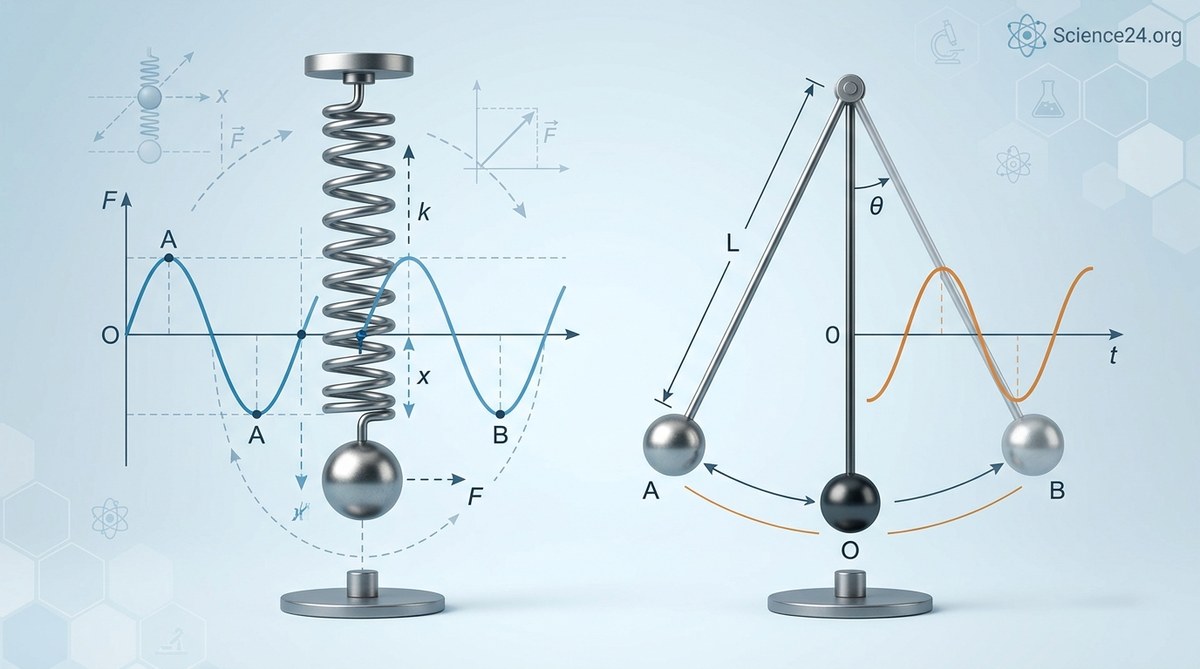
Picture a grandfather clock ticking steadily in the corner of a room. Its pendulum swings back and forth with perfect rhythm, never speeding up or slowing down. That predictable, repetitive motion is simple harmonic motion at work. Understanding this concept unlocks the behavior of countless systems in physics, from vibrating guitar strings to atoms in a crystal lattice. For students tackling AP Physics or introductory college courses, mastering simple harmonic motion through springs and pendulums builds a foundation for understanding waves, oscillations, and energy transfer.
Simple harmonic motion describes oscillations where restoring force is proportional to displacement from equilibrium. Springs follow Hooke’s Law, while pendulums rely on gravity. Both systems exhibit periodic motion with predictable periods and frequencies. Understanding position, velocity, and acceleration relationships helps solve problems involving energy conservation, amplitude, and phase. These concepts form the backbone of oscillatory systems throughout physics.
What Makes Motion “Simple” and “Harmonic”
Simple harmonic motion occurs when an object oscillates around an equilibrium position with a restoring force proportional to its displacement. The term “harmonic” refers to the sinusoidal pattern these oscillations follow over time.
Think of a mass attached to a spring. When you pull the mass and release it, the spring pulls it back toward the center. The farther you stretch the spring, the stronger the pull. This proportional relationship creates the signature back-and-forth motion.
Three conditions must be met for true simple harmonic motion:
- The restoring force must be directly proportional to displacement
- The force must always point toward equilibrium
- No energy should be lost to friction or air resistance (ideal conditions)
Real-world systems approximate these conditions closely enough for practical calculations. A pendulum swinging through small angles behaves almost identically to ideal simple harmonic motion.
Understanding Hooke’s Law and Spring Systems
Springs provide the clearest example of simple harmonic motion. Robert Hooke discovered that the force a spring exerts is proportional to how far you stretch or compress it.
The mathematical relationship is:
F = -kx
Here, F represents the restoring force, k is the spring constant (measuring stiffness), and x is displacement from equilibrium. The negative sign indicates the force always opposes displacement.
A stiffer spring has a higher k value. If you compare a car suspension spring to a pen spring, the car spring requires much more force to compress the same distance. That difference shows up in their spring constants.
When you release a mass on a spring, it oscillates with a period determined by:
T = 2π√(m/k)
Mass and spring constant completely determine how long each oscillation takes. Heavier masses oscillate more slowly. Stiffer springs oscillate faster.
The frequency (how many oscillations per second) is simply the reciprocal of period:
f = 1/T = (1/2π)√(k/m)
Position, Velocity, and Acceleration Relationships
Simple harmonic motion creates elegant mathematical relationships between position, velocity, and acceleration. These relationships help predict where an object will be at any moment.
Position varies sinusoidally with time:
x(t) = A cos(ωt + φ)
The amplitude A represents maximum displacement. Angular frequency ω equals 2πf. The phase constant φ depends on initial conditions.
Velocity is the derivative of position:
v(t) = -Aω sin(ωt + φ)
Maximum velocity occurs at equilibrium (x = 0). The object moves fastest when passing through the center point.
Acceleration is the derivative of velocity:
a(t) = -Aω² cos(ωt + φ)
Notice that acceleration equals -ω²x. This confirms that acceleration is always proportional to displacement and points toward equilibrium.
When solving simple harmonic motion problems, remember that position, velocity, and acceleration are 90 degrees out of phase. When displacement is maximum, velocity is zero. When velocity is maximum, acceleration is zero.
How Pendulums Demonstrate Simple Harmonic Motion
Pendulums use gravity instead of spring force to create oscillations. A mass suspended from a fixed point swings back and forth under gravitational pull.
For small angles (less than about 15 degrees), the restoring force is approximately proportional to angular displacement. This approximation makes pendulum motion nearly identical to simple harmonic motion.
The period of a simple pendulum depends on length and gravitational acceleration:
T = 2π√(L/g)
Length L is measured from the pivot point to the center of mass. Gravitational acceleration g equals 9.8 m/s² on Earth’s surface.
Notice that mass doesn’t appear in this equation. A heavy pendulum bob and a light one swing with identical periods if their lengths match. This counterintuitive fact confused early physicists but follows directly from how gravity accelerates all masses equally, similar to why objects fall at the same rate regardless of mass.
Changing pendulum length has a square root relationship with period. Doubling the length increases the period by √2, not by 2. To double the period, you must quadruple the length.
Energy Conservation in Oscillating Systems
Energy constantly transforms between kinetic and potential forms during simple harmonic motion. Total mechanical energy remains constant in ideal systems.
For a spring system, potential energy is:
PE = (1/2)kx²
Maximum potential energy occurs at maximum displacement (amplitude). At this point, the mass momentarily stops, so kinetic energy equals zero.
Kinetic energy follows the standard formula:
KE = (1/2)mv²
Maximum kinetic energy occurs at equilibrium, where velocity peaks and potential energy equals zero.
Total energy equals:
E = (1/2)kA²
This total stays constant throughout the motion. Energy shifts between kinetic and potential, but their sum never changes.
For pendulums, gravitational potential energy replaces spring potential energy:
PE = mgh
Height h varies as the pendulum swings. At the lowest point, potential energy is minimum and kinetic energy is maximum.
Solving Common Simple Harmonic Motion Problems
Following a systematic approach helps tackle simple harmonic motion problems efficiently. Here’s a reliable method:
- Identify the system type (spring or pendulum) and write down known values.
- Determine what the problem asks for (period, frequency, amplitude, energy, position at a specific time).
- Select the appropriate equation based on the system and desired quantity.
- Solve algebraically before substituting numbers to catch errors easily.
- Check units carefully and verify the answer makes physical sense.
Students often mix up similar-looking equations or forget to convert angles to radians. Writing out each step prevents these mistakes. If you struggle with algebraic manipulation, reviewing techniques from resources like 10 common algebra mistakes and how to avoid them can help.
Consider this example: A 0.5 kg mass on a spring with k = 200 N/m is pulled 0.1 m from equilibrium and released. Find the period and maximum velocity.
Period: T = 2π√(m/k) = 2π√(0.5/200) = 0.314 seconds
Angular frequency: ω = 2π/T = 20 rad/s
Maximum velocity: v_max = Aω = 0.1 × 20 = 2.0 m/s
Common Mistakes and How to Avoid Them
Understanding where students typically struggle helps you avoid the same pitfalls. This table summarizes frequent errors and their solutions:
| Mistake | Why It Happens | Correct Approach |
|---|---|---|
| Using degrees instead of radians | Calculators default to degrees | Always set calculator to radian mode for physics |
| Confusing period and frequency | Similar-sounding concepts | Remember f = 1/T; they are reciprocals |
| Forgetting the negative sign in F = -kx | Focusing only on magnitude | The sign indicates direction toward equilibrium |
| Using large-angle formulas for pendulums | Not checking angle size | Only use T = 2π√(L/g) for angles under 15° |
| Mixing up amplitude and displacement | Both measure distance | Amplitude is maximum displacement |
| Applying spring formulas to pendulums | Not identifying system type | Check whether restoring force comes from elasticity or gravity |
Amplitude, Phase, and Initial Conditions
Initial conditions determine amplitude and phase constant. These values describe how the motion begins.
Amplitude represents the maximum distance from equilibrium. If you pull a spring 5 cm before releasing it, the amplitude is 5 cm. The mass will oscillate between +5 cm and -5 cm.
Phase constant φ depends on where you start timing. If you release the mass from maximum positive displacement at t = 0, then φ = 0 and position is:
x(t) = A cos(ωt)
If you release it from equilibrium with positive velocity, φ = -π/2 and position becomes:
x(t) = A cos(ωt – π/2) = A sin(ωt)
Different initial conditions produce the same motion shifted in time. The period, frequency, and amplitude remain unchanged.
Damping and Real-World Oscillations
Ideal simple harmonic motion continues forever with constant amplitude. Real systems lose energy to friction and air resistance.
Damping describes how oscillation amplitude decreases over time. Three categories exist:
- Underdamped: System oscillates with gradually decreasing amplitude
- Critically damped: System returns to equilibrium as fast as possible without oscillating
- Overdamped: System returns to equilibrium slowly without oscillating
Car shock absorbers aim for critical damping. They want to stop bouncing after hitting a bump without excessive oscillation or sluggish response.
The damping force typically depends on velocity:
F_damping = -bv
The damping coefficient b determines how strongly the system resists motion. Higher b values cause faster amplitude decay.
Frequency and Period Relationships
Frequency and period describe the same physical property from different perspectives. Period measures time per oscillation. Frequency measures oscillations per time.
Their relationship is:
f = 1/T
A pendulum with a 2-second period completes 0.5 oscillations per second. Its frequency is 0.5 Hz.
Angular frequency ω relates to regular frequency through:
ω = 2πf
Angular frequency appears naturally in equations because it simplifies the mathematics of circular and oscillatory motion. One complete oscillation corresponds to 2π radians.
Converting between these quantities becomes second nature with practice. Keep these relationships handy:
- T = 1/f = 2π/ω
- f = 1/T = ω/2π
- ω = 2πf = 2π/T
Comparing Springs and Pendulums
Both springs and pendulums exhibit simple harmonic motion, but their behaviors differ in important ways:
Springs:
– Restoring force comes from elastic deformation
– Period depends on mass and spring constant
– Work in any orientation (horizontal, vertical, angled)
– Amplitude doesn’t affect period
– Easy to change period by adding mass
Pendulums:
– Restoring force comes from gravity
– Period depends on length and gravitational field
– Require gravity to function
– Small-angle approximation necessary for true simple harmonic motion
– Easy to change period by adjusting length
Understanding these differences helps you choose the right equations and recognize which system a problem describes.
Energy Methods for Problem Solving
Energy conservation provides an alternative to kinematic equations. Sometimes calculating energy proves simpler than tracking position and velocity.
Consider a spring compressed by 0.2 m with k = 100 N/m. What is the maximum speed of the 0.5 kg mass?
Energy method:
Initial energy (all potential): E = (1/2)kx² = (1/2)(100)(0.2)² = 2.0 J
At equilibrium (all kinetic): E = (1/2)mv²
Setting them equal: (1/2)mv² = 2.0 J
Solving: v = √(4.0/0.5) = 2.83 m/s
This approach bypasses finding angular frequency and period entirely. Energy methods work particularly well for finding speeds at specific positions.
Applications Beyond the Classroom
Simple harmonic motion appears throughout physics and engineering. Recognizing these applications reinforces why the concept matters.
Molecular vibrations in chemistry follow simple harmonic motion. Chemical bonds act like springs connecting atoms. Understanding these vibrations helps predict molecular behavior and spectroscopy results.
Electrical circuits with inductors and capacitors oscillate with the same mathematical form as mechanical systems. The LC circuit is the electrical analog of a mass on a spring.
Seismology uses simple harmonic motion to model earthquake waves. Buildings sway with characteristic frequencies that engineers must consider when designing earthquake-resistant structures.
Musical instruments produce sound through vibrating strings, air columns, and membranes. These vibrations follow simple harmonic motion principles, creating the pure tones we hear.
Even atomic clocks rely on oscillations of cesium atoms, which exhibit quantum mechanical simple harmonic motion with extraordinary precision.
Practice Problems to Build Confidence
Working through varied problems builds the pattern recognition needed for exams. Here are scenarios to test your understanding:
Problem 1: A 2.0 kg mass on a spring oscillates with period 0.5 seconds. What is the spring constant?
Problem 2: A pendulum has length 1.0 m. What is its period on Earth? What would its period be on the Moon where g = 1.6 m/s²?
Problem 3: A spring with k = 50 N/m is compressed 0.3 m. If a 1.0 kg mass is attached and released, what is the maximum acceleration?
Problem 4: An oscillating mass has maximum speed 3.0 m/s and maximum acceleration 12 m/s². What are the angular frequency and amplitude?
Working these problems reveals whether you truly understand the relationships or just memorized formulas. If you get stuck, review the relevant sections and try again before checking solutions.
Graphing Position, Velocity, and Acceleration
Visual representations clarify the phase relationships between kinematic quantities. Graphing these functions reveals patterns that equations alone might obscure.
Position follows a cosine curve (assuming x = A at t = 0). The graph oscillates between +A and -A with period T.
Velocity is 90 degrees ahead of position. When position reaches maximum, velocity crosses zero. When position is zero, velocity reaches its extremes.
Acceleration is 180 degrees ahead of position (or equivalently, directly opposite). When position is maximum positive, acceleration is maximum negative.
All three graphs have the same period. They differ in amplitude and phase. Creating these graphs by hand for a few cycles helps internalize the relationships.
Why This Foundation Matters for Advanced Physics
Simple harmonic motion isn’t just an isolated topic. It provides the foundation for understanding waves, quantum mechanics, and electromagnetism.
Wave motion combines simple harmonic motion in space and time. Each point on a wave oscillates with simple harmonic motion. Understanding oscillations makes wave equations intuitive.
Quantum mechanics describes particles as wave functions. The Schrödinger equation for a quantum harmonic oscillator directly parallels the classical case. Energy levels are quantized, but the mathematical structure remains familiar.
Electromagnetic radiation consists of oscillating electric and magnetic fields. These fields undergo simple harmonic motion perpendicular to the direction of propagation.
Mastering simple harmonic motion now saves countless hours when you encounter these advanced topics. The investment pays dividends throughout your physics education.
Building Your Problem-Solving Toolkit
Success with simple harmonic motion requires more than memorizing equations. You need strategies for approaching unfamiliar problems.
Start by sketching the system. Draw the spring or pendulum, mark equilibrium, and indicate the direction of motion. Visual representation prevents sign errors.
List known and unknown quantities. Write them down explicitly rather than keeping them in your head. This habit prevents overlooking given information.
Identify which equations connect your knowns to your unknowns. Sometimes you need multiple steps, calculating an intermediate quantity first.
Check limiting cases. If mass approaches zero, does the period make sense? If the spring constant becomes very large, does the behavior match intuition?
Verify units throughout your calculation. Dimensional analysis catches algebraic errors before you get a nonsensical answer.
These strategies apply beyond simple harmonic motion. Building good problem-solving habits now, similar to developing skills through how to master time management during SAT math sections, serves you throughout physics and engineering courses.
Making Simple Harmonic Motion Second Nature
Simple harmonic motion appears so frequently in physics that fluency with it becomes essential. Springs and pendulums provide concrete examples that make abstract concepts tangible.
The beauty of simple harmonic motion lies in its predictability. Once you know the system parameters, you can predict its behavior at any future time. This deterministic nature makes it perfect for building physical intuition.
As you work through problems, notice the patterns. Period equations always involve square roots. Energy is always proportional to amplitude squared. Acceleration always opposes displacement.
These patterns become mental shortcuts that let you solve problems faster and check your work more effectively. You’ll start recognizing when an answer can’t be right because it violates these fundamental relationships.
Practice with springs and pendulums until the equations feel natural. Try predicting answers before calculating them. Estimate whether a period should be longer or shorter when you change a parameter.
This intuition transforms simple harmonic motion from a collection of formulas into a coherent framework for understanding oscillatory systems. That understanding will serve you well in every physics course that follows.