
You’ve practiced hundreds of problems. You know your formulas. You understand the concepts. But when the proctor calls time, you’re staring at five blank answers you never reached. Sound familiar?
Running out of time on SAT math isn’t about being slow or unprepared. It’s about strategy. The difference between a good score and a great score often comes down to how you allocate your minutes, not just what you know.
Effective SAT math time management requires understanding your target score, practicing with realistic timing, using a two-pass approach to tackle easier questions first, and developing the discipline to skip problems that consume too much time. Master these techniques through timed practice tests that simulate real conditions, and you’ll finish sections confidently while maximizing your point potential.
Understanding the SAT Math Time Structure
The SAT gives you two math sections with different time constraints. Module 1 and Module 2 each contain 22 questions. You get 35 minutes per module.
That breaks down to roughly 95 seconds per question. But here’s the thing: not all questions deserve equal time.
Some problems take 30 seconds. Others might need three minutes. Your job isn’t to spend 95 seconds on every question. Your job is to recognize which problems deserve more time and which ones you should handle fast.
The digital SAT adapts to your performance. If you do well on Module 1, Module 2 gets harder. This means time management becomes even more critical as the test progresses.
Setting Your Target Score Before You Plan Your Time

Before you worry about pacing, figure out where you’re aiming. A student targeting 500 has different priorities than someone shooting for 750.
Here’s why this matters: you don’t need to answer every question correctly to hit your goal.
Scoring around 500? You can skip the hardest 20% of questions and still reach your target. Focus your energy on getting the easier and medium questions right. Speed through what you know. Skip what stumps you.
Scoring around 650? You need most questions correct, but you can still afford to miss a few tough ones. Your strategy should focus on accuracy over speed on medium and hard problems.
Aiming for 750 or higher? You need nearly every question correct. Your time management centers on efficiency. You can’t afford to waste minutes on problems you could solve faster with better techniques.
Take a full practice test under real conditions. Score it honestly. That number tells you where to focus your prep time.
The Two-Pass Strategy That Changes Everything
Stop answering questions in order from 1 to 22. That’s a beginner mistake.
Instead, use two passes through each module.
Pass 1: Move through the entire section. Answer every question you can solve confidently within 60 seconds. Skip anything that makes you pause or think “this will take a while.”
Pass 2: Return to the beginning. Now tackle the questions you skipped, starting with the ones that seem most approachable.
This strategy ensures you collect all the easy points before time runs out. Nothing feels worse than missing simple questions at the start because you burned five minutes on a complex problem you couldn’t solve anyway.
Mark questions digitally as you skip them. The digital SAT lets you flag problems for review. Use this feature religiously.
Here’s what a two-pass approach looks like in practice:
- Start the module and glance at question 1
- Can you solve it in under a minute? Do it now
- Does it look time-intensive or confusing? Flag it and move to question 2
- Repeat through all 22 questions
- Check your time remaining
- Return to flagged questions, starting with the ones that looked easiest
Recognizing Time Traps Before They Catch You
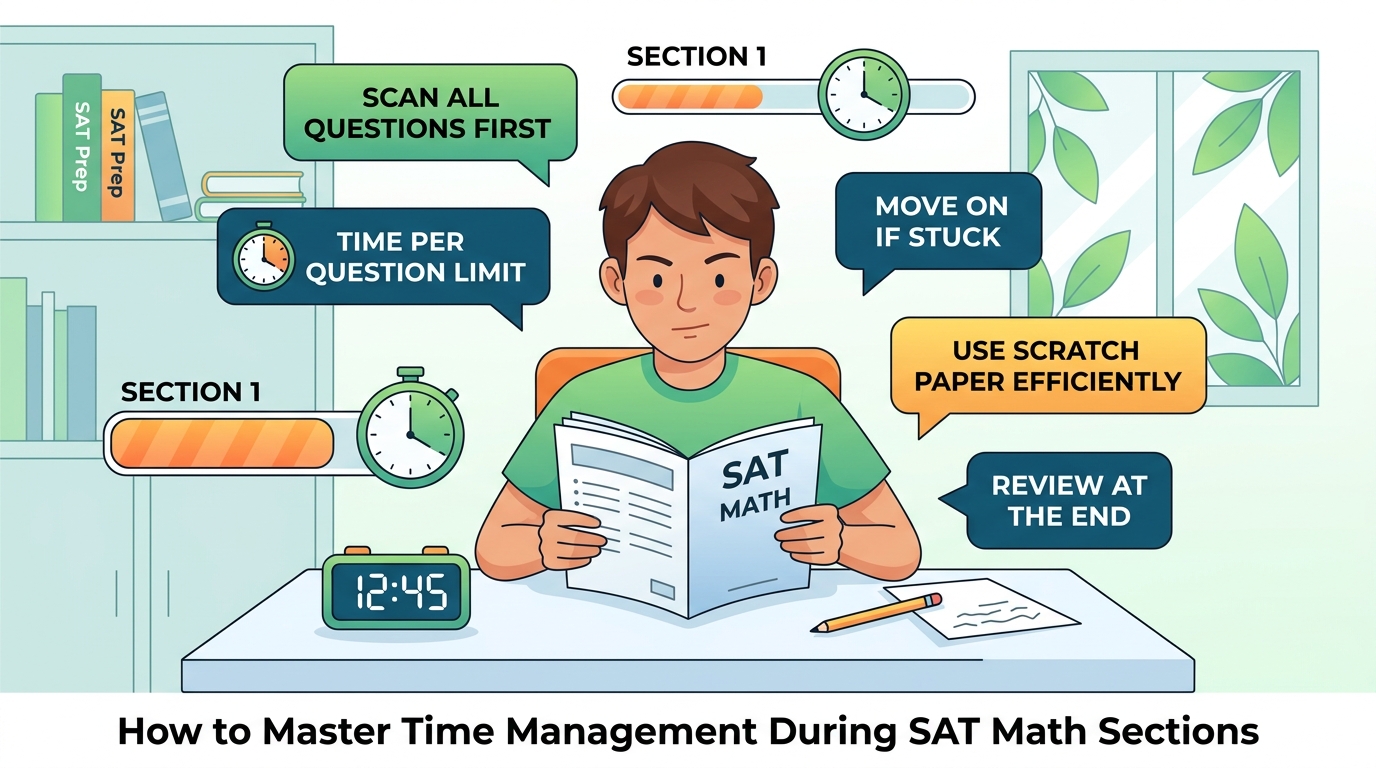
Certain question types eat up time without warning. Learn to spot them.
Word problems with multiple steps. These often require you to extract information, set up equations, solve, and then answer what’s actually being asked (which might not be the number you just calculated).
Problems requiring extensive calculation. If you see a question that will need four or five separate computations, consider whether there’s a faster approach or whether you should save it for Pass 2.
Questions with roman numerals (I, II, III). These force you to evaluate multiple statements. Each one is essentially a mini-question. They’re not necessarily hard, but they’re time-consuming.
Geometry problems requiring multiple formulas. When you need to find the area of a triangle, then use that to find the volume of a prism, then calculate a ratio, you’re looking at a 2-3 minute investment.
None of these are impossible. But if you encounter three of them in the first ten questions and spend nine minutes total, you’ve already put yourself behind pace.
| Question Type | Average Time | Strategy |
|---|---|---|
| Basic algebra | 45-60 seconds | Answer immediately |
| Multi-step word problems | 2-3 minutes | Save for Pass 2 |
| Roman numeral questions | 2-3 minutes | Save for Pass 2 |
| Simple geometry | 60-90 seconds | Answer if formula is familiar |
| Complex geometry | 2-4 minutes | Evaluate difficulty first |
| Data interpretation | 60-90 seconds | Usually straightforward |
Building Speed Through Targeted Practice
You can’t manage time well if you’re slow at fundamental operations. This is where preparation matters.
Master your basic calculations. If you’re still counting on your fingers for 7 × 8 or pausing to remember how to find a percentage, you’re losing seconds on every problem.
Developing strong mental math skills can shave precious seconds off each calculation, giving you more time for complex reasoning.
Memorize common formulas cold. Area of a circle. Pythagorean theorem. Slope formula. Quadratic formula. You should be able to write these from memory in three seconds.
Know your calculator. The digital SAT provides Desmos. Practice with it before test day. Learn how to graph functions, create tables, and solve equations. The calculator can save you time, but only if you’re fluent with it.
Practice problem recognition. The more problems you’ve seen, the faster you’ll recognize problem types. When you’ve solved 50 quadratic equations, the 51st takes half the time.
Handling Calculation-Heavy Problems Strategically
Some problems require significant computation. You can’t avoid them entirely.
But you can handle them smarter.
Check if estimation works. Many multiple-choice answers are far enough apart that you can estimate rather than calculate exactly. If the choices are 12, 24, 48, and 96, you don’t need precision.
Look for shortcuts. Before you start calculating, pause. Is there a faster path? Can you eliminate obviously wrong answers? Can you work backwards from the answer choices?
Use your calculator effectively. Don’t waste time doing arithmetic by hand that Desmos can handle instantly. But also don’t waste time typing in simple calculations like 5 + 3.
Know when to move on. If you’ve spent 90 seconds on a calculation and you’re not close to an answer, you might have made an early error. Starting over could take another 90 seconds. Sometimes it’s smarter to guess and move forward.
“The students who score highest aren’t always the ones who know the most math. They’re the ones who know which questions to spend time on and which ones to handle fast or skip entirely. Time management is a skill you can practice just like algebra or geometry.”
Practicing Under Real Test Conditions
Reading about time management helps. Practicing it under pressure is what actually builds the skill.
Take full-length practice tests with strict timing. No pausing. No extra minutes. Set a timer and stop when it goes off, even if you’re mid-problem.
Simulate test-day conditions as closely as possible:
- Use the digital testing platform
- Sit at a desk, not on your bed
- Eliminate distractions
- Take the full test in one sitting, including the reading section
- Use only the allowed break time between sections
After each practice test, analyze your timing. Which questions took longest? Were they the hardest ones, or did you waste time on problems you should have handled faster?
Track your flagged questions. How many did you skip on Pass 1? Did you have time to return to all of them? If you’re consistently running out of time with five questions untouched, you need to speed up your Pass 1.
Common Timing Mistakes That Cost You Points
Spending too long on one problem. If you’ve invested three minutes in a single question, you’ve used the time budget for three questions. Even if you get it right, you might miss three easier questions later because you ran out of time.
Not skipping hard questions. Your ego says “I should be able to solve this.” Your strategy should say “I’ll come back to this if I have time.” Trust the strategy.
Panicking when you check the clock. You glance up and see you’re at question 12 with 15 minutes left. Don’t panic. Take a breath. Adjust your pace slightly, but don’t rush so much that you make careless errors.
Rushing through easy questions. Speed matters, but accuracy matters more. A careless mistake on an easy question hurts just as much as missing a hard one. Stay focused even when a problem seems simple.
Forgetting to guess. The SAT has no penalty for wrong answers. If you have 30 seconds left and three blank questions, fill them in. You have a 25% chance of guessing correctly on each one.
Adjusting Your Strategy Mid-Test
Sometimes your timing plan falls apart. Maybe Module 1 was harder than expected. Maybe you blanked on a formula and lost time.
Stay flexible.
If you finish Pass 1 with only 10 minutes remaining and eight flagged questions, you need to triage. Scan those eight questions and pick the three or four that look most solvable. Give those your full attention. Make educated guesses on the rest.
If you’re ahead of pace, don’t coast. Use the extra time to double-check your work. Review flagged questions more carefully. Look for careless errors in your calculations.
The digital SAT shows you exactly how much time remains. Glance at it after every few questions during Pass 1, and after each problem during Pass 2. This keeps you calibrated.
Building Mental Stamina for Sustained Focus
Time management isn’t just about speed. It’s about maintaining focus for 70 minutes of math.
Your brain gets tired. Your concentration slips. By question 40, you’re more likely to misread a problem or make a calculation error.
Build endurance through practice. Don’t just do 10-question problem sets. Do full 44-question practice tests regularly. Train your brain to stay sharp for the full duration.
Take care of the basics. Sleep well before the test. Eat a good breakfast. Stay hydrated. These sound obvious, but they directly impact your mental processing speed.
During the test, use the break between modules. Stand up. Stretch. Get your blood flowing. Those five minutes can reset your focus for Module 2.
Knowing Your Weak Spots and Planning Around Them
Everyone has content areas that slow them down. Maybe you’re great at algebra but shaky on geometry. Maybe you freeze up on probability questions.
Identify your weak spots during practice. When you review practice tests, note which topics consistently take you longest or cause the most errors.
On test day, this knowledge informs your skipping strategy. If you know trigonometry slows you down, and you see a trig problem early in the section, flag it immediately. Get your confidence up with problems you handle well, then return to your weak areas when you’re in rhythm.
Understanding topics like solving quadratic equations efficiently can turn a former weak spot into a strength, saving you valuable time on test day.
This doesn’t mean avoiding your weaknesses in preparation. It means being strategic about when you tackle them during the actual test.
The Role of Process of Elimination
When time is tight, smart guessing beats random guessing.
Process of elimination is a time management tool. If you can eliminate two answer choices in 15 seconds, you’ve just improved your guessing odds from 25% to 50%. That’s often a better use of time than spending two minutes trying to solve a problem you’re not sure how to approach.
Look for obviously wrong answers:
- Numbers that are way too large or too small
- Answers that don’t match the units asked for
- Results that violate basic mathematical principles
- Choices that don’t make logical sense in context
Even eliminating one choice improves your odds to 33%. That’s worth doing when you’re running short on time.
Managing Different Question Formats
The SAT includes both multiple-choice and student-produced response questions (where you enter your own answer).
Student-produced responses take slightly longer on average because you can’t use process of elimination or work backwards from answer choices. Plan accordingly.
These questions also require more careful attention to formatting. If the answer is a fraction, you need to enter it correctly. If it’s a decimal, you need the right number of places. A correct answer entered wrong gets zero points.
When you flag questions during Pass 1, consider flagging student-produced responses that look time-intensive. Handle the multiple-choice questions first, where you have more strategic options.
Avoiding Common Algebra Mistakes Under Time Pressure
When you’re rushing, careless errors multiply. The most common mistakes happen in basic algebra.
Sign errors. Forgetting to distribute a negative. Dropping a variable. Solving for x when the question asks for 2x.
These mistakes aren’t about understanding. They’re about attention and process. Being aware of common algebra pitfalls helps you catch errors before they cost you points.
Build habits that catch these errors:
- Reread what the question is actually asking before you select your answer
- Check your algebra steps when you have time
- Verify that your answer makes logical sense
- When possible, plug your answer back into the original equation
These checks take 10-15 seconds. That’s time well spent when it prevents losing a point to a careless mistake.
Your Time Management Plan for Test Day
Here’s your complete strategy, ready to use:
Before the test:
– Take at least three full-length timed practice tests
– Identify your target score and the accuracy level you need
– Know your weak content areas
– Practice with the digital testing platform and Desmos calculator
– Get comfortable with the two-pass approach
During Module 1:
– Start Pass 1 immediately, aiming to reach question 22 by the 20-minute mark
– Flag anything that will take more than 90 seconds
– Answer confidently and keep moving
– At 20 minutes, start Pass 2 with your flagged questions
– Prioritize the ones that look most solvable
– With 2 minutes left, fill in any remaining blanks with educated guesses
During Module 2:
– Expect harder questions if you did well on Module 1
– Use the same two-pass approach
– Stay calm if problems seem difficult (that means you’re in the harder module, which is good)
– Maintain your pacing discipline even when problems get tough
– Reserve the last minute for final guesses and review
Making Every Practice Session Count
Your practice approach determines your test-day performance. Random problem-solving won’t build time management skills.
Structure your practice deliberately:
Untimed practice: When learning new content or techniques, ignore the clock. Focus on understanding and accuracy. Build your foundation first.
Timed problem sets: Once you understand a topic, practice it under time pressure. Give yourself 60-90 seconds per problem and stick to it.
Full timed tests: At least once per week, take a complete math section (both modules) under real timing. This builds stamina and reveals pacing issues.
Review strategically: After each timed practice, spend twice as long reviewing as you did testing. Analyze not just which problems you missed, but which ones took too long and why.
Staying Calm When the Clock Is Running
The timer creates pressure. Pressure creates anxiety. Anxiety slows you down and increases errors.
Breaking this cycle requires mental preparation as much as content knowledge.
Practice breathing techniques. When you feel rushed, take one deep breath. Five seconds of calm can prevent a cascade of mistakes.
Reframe the timer as a tool, not a threat. It’s there to help you pace yourself, not to stress you out. Glance at it regularly, note the information, and return to the problem.
Remember that everyone faces the same time constraints. The test is designed to feel tight. Feeling time pressure doesn’t mean you’re doing poorly. It means you’re taking the SAT.
Turning Time Management Into Your Competitive Advantage
Most students treat time management as an afterthought. They focus on learning content and hope speed comes naturally.
You’re smarter than that.
By treating SAT math time management as a skill you can practice and improve, you’re giving yourself an edge. Two students with identical math knowledge will score differently if one manages time well and the other doesn’t.
The strategies in this guide work. But they only work if you practice them. Start today. Take a timed section using the two-pass approach. Track your results. Adjust your strategy. Repeat.
Test day will feel different when you have a plan. You’ll sit down knowing exactly how to allocate your 70 minutes. You’ll move through problems with purpose instead of panic. You’ll finish the section having attempted every question you were capable of solving.
That confidence, combined with solid content knowledge and practiced technique, is what turns a good score into a great one. Your timer isn’t your enemy. With the right approach, it becomes one more tool helping you show what you know.