Quantum mechanics often sounds like a mysterious world reserved for scientists and advanced students. Yet, understanding its basics can be fascinating and surprisingly accessible. Whether you’re a high school student, a college freshman, or just a curious mind, this guide aims to introduce you to the core ideas that make quantum physics so intriguing. We will break down complex topics into simple, relatable explanations so you can start your journey into the quantum realm with confidence.
This beginner’s guide introduces the core principles of quantum mechanics, illustrating how particles behave at tiny scales and why this science is fundamental to modern technology. With simple explanations and practical steps, you can start exploring the quantum world today.
What exactly is quantum physics?
Quantum physics, also known as quantum mechanics, studies how matter and energy behave at the smallest scales—think atoms and subatomic particles. Unlike everyday objects, which follow the rules of classical physics, particles in the quantum world behave in strange and often unpredictable ways. For example, particles can exist in multiple places at once or become linked with others across vast distances.
This field revolutionized our understanding of reality and led to technologies like lasers, semiconductors, and quantum computers. But at its heart, quantum physics asks questions about the very nature of existence—how particles behave, how they interact, and how reality itself is constructed at the smallest level.
Starting with classical physics: laying the groundwork
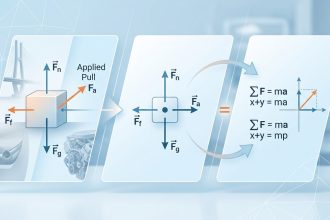
Before diving into the quantum world, it’s helpful to understand classical physics—think Newton’s laws and simple energy concepts. Classical physics works well for large objects like cars, planets, or baseballs. It explains why a thrown ball follows a predictable path or why planets orbit the sun.
However, classical physics hits limits when applied to tiny particles. For instance, it cannot explain phenomena like blackbody radiation or the photoelectric effect. Recognizing these limits paved the way for the development of quantum theory.
How quantum mechanics defies intuition
Quantum physics introduces several key principles that challenge our everyday understanding:
- Wave-particle duality: Particles like electrons can behave both as particles and waves.
- Superposition: Particles can exist in multiple states or locations at once until observed.
- Quantum entanglement: Particles can become linked so that the state of one instantly influences the other, regardless of distance.
- Uncertainty principle: It’s impossible to precisely know both a particle’s position and momentum at the same time.
These ideas seem bizarre but are supported by countless experiments. They form the core of quantum theory and are essential to grasp for anyone interested in this field.
Practical steps to understand quantum mechanics
Learning quantum mechanics might seem intimidating but can be made manageable with these steps:
- Learn basic math and physics: A good grasp of algebra, calculus, and classical physics concepts provides a solid foundation.
- Study fundamental principles: Focus on wave-particle duality, superposition, and entanglement through simplified explanations and visualizations.
- Use visual aids and simulations: Websites like PhET Interactive Simulations offer interactive models to see quantum phenomena in action.
- Read beginner-friendly books and articles: Titles like “Quantum Physics for Beginners” or articles on educational sites can provide clear overviews.
- Solve simple problems: Practice questions help solidify understanding and build confidence.
- Join online communities: Forums like Reddit’s r/quantumphysics allow you to ask questions and learn from enthusiasts.
- Stay patient and curious: Quantum physics is complex but rewarding. Progress takes time, so keep exploring!
Common misconceptions and pitfalls
| Technique | Mistake | Explanation |
|---|---|---|
| Rushing into math | Jumping into complex equations too early | Focus on conceptual understanding first to avoid confusion. |
| Ignoring experiments | Believing only in theory | Experiments like the double-slit are crucial to understanding quantum behavior. |
| Oversimplifying | Assuming particles are just tiny balls | Recognize that particles exhibit wave-like properties and probabilistic behavior. |
“Remember, quantum mechanics is about probabilities and observations. It’s not about certainties.” — Dr. Alice Johnson, quantum physicist
Resources to deepen your understanding
- Books: “Quantum Mechanics: The Theoretical Minimum” by Leonard Susskind offers a straightforward approach.
- Online courses: Platforms like Coursera and edX have beginner courses taught by top universities.
- Videos: YouTube channels like PBS Space Time or Veritasium explain complex ideas simply.
- Simulations: Try out quantum experiments virtually with tools like Quantum Experience.
Common mistakes to avoid as you learn
- Skipping foundational concepts can lead to confusion later.
- Believing that quantum phenomena are purely mystic rather than scientifically proven.
- Expecting classical intuition to always apply—be open to new ways of thinking.
- Overloading on information without practicing or visualizing.
Applying quantum ideas in everyday life
While quantum physics seems distant from daily routines, it influences many technologies you use every day. Your smartphone, GPS, and even your internet rely on principles rooted in quantum mechanics. As you learn, consider how these tiny particles shape the devices and systems we depend on.
Embracing the quantum journey
Understanding quantum mechanics requires patience and an open mind. Focus on grasping core principles first, use visual and practical resources, and connect ideas to real-world applications. The quantum world offers a new perspective on reality—one that is both challenging and captivating.
Your next steps into the quantum realm
Begin by exploring resources that match your learning style. Whether through books, videos, or interactive simulations, each step brings you closer to understanding the strange and wonderful universe at the microscopic level. Remember, every expert started as a curious beginner. Keep questioning, practicing, and enjoying the journey into quantum physics.