Electromagnetic waves are the invisible carriers of modern communication. They make it possible for your smartphone to connect to the internet, for satellite TV signals to reach your home, and for GPS to guide you through unfamiliar streets. These waves are a fundamental part of the electromagnetic spectrum, traveling at the speed of light and carrying data across vast distances. Understanding how electromagnetic waves work helps us appreciate the technology that keeps us connected in today’s fast-paced world.
Electromagnetic waves are essential for modern communication, enabling everything from wireless internet to satellite navigation by transmitting energy across the spectrum at light speed.
What Are Electromagnetic Waves and How Do They Work?
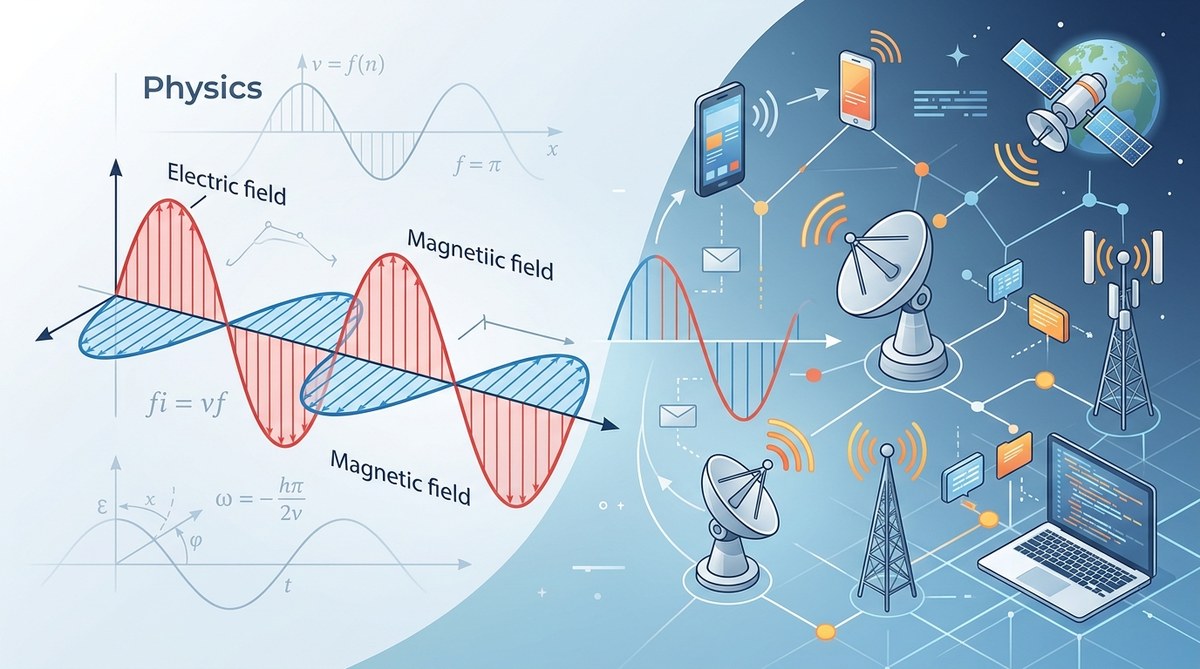
Electromagnetic waves are oscillations of electric and magnetic fields that propagate through space. These waves do not require a medium like air or water to travel; they move through the vacuum of space at a constant speed, which is approximately 299,792 kilometers per second. When we talk about electromagnetic waves in modern communication, we refer to a specific part of the spectrum that includes radio waves, microwaves, and infrared radiation.
The Electromagnetic Spectrum and Its Properties
The electromagnetic spectrum covers a wide range of frequencies and wavelengths. It includes:
- Radio waves, used in broadcasting and cell phones
- Microwaves, for radar and wireless networks
- Infrared radiation, which heat objects and are used in remote controls
- Visible light, the only part humans can see
- Ultraviolet rays, used in sterilization
- X-rays, for medical imaging
- Gamma rays, emitted by nuclear reactions and cosmic sources
Each type of wave has unique properties that make it suitable for different kinds of communication. For example, radio waves can travel long distances and penetrate obstacles, making them ideal for broadcasting. Microwaves have higher frequencies, which allow for high data rates necessary for modern wireless networks.
Core Characteristics of Electromagnetic Waves
Some key properties include:
- Wavelength and frequency are inversely related: shorter wavelengths have higher frequencies.
- They carry energy, which can be modulated to encode information.
- They can reflect, refract, and diffract, allowing signals to bend around obstacles and reach receivers indirectly.
- Their amplitude, frequency, or phase can be altered to carry data in different modulation schemes.
How Electromagnetic Waves Power Modern Communication
Electromagnetic waves form the backbone of nearly all wireless communication systems. They transmit information through modulation—changing certain wave features to encode data. Here’s how they enable some of our most common technologies.
Wireless Internet and Wi-Fi
Wi-Fi routers emit microwave electromagnetic waves to connect devices within a home or office. These waves transmit data between your device and the internet service provider. The key lies in the ability of microwaves to carry high-speed data over short distances with minimal interference.
Cell Phone Networks
Cell towers broadcast and receive electromagnetic signals across the spectrum. With 4G and 5G networks, higher frequency microwave and millimeter-wave bands support faster data transfer rates and lower latency. Your phone communicates with nearby towers using these waves, translating radio signals into your voice, texts, or streaming content.
Satellite and Space Communications
Satellites orbiting Earth use radio frequency electromagnetic waves to relay signals across continents. These waves can travel through the atmosphere with little loss, making satellite communication reliable for GPS, weather monitoring, and global internet coverage.
Radio and Television Broadcasting
Traditional radio and TV signals are transmitted via radio waves. These waves can cover large areas, allowing broadcasts to reach millions of listeners and viewers simultaneously.
Beyond Daily Use
Electromagnetic waves also power radar systems, which detect objects at great distances, and are fundamental in scientific applications like spectroscopy and astrophysics. They help scientists understand the universe and improve technologies on Earth.
Practical Steps in Using Electromagnetic Waves in Communication
For engineers and enthusiasts, understanding the practical application of electromagnetic waves involves several steps:
- Choosing the right frequency band for the intended purpose, considering range and data rate.
- Modulating the wave by altering its amplitude, frequency, or phase to encode information.
- Transmitting the wave through antennas designed for specific frequencies.
- Receiving and demodulating the wave at the destination to retrieve the original data.
Common Techniques and Mistakes
| Technique | Description | Common Mistakes |
|---|---|---|
| Amplitude modulation (AM) | Varies the wave’s amplitude to encode data | Using too much power, causing interference |
| Frequency modulation (FM) | Uses changing frequency to transmit info | Ignoring bandwidth limits, leading to distortion |
| Phase modulation (PM) | Alters wave phase for data encoding | Poor synchronization, resulting in errors |
Tips for Effective Communication
- Use antennas designed for your specific frequency to maximize signal strength.
- Avoid obstacles and sources of interference like microwaves or thick walls.
- Apply error correction techniques to improve data integrity.
- Keep modulation schemes within the capacity of your hardware and spectrum regulations.
“Maximizing the efficiency of electromagnetic wave transmission requires attention to frequency selection, antenna design, and modulation strategies,” advises Dr. Jane Smith, a telecommunications expert.
Challenges and Future Developments
Despite their versatility, electromagnetic waves face challenges such as interference, signal attenuation, and spectrum congestion. As demand for higher data rates grows, researchers are exploring new technologies like millimeter-wave communication, massive MIMO antennas, and advanced materials to improve signal quality and capacity.
The future of electromagnetic wave communication in 2026 looks promising with the development of 6G networks. These will utilize even higher frequency bands, enabling ultra-fast internet, smart city infrastructure, and seamless device connectivity. Innovations in antenna design and spectrum management will continue to push the boundaries of what electromagnetic waves can achieve.
Tips for Deepening Your Understanding
- Study the principles of wave modulation and antenna technology.
- Practice analyzing real-world signals with software-defined radios.
- Stay updated on emerging spectrum allocations and standards.
- Explore online tutorials and courses dedicated to wireless communication systems.
Making the Most of Electromagnetic Waves in Your Projects
Applying your knowledge of electromagnetic waves can lead to exciting projects, from building your own radio receiver to designing a simple wireless sensor network. Start with small experiments, understand the physics behind the signals, and gradually move toward more complex systems.
Connecting the Dots in Modern Communication
Electromagnetic waves are the invisible threads that weave our connected lives. They make possible the rapid transfer of information across distances, transforming industries and daily routines. As technology advances, our reliance on these waves will only grow, opening new frontiers in communication, science, and innovation.
By understanding the fundamental science of electromagnetic waves, you can better appreciate the technology around you and even contribute to future breakthroughs. Whether you’re a student, researcher, or hobbyist, diving into the world of electromagnetic communication offers endless opportunities to learn and create.
Stay curious, keep experimenting, and remember that behind every call, click, or stream, electromagnetic waves are working tirelessly to keep us connected in 2026 and beyond.