Every night, a strange and vivid movie plays inside your head. You might fly through impossible landscapes, confront forgotten faces, or wake up in a cold sweat from a monster chase. These nighttime stories feel so real, yet they vanish seconds after you open your eyes. For centuries, humans have asked a simple question that scientists are only now starting to answer: why do we dream?
Dreaming is not random noise from a sleeping brain. It is a highly active process tied to memory consolidation, emotional processing, and creativity. Neuroscience shows that dreams arise from the brain’s attempt to make sense of neural signals during REM sleep, helping us learn, cope with emotions, and even solve problems.
What Happens in Your Brain While You Dream
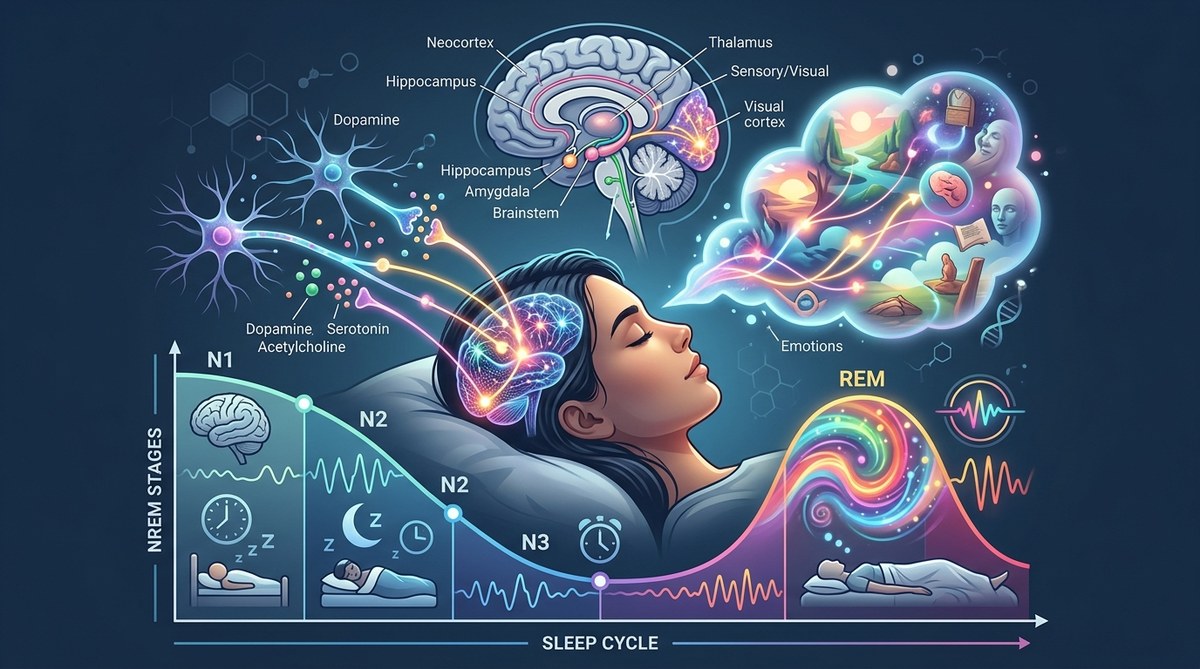
Your brain does not shut down during sleep. In fact, some areas become more active than when you are awake. The key to understanding why we dream lies in the sleep cycle, specifically in rapid eye movement (REM) sleep.
During REM sleep, your eyes dart back and forth behind closed lids. Your heart rate and breathing speed up. Your body becomes temporarily paralyzed, a safety mechanism to stop you from acting out your dreams. And inside your skull, a storm of electrical activity lights up the cortex.
Functional MRI studies show that the limbic system (the emotional center) and the visual cortex are highly active during REM. At the same time, the prefrontal cortex (your logical decision-maker) is largely offline. This combination explains why dreams can feel emotionally intense, visually rich, and yet logically absurd.
The Stages of Sleep: REM and NREM
Sleep is not one long block. It cycles through four stages every 90 minutes or so. The first three are non-REM (NREM) stages, and the last is REM sleep.
- NREM Stage 1: Light sleep. You drift in and out. Muscles relax.
- NREM Stage 2: Deeper sleep. Brain waves slow with occasional bursts called sleep spindles. Memory processing begins.
- NREM Stage 3: Deep sleep or slow-wave sleep. This is when your body repairs tissue and strengthens the immune system.
- REM Sleep: The dreaming stage. It first occurs about 90 minutes after falling asleep, and each subsequent REM period gets longer. By morning, you might spend 20 to 30 minutes per cycle in REM.
Most of your vivid, story-like dreams happen during REM. But you can also dream during NREM sleep; those dreams tend to be shorter, less emotional, and more thought-like.
Why Do We Dream? The Leading Scientific Theories
Neuroscientists have proposed several explanations for dreaming. No single theory is universally accepted, but together they paint a compelling picture.
Memory Consolidation and Learning
One of the strongest supported functions of dreaming is memory consolidation. During REM sleep, your brain replays and strengthens new neural connections formed during the day. This is especially important for procedural memories (how to do things) and emotional memories.
A 2010 study by researchers at Harvard Medical School found that people who napped after learning a new task performed better when tested again. The nap group’s dreams often contained elements of the task. This suggests that dreams are the brain’s way of rehearsing and integrating new information.
Emotional Regulation
Dreams also help you process emotions. The high activity in the amygdala during REM allows you to re-experience emotional events in a safe environment. The lack of cortical control means you can feel fear, sadness, or joy without the usual inhibitions.
Some researchers believe that dreaming acts as a form of overnight therapy. By linking new emotional experiences with existing memories, the brain reduces the emotional charge of distressing events. This might explain why a good night’s sleep often makes you feel calmer about a problem that seemed huge the night before.
Threat Simulation Theory
Antti Revonsuo, a Finnish cognitive neuroscientist, proposed that dreams evolved as a virtual reality training ground for handling threats. In his view, the brain simulates dangerous situations (being chased, falling, losing teeth) to practice survival responses without real-world risk.
This theory is supported by the fact that children and adults in threatening environments tend to have more intense and frequent threat-related dreams. However, the theory does not fully explain pleasant or bizarre dreams.
Random Activation and Making Sense of Noise
The activation-synthesis hypothesis, first proposed by J. Allan Hobson and Robert McCarley in 1977, suggests that dreams are the brain’s attempt to interpret random neural signals originating from the brainstem. The forebrain receives these signals and tries to weave them into a coherent story.
Modern versions of this theory recognize that the brain is not simply manufacturing nonsense. Instead, it uses the random input as a canvas for its own creative and memory-based narratives. The result is a blend of past experiences, knowledge, and raw impulses.
Cognitive and Creative Benefits
Dreams can also boost creativity. The associative nature of the dreaming brain (free from logical constraints) allows novel connections between ideas. Famous examples include Paul McCartney’s melody for “Yesterday” and Mendeleev’s periodic table dream.
Researchers at the University of California, Berkeley found that REM sleep enhances the brain’s ability to solve problems that require creative insight. This may be because dreaming weakens existing associations and strengthens more distant connections.
How the Brain Constructs Dream Content
Understanding the neuroscience behind dream creation requires looking at specific brain regions:
| Brain Region | Role in Dreaming |
|---|---|
| Pons (brainstem) | Initiates REM sleep and sends random signals to the cortex. |
| Thalamus | Relays sensory information; during REM it is active but blocks external inputs. |
| Hippocampus | Retrieves recent memories and integrates them into dream narratives. |
| Amygdala | Adds emotional tone: fear, excitement, anger. |
| Visual Cortex | Generates the vivid visual scenes you see. |
| Prefrontal Cortex | Mostly inactive; explains why dreams lack logic and self-awareness. |
This table shows that dreaming is a collaboration between ancient emotional structures and higher-order sensory areas, with the logical manager taking a break.
A Numbered Plan: How to Understand Your Own Dreams Better
If you want to use the science of dreaming to learn about your own brain, try these three steps:
- Keep a dream journal. Place a notebook and pen next to your bed. Write the second you wake up, before you move or talk. Record details, emotions, and any links to recent experiences.
- Identify the emotional core. Look for the dominant feeling in each dream, not the plot. Ask yourself: what am I anxious about? What am I avoiding? This can reveal emotional patterns you overlook while awake.
- Look for memory chunks. Notice if specific people, places, or objects from the past few days appear. Your brain is likely consolidating that information, and the dream is a sign that the memory is being strengthened.
Common Dream Themes and What They Might Mean
Dream themes are surprisingly universal across cultures. Here are a few and their possible neurological explanations:
- Falling: Often linked to a loss of control or anxiety. The brainstem during REM may trigger sensations of falling from muscle paralysis and balance changes.
- Being chased: A classic threat simulation. The amygdala is highly active, creating a fear response without actual danger.
- Flying: Associated with euphoria and freedom. Might reflect positive emotional states or a feeling of overcoming obstacles.
- Teeth falling out: Common in stressful periods. Some researchers believe it relates to concerns about appearance, helplessness, or communication issues.
- Taking a test unprepared: Reflects real academic or performance pressure. The hippocampus retrieves school-related memories during consolidation.
These themes are not universal predictions, but they illustrate how waking life influences dream content.
“Dreaming is not just a random byproduct of sleep; it is an active neurobiological process that serves critical functions for memory and emotion.” — Dr. Matthew Walker, author of Why We Sleep
The Connection Between Sleep Quality and Dream Recall
You may not remember your dreams every night. That is normal. Dream recall depends on whether you wake up during or right after a REM phase. Factors that improve recall include:
- Sleeping longer (more REM time in the morning)
- Waking naturally without an alarm
- Keeping a consistent sleep schedule
- Minimizing alcohol and caffeine before bed
Alcohol suppresses REM sleep, especially in the first half of the night. If you drink heavily, you will experience less dreaming and poorer memory consolidation.
What Dreams Can Tell Us About Mental Health
Dream disturbances are common in people with depression, PTSD, and anxiety disorders. Nightmares, for example, are associated with hyperactive amygdala and insufficient emotional regulation during REM.
Therapies like image rehearsal therapy help patients rewrite recurring nightmares, reducing their frequency. This approach works because it leverages the brain’s plasticity during sleep: you can teach your brain a new, less threatening narrative.
On the other hand, vivid and positive dreams often correlate with better emotional health and higher creative output. Tracking dream patterns over time can give you a window into your mental state.
Next Time You Dream, Remember This
Your dreams are not mere entertainment or random noise. They are a reflection of your brain working hard while your body rests. Each night, your neurons replay, reorganize, and rewire. They sort through the day’s experiences, strengthen important memories, and help you make sense of your emotions.
The next time you wake up from a wild dream, take a moment to appreciate the complex machinery behind it. Write it down. Think about what your brain might be processing. And remember that you are witnessing one of the most fascinating processes in neuroscience: the brain’s way of keeping itself healthy, creative, and resilient.
Sleep well, dream often, and trust that your brain knows exactly what it is doing. If you want to dive deeper into related topics, check out our guides on how cells produce energy or what happens during memory formation. (But only if those topics genuinely interest you.) For now, just let your dreams do their job.