You pick up a wrench to loosen a rusty bolt. You push on the handle far from the center, not right next to the nut. That push works wonders because of torque. Torque is the twist that gets things spinning. Without it, doors would never open, cars wouldn't move, and even opening a jar would feel impossible. Let's break down what torque is in simple terms, with examples you can try yourself.
Torque is the rotational version of force. It depends on how much force you apply and how far from the pivot you apply it. The formula is torque = force × lever arm × sin(angle). Real world examples like turning a doorknob or using a wrench show how torque makes rotation happen.
What Exactly Is Torque?
Torque (often called the moment of force) is the measure of how much a force causes an object to rotate around an axis. Think of it as the "twisting power" you apply.
When you push a door open, you push near the handle, not the hinges. That distance from the hinge (the pivot) matters. Push near the hinge and the door barely moves; push at the handle and it swings open easily. That difference is torque.
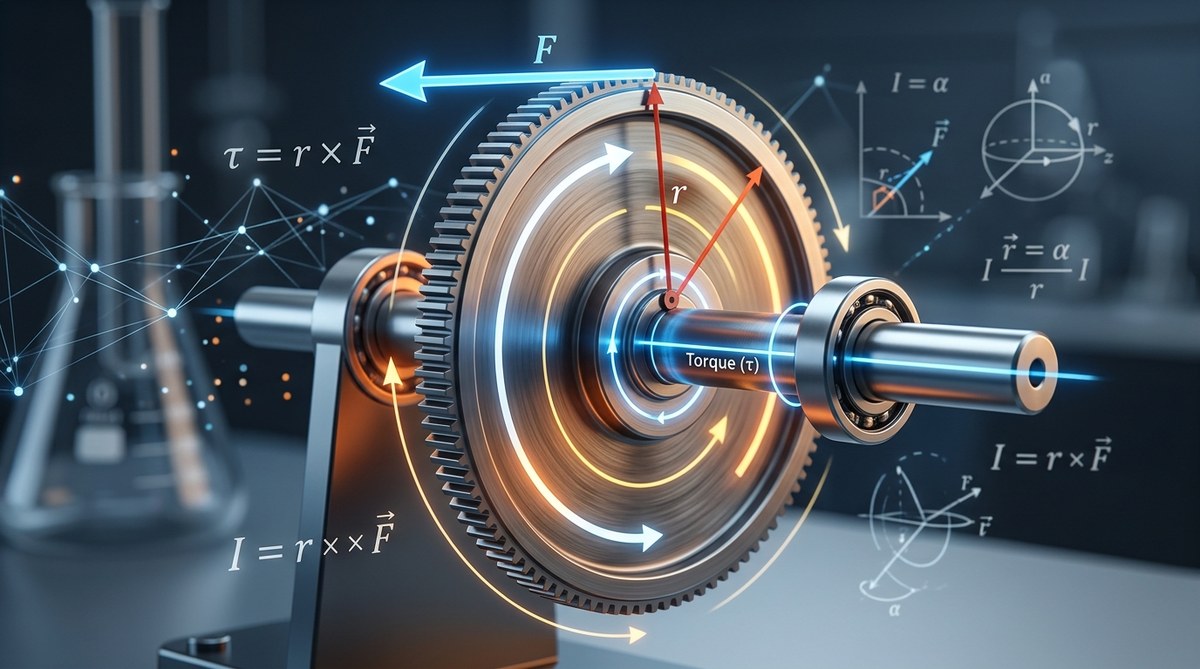
In physics terms, torque (symbol τ) is the product of three things:
- The force you apply (F)
- The lever arm, or the perpendicular distance from the pivot to the line of action of the force (r)
- The sine of the angle between the force and the lever arm (sin θ)
The full formula: τ = r × F × sin θ
The units are newton meters (N·m) in the metric system or foot pounds (ft·lb) in the US customary system.
The direction of torque depends on the direction of the force and is usually described as clockwise or counterclockwise. For example, opening a jar lid counterclockwise (lefty loosey) creates a torque that loosens it; turning it the other way tightens it.
The Formula That Makes It All Click
Let's decode the torque formula piece by piece. You don't need to memorize it; you need to understand it.
Force (F) – The push or pull you apply. A stronger force gives more torque, but only if you apply it at the right spot.
Lever arm (r) – The distance from the pivot point (the axis of rotation) to where you apply the force. The farther you push from the pivot, the more torque you get. That's why a long wrench gives you more twisting power than a short one.
Angle (θ) – The angle between the force vector and the lever arm. The best torque comes when you push perpendicular (90 degrees) to the lever arm. If you push at a smaller angle, part of your force is wasted pushing along the arm, not turning it.
For example, when you use a wrench, you push straight down (perpendicular) for maximum torque. If you push at a shallow angle, you get less twisting force.
The formula looks like a cross product in vector math: τ = r × F. The magnitude is r F sin θ. The sine means that at 0° or 180° (pushing straight toward the pivot), torque is zero. At 90°, torque is maximum.
This idea is central to understanding how objects rotate. Many common physics problems about torque involve levers, seesaws, and balancing. If you're curious about how forces affect motion in other scenarios, check out our guide on common misconceptions about Newton's third law of motion. Understanding those misconceptions will deepen your grasp of torque and rotational motion.
How to Calculate Torque Step by Step
Follow these steps to solve any basic torque problem. You'll use the formula and think about the geometry.
- Identify the pivot point – Where does the object rotate around? It could be a hinge, a bolt, or a fulcrum on a seesaw.
- Measure the lever arm – Find the perpendicular distance from the pivot to the point where the force is applied. If the force is not perpendicular, you'll need to find the component that is perpendicular.
- Determine the force – How much force is applied and in what direction? Include the magnitude and the angle relative to the lever arm.
- Apply the formula – Multiply the force by the lever arm and by sin(θ). Use consistent units (meters for distance, newtons for force, radian or degrees for angle). The result is torque in N·m.
- Check the sign – Decide whether the torque is clockwise or counterclockwise. By convention, counterclockwise is often positive, clockwise negative. This helps when adding torques to find net torque.
- Solve for the unknown – If the problem asks for force or distance, rearrange the equation.
For example, a 30 N force applied perpendicular at 0.5 m from the pivot gives torque = 30 × 0.5 × sin 90° = 15 N·m. If you apply the same force at a 30° angle, the perpendicular component is 30 × sin 30° = 15 N, so torque = 15 × 0.5 = 7.5 N·m.
Common Mistakes and How to Avoid Them
Many students trip up on torque problems. Here's a table of common errors and the fixes.
| Mistake | Why It's Wrong | How to Fix |
|---|---|---|
| Using the full distance instead of the perpendicular lever arm | The lever arm is always the perpendicular distance from the pivot to the line of action of the force. Using the straight-line distance ignores the angle. | Always draw the force vector and find the perpendicular distance using geometry (r sin θ). |
| Forgetting to convert units (e.g., cm to m) | Torque in standard physics requires meters and newtons. Using centimeters gives numbers off by 100. | Convert all lengths to meters before plugging into the formula. |
| Mixing up clockwise vs. counterclockwise | Torque is a vector; its sign matters for equilibrium problems. | Practice assigning positive for one direction and stick with it. |
| Thinking torque equals force times distance regardless of angle | The angle between force and lever arm directly affects torque. Zero angle gives zero torque. | Use the full formula τ = r F sin θ, not a simplified version. |
| Ignoring the direction of force relative to the lever arm | Forces that point directly toward the pivot produce no torque. | Check that the line of action doesn't pass through the pivot. |
Why Torque Matters in Everyday Life
Torque isn't just a textbook idea. It's everywhere:
- Opening a door – The hinge is the pivot; you push at the edge to maximize lever arm.
- Using a wrench – A longer wrench gives more torque with the same force. Mechanics love breaker bars for stubborn bolts.
- Pedaling a bicycle – Your leg pushes the pedal at a distance from the crank axle; the longer the crank, the more torque you generate.
- Turning a screwdriver – The diameter of the handle affects how much torque your hand can apply.
- Seesaw at the playground – A lighter person can balance a heavier person by sitting farther from the fulcrum, using torque.
- Car engines – Engine torque determines how hard the wheels can push the car forward, especially from a stop.
Understanding torque helps you understand why certain tools work the way they do and how to use them more efficiently.
Torque vs. Force: What's the Difference?
Force is a push or pull that causes linear motion. Torque is a twist that causes rotational motion. They are related but not the same.
| Force | Torque |
|---|---|
| Causes acceleration in a straight line | Causes angular acceleration (spin) |
| Measured in newtons (N) | Measured in newton meters (N·m) |
| Depends only on magnitude and direction | Depends on magnitude, direction, and distance from pivot |
| Example: pushing a box across the floor | Example: turning a steering wheel |
If you apply a force at a distance from a pivot, you create torque. If the force goes through the pivot, torque is zero.
Think of turning a bolt with a wrench. The force you apply at the handle creates torque. The bolt itself feels a force? No, the bolt feels torque that rotates it. Force and torque work together in machines like levers, gears, and pulleys.
For more about different types of forces and how they interact, check out our article on why forces in circular motion work the way they do. Centripetal force and torque are both crucial for understanding rotational dynamics.
Expert Tip: The Right Angle Changes Everything
"The most common mistake I see in introductory physics is thinking that any push near the edge of a wheel will spin it. The angle matters massively. Push radially inward and you get zero torque. Push tangentially (perpendicular) and you get maximum torque. Always break forces into components: radial and tangential. The tangential component is the one that creates torque. Practice with a real wrench to feel the difference." – Dr. Maria Gonzalez, physics professor at a community college in Ohio
This advice is gold. When you're solving torque problems, always ask: "Is the force perpendicular to the lever arm?" If not, find the perpendicular component and use that in your calculation.
Putting Torque to Work for Your Physics Success
Torque is the rotational counterpart of force, and mastering it unlocks a whole world of physics problems from simple seesaws to complex engine dynamics. Start by remembering the key points:
- Torque = force × lever arm × sin(angle)
- Maximum torque when pushing perpendicular
- Long lever arms give more torque with less effort
Practice on everyday objects. Try opening a door while pushing at different distances from the hinge. Notice how much easier it is near the handle. That's torque in action.
If you run into tricky problems, remember to isolate the pivot, find the perpendicular distance, and keep your units straight. With a little practice, torque will become second nature.
To build more confidence in physics problem solving, explore our other guides on mastering complex physics problems using diagramming techniques. Good diagrams make torque calculations much easier.
Keep experimenting. The world is full of rotations. Now you know what makes them spin.