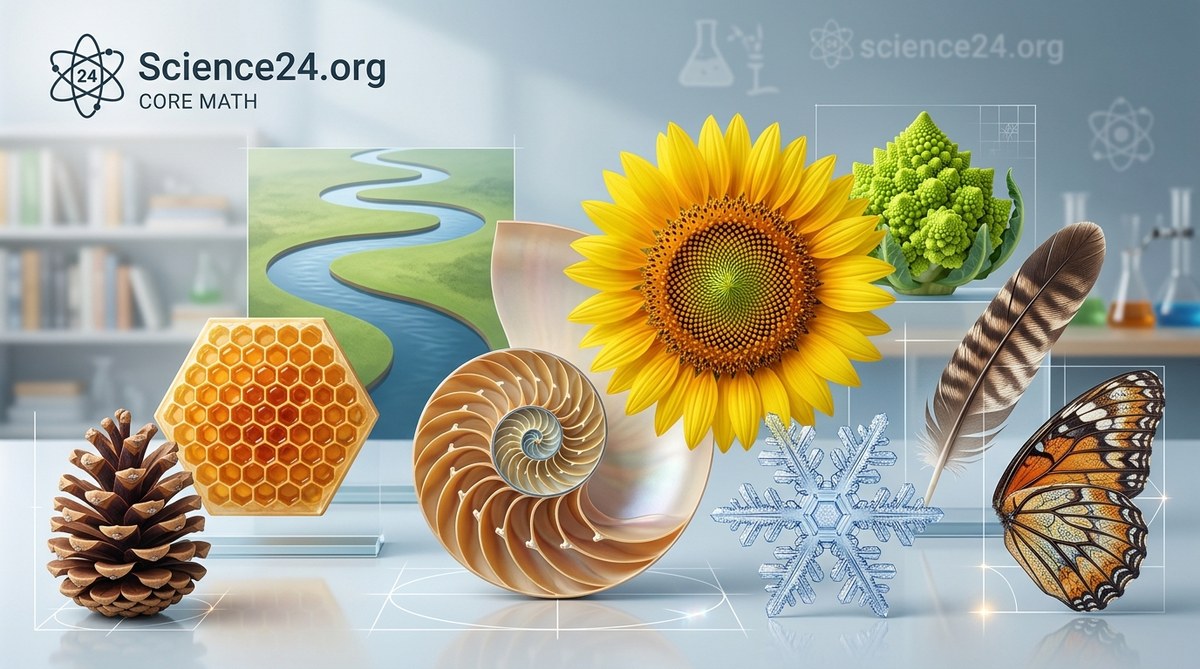
A walk through the woods or a stroll along the beach might feel like a break from numbers. But look closer. The spiral of a seashell, the branching of a tree, even the spots on a giraffe all obey mathematical rules. Nature uses math as its secret design language. Once you know what to look for, you will see equations and geometry everywhere. This article reveals ten surprising ways math appears in nature and explains why you probably never noticed them before. Whether you are a student, a curious learner, or a nature enthusiast, these examples will change how you see the world.
Mathematics is the hidden language of the natural world. Patterns like the Fibonacci sequence, fractals, and hexagonal tiling appear in plants, animals, and weather systems. Recognizing these patterns helps you understand why nature builds things the way it does. This knowledge deepens your appreciation for both math and the environment around you.
Why Math Is the Hidden Blueprint of Nature
Nature does not have a calculator, yet it follows precise mathematical rules. These rules emerge from physical constraints. For example, a honeycomb cell is hexagonal because that shape uses the least wax to store the most honey. A sunflower arranges its seeds in spirals to pack as many seeds as possible into a small space. When you understand the underlying math, you start to see that nature is an engineer, an artist, and a mathematician all at once.
Many of these patterns fall into a few categories. Some are about efficiency, others about growth. And some appear because of simple physics. In the next section, we will look at ten specific examples that demonstrate just how deeply math is woven into the fabric of life.
10 Surprising Ways Math Appears in Nature (and Why You Never Noticed)
1. The Fibonacci Spiral in Sunflowers
Sunflowers are famous for their seed heads. If you count the spirals that curve clockwise and those that curve counterclockwise, you will often find two consecutive Fibonacci numbers. For large sunflowers, these numbers might be 34 and 55, or 55 and 89. This arrangement allows the maximum number of seeds to fit in the flower head, and it follows a pattern of golden angle (about 137.5 degrees) between successive seeds. You probably never noticed because the spirals are small and tightly packed, but once you see them, you cannot unsee them.
2. The Golden Ratio in Hurricane Spirals
Hurricanes are massive, destructive storms, yet their shape follows a mathematical proportion. The spiral arms of a hurricane often approximate the golden ratio. The distance between successive spiral arms grows by a factor of about 1.618, the golden ratio itself. This happens because the Coriolis effect and pressure gradients create a natural logarithmic spiral. You might not see it because the storm is huge and you view it from satellite images, but the math is there.
3. Fractals in Fern Leaves
A fern leaf is made of smaller leaflets that look like miniature versions of the whole leaf. This self-similarity is a fractal. Trees, broccoli (especially Romanesco broccoli), and even river networks display fractal patterns. Fractals allow nature to pack a large surface area into a small volume. For example, the branching of a lung maximizes oxygen absorption. You probably never noticed because your brain treats leaves as just leaves, but their repeated structure is pure geometry.
4. Hexagons in Honeycomb
Honeybees build their honeycomb with hexagonal cells. Why hexagons? Because a hexagon tiles a plane with no gaps and uses the least perimeter to enclose a given area. Circles would leave gaps, and squares or triangles would use more wax. The bees do not calculate this; evolution favored the hexagon through millions of years. You may have seen honeycomb before, but you might not have realized it is a perfect example of geometric optimization.
5. Symmetry in Snowflakes
Every snowflake has six-fold rotational symmetry. This happens because water molecules arrange themselves in a hexagonal crystal lattice when they freeze. The temperature and humidity during the snowflake’s fall cause details to vary, but the six-sided symmetry remains. You probably never noticed the exact math behind it because snowflakes are tiny and melt quickly. But under a microscope, they reveal stunning symmetry that follows strict crystallographic rules.
6. The Logarithmic Spiral in Nautilus Shells
The chambered nautilus grows a shell that spirals outward in a logarithmic curve. As the nautilus adds new chambers, each one is a scaled-up version of the previous one. This growth pattern maintains the same shape throughout the mollusk’s life. The spiral is often described by the golden ratio, though real shells vary slightly. You might not have noticed because we rarely see nautilus shells in person, but their mathematical elegance is famous.
7. Voronoi Patterns in Giraffe Spots
The spots on a giraffe are not random. They form a Voronoi pattern, which is a type of tessellation based on proximity to seed points. Each spot is roughly the region closest to a particular hair follicle. This pattern minimizes tension in the skin as the giraffe grows. Similar patterns appear in the wings of dragonflies and the dried mud of cracked earth. You probably never noticed because spots look like an irregular blob, but the underlying geometry is systematic.
8. Sine Waves in Ocean Waves
Ocean waves are not perfect sine waves, but they approximate them. A sine wave describes periodic motion, and water waves are a result of wind transferring energy to the water surface. The shape of a wave can be modeled by trigonometric functions. The height, wavelength, and frequency follow mathematical relationships. You may have watched waves without realizing that their rhythmic rise and fall is a pure mathematical oscillation.
9. Prime Numbers in Cicada Life Cycles
Some cicada species, like the periodical cicadas in the eastern United States, emerge only every 13 or 17 years. These numbers are prime. Biologists think this strategy reduces the chance of synchronizing with predator cycles. A predator with a 2-year or 3-year life cycle would rarely overlap with a 13-year cicada, because prime numbers have few multiples. You probably never noticed this because the insects spend most of their lives underground, but their emergence schedule is a clever use of number theory.
10. The Bell Curve in Height Distribution
Human height follows a normal distribution, also called a bell curve. Most people cluster around the average height, with fewer people very tall or very short. This pattern emerges from many small genetic and environmental factors adding together, which creates a Gaussian distribution. You might not think of height as math, but it is a classic statistical pattern found throughout biology, from leaf sizes to blood pressure.
Common Mathematical Patterns and Their Natural Examples
| Mathematical Pattern | Natural Example | What It Does |
|---|---|---|
| Fibonacci spiral | Sunflower seeds, pinecones | Maximizes packing efficiency |
| Golden ratio | Hurricanes, nautilus shells | Maintains shape during growth |
| Fractal | Fern leaves, Romanesco broccoli | Maximizes surface area in small volume |
| Hexagonal tiling | Honeycomb, snowflakes | Minimizes material for strength |
| Voronoi diagram | Giraffe spots, cracked mud | Minimizes tension in structures |
| Sine wave | Ocean waves, sound waves | Describes periodic motion |
| Prime numbers | Cicada life cycles | Avoids predator synchronization |
| Bell curve | Human height, leaf sizes | Describes natural variation |
“Mathematics is the science of patterns, and nature uses patterns obsessively.” — Ian Stewart, mathematician and science writer. Once you start looking for patterns, you will see them everywhere.
How to Start Seeing Math in Your Own Backyard
You do not need a microscope or a satellite to find math in nature. Here are a few ways to begin:
- Count spirals on pinecones or sunflower seed heads. Compare clockwise and counterclockwise numbers.
- Look at tree branches. Notice how the pattern repeats at smaller scales.
- Examine a honeycomb up close (from a safe distance) and measure the angles.
- Check the symmetry of a dandelion or a daisy.
- Observe the spacing of leaves on a stem. Many follow a pattern called phyllotaxis, which relates to the Fibonacci sequence.
By actively looking for these patterns, you turn a simple walk into a discovery session. You will start to appreciate that math is not just in textbooks. It is in the petals of a flower and the curve of a river. And you will never see the world the same way again.
Where to Go Next with Your Curiosity
If you enjoyed these examples, there is a whole universe of mathematical wonders waiting for you. Patterns like the ones we discussed often lead to deeper questions. For instance, why do prime numbers keep appearing in unexpected places? You can learn more about their unique properties in our guide on what makes prime numbers so special in mathematics. And if the sine waves in ocean piqued your interest, we have a clear breakdown of how to master trigonometric identities in 5 simple steps. Each pattern you spot is an invitation to understand more.
The next time you step outside, take a moment to look closely. Count, measure, and wonder. Nature has been doing math all along. Now you can see it too.