Every time you board a flight, you trust a remarkable force to keep a hundred tons of metal suspended miles above the ground. That force is lift. But what causes airplanes to fly? It is not magic. It is physics, and it is something you can understand without an engineering degree. Let us break down the mechanics of lift into clear, human friendly steps.
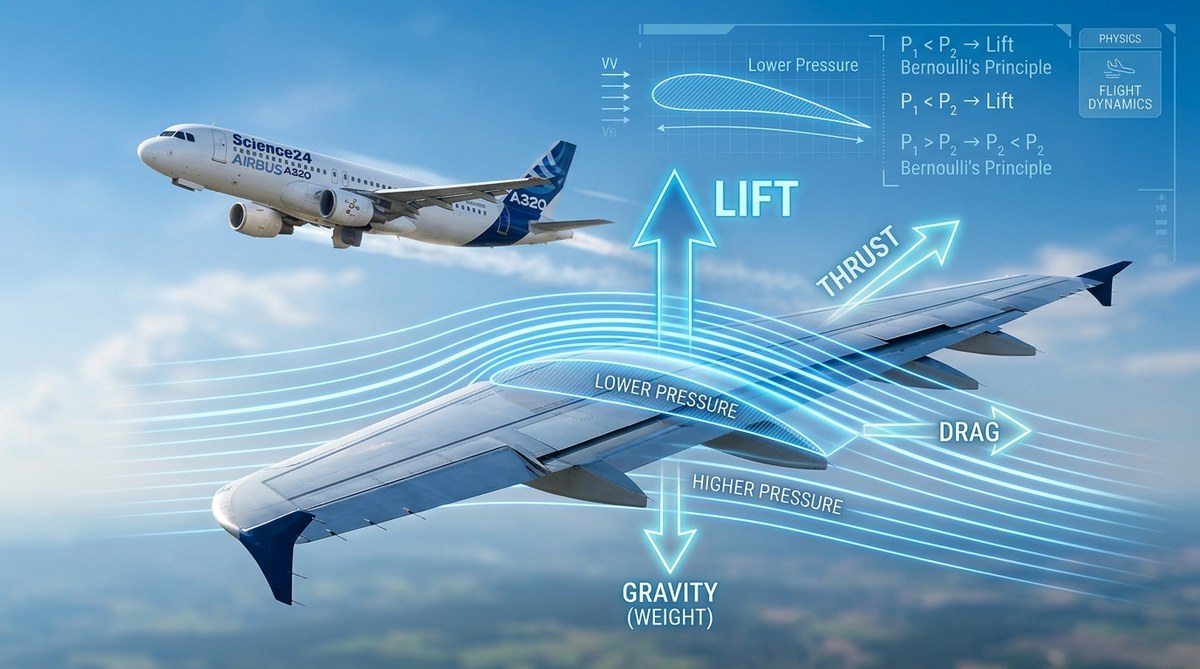
Airplanes fly because wings generate lift by manipulating air pressure. Faster airflow over the curved top of a wing reduces pressure above, while slower air below maintains higher pressure. This pressure difference pushes the wing upward. Newton's third law also contributes as the wing deflects air downward, creating an equal upward reaction force.
The Four Forces of Flight
To understand lift, you first need to see how it fits into the bigger picture. Every airplane in the sky experiences four main forces:
- Lift – The upward force that counteracts weight.
- Weight – The downward pull of gravity.
- Thrust – The forward push from engines or propellers.
- Drag – The backward resistance from air.
During steady level flight, lift equals weight, and thrust equals drag. Change any one force, and the plane climbs, descends, speeds up, or slows down. Lift is the star of the show, but it does not work alone.
How a Wing Creates Lift: The Role of Air Pressure
The wing, also called an airfoil, is the key to lift. Its shape matters greatly. Most wings have a curved upper surface and a flatter lower surface. When the wing moves through the air, it splits the oncoming flow.
Here is a simple numbered breakdown of what happens:
- Air approaches the front of the wing (the leading edge).
- The air splits, with some flowing over the top and some under the bottom.
- Because the top surface is curved, the air traveling over it must move farther to reach the trailing edge at the same time as the air below.
- This longer path forces the upper air to speed up relative to the lower air.
- Faster moving air has lower static pressure (Bernoulli's principle).
- Slower moving air under the wing has higher pressure.
- The pressure difference creates a net upward force: lift.
That is the core idea. But there is more to the story.
Bernoulli's Principle: Faster Air, Lower Pressure
Daniel Bernoulli discovered in the 1700s that in a flowing fluid, an increase in speed happens at the same time as a decrease in pressure. This principle applies directly to airplane wings. The curved top of the wing forces the air to accelerate. Lower pressure on top relative to the bottom produces lift.
Many textbooks present this as the complete explanation. It is not wrong, but it is only half of the picture. The speed increase also depends on the wing's shape and its orientation to the incoming air.
Newton's Third Law: Angle of Attack and Downwash
Here is where things get even more interesting. Lift also comes from Newton's third law: for every action, there is an equal and opposite reaction. The wing pushes air downward, and the air pushes the wing upward.
This downward deflection of air is called downwash. Even when a wing is perfectly level, the curved shape bends the airflow downward. The angle at which the wing meets the air, called the angle of attack, makes this effect stronger. A higher angle of attack (up to a point) increases downwash and therefore lift.
As NASA's Glenn Research Center explains, "Lift is generated by every part of the airplane, but most of the lift on a typical airliner is generated by the wings." The physics is a combination of both pressure differences and momentum transfer.
So the two explanations are not competing. They are complementary. Bernoulli accounts for the pressure difference, and Newton accounts for the reaction from redirecting air. Together they give a full picture.
Common Misconceptions About Lift
Even experts sometimes get the details wrong. Here is a table that clears up frequent misunderstandings.
| Mistake | Correct Understanding |
|---|---|
| The "equal transit time" theory (air must meet at trailing edge) is false. | Air over the top actually arrives sooner than air below in most conditions. |
| Lift only comes from Bernoulli's principle. | Newton's third law is equally essential. |
| Wings need a curved top to generate lift. | Flat wings can also produce lift if angled correctly (think of a paper airplane). |
| A wing stalls only when it stops moving forward. | Stall happens when the angle of attack becomes too high, causing airflow to separate from the wing surface. |
Understanding these errors helps you avoid confusion later. It also shows why the physics of lift is still a topic of active research. If you want to avoid similar traps in other areas, check out our guide on 5 common misconceptions about Newton's third law of motion.
A Practical Look: How Pilots Use Lift
Pilots do not think about Bernoulli or Newton in the cockpit. They use control surfaces to manage lift directly.
Here are the main tools:
- Flaps – Extend from the trailing edge of the wing to increase camber and lift at low speeds, useful during takeoff and landing.
- Slats – Deploy from the leading edge to allow a higher angle of attack without stalling.
- Ailerons – Move differentially to increase lift on one wing and decrease it on the other, causing the plane to roll.
Each of these changes the wing's effective shape or angle relative to the oncoming air. For students studying for exams, knowing how these controls affect lift is a common test question. If you struggle with similar physics problems, our guide on how to approach electric circuit problems when you don't know where to start might give you a new way to think through tough scenarios.
The Future of Lift Research
You might think scientists have figured out lift completely. They have not. There is still debate about how best to teach it, and researchers continue to study high lift devices and new wing designs for efficiency. In 2026, engineers are exploring laminar flow wings that reduce drag while maintaining lift. The physics fundamentals stay the same, but the applications keep evolving.
For curious learners, this is a great reminder that even established science leaves room for new insights. If you enjoyed this deep look into a physical phenomenon, you might also like what happens to energy during elastic and inelastic collisions, another area where intuition often clashes with reality.
Putting Lift Into Perspective
The next time you look out the window during a flight, remember that the wing is doing two things at once. It is creating a low pressure zone above itself, and it is shoving air downward. Both actions produce the upward force that keeps the plane in the sky.
That is the answer to what causes airplanes to fly: a careful marriage of pressure differences and momentum exchange, all made possible by the wing's shape and the pilot's skill. It is elegant, reliable, and deeply satisfying to understand.
Take this knowledge with you. Explain it to a friend. Use it on your next physics quiz. The sky is not a mystery anymore.