
Optimization problems in calculus feel impossible until you understand the pattern. You stare at a word problem about fencing a garden or designing a can, and the path forward seems murky. But here’s the truth: every optimization problem follows the same blueprint. Once you see it, these questions transform from confusing puzzles into predictable exercises.
Solving calculus optimization problems requires a systematic approach: identify what you’re maximizing or minimizing, express it as a function of one variable, find [critical points](https://en.wikipedia.org/wiki/Maxima_and_minima) using [derivatives](https://en.wikipedia.org/wiki/Derivative), and verify your answer makes physical sense. This framework works for every optimization question you’ll encounter in AP Calculus or Calculus 1, from geometry problems to applied real-world scenarios.
Understanding What Optimization Actually Asks You to Do
Optimization problems want you to find the best value. Sometimes that means the largest area, the smallest cost, or the shortest distance. The calculus part comes in because derivatives tell you exactly where functions reach their peaks and valleys.
Think about it this way: if you graph any smooth function, the highest or lowest point occurs where the slope equals zero. That’s where the derivative vanishes. Your job is to set up the right function, take its derivative, and solve for those special points.
The challenge isn’t the calculus itself. Most students get stuck translating words into equations. That’s where the real work happens.
The Five-Step Framework for Every Optimization Problem

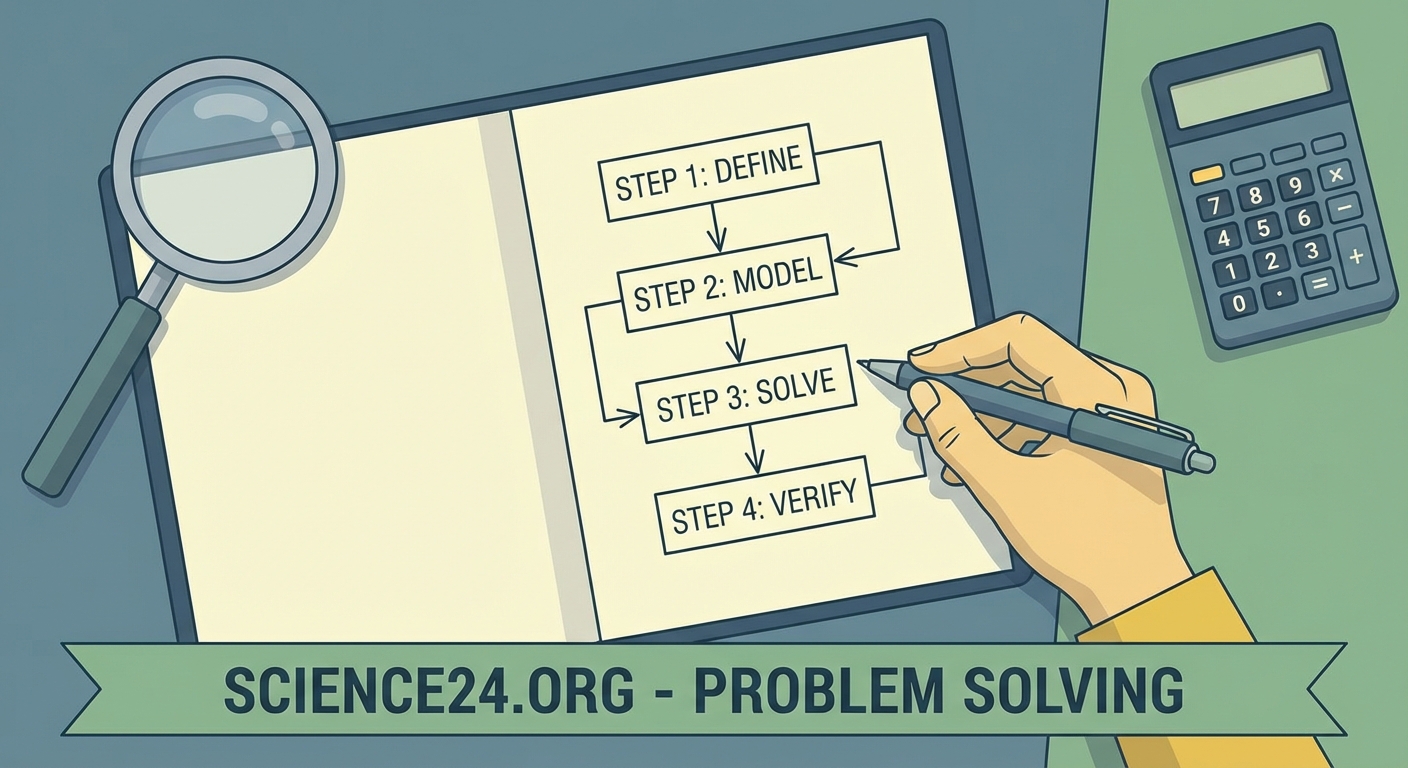
Here’s the process that works every single time:
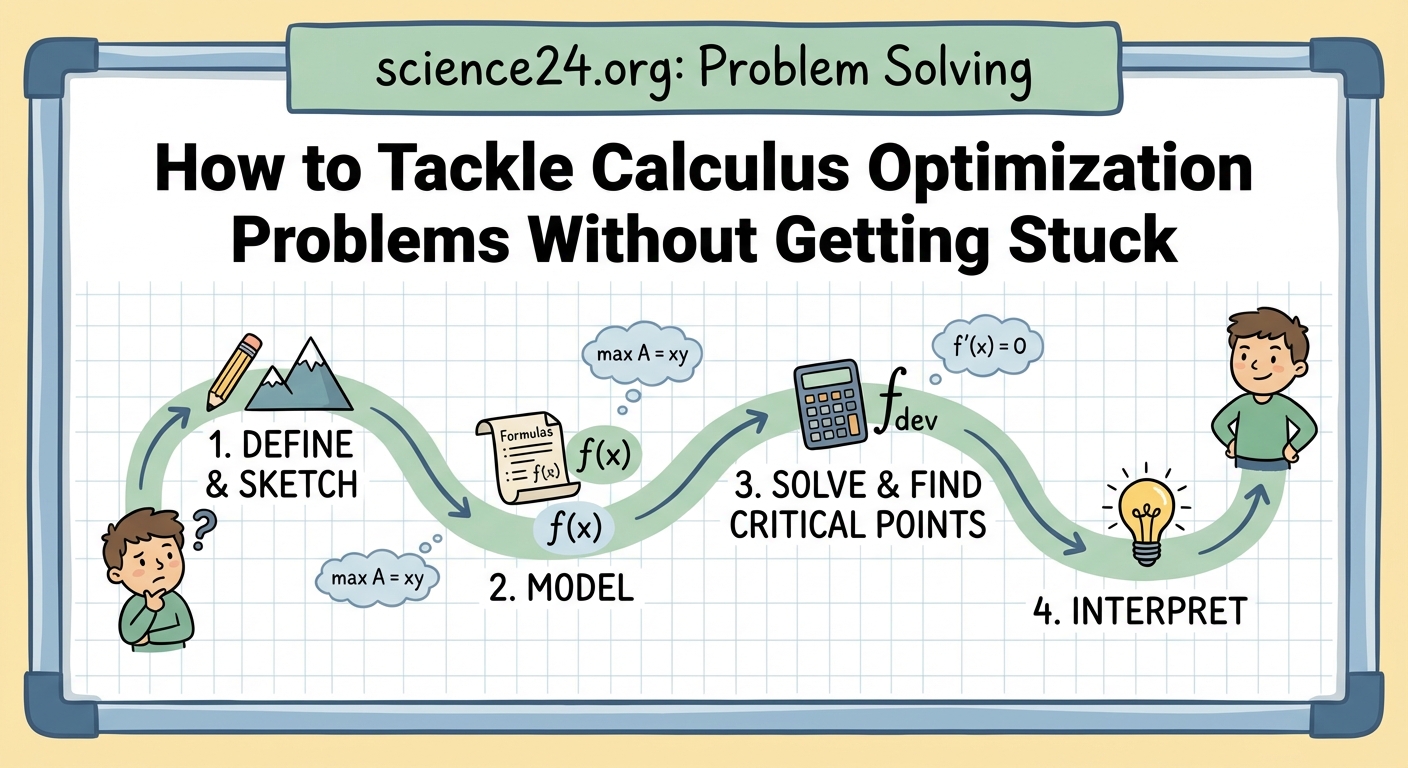
- Read the problem and identify what quantity you need to maximize or minimize.
- Draw a diagram if the problem involves physical dimensions or spatial relationships.
- Write an equation for the quantity you’re optimizing, using two or more variables.
- Use the given constraints to eliminate variables until you have a function of one variable.
- Take the derivative, find critical points, and verify which one gives your answer.
Let’s break down each step so you know exactly what to do.
Step One: Name Your Target
Before you write anything, figure out what the problem asks you to optimize. Are you maximizing area? Minimizing surface area? Finding the shortest path?
Write it down. Label it clearly. This becomes your objective function.
For example, if a problem asks for the largest rectangular area you can enclose with 100 feet of fencing, your target is area. Call it A.
Step Two: Sketch the Situation
Most optimization problems become clearer with a picture. Draw a rectangle for fencing problems. Sketch a cylinder for volume questions. Mark the variables on your diagram.
This step prevents mistakes later. You’ll see relationships between variables that aren’t obvious from words alone.
Step Three: Build Your Objective Function
Write an equation for the quantity you’re optimizing. Use multiple variables if needed.
For that fencing problem, if the rectangle has length l and width w, then:
A = l × w
You also know the perimeter constraint: 2l + 2w = 100.
Step Four: Reduce to One Variable
Calculus can only optimize functions of a single variable. Use your constraint equations to eliminate extras.
From 2l + 2w = 100, solve for one variable:
w = 50 – l
Substitute into your area equation:
A(l) = l(50 – l) = 50l – l²
Now you have area as a function of length alone.
Step Five: Apply Calculus and Verify
Take the derivative of your function:
A'(l) = 50 – 2l
Set it equal to zero:
50 – 2l = 0
Solve: l = 25
Find the corresponding width: w = 50 – 25 = 25
Check that this makes sense. A square gives maximum area for a fixed perimeter, which matches what geometry tells us.
Always verify your answer fits the physical constraints. Negative dimensions or impossible values mean you made an error.
Common Mistakes That Derail Your Solution
Students make predictable errors when working through optimization problems. Knowing them helps you avoid the traps.
| Mistake | Why It Happens | How to Fix It |
|---|---|---|
| Forgetting to eliminate variables | Rushing through step four | Always count your variables before taking derivatives |
| Using the constraint as the objective | Confusing what you’re given with what you’re finding | Reread the question and highlight the word “maximize” or “minimize” |
| Ignoring domain restrictions | Not checking if critical points make physical sense | Test endpoints and verify all values are realistic |
| Skipping the second derivative test | Assuming every critical point is the answer | Confirm whether you found a max or min using f”(x) |
The biggest mistake? Treating every problem as unique instead of following the same framework. The setup changes, but the process stays identical.
Working Through a Complete Example
Let’s solve a classic problem from start to finish.
Problem: You have a piece of wire 40 cm long. You cut it into two pieces. One piece forms a circle, the other forms a square. Where should you cut the wire to minimize the total area enclosed by both shapes?
Step 1: You’re minimizing total area.
Step 2: Sketch a circle and a square. Label the circle’s circumference as c and the square’s perimeter as s.
Step 3: Write area equations.
For the circle: A₁ = πr², where c = 2πr, so r = c/(2π)
A₁ = π[c/(2π)]² = c²/(4π)
For the square: A₂ = (side)², where each side equals s/4
A₂ = (s/4)² = s²/16
Total area: A = c²/(4π) + s²/16
Step 4: Use the constraint c + s = 40 to eliminate one variable.
s = 40 – c
Substitute: A(c) = c²/(4π) + (40 – c)²/16
Step 5: Take the derivative and solve.
A'(c) = 2c/(4π) + 2(40 – c)(-1)/16
A'(c) = c/(2π) – (40 – c)/8
Set equal to zero:
c/(2π) = (40 – c)/8
Multiply both sides by 8: 4c/π = 40 – c
4c/π + c = 40
c(4/π + 1) = 40
c = 40/(4/π + 1) ≈ 17.6 cm
This means you cut the wire so about 17.6 cm forms the circle and 22.4 cm forms the square.
Check the endpoints too. If c = 0 (all square) or c = 40 (all circle), you get larger total areas. Your critical point gives the minimum.
When Your Answer Doesn’t Match the Back of the Book
Sometimes your work looks perfect but the answer differs from the solution manual. Before you panic, check these common issues:
- Units matter. Did you convert centimeters to meters or vice versa?
- Exact vs. approximate. Some books want π and √2 in the answer, others want decimals.
- Multiple valid forms. Your answer might be algebraically equivalent but look different.
If none of those explain the discrepancy, retrace your constraint equation. That’s where most errors hide. Make sure you solved for the right variable and substituted correctly.
Similar to how avoiding common algebra mistakes saves time on tests, double-checking your constraint work prevents wasted effort on optimization problems.
Handling Problems With Closed Intervals
Not every optimization problem involves finding where the derivative equals zero. Some give you a specific interval like [0, 10] and ask for the maximum value on that domain.
Your process expands slightly:
- Find all critical points inside the interval where f'(x) = 0
- Evaluate the function at each critical point
- Evaluate the function at both endpoints
- Compare all values and identify the largest or smallest
The maximum or minimum might occur at an endpoint rather than where the derivative vanishes. Closed interval problems test whether you remember to check boundaries.
Applying Optimization to Real Scenarios
Textbook problems use fences and boxes, but the same techniques solve practical questions.
Want to minimize the material cost for a cylindrical can holding 500 mL? Set up the surface area function, use the volume constraint, and optimize.
Need to find the angle that maximizes the range of a projectile? Express range as a function of launch angle and differentiate.
These problems look different but follow identical steps. Identify the objective, write the function, apply constraints, differentiate, solve.
The math doesn’t care whether you’re fencing a garden or designing packaging. The framework handles everything.
Why Drawing Helps More Than You Think

Students who skip diagrams struggle more with optimization. A picture reveals relationships that remain hidden in pure algebra.
When you draw a rectangle inscribed in a circle, you immediately see how the diagonal relates to the circle’s diameter. That connection becomes your constraint equation.
When you sketch a ladder leaning against a wall, you notice the triangle formed with the ground. Pythagorean theorem gives you the relationship you need.
Don’t just draw any picture. Label every dimension with a variable. Mark known quantities. Your diagram should show exactly what you’re working with.
Testing Whether You Found a Maximum or Minimum
Finding where f'(x) = 0 tells you where the function has a horizontal tangent. But is that point a peak, a valley, or neither?
Three methods confirm your answer:
First derivative test: Check the sign of f'(x) on either side of your critical point. If the derivative changes from positive to negative, you found a maximum. If it changes from negative to positive, you found a minimum.
Second derivative test: Evaluate f”(x) at your critical point. If f”(x) > 0, the function is concave up and you found a minimum. If f”(x) < 0, the function is concave down and you found a maximum.
Common sense test: Does your answer make physical sense? You can’t have negative length or a box bigger than the material you started with.
Use at least two methods. The second derivative test fails when f”(x) = 0, so always have a backup.
The most reliable approach combines the second derivative test with a quick reality check. Calculate f”(x) to classify your critical point mathematically, then verify the answer makes sense in context. This catches both calculation errors and conceptual misunderstandings.
Building Speed Without Sacrificing Accuracy

Optimization problems take time when you’re learning. That’s normal. But exams give you limited minutes per question, so efficiency matters.
Here’s how to work faster:
- Practice the framework until it becomes automatic
- Write constraint equations immediately after reading the problem
- Use the same variable names consistently (r for radius, h for height, etc.)
- Keep your algebra organized so you can spot errors easily
- Skip the diagram only if the problem is purely algebraic
Speed comes from repetition, not shortcuts. Do enough problems that you recognize patterns instantly. After solving ten box optimization questions, the eleventh takes half the time.
Just like improving your calculation speed with mental math helps across all math topics, drilling optimization builds fluency that pays off on exams.
Recognizing Problem Types by Their Setup
Certain optimization problems appear repeatedly in calculus courses. Learning to categorize them saves time.
Geometry problems: Maximize area or minimize perimeter given constraints. Usually involve rectangles, triangles, or circles.
Volume and surface area: Minimize material for containers holding a fixed volume. Cylinders and boxes dominate this category.
Distance problems: Find the shortest path between a point and a curve, or between two moving objects.
Business applications: Maximize profit or minimize cost given production constraints.
Each type uses the same five-step framework, but knowing the category helps you set up equations faster. You’ve seen similar problems before, so you know what to expect.
What to Do When You’re Completely Stuck

Sometimes you read a problem three times and still can’t start. Here’s your unsticking protocol:
- Identify what you’re optimizing and write it down explicitly
- List every piece of information the problem gives you
- Draw a diagram even if you think you don’t need one
- Write equations for any relationships you can see
- Look for a constraint that relates two variables
If you’re still stuck, try working backward. What would the final answer look like? What function would you need to differentiate to get there? Sometimes reverse engineering reveals the path forward.
Tackling Optimization Problems With Trigonometry
Some optimization problems hide trigonometric functions inside geometric setups. A ladder sliding down a wall, a light shining on a wall, or an observer watching a rocket launch might all require trig.
The framework stays the same, but your constraint equations involve sine, cosine, or tangent. Don’t let that intimidate you.
Label angles clearly in your diagram. Write the trig relationships you know. If you need to refresh those identities, mastering trigonometric identities makes optimization problems much smoother.
Remember that derivatives of trig functions follow standard rules. The calculus doesn’t get harder, you just have more terms to track.
Checking Your Work Before Moving On
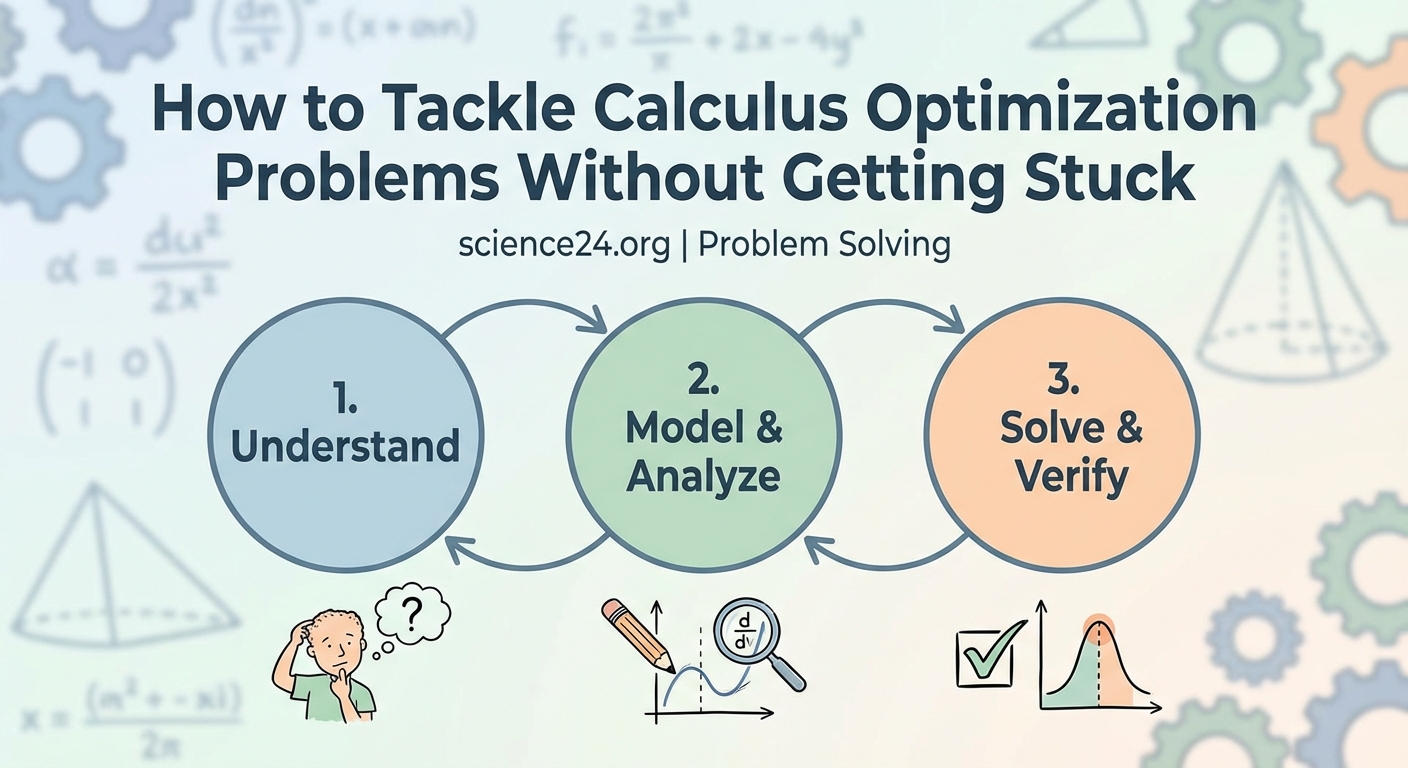
Before you circle your final answer, run through this verification checklist:
- Does your answer satisfy all constraints?
- Are all dimensions positive?
- Did you answer the actual question asked?
- Does the second derivative confirm you found the right type of extremum?
- Can you plug your answer back into the original setup and verify it works?
Catching an error before you turn in your exam beats losing points to a careless mistake. Spend 30 seconds checking and save yourself from frustration later.
Building Confidence Through Practice
Optimization problems feel overwhelming at first. That’s universal. Every calculus student faces that moment of staring at a word problem and feeling lost.
The difference between students who master optimization and those who don’t comes down to practice. Work through problems systematically. Follow the framework even when you think you see a shortcut. Build the habit of careful setup.
After solving 20 optimization problems using the five-step method, you’ll recognize patterns instantly. The 21st problem won’t scare you. You’ll see it as another variation of something you’ve done before.
Start with simple problems. Maximize the area of a rectangle with fixed perimeter. Minimize the surface area of a box with fixed volume. Build confidence with straightforward setups before tackling complex scenarios.
Turning Practice Into Mastery

You now have a complete system for approaching any optimization problem in calculus. The five-step framework works whether you’re dealing with geometry, business applications, or physics scenarios.
Remember that optimization problems aren’t random puzzles. They follow predictable patterns. Your job is to identify the pattern, set up the function, and let calculus do what it does best: find where functions reach their extreme values.
Start applying this method today. Grab your textbook or problem set and work through three optimization problems using the framework. Draw diagrams. Write clear constraint equations. Check your answers against the solution manual.
With each problem you solve, the process becomes more natural. Soon you’ll approach optimization questions with confidence instead of dread. The problems that once seemed impossible will become routine exercises you can handle in minutes.