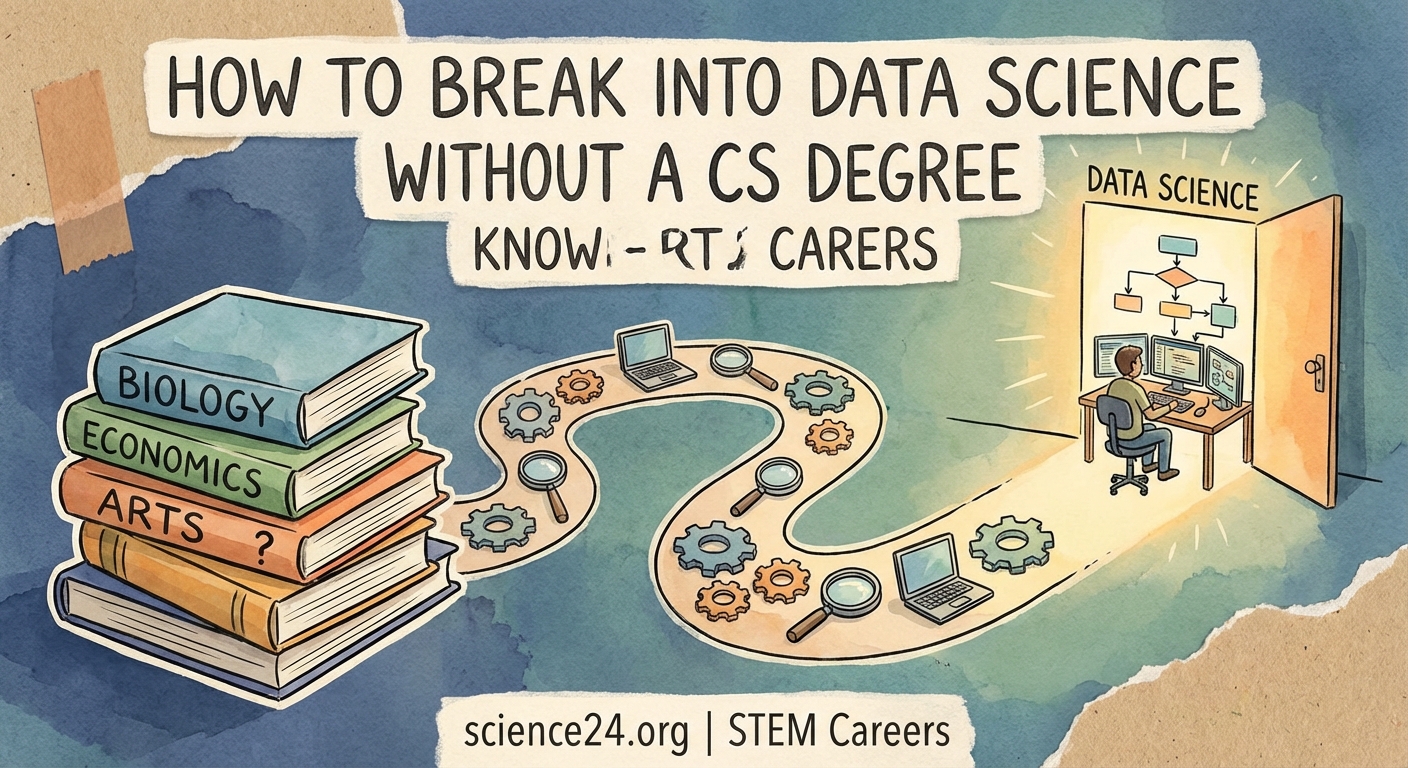
Breaking into data science without a computer science degree feels impossible until you realize that most hiring managers care more about what you can build than where you studied. The field rewards demonstrated skills over credentials, making it one of the few technical careers where self-taught professionals regularly compete with university graduates.
You can become a data scientist without a formal degree by mastering Python, statistics, and [machine learning](https://en.wikipedia.org/wiki/Machine_learning) through structured self-study, building a portfolio of real-world projects, gaining hands-on experience through freelance work or competitions, and networking strategically within the data science community. Employers increasingly value demonstrable skills and practical problem-solving ability over traditional educational credentials when hiring for data roles.
Understanding What Data Scientists Actually Do
Data scientists extract insights from complex datasets to solve business problems. They clean messy data, build predictive models, create visualizations, and communicate findings to non-technical stakeholders.
The role combines three skill areas: programming, statistics, and domain knowledge. You write code to process data, apply mathematical concepts to analyze patterns, and understand the business context that makes your analysis valuable.
Most data scientists spend 60% of their time cleaning and preparing data. The glamorous machine learning work happens after you’ve wrestled spreadsheets into usable formats, handled missing values, and removed outliers.
The Mathematical Foundation You Need
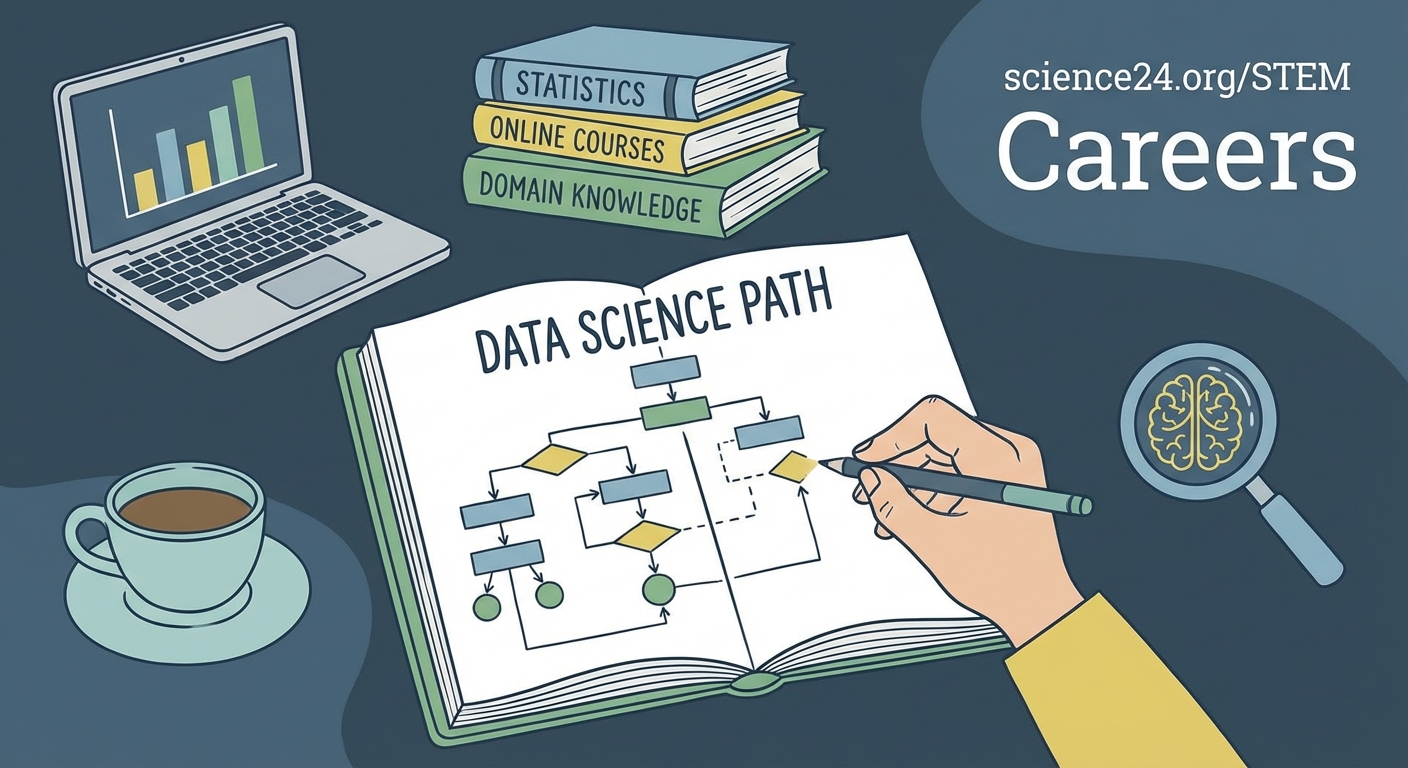
Statistics forms the backbone of data science work. You need comfort with probability distributions, hypothesis testing, regression analysis, and correlation versus causation.
Start with descriptive statistics: mean, median, mode, standard deviation, and variance. These concepts appear in every analysis you’ll run.
Move to inferential statistics once you grasp the basics. Learn about confidence intervals, p-values, and statistical significance. Understanding what makes prime numbers so special in mathematics can help build your number sense for pattern recognition.
Linear algebra becomes important when you work with machine learning algorithms. Matrices, vectors, and transformations power the models you’ll build.
Calculus helps you understand optimization and gradient descent, though you won’t calculate derivatives by hand. The conceptual understanding matters more than manual computation.
| Mathematical Topic | Why It Matters | Where You’ll Use It |
|---|---|---|
| Descriptive Statistics | Summarize and understand data | Every exploratory analysis |
| Probability | Quantify uncertainty | Model evaluation, A/B testing |
| Linear Algebra | Understand data transformations | Machine learning algorithms |
| Calculus | Grasp optimization concepts | Neural networks, gradient descent |
| Hypothesis Testing | Make data-driven decisions | Experiment analysis, validation |
Programming Skills That Open Doors
Python dominates the data science landscape. Most job postings list it as a requirement, and the ecosystem of libraries makes it perfect for data work.
Start with Python fundamentals: variables, loops, functions, and data structures. You need solid programming basics before tackling data-specific libraries.
Learn these libraries in order:
- NumPy for numerical computing and array operations
- Pandas for data manipulation and analysis
- Matplotlib and Seaborn for visualization
- Scikit-learn for machine learning algorithms
- TensorFlow or PyTorch for deep learning (advanced)
SQL ranks as the second most important language. Every data scientist queries databases daily. Master SELECT statements, JOINs, GROUP BY operations, and window functions.
Write code every single day. Consistency beats intensity. Thirty minutes of daily practice builds skills faster than weekend marathons.
Building Your Learning Path Without Formal Classes
Self-directed learning requires structure. Random tutorial hopping wastes time and creates knowledge gaps.
Create a curriculum that mirrors university programs:
- Months 1-2: Python fundamentals and basic statistics
- Months 3-4: Data manipulation with Pandas and SQL
- Months 5-6: Exploratory data analysis and visualization
- Months 7-8: Machine learning fundamentals
- Months 9-10: Advanced algorithms and model deployment
- Months 11-12: Portfolio projects and interview preparation
Free resources provide everything you need. Coursera, edX, and YouTube offer university-level content without tuition costs. DataCamp and Kaggle Learn provide hands-on practice environments.
Books supplement video courses. “Python for Data Analysis” by Wes McKinney teaches Pandas from its creator. “An Introduction to Statistical Learning” covers machine learning theory with practical examples.
Focus on understanding concepts deeply rather than collecting certificates. Employers care about what you can build, not how many courses you’ve completed. One well-executed project demonstrates more competence than ten course completion badges.
Creating Projects That Prove Your Skills
Your portfolio separates you from other candidates. Projects show you can apply knowledge to solve real problems.
Choose projects that tell a story about your interests and capabilities. Analyzing sports statistics, predicting housing prices, or building recommendation systems all work if you execute them well.
Each project should follow this structure:
- Define a clear question or problem
- Collect and clean relevant data
- Perform exploratory analysis
- Build and evaluate models
- Communicate findings with visualizations
- Document your process and decisions
Start simple and increase complexity. Your first project might analyze a single dataset with basic statistics. Your fifth project could involve web scraping, multiple data sources, and advanced machine learning techniques.
GitHub hosts your code and demonstrates version control skills. Write clear README files that explain your process, findings, and how to reproduce your work.
Kaggle competitions provide datasets and benchmarks. You don’t need to win to benefit. Working through competition notebooks teaches you techniques and exposes you to different approaches.
The Technical Skills Employers Actually Want
Job postings reveal what companies value. Analyzing hundreds of data science listings shows consistent patterns.
Must-have skills:
- Python programming
- SQL database querying
- Statistical analysis
- Data visualization
- Machine learning fundamentals
- Communication abilities
Nice-to-have skills:
- Big data tools (Spark, Hadoop)
- Cloud platforms (AWS, Azure, GCP)
- Deep learning frameworks
- A/B testing experience
- Business intelligence tools
- Domain expertise
Focus on the must-have list first. You can learn nice-to-have skills on the job or when specific opportunities require them.
Communication matters more than most beginners realize. You’ll spend significant time explaining technical concepts to non-technical colleagues. Practice translating statistical findings into business recommendations.
Gaining Experience Without a Job
The experience paradox frustrates career changers: jobs require experience, but you can’t get experience without a job.
Break the cycle through alternative experience sources:
Freelance projects on Upwork or Fiverr let you solve real problems for real clients. Start with small data cleaning or visualization tasks. Build your reputation and tackle larger projects.
Open source contributions demonstrate collaboration skills and code quality. Find data science projects on GitHub that need help. Fix bugs, improve documentation, or add features.
Volunteer work for nonprofits provides portfolio material and networking opportunities. Many organizations need help analyzing donor data, program effectiveness, or community impact.
Personal projects with public datasets show initiative. Use government data, APIs, or web scraping to create original analyses. The key is answering interesting questions with data.
Kaggle competitions offer structured problems and community feedback. Even finishing in the middle of the pack demonstrates competence with real-world datasets.
Common Mistakes That Slow Your Progress
Career changers often stumble over predictable obstacles. Avoiding these mistakes accelerates your timeline.
| Mistake | Why It Hurts | Better Approach |
|---|---|---|
| Tutorial hell | Passive learning without application | Build projects while learning |
| Perfectionism | Never finishing projects | Ship imperfect work and iterate |
| Ignoring math | Weak foundation limits growth | Study statistics alongside coding |
| Isolated learning | Missing feedback and connections | Join communities and share work |
| Chasing trends | Surface knowledge of many tools | Deep expertise in core skills |
Many beginners collect courses without building anything. They watch tutorials, take notes, and feel productive while developing no practical skills. The solution is simple: code along with every tutorial and then build something similar without guidance.
Others never share their work because it doesn’t feel good enough. Your first projects will be rough. Share them anyway. Feedback helps you improve faster than private practice.
Some career changers avoid the mathematical foundations, hoping to get by with just coding skills. This approach works until you need to debug a model, explain an algorithm, or make methodological decisions. Understanding concepts like why dividing by zero breaks mathematics builds the logical thinking data science requires.
Networking Your Way Into Opportunities
Most data science jobs never get posted publicly. Companies fill positions through referrals and internal networks.
Attend local meetups and data science events. These gatherings connect you with practitioners, hiring managers, and fellow learners. Arrive with questions, not a sales pitch about your job search.
Contribute to online communities. Answer questions on Stack Overflow, participate in r/datascience discussions, or share insights on LinkedIn. Helpful contributions build your reputation and visibility.
Reach out to data scientists for informational interviews. Most professionals enjoy discussing their work and helping newcomers. Ask about their path, current challenges, and advice for breaking in.
Write about what you’re learning. Blog posts, LinkedIn articles, or Twitter threads demonstrate your knowledge and communication skills. You don’t need massive audiences. Thoughtful content attracts the right attention.
Connect with recruiters who specialize in data science placements. They know about opportunities before public postings and can advocate for candidates with non-traditional backgrounds.
Crafting a Resume That Gets Interviews
Your resume needs to overcome the “no degree” objection before you get a chance to interview.
Lead with a skills summary that lists your technical capabilities. Group them logically: Programming Languages, Data Analysis Tools, Machine Learning Techniques, and Databases.
Feature your projects prominently. Each entry should include:
- Project name and brief description
- Technologies and methods used
- Key findings or results
- Link to GitHub repository
Quantify your impact wherever possible. “Improved model accuracy by 15%” tells a better story than “Built predictive model.”
Include relevant work experience even if it’s not data science. Project management, research, analysis, or any role involving problem-solving and communication provides transferable skills.
List your education honestly. If you have a degree in any field, include it. If you don’t, focus on certifications, completed courses, and demonstrable skills.
Add a section for online courses and certifications, but keep it brief. One or two respected certifications matter more than a long list of completion badges.
Preparing for Data Science Interviews
Technical interviews test your ability to code, analyze data, and communicate findings.
Coding challenges assess your Python and SQL skills. Practice on LeetCode, HackerRank, or StrataScratch. Focus on problems tagged for data science: array manipulation, string processing, and database queries.
Take-home assignments mirror real work. You’ll receive a dataset and business question, then have several days to analyze and present findings. Practice by setting yourself similar challenges with public datasets.
Case interviews evaluate your analytical thinking. An interviewer describes a business problem and asks how you’d approach it with data. Structure your response: clarify the question, identify needed data, propose analytical methods, and discuss potential findings.
Behavioral questions probe your collaboration and communication skills. Prepare stories about past projects, challenges you’ve overcome, and how you handle feedback. The STAR method (Situation, Task, Action, Result) helps structure responses.
Study common machine learning concepts. You should explain algorithms like linear regression, decision trees, and random forests without looking at notes. Understand their strengths, weaknesses, and appropriate use cases.
Alternative Paths Worth Considering
Data science isn’t the only entry point to working with data. Related roles often have lower barriers and provide stepping stones.
Data analysts focus more on business intelligence and reporting than machine learning. The role requires less programming and advanced math, making it accessible for beginners. Many data scientists started as analysts.
Business intelligence developers build dashboards and reporting systems. If you enjoy visualization and working with stakeholders, this path might suit you better than pure data science.
Data engineers build the infrastructure that data scientists use. If you prefer backend systems and databases over statistics, engineering might align better with your interests.
Machine learning engineers implement and deploy models in production systems. The role emphasizes software engineering over statistical analysis. Consider this path if you have a programming background but lack formal statistics training.
Starting in an adjacent role and transitioning to data science is completely valid. You’ll gain domain knowledge, build professional networks, and develop complementary skills while working toward your goal.
Making the Math Less Intimidating
Many career changers panic when they see the mathematical requirements for data science. The math is real, but you don’t need a mathematics degree to understand it.
Start with the practical applications before the theory. Run a linear regression in Python and see how it works. Then study the underlying mathematics. This approach makes abstract concepts concrete.
Use visual learning resources. 3Blue1Brown’s YouTube channel explains linear algebra and calculus through animations that make complex ideas intuitive. Seeing concepts visually often clarifies what textbooks obscure.
Practice with real data constantly. Apply each statistical concept to actual datasets as soon as you learn it. This reinforcement helps concepts stick better than solving textbook problems.
Khan Academy provides free math instruction from basics through advanced topics. If you need to fill gaps in your foundation, their structured curriculum works well for self-study.
Remember that data scientists use libraries that handle complex calculations. You need to understand what’s happening conceptually and when to apply different techniques. You won’t derive formulas from scratch on the job.
Resources That Actually Help
Free and low-cost resources provide everything you need to learn data science fundamentals.
For Python programming:
– Python.org’s official tutorial
– “Automate the Boring Stuff with Python” by Al Sweigart
– Real Python website tutorials
For statistics:
– Khan Academy Statistics and Probability course
– “Think Stats” by Allen Downey (free online)
– StatQuest YouTube channel
For machine learning:
– Andrew Ng’s Machine Learning course on Coursera
– “Hands-On Machine Learning” by Aurélien Géron
– Fast.ai practical courses
For practice:
– Kaggle datasets and competitions
– DataCamp exercises
– LeetCode SQL problems
For community:
– r/datascience and r/learnmachinelearning on Reddit
– Data Science Stack Exchange
– Local meetup groups
Paid bootcamps accelerate learning but aren’t necessary. They provide structure, mentorship, and career support. Evaluate whether the cost justifies these benefits for your situation.
Timeline Expectations for Career Changers
Breaking into data science without a degree typically takes 12 to 18 months of focused effort.
The first three months feel overwhelming. You’re learning programming syntax, statistical concepts, and new tools simultaneously. Progress seems slow because you’re building foundational knowledge.
Months four through six bring confidence. Concepts start connecting, and you can complete small projects independently. You’re still learning constantly but feel less lost.
Months seven through nine focus on building your portfolio. You tackle more complex projects and start applying for entry-level positions or freelance work.
Months ten through twelve involve intensive interview preparation and job searching. You’re refining your skills, networking actively, and learning from rejections.
Some people break in faster, especially if they have adjacent experience or can study full-time. Others take longer while balancing learning with full-time work and family responsibilities.
The timeline matters less than consistent progress. Studying 10 hours per week for 18 months beats cramming 40 hours per week for three months and burning out.
Your Path Forward Starts With One Dataset
The journey from complete beginner to employed data scientist feels impossibly long when you’re starting. Every expert you see online seems to know everything while you struggle with basic concepts.
They started exactly where you are now. The difference is they kept going when learning felt hard, when projects failed, and when progress seemed invisible.
Your first step is simple: pick a dataset that interests you and ask one question about it. Sports statistics, movie ratings, weather patterns, anything that makes you curious. Download the data, load it into Python, and calculate a basic statistic.
That single action moves you from thinking about becoming a data scientist to actually doing data science. Everything else builds from there, one small step at a time, until the person who couldn’t figure out how to import a CSV file is confidently explaining machine learning models in job interviews.
The path exists. Thousands of self-taught data scientists prove it works. Now you just need to take the first step.