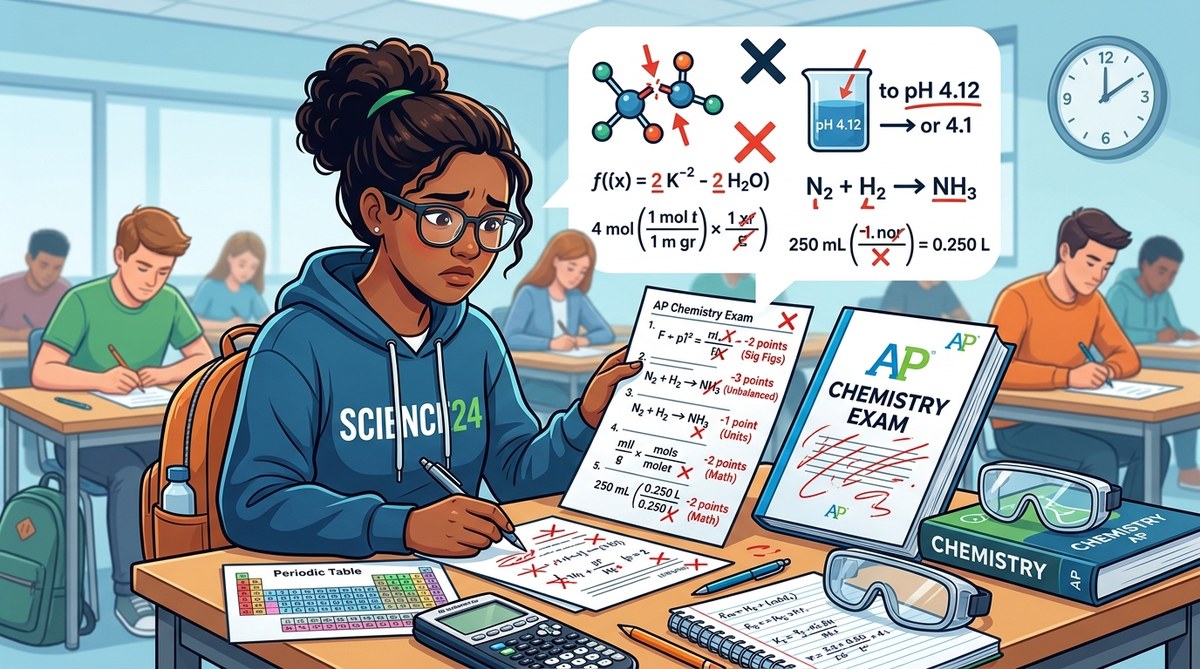
You studied for months. You memorized formulas, practiced problems, and reviewed your notes. Then exam day arrives, and you lose points on questions you actually knew how to solve. Sound familiar?
The AP Chemistry exam punishes small mistakes harder than almost any other standardized test. A missing unit here, a rounding error there, or forgetting to show your work can cost you points even when your understanding is solid. The good news? Most of these errors are completely avoidable once you know what to watch for.
Students lose points on AP Chemistry exams through preventable mistakes like missing units, improper [significant figures](https://en.wikipedia.org/wiki/Significant_figures), incomplete work shown, and misreading questions. Understanding these common errors and practicing deliberate correction strategies can improve your score by several points. This guide identifies the most frequent mistakes across multiple choice and free response sections, providing actionable fixes you can implement immediately in your test preparation routine.
Significant Figure Errors That Silently Steal Points
Significant figures trip up more students than almost any other technical detail on the AP Chemistry exam. You might calculate the perfect answer, but if you round incorrectly or carry too many digits through your work, you lose points.
The scoring rubric is strict about this. When a problem requires three significant figures and you provide four, graders mark it wrong. When you round too early in a multi-step calculation, your final answer drifts from the expected value.
Here’s what actually happens during scoring. Free response questions often include a specific statement about significant figures in the prompt. If the question says “calculate to three significant figures,” that’s not a suggestion. It’s a requirement tied directly to the point allocation.
Common significant figure mistakes:
- Rounding intermediate steps instead of keeping extra digits until the final answer
- Counting zeros incorrectly (leading zeros don’t count, trailing zeros after a decimal do)
- Using calculator display values without considering measurement precision
- Forgetting that addition and subtraction follow different rules than multiplication and division
- Mixing exact numbers with measured values incorrectly
The fix is simpler than you think. Keep at least one extra digit throughout your calculations. Only round your final answer to match the least precise measurement in the problem. When in doubt, match the significant figures given in the question data.
Practice this deliberately. Take five old free response questions and solve them twice. First, round at every step. Second, carry extra digits until the end. Compare your answers to the scoring guidelines. You’ll see exactly where early rounding costs you points.
Missing or Incorrect Units Across All Problem Types
Units aren’t decoration. They’re part of your answer, and leaving them off guarantees point loss on the AP Chemistry exam.
Every numerical answer needs a unit unless the question specifically asks for a dimensionless quantity. Molarity needs mol/L. Pressure needs atm or kPa or mmHg. Temperature needs K or °C. Energy needs joules or kilojoules.
Graders don’t give partial credit for correct numbers with wrong units. If you calculate 2.5 and write “2.5 M” when the answer should be “2.5 g,” you get zero points for that part of the question.
The trickiest unit mistakes happen during conversions. You might start with grams, convert to moles, then forget to convert your final answer back to the requested unit. Or you’ll use the gas constant R = 0.0821 but forget that it requires specific units (L·atm/mol·K) for pressure, volume, and temperature.
| Calculation Type | Required Units | Common Error |
|---|---|---|
| Concentration | mol/L or M | Writing just the number |
| Gas pressure | atm, kPa, mmHg | Mixing units mid-problem |
| Energy | J or kJ | Forgetting to convert between them |
| Temperature | K (usually) | Using Celsius in gas law calculations |
| Reaction rate | M/s or mol/L·s | Omitting time unit |
Create a unit checklist for your scratch paper. Before you write any answer, glance at your checklist and confirm you’ve included the correct unit. This takes three seconds and saves points on every single exam.
Similar to how students make common mistakes when balancing chemical equations, unit errors often stem from rushing rather than lack of knowledge.
Incomplete Work on Free Response Questions
The AP Chemistry free response section rewards process, not just answers. You can arrive at the wrong final number and still earn most of the points if you show clear, logical work.
Many students lose points because they skip steps they consider “obvious.” They write the initial equation and the final answer, leaving out the algebraic manipulation or substitution in between. To the grader, that looks like guessing.
The scoring guidelines are explicit. Each free response question breaks down into multiple point opportunities. Some points go to setting up the problem correctly. Others go to showing the calculation. The final answer might be worth only one point out of four or five total.
When you skip steps, you forfeit those intermediate points. Even if your calculator gives you the right answer, you need to demonstrate that you understand the process.
Write every step as if you’re explaining it to someone who hasn’t taken chemistry. If you wouldn’t understand your own work without filling in mental gaps, the grader won’t either.
Steps to show in every free response calculation:
- Write the relevant equation or formula
- List the given values with units
- Show the substitution of values into the equation
- Display the calculation with units carried through
- State the final answer with proper significant figures and units
This approach protects you even when you make arithmetic errors. If your setup is correct and your process is logical, you’ll earn partial credit. Students who only write the final answer get zero points when that answer is wrong.
Practice writing out full solutions on past free response questions. Time yourself. You’ll discover that showing complete work takes less time than you think, especially compared to the points it saves.
Misreading Questions and Answering the Wrong Thing
You know the chemistry. You can solve the problem. But you answered what you thought the question asked instead of what it actually asked.
This mistake costs students more points than any conceptual misunderstanding. The AP exam writers are precise with language. When they ask for “concentration,” they want molarity. When they ask for “mass,” they want grams. When they ask you to “explain,” they want words, not just an equation.
The most painful version of this error happens on multi-part questions. Part (a) asks you to calculate the pH. Part (b) asks you to calculate the pOH. You solve for pH in both parts because you’re on autopilot. You lose all the points for part (b) despite doing the calculation correctly.
Another common trap involves “justify” or “explain” prompts. These require you to provide reasoning, not just show math. If the question says “Calculate the enthalpy change and explain whether the reaction is exothermic or endothermic,” you need to do both. Students who only calculate lose half the points.
Watch for these specific question verbs and what they require:
- Calculate means show numerical work with units
- Explain means provide reasoning in complete sentences
- Justify means give evidence or logic supporting your answer
- Identify means name or state something specific
- Compare means discuss similarities and differences
Circle or underline the question verb before you start solving. This simple habit forces you to register what the question actually wants. It takes two seconds and prevents you from wasting minutes on the wrong calculation.
Forgetting to Balance Equations Before Stoichiometry
Stoichiometry problems are point machines if you set them up correctly. They’re point drains if you use unbalanced equations.
Every stoichiometry calculation depends on the mole ratio between reactants and products. If your equation isn’t balanced, your ratio is wrong. Your answer will be wrong. You’ll lose points for the calculation even if your process is otherwise perfect.
The AP exam sometimes gives you unbalanced equations deliberately. The question might say “given the following reaction” and show unbalanced chemical formulas. If you don’t balance it first, everything that follows is incorrect.
Other times, you need to write the equation yourself. Maybe the question describes a reaction in words and asks you to calculate the theoretical yield. You have to translate words into a balanced equation before you can solve anything.
Students rush past this step because balancing equations feels basic. It feels like something you shouldn’t need to think about anymore. But under exam pressure, simple mistakes happen. You forget a coefficient or miss a polyatomic ion.
Make balancing equations your first step in any stoichiometry problem, no matter how simple it seems. Write the equation. Check that atoms balance on both sides. Verify your coefficients. Only then start your calculation.
If you struggle with balancing under time pressure, the strategies in common mistakes students make when balancing chemical equations can help you develop faster, more reliable methods.
Mixing Up Formulas for Similar Concepts
AP Chemistry loves testing your ability to choose the right formula for the situation. The exam includes multiple equations that look similar but apply to different scenarios.
Take pH and pOH. Students mix these up constantly. They calculate pH when the question asks for pOH, or they forget that pH + pOH = 14 at 25°C. Same with Ka and Kb, or ΔH and ΔG.
Gas law problems create another formula confusion zone. You have the ideal gas law (PV = nRT), the combined gas law, Dalton’s law of partial pressures, and Graham’s law of effusion. Each applies to specific situations. Using the wrong one guarantees an incorrect answer.
Thermochemistry presents similar challenges. Students confuse Hess’s law calculations with standard enthalpy of formation problems. They mix up q = mcΔT (for heating substances) with q = nΔH (for reactions).
| Concept Pair | When to Use Each | Key Difference |
|---|---|---|
| pH vs pOH | pH for [H+], pOH for [OH-] | pH + pOH = 14 |
| Ka vs Kb | Ka for acids, Kb for bases | Ka × Kb = Kw |
| ΔH vs ΔG | ΔH for heat, ΔG for spontaneity | ΔG = ΔH – TΔS |
| q = mcΔT vs q = nΔH | First for heating, second for reactions | Different variables |
| Molarity vs molality | M uses liters, m uses kg solvent | Different denominators |
Create a formula sheet organized by concept category. Group similar equations together and note when to use each one. Review this sheet regularly, but don’t bring it to the exam. The goal is to internalize the distinctions so you automatically grab the right tool.
When you practice problems, pause before calculating. Ask yourself which formula applies and why. This deliberate practice builds the pattern recognition you need on exam day.
Ignoring the Provided Reference Sheet
The AP Chemistry exam gives you a reference sheet with equations, constants, and reduction potentials. Students either ignore it completely or waste time looking up things they should have memorized.
The reference sheet is not a substitute for knowing chemistry. It won’t tell you when to use each equation or how to set up a problem. It just provides the mathematical relationships and constants so you don’t have to memorize every number.
Smart use of the reference sheet means knowing what’s on it and what isn’t. The ideal gas constant R is there. The value of Avogadro’s number is there. The equation for calculating pH is there. But you still need to know which equation applies to your specific problem.
The biggest mistake is searching the reference sheet during the exam without knowing what you’re looking for. Students flip through it randomly, hoping something will click. This wastes time and breaks your problem-solving flow.
What you should memorize despite the reference sheet:
- Common polyatomic ions and their charges
- Solubility rules for ionic compounds
- Strong acids and strong bases
- Electron configurations for the first 36 elements
- Common oxidation states for transition metals
What you can look up:
- Specific values for constants (R, NA, F)
- Standard reduction potentials for electrochemistry
- Equations for less common calculations
- The relationship between Ka and Kb
Familiarize yourself with the reference sheet layout before exam day. Know where each section is located. This way, when you need to check a constant or verify an equation, you can find it in seconds instead of minutes.
Calculation Errors From Skipping Calculator Checks
Your calculator is both your best friend and your worst enemy on the AP Chemistry exam. It handles complex calculations instantly, but it also magnifies errors when you input values incorrectly.
The most common calculator mistake is entering values in the wrong order or forgetting parentheses. This especially matters for calculations involving exponents, logarithms, or division by multi-term expressions.
Take pH calculations. The formula is pH = -log[H+]. Students often type “log” and then the concentration, forgetting the negative sign. Or they calculate pOH and forget to subtract from 14 to get pH.
Gas law problems create calculator chaos too. The equation PV = nRT involves multiplication and division. If you type P×V÷n÷R÷T instead of (P×V)÷(n×R×T), you might get a different answer depending on your calculator’s order of operations.
Logarithms and exponentials trip up students who don’t understand their calculator’s syntax. Some calculators require you to enter the number first, then press “log.” Others work the opposite way. Under exam pressure, you might mix up the sequence.
Calculator habits that prevent errors:
- Always use parentheses to group terms, even when you think you don’t need them
- Double-check that you’ve entered the correct number of digits
- Verify that your answer makes physical sense (no negative concentrations, no temperatures below absolute zero)
- Clear your calculator between problems to avoid using leftover values
- Practice with the exact calculator model you’ll use on exam day
Some students benefit from estimating answers before calculating. If you expect a pH around 3 and your calculator gives you 11, you know something went wrong. This reality check catches input errors before you write the wrong answer.
The same mental math skills that help in other contexts, like those covered in mental math tricks that improve calculation speed, can help you catch calculator errors through quick estimation.
Neglecting Limiting Reactant Identification
Stoichiometry problems often provide amounts for multiple reactants. You need to determine which one runs out first before you can calculate theoretical yield or percent yield.
Students lose points by assuming the reactant with the smallest mass or smallest number of moles is the limiting reactant. That’s not how it works. The limiting reactant depends on the stoichiometric ratio from the balanced equation.
You might have fewer moles of reactant A, but if the balanced equation requires twice as many moles of reactant B per mole of A, then B could be limiting instead.
The correct process requires three steps:
- Balance the chemical equation
- Convert all given amounts to moles
- Divide moles of each reactant by its coefficient in the balanced equation
The reactant with the smallest result from step 3 is your limiting reactant. All subsequent calculations must use this reactant’s amount.
Skipping this identification step means you might calculate theoretical yield based on the wrong reactant. Your answer will be too high or too low. You’ll lose points for the calculation and for any follow-up questions that depend on it.
Practice limiting reactant problems until the process becomes automatic. The exam will include at least one stoichiometry problem, and there’s a good chance it involves multiple reactants.
Confusing Endothermic and Exothermic Energy Signs
Energy changes in chemical reactions carry signs that indicate direction. Positive ΔH means endothermic (absorbs heat). Negative ΔH means exothermic (releases heat). Students mix these up constantly.
The confusion gets worse when dealing with energy diagrams or thermochemical equations. An exothermic reaction shows products at lower energy than reactants. Students sometimes draw the diagram correctly but label the ΔH value with the wrong sign.
Thermochemical equations add another layer of complexity. When you reverse a reaction, you flip the sign of ΔH. When you multiply a reaction by a coefficient, you multiply ΔH by the same number. Hess’s law problems require careful tracking of these sign changes.
The AP exam tests this understanding in multiple ways. You might need to calculate ΔH using bond energies (bonds broken minus bonds formed). You might need to use standard enthalpies of formation. You might need to interpret a heating curve or a calorimetry experiment.
In each case, the sign matters. Getting it backwards doesn’t just lose you one point. It can invalidate your answer to a multi-part question where later parts depend on the energy change you calculated.
Create a simple memory device that works for you. Some students remember “exo = exit = energy leaves = negative.” Others visualize a reaction coordinate diagram and associate downhill with exothermic. Find what sticks in your brain and use it consistently.
Understanding energy changes connects to broader concepts, similar to how exothermic reactions involve specific energy transformations that students need to track carefully.
Misapplying Le Chatelier’s Principle
Le Chatelier’s principle predicts how equilibrium systems respond to stress. The AP exam loves testing this because it requires conceptual understanding, not just calculation.
The most common mistake is predicting the wrong direction of shift. When you add a reactant, the system shifts right to consume it. When you remove a product, the system shifts right to replace it. Students often get this backwards under pressure.
Temperature changes create extra confusion because they affect the equilibrium constant K, not just the position of equilibrium. For an endothermic reaction, increasing temperature shifts the equilibrium right AND increases K. For an exothermic reaction, increasing temperature shifts left AND decreases K.
Pressure and volume changes only affect equilibria involving gases. The system shifts toward the side with fewer moles of gas when you increase pressure or decrease volume. Students sometimes apply this rule to aqueous solutions where it doesn’t apply.
Catalysts don’t shift equilibrium at all. They just help the system reach equilibrium faster. If a question asks how adding a catalyst affects the equilibrium position, the answer is “it doesn’t.” Students who say it shifts right or left lose points.
Le Chatelier’s principle quick reference:
- Adding reactant or removing product: shifts right
- Removing reactant or adding product: shifts left
- Increasing pressure (gases only): shifts toward fewer moles
- Increasing temperature: shifts toward endothermic direction
- Adding catalyst: no shift, just faster equilibrium
Practice predicting shifts with a variety of equilibrium systems. Include both gaseous and aqueous equilibria. Include both endothermic and exothermic reactions. The more patterns you see, the more automatic your predictions become.
Improper Electron Configuration Notation
Electron configurations appear throughout the AP Chemistry exam, from atomic structure questions to bonding to periodic trends. Small notation errors cost points.
The most frequent mistake is writing configurations that violate the Pauli exclusion principle or Hund’s rule. Students might put three electrons in a p orbital before pairing any, or they might write a configuration that doesn’t match the element’s actual electron count.
Noble gas shorthand creates its own problems. You need to use the previous noble gas, not just any noble gas. For iron (Fe), you write [Ar]3d⁶4s², not [Ne] or [Kr]. Students sometimes grab the wrong noble gas core, making the entire configuration incorrect.
Transition metals add complexity because they involve d orbitals. The 4s orbital fills before 3d, but when writing the configuration, you typically list 3d before 4s to group orbitals by shell. When removing electrons to form ions, you remove from 4s first, even though it filled first.
Exceptions to the expected filling order trip up students who rely purely on memorization. Chromium and copper are famous for their irregular configurations (Cr is [Ar]3d⁵4s¹, Cu is [Ar]3d¹⁰4s¹). The exam might ask about these specifically because they test whether you understand electron configuration principles or just memorized the first 20 elements.
Electron configuration checklist:
- Count electrons to match the atomic number (or adjust for charge in ions)
- Use the correct noble gas core for shorthand notation
- Follow the Aufbau principle: 1s, 2s, 2p, 3s, 3p, 4s, 3d, 4p…
- Apply Hund’s rule: spread electrons before pairing
- Remember transition metal exceptions
Write out electron configurations for the first 36 elements at least once. Then practice converting between full notation and noble gas shorthand. Finally, practice writing configurations for ions by removing electrons in the correct order.
The same attention to detail that helps with electron configurations applies to understanding how atoms form bonds based on their electron arrangements.
Overlooking Spectator Ions in Net Ionic Equations
Net ionic equations show only the species that actually participate in a reaction. Spectator ions appear on both sides unchanged, so you remove them.
Students lose points by including spectator ions in their net ionic equations. Or they remove the wrong ions, eliminating something that actually participates in the reaction.
The process requires three steps. First, write the complete ionic equation by breaking all soluble ionic compounds into their constituent ions. Second, identify which ions appear unchanged on both sides. Third, cancel those spectator ions and write what remains.
The tricky part is knowing which compounds to break apart. Strong acids, strong bases, and soluble salts dissociate completely. Weak acids, weak bases, insoluble compounds, and molecular substances stay together.
If you incorrectly break apart a weak acid or treat an insoluble compound as soluble, your net ionic equation will be wrong. You need solid understanding of solubility rules and acid/base strength.
Common spectator ions in AP Chemistry problems:
- Sodium (Na⁺) and potassium (K⁺) in most reactions
- Nitrate (NO₃⁻) in most reactions
- Chloride (Cl⁻) in many reactions (except with Ag⁺, Pb²⁺, Hg₂²⁺)
- Sulfate (SO₄²⁻) in many reactions (except with Ba²⁺, Ca²⁺, Pb²⁺)
Practice writing net ionic equations for precipitation, acid-base, and redox reactions. Check your answers against scoring guidelines from past exams. You’ll quickly learn which ions typically stick around and which ones cancel out.
Forgetting to Account for Dilution in Molarity Problems
Dilution problems are straightforward in theory. You use M₁V₁ = M₂V₂ to find the new concentration or volume after adding solvent. In practice, students make several recurring mistakes.
The biggest error is forgetting that V₂ represents the total final volume, not the volume of solvent added. If you start with 50 mL of solution and add 150 mL of water, the final volume is 200 mL, not 150 mL.
This mistake cascades through the calculation. Your final concentration will be wrong by a significant factor. If the question has multiple parts, every subsequent answer that depends on concentration will also be wrong.
Another common problem is mixing up M₁ and M₂. Students sometimes put the final concentration in the M₁ position and the initial concentration in the M₂ position. The equation still works mathematically, but it’s easy to lose track of which value you’re solving for.
Units create additional confusion. The equation works with any volume units as long as they’re consistent on both sides. You can use mL for both V₁ and V₂, or L for both, but mixing them gives you the wrong answer.
Dilution problem strategy:
- Identify what you know: initial concentration, initial volume, final concentration OR final volume
- Identify what you’re solving for
- Write M₁V₁ = M₂V₂ and label which values you have
- Solve algebraically before plugging in numbers
- Check that your answer makes sense (dilution always decreases concentration)
The last step is crucial. If your calculated final concentration is higher than your initial concentration, something went wrong. Dilution can’t make a solution more concentrated.
Similar attention to concentration calculations matters in understanding molarity and solution concentrations across different problem types.
Misinterpreting Graphs and Data Tables
The AP Chemistry exam includes questions based on experimental data presented in graphs or tables. These questions test whether you can extract information and apply it to chemical concepts.
Students lose points by misreading axis labels, confusing independent and dependent variables, or failing to recognize the relationship the data shows. Sometimes the graph uses a log scale, and students treat it as linear. Sometimes the table includes extraneous information, and students incorporate irrelevant data into their calculations.
Rate law problems frequently use data tables. You need to compare trials where one reactant concentration changes while others stay constant. Students sometimes compare the wrong trials or calculate the order of reaction incorrectly.
Titration curves present another interpretation challenge. The equivalence point isn’t necessarily at pH 7. The steepest part of the curve indicates the equivalence point. The half-equivalence point gives you the pKa. Students mix these up or read values from the wrong location on the curve.
Graph and data interpretation checklist:
- Read all axis labels and units before looking at the data
- Identify what stays constant and what changes
- Look for the relationship: linear, exponential, inverse, etc.
- Check whether axes use linear or logarithmic scales
- Verify that you’re using data from the correct trials or conditions
Practice with released exam questions that include data analysis. Time yourself. You’ll develop pattern recognition for common graph types and learn to extract information efficiently.
Rushing Through Multiple Choice Without Elimination
Multiple choice questions on the AP Chemistry exam often include tempting wrong answers that represent common mistakes. If you rush, you’ll pick these trap answers.
The test writers know where students typically go wrong. They include answer choices that match what you’d get if you forgot to balance the equation, used the wrong formula, or made a sign error. These wrong answers aren’t random. They’re deliberately designed to catch specific mistakes.
Effective multiple choice strategy involves elimination as much as calculation. Even if you’re not sure of the right answer, you can often eliminate two or three options that don’t make sense.
Maybe one answer has the wrong units. Maybe another is negative when the answer must be positive. Maybe a third is orders of magnitude too large. Eliminating these obviously wrong choices improves your odds even if you have to guess among the remaining options.
Multiple choice approach that saves points:
- Read the entire question before looking at answers
- Cover the answers and try to solve independently
- Look at all four options before selecting
- Eliminate answers that violate basic principles
- Check that your chosen answer has correct units and reasonable magnitude
- If stuck, eliminate what you can and make an educated guess
Never leave multiple choice questions blank. There’s no penalty for wrong answers, so guessing gives you a chance at points you’d otherwise forfeit.
Time management matters too. If you spend three minutes on one multiple choice question, that’s three minutes you can’t spend on free response. Mark difficult questions and return to them after finishing the easier ones.
Neglecting Oxidation States in Redox Reactions
Redox reactions involve electron transfer. To identify what’s oxidized and what’s reduced, you need to track oxidation states.
Students often skip this step and try to balance redox equations by intuition. This works for simple reactions but fails for complex ones involving multiple elements changing oxidation state.
The half-reaction method requires you to separate oxidation and reduction. You can’t do this without knowing which elements change oxidation state and by how much. If you assign oxidation states incorrectly, your half-reactions will be wrong, your electron balance will be wrong, and your final equation won’t balance.
Electrochemistry problems depend heavily on oxidation states. Standard reduction potentials are tabulated for specific half-reactions. If you write the wrong half-reaction because you misidentified the oxidation state change, you’ll use the wrong potential and calculate the wrong cell voltage.
Rules for assigning oxidation states:
- Elements in their standard state have oxidation state 0
- Monatomic ions have oxidation state equal to their charge
- Oxygen is usually -2 (except in peroxides where it’s -1)
- Hydrogen is usually +1 (except in metal hydrides where it’s -1)
- Sum of oxidation states in a neutral compound equals 0
- Sum of oxidation states in a polyatomic ion equals the ion charge
Practice assigning oxidation states for 20 different compounds. Include simple ones like H₂O and complex ones like K₂Cr₂O₇. Check your answers. Then practice writing half-reactions for redox equations until the process becomes automatic.
Understanding redox processes connects to oxidation-reduction reactions and electron transfer, which provides visual strategies for tracking these changes.
Putting Your Mistake Prevention Plan Into Action
Knowing these mistakes is only the first step. Actually avoiding them on exam day requires deliberate practice with the specific goal of catching errors before they cost you points.
Start by taking a practice exam under real conditions. Time yourself. Use only the allowed calculator and reference sheet. Don’t pause to look up information or check your textbook.
After finishing, score your exam. But don’t just count points. Analyze every mistake. Was it a conceptual error where you didn’t understand the chemistry? Or was it a technical error where you knew the chemistry but made a preventable mistake?
Create two lists. One for concepts you need to study more deeply. Another for mistake patterns you need to fix through better habits.
Your habit fixes might include writing units immediately after every number, circling question verbs before answering, or double-checking that equations balance before using them in calculations. Pick three specific habits to focus on in your next practice session.
The week before the exam, do one more full practice test. Implement your mistake prevention habits deliberately. See how many of your previous error patterns you’ve eliminated.
On exam day, spend the first 30 seconds of each section doing a mental reset. Remind yourself of your three most important habits. Then work through the exam with those habits active.
You’ve learned the chemistry. You’ve practiced the problems. Now you’re learning to show what you know without losing points to avoidable mistakes. That’s the difference between a good score and a great one.