Physics and mathematics constantly reveal the universe’s secrets. Among these, the laws of thermodynamics stand out as fundamental principles that influence not only classical physics but also modern scientific theories. Understanding these laws provides insight into how energy flows, how systems evolve, and how the universe behaves on both small and large scales. Whether you’re a student trying to grasp the basics or an enthusiast eager for deeper knowledge, exploring these principles unlocks a wealth of scientific understanding.
The laws of thermodynamics are core principles that govern energy transfer, entropy, and the behavior of physical systems. They shape modern physics, underpin theories like quantum mechanics and cosmology, and influence technological advancements in energy and engineering.
The Foundations: What Are The Laws Of Thermodynamics?
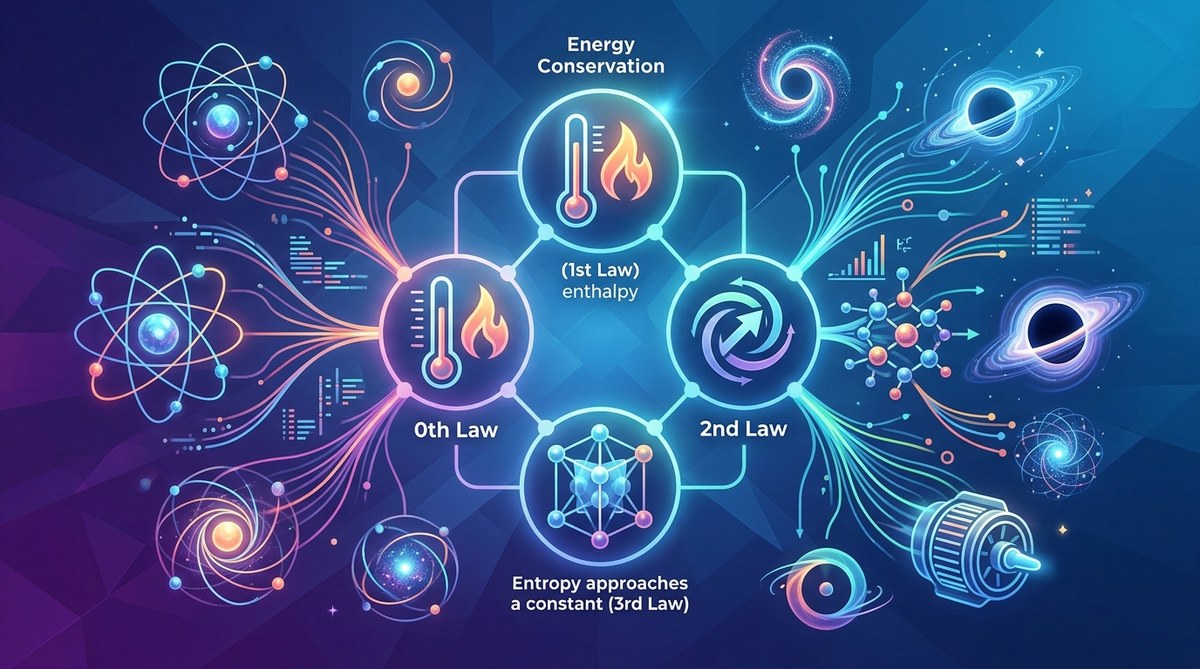
The laws of thermodynamics are a set of four principles that describe how energy behaves in physical systems. They are based on empirical observations and have been refined over centuries. These laws form the backbone of modern physics and engineering, shaping our understanding of everything from engines to black holes.
The Zeroth Law: Establishing Thermal Equilibrium
The zeroth law states that if two systems are each in thermal equilibrium with a third system, then they are in thermal equilibrium with each other. This principle underpins the concept of temperature and allows us to use thermometers reliably. It asserts that temperature is a transitive property, serving as a fundamental measure of heat.
The First Law: Conservation of Energy
The first law emphasizes that energy cannot be created or destroyed, only transformed. In practical terms, when you heat a pot, the energy from the stove transfers to the water, raising its temperature. This law is essential for understanding engines, refrigerators, and even biological processes where energy conversion occurs.
The Second Law: Entropy and Irreversibility
The second law introduces the concept of entropy, a measure of disorder within a system. It states that in an isolated system, entropy tends to increase over time. This explains why certain processes are irreversible; for instance, cream mixing into coffee cannot spontaneously separate. It also explains the arrow of time and the ultimate fate of the universe.
The Third Law: Approaching Absolute Zero
The third law states that as temperature approaches absolute zero, the entropy of a perfect crystal approaches zero. This has profound implications in low-temperature physics and the quest to achieve near-zero temperatures, enabling the study of quantum phenomena.
How These Laws Shape Modern Physics
These four principles are not isolated ideas but form the foundation for many modern physics theories. They influence how scientists understand energy, matter, and the universe’s evolution.
Impact on Thermodynamic Systems and Statistical Mechanics
Thermodynamics and statistical mechanics are deeply intertwined. The laws guide how microscopic particles behave and how their collective properties emerge. For example, understanding entropy helps explain the behavior of gases, solids, and liquids at the atomic level.
Influence on Quantum Physics and Cosmology
Quantum physics often deals with energy quantization and uncertainty, concepts that are compatible with thermodynamic principles. In cosmology, the second law explains the increasing disorder of the universe, influencing theories about its origin and ultimate destiny.
Applications in Modern Technology
From engines and refrigerators to solar panels and quantum computers, thermodynamic principles underpin countless technologies. Engineers use these laws to optimize energy efficiency and develop new materials and devices.
Practical Processes and Thermodynamics
Understanding these laws helps in designing efficient systems and solving real-world problems. Here are three practical processes where thermodynamics principles are crucial:
- Heat Engine Optimization: Improving the efficiency of engines by minimizing energy loss due to entropy.
- Refrigeration Cycles: Using entropy and energy transfer principles to produce cooling.
- Renewable Energy Systems: Harnessing solar and wind energy with an understanding of energy transfer and entropy.
Scanning Key Concepts
- Energy conservation
- Entropy increase
- Absolute zero
- Thermodynamic equilibrium
- Irreversible processes
Techniques and Mistakes Table
| Technique | Common Mistake |
|---|---|
| Using the first law to balance energy in systems | Ignoring work and heat transfer terms |
| Applying entropy calculations properly | Assuming entropy decreases in isolated systems |
| Approaching absolute zero in experiments | Overestimating achievable low temperatures |
Expert Advice
“Thermodynamics isn’t just about engines; it describes how the universe itself evolves. Recognizing the role of entropy helps us understand cosmic phenomena and the limits of technological progress.” — Dr. Jane Smith, Physicist
Thermodynamics and the Evolution of Modern Theories
The influence of thermodynamic laws extends beyond classical mechanics into contemporary physics theories. They provide a framework for understanding complex phenomena and developing innovative technologies.
Linking Thermodynamics with Quantum Mechanics
Quantum systems exhibit behaviors that seem to challenge classical thermodynamics. However, the principles remain valid at microscopic scales, guiding research in quantum thermodynamics and information theory.
Cosmology and the Universe’s Fate
The second law predicts that entropy in the universe increases, leading to the concept of the heat death. This ultimate state involves a universe in thermodynamic equilibrium, with no free energy to perform work.
Emerging Fields and Future Directions
Thermodynamics continues to evolve, especially in fields like nanoscale physics, black hole thermodynamics, and energy storage. Researchers seek to understand how these laws operate in extreme conditions and novel materials.
How To Apply Thermodynamic Principles
Applying these principles involves careful analysis of energy flows, system boundaries, and entropy changes. Here are three steps to incorporate thermodynamics into your studies or projects:
- Identify the System and Surroundings: Define what is contained within your system and what lies outside.
- Apply Conservation Laws: Use the first law to account for energy transfer via heat, work, or mass flow.
- Analyze Entropy Changes: Determine whether processes are reversible or irreversible, considering entropy production.
Common Mistakes to Avoid
- Overlooking work when calculating energy transfer
- Assuming processes are reversible without justification
- Neglecting entropy generation in real-world systems
Wrapping Up the Role of Thermodynamics in Modern Physics
Grasping the laws of thermodynamics offers a window into the universe’s underlying order and chaos. These principles guide scientists in designing better engines, understanding the cosmos, and exploring new frontiers like quantum computing. By understanding how energy moves, transforms, and disperses, you build a solid foundation for engaging with the most exciting areas of physics today.
Whether you’re analyzing a simple heat engine or contemplating the universe’s fate, applying thermodynamic principles unlocks a deeper appreciation of nature’s laws. Keep these laws in mind as you progress in your studies or curiosity-driven exploration—they are keys to many scientific mysteries.