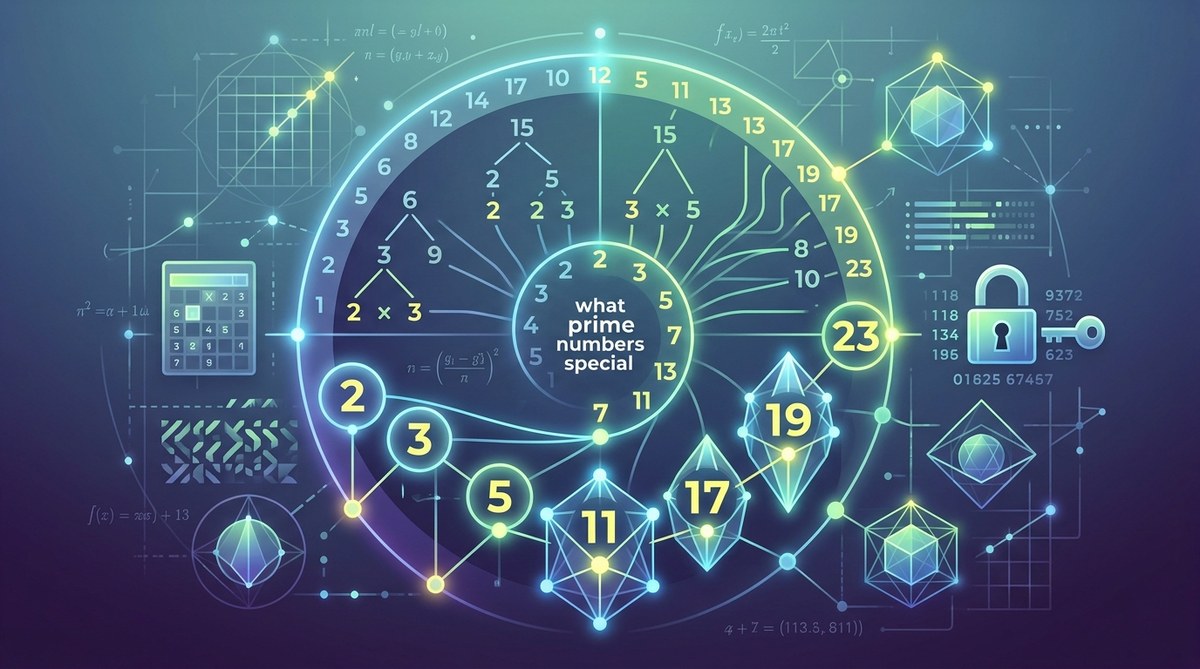
Prime numbers appear simple at first glance. They’re just numbers divisible only by 1 and themselves. Yet these mathematical building blocks drive modern encryption, secure online transactions, and form the foundation of entire branches of mathematics. Their importance stretches far beyond classroom exercises into real-world applications that shape our digital lives.
Prime numbers serve as the fundamental building blocks of all integers through unique factorization. They secure digital communications through encryption algorithms, drive advances in number theory, and create patterns that mathematicians still work to understand. Their unpredictable distribution makes them essential for cryptography while their mathematical properties continue revealing new insights about the nature of numbers themselves.
Building Blocks of All Numbers
Every whole number greater than 1 breaks down into prime factors in exactly one way. This property, called the Fundamental Theorem of Arithmetic, makes primes the atoms of mathematics.
Consider the number 60. You can factor it as 2 × 2 × 3 × 5. No other combination of primes multiplies to give 60. This uniqueness matters because it means primes provide a universal language for describing all integers.
Think of primes like chemical elements. Just as water always consists of hydrogen and oxygen in the same ratio, composite numbers always factor into the same primes. This consistency allows mathematicians to study number properties by examining their prime components.
The number 1 doesn’t count as prime for this exact reason. If 1 were prime, factorization wouldn’t be unique anymore. You could write 6 as 2 × 3, or 1 × 2 × 3, or 1 × 1 × 2 × 3, breaking the system.
Securing Your Digital Life
Every time you shop online, check your bank account, or send a private message, prime numbers protect your information. Modern encryption relies on the difficulty of factoring large numbers into their prime components.
RSA encryption, used across the internet, works like this:
- Generate two massive prime numbers, each hundreds of digits long
- Multiply them together to create a public key
- Use the original primes as a private key for decryption
- Share the public key freely while keeping primes secret
Breaking this encryption requires factoring that huge product back into its prime components. With current technology, this takes longer than the age of the universe for sufficiently large primes. The security of online banking, medical records, and government communications depends on this mathematical difficulty.
Credit card transactions use prime-based encryption every second. Without primes, secure e-commerce wouldn’t exist. Your personal data would be vulnerable to anyone intercepting network traffic.
Cryptocurrency systems also rely on prime-based cryptography. Bitcoin, Ethereum, and other digital currencies use elliptic curve cryptography, which builds on prime number mathematics to verify transactions and maintain blockchain security.
Patterns That Refuse to Conform
Primes follow no predictable pattern, which makes them fascinating to mathematicians. The gaps between consecutive primes vary wildly. Sometimes primes appear close together (like 11 and 13), other times huge gaps separate them.
The Prime Number Theorem describes roughly how many primes exist below any given number. Yet predicting where the next prime appears remains impossible. This unpredictability serves both theoretical mathematics and practical applications.
Consider these prime pairs:
| Prime Pair | Gap | Pattern Type |
|---|---|---|
| 3, 5 | 2 | Twin primes |
| 11, 13 | 2 | Twin primes |
| 89, 97 | 8 | Cousin primes |
| 113, 127 | 14 | Large gap |
Twin primes (pairs differing by 2) appear throughout the number line, but mathematicians haven’t proven whether infinitely many exist. This unsolved problem, the Twin Prime Conjecture, has challenged researchers for centuries.
The Riemann Hypothesis, one of mathematics’ most famous unsolved problems, concerns the distribution of primes. Solving it would win a million-dollar prize and revolutionize our understanding of number theory.
Testing and Finding Primes
Determining whether a number is prime becomes harder as numbers grow larger. For small numbers, trial division works fine. Just check if any prime up to the square root divides the number evenly.
For enormous numbers with thousands of digits, mathematicians use probabilistic tests. The Miller-Rabin test, for example, doesn’t guarantee a number is prime but makes the probability of error vanishingly small after repeated testing.
Finding large primes matters for both cryptography and pure mathematics. The Great Internet Mersenne Prime Search (GIMPS) uses distributed computing to hunt for Mersenne primes, which take the form 2^p – 1 where p is prime.
The largest known prime, discovered in 2018, contains over 24 million digits. Writing it out would fill thousands of pages. These discoveries push the boundaries of computational mathematics and test new algorithms.
Understanding prime distribution helps us grasp fundamental questions about how numbers behave. Every advance in prime number theory ripples through multiple areas of mathematics, from algebra to analysis.
Applications Beyond Encryption
Prime numbers influence fields you might not expect. Computer scientists use them in hash tables, data structures that store and retrieve information efficiently. Choosing table sizes as primes reduces collisions and improves performance.
Cicadas in North America emerge from underground in cycles of 13 or 17 years, both prime numbers. This timing helps them avoid predators that operate on shorter cycles. Using prime-year cycles means fewer overlaps with predator population peaks.
Random number generators, essential for simulations and statistical sampling, often incorporate prime numbers in their algorithms. The unpredictability of primes helps create better randomness.
Music theorists study rhythmic patterns based on prime numbers. Composers use prime-based time signatures to create complex, non-repeating patterns that challenge traditional musical structures.
Error-correcting codes, which fix data corruption in CDs, DVDs, and digital transmissions, use prime-based mathematics. These codes detect and repair errors without retransmitting data.
Common Misconceptions About Primes
Many students think 1 is prime because it’s only divisible by itself. But the definition requires exactly two distinct divisors. The number 1 has only one divisor, disqualifying it from prime status.
Some believe all prime numbers are odd. While true for all primes except 2, this exception matters. The number 2 stands as the only even prime and plays a special role in number theory.
People sometimes assume mathematicians have found all primes up to some limit. Actually, Euclid proved over 2,000 years ago that infinitely many primes exist. No matter how high you count, more primes await discovery.
The idea that primes become increasingly rare is partially true but misleading. While the density of primes decreases as numbers grow, the absolute count of primes in any range still increases. Between 1 and 100, there are 25 primes. Between 1 and 1,000, there are 168 primes.
Learning to Work With Primes
Students often struggle with prime factorization at first. The process becomes easier with practice and systematic approaches.
Start by testing divisibility rules:
- Check if the number is even (divisible by 2)
- Sum digits to test for divisibility by 3
- Check if it ends in 0 or 5 (divisible by 5)
- Apply other divisibility tests as needed
Build a mental list of small primes: 2, 3, 5, 7, 11, 13, 17, 19, 23, 29. Knowing these by heart speeds up factorization and problem-solving.
Practice recognizing prime-related patterns. Perfect squares always have an odd number of factors. Prime powers (like 8 = 2³) have factors that are all powers of a single prime.
Understanding why dividing by zero breaks mathematics helps clarify why certain operations with primes work while others don’t. Both concepts reveal fundamental mathematical structures.
Historical Significance and Future Research
Ancient Greek mathematicians studied primes 2,300 years ago. Euclid’s proof that infinitely many primes exist remains elegant and accessible. His method assumes a finite list of primes, multiplies them together, adds 1, and shows the result must be divisible by a new prime not on the list.
The Sieve of Eratosthenes, another ancient algorithm, systematically eliminates composite numbers to reveal primes. This method still teaches the concept effectively today.
Modern research tackles questions about prime gaps, prime patterns, and connections between primes and other mathematical structures. Advances in computational power let researchers test hypotheses on scales impossible a generation ago.
Quantum computing threatens current encryption methods but also opens new possibilities. Post-quantum cryptography develops new prime-based systems resistant to quantum attacks.
The Goldbach Conjecture states that every even number greater than 2 is the sum of two primes. Verified for numbers up to astronomical values, it remains unproven in general. Solving it would deepen our understanding of additive properties of primes.
Primes in Education and Problem Solving
Teachers introduce primes early because they build foundational number sense. Recognizing primes helps students understand factors, multiples, and divisibility.
Competition mathematics frequently features prime problems. Students learn to spot prime patterns, apply theorems, and construct proofs. These skills transfer to other mathematical areas.
Developing mental math tricks that will transform your calculation speed often involves recognizing prime factors. Quick factorization helps simplify fractions, find common denominators, and solve algebraic equations.
Real-world problem solving benefits from prime number knowledge. Scheduling problems, resource allocation, and optimization sometimes find elegant solutions through prime-based approaches.
Why Mathematicians Stay Fascinated
Prime numbers combine accessibility with depth. A child can understand the definition, yet the world’s best mathematicians still can’t answer basic questions about their distribution.
This combination of simplicity and mystery drives research forward. Each discovery about primes potentially unlocks new mathematical tools and applications.
The connection between primes and other mathematical areas keeps expanding. Number theory links to complex analysis through the Riemann zeta function. Primes appear in algebraic geometry, topology, and even physics.
Unsolved problems about primes motivate entire careers. Researchers spend decades pursuing answers, sometimes achieving breakthroughs that reshape mathematics.
The practical applications provide additional motivation. Advances in prime number theory directly improve cryptographic security, benefiting everyone who uses digital technology.
The Lasting Impact of Prime Numbers
Prime numbers matter because they sit at the intersection of pure mathematics and practical application. They protect your digital privacy while challenging our deepest understanding of numbers.
Their importance extends from ancient Greek geometry to modern quantum computing. Every online transaction, every encrypted message, every secure database relies on the mathematical properties of primes.
For students, understanding why primes matter transforms them from abstract concepts into powerful tools. Whether you’re factoring polynomials, analyzing algorithms, or simply appreciating mathematical beauty, primes provide essential insights.
The next time you enter a password, send an email, or make an online purchase, remember that prime numbers work behind the scenes to keep your information secure. These simple mathematical objects, defined by what they can’t be divided by, have become indispensable to modern life.