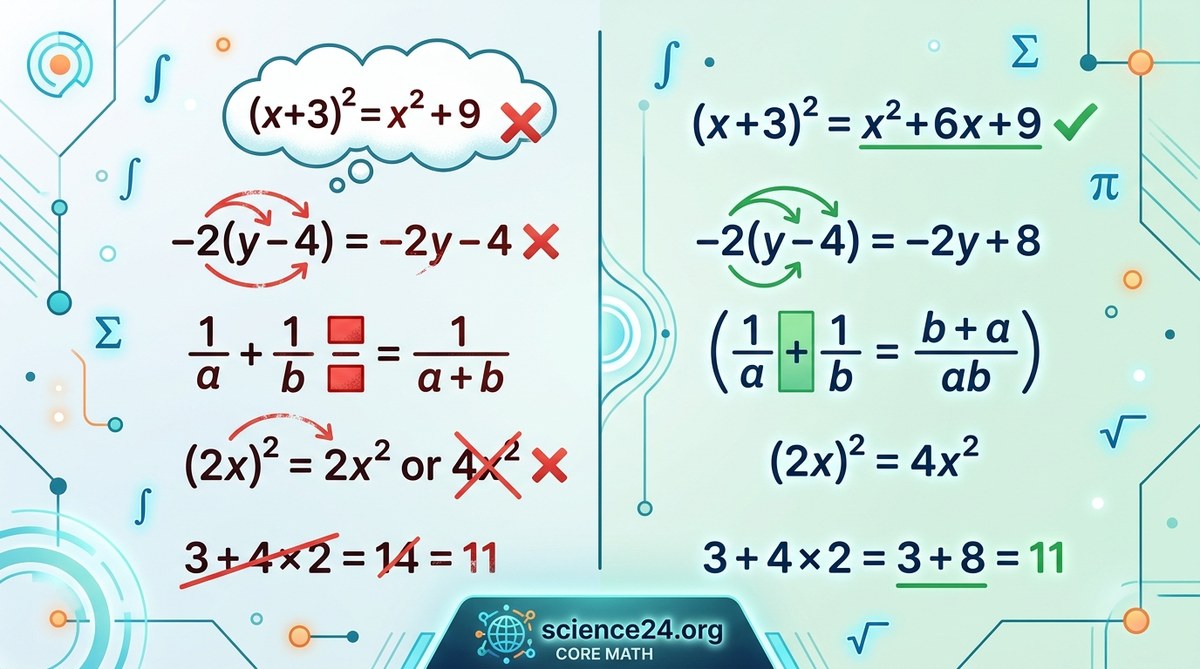
You’re staring at your algebra homework, and something feels off. The answer in the back of the book doesn’t match yours. Again. You’ve checked your work twice, but you can’t spot where things went wrong. Sound familiar? You’re not alone. Students make the same algebra errors over and over, not because the math is too hard, but because certain patterns trip everyone up.
Most algebra errors stem from ten recurring patterns: sign mistakes, order of operations confusion, incorrect distribution, combining unlike terms, fraction errors, exponent misuse, equation solving shortcuts, zero division, variable cancellation, and notation misunderstandings. Recognizing these patterns and applying specific correction strategies will dramatically improve your accuracy and confidence in algebra.
Sign errors destroy otherwise perfect solutions
Negative signs are sneaky. They hide in parentheses, flip during subtraction, and multiply when you least expect them.
The most common sign error happens when students subtract a negative number. If you see 5 – (-3), you need to recognize this becomes 5 + 3 = 8. The two negatives create a positive.
Another trap occurs when distributing a negative sign across parentheses. Look at this example:
Wrong: -(2x – 5) = -2x – 5
Right: -(2x – 5) = -2x + 5
That negative sign outside the parentheses must multiply every term inside. The -5 becomes +5.
Here’s how to catch sign errors before they ruin your work:
- Circle every negative sign in your problem before you start
- When distributing a negative, write out the multiplication explicitly: -1(2x – 5)
- Double-check your signs after each step, not just at the end
- Use different colored pens for positive and negative terms if that helps you track them
A simple habit saves countless points: pause after writing each new line and scan specifically for sign changes. Your brain wants to rush, but signs demand attention.
Order of operations gets ignored under pressure
PEMDAS (Parentheses, Exponents, Multiplication/Division, Addition/Subtraction) isn’t just a catchy phrase. It’s the law of algebra.
Students know the rule but forget it when problems get complicated. Consider this expression:
3 + 2 × 5²
If you work left to right, you get (3 + 2) × 5² = 5 × 25 = 125. Wrong.
The correct path follows order of operations:
– First, handle the exponent: 5² = 25
– Then multiply: 2 × 25 = 50
– Finally add: 3 + 50 = 53
The mistake multiplies when fractions enter the picture. Students often add numerators and denominators separately without recognizing that division is part of the operation sequence.
Building better habits with mental math tricks that will transform your calculation speed can reinforce proper operation order naturally.
The distributive property demands precision
The distributive property states that a(b + c) = ab + ac. Simple enough, right? Yet this is where errors pile up fast.
Common mistake: 3(x + 4) = 3x + 4
Students distribute to the first term but forget the second. The correct answer is 3x + 12.
The error gets worse with subtraction and negative coefficients:
Wrong: -2(3x – 7) = -6x – 14
Right: -2(3x – 7) = -6x + 14
That negative coefficient must multiply both terms, and the -7 becomes +14 because (-2)(-7) = +14.
Here’s a distribution checklist:
- Count the terms inside the parentheses before you start
- Draw an arrow from the outside term to each inside term
- Write out each multiplication separately
- Count your final terms to match the original count inside parentheses
Like terms have specific rules
You can’t add apples and oranges. You also can’t combine x² and x.
Like terms must have identical variable parts with identical exponents. The coefficient can differ, but everything else must match.
| Term Type | Can Combine With | Cannot Combine With |
|---|---|---|
| 3x | 5x, -2x, x | 3x², 3y, 3 |
| 4x²y | -2x²y, x²y | 4xy², 4x², 4y |
| 7 | -3, 12, 100 | 7x, 7y, 7x² |
Look at this problem: Simplify 2x² + 3x + 5x² – x
Students often create: 10x³ or 7x³ + 2x
The correct answer recognizes two separate groups:
– x² terms: 2x² + 5x² = 7x²
– x terms: 3x – x = 2x
– Final answer: 7x² + 2x
These terms cannot combine further because the exponents differ.
Fraction operations need careful attention
Fractions in algebra follow the same rules as arithmetic fractions, but variables make students second-guess themselves.
Adding fractions requires common denominators:
Wrong: x/3 + x/4 = 2x/7
Right: x/3 + x/4 = 4x/12 + 3x/12 = 7x/12
You cannot add denominators. You must find a common denominator first.
Multiplying fractions is more forgiving:
(2/3)(x/5) = 2x/15
Multiply straight across: numerator times numerator, denominator times denominator.
Dividing by a fraction means multiplying by its reciprocal:
(x/4) ÷ (2/3) = (x/4) × (3/2) = 3x/8
Students often flip the wrong fraction or forget to flip at all.
Exponent rules create confusion
Exponents have specific laws that don’t match intuition.
When multiplying same bases, add exponents:
x³ × x⁴ = x⁷ (not x¹²)
When dividing same bases, subtract exponents:
x⁵ ÷ x² = x³ (not x²·⁵)
When raising a power to a power, multiply exponents:
(x²)³ = x⁶ (not x⁵)
Anything to the zero power equals one:
x⁰ = 1 (as long as x ≠ 0)
Negative exponents mean reciprocals:
x⁻² = 1/x²
Here’s what trips students up most: (2x)³ ≠ 2x³
The parentheses mean the exponent applies to everything inside:
(2x)³ = 2³ × x³ = 8x³
Without parentheses, only the x gets cubed: 2x³
Solving equations requires balanced operations
Whatever you do to one side of an equation, you must do to the other. Always.
Wrong approach:
3x + 5 = 20
3x = 20
x = 20/3
The student forgot to subtract 5 from the right side.
Correct approach:
3x + 5 = 20
3x + 5 – 5 = 20 – 5
3x = 15
x = 5
Every operation needs a matching operation on the opposite side. Write it out explicitly until this becomes automatic.
Another frequent error: dividing only part of one side.
Wrong:
2x + 6 = 10
x + 6 = 5
x = -1
The student divided only the 2x by 2, leaving the 6 untouched.
Right:
2x + 6 = 10
2x = 4
x = 2
You must isolate the variable term before dividing.
Division by zero breaks everything
You cannot divide by zero. Period. This isn’t a suggestion or a guideline. It’s a mathematical impossibility.
Why? Division asks “how many times does this number fit into that number?” But zero fits into any number an infinite number of times, and any number fits into zero… never? Both? The operation creates contradictions.
Students make this error when canceling variables:
Dangerous move:
x²/x = x
This looks fine, but what if x = 0? Then you’ve divided by zero without realizing it.
Safer approach:
x²/x = x, where x ≠ 0
Always state your restrictions. Understanding why dividing by zero breaks mathematics helps you spot these hidden dangers.
When solving equations, check if your solution makes any denominator equal zero:
(x + 3)/(x – 2) = 5
If you solve and get x = 2, that solution is invalid because it creates 0 in the denominator.
Canceling variables requires matching factors
You can only cancel factors, not terms.
Wrong:
(x + 3)/x = 3
Students see x in both numerator and denominator and think they cancel. They don’t. The x is added to 3, not multiplied.
You can cancel here:
(x × 3)/x = 3
Now x is a factor of the numerator, so it cancels with the x in the denominator.
Another example:
Wrong:
(2x + 4)/(2) = x + 4
Right:
(2x + 4)/(2) = x + 2
You must distribute the division to both terms: 2x/2 + 4/2 = x + 2
Or factor first: 2(x + 2)/2 = x + 2
Factoring makes cancellation clearer and safer.
Parentheses and brackets need respect
Parentheses group operations together. Remove them incorrectly and you change the entire problem.
Wrong:
2(x + 3) = 2x + 3
Right:
2(x + 3) = 2x + 6
Nested parentheses require extra care:
3[2(x – 4) + 5]
Work from the inside out:
- Handle the innermost parentheses: 2(x – 4) = 2x – 8
- Substitute back: 3[2x – 8 + 5]
- Simplify inside brackets: 3[2x – 3]
- Distribute the 3: 6x – 9
Skipping steps or working out of order creates errors that cascade through the rest of your work.
Building habits that prevent these mistakes
Knowing the errors isn’t enough. You need systems that catch them automatically.
- Write every step on a new line instead of cramming work into margins
- Use graph paper to keep terms aligned vertically
- Read your work backwards to spot errors your forward-reading brain misses
- Keep an error log where you write down every mistake and its correction
- Practice problems specifically designed to target your weak spots
When you’re learning to solve more complex problems like those covered in the complete guide to solving quadratic equations every time, these foundational habits become even more critical.
Set up a checking routine:
- Scan for sign errors first
- Verify you followed order of operations
- Confirm like terms are truly alike
- Check that both sides of equations received the same operations
- Test your final answer by substituting it back into the original equation
That last step catches errors that slip through everything else. If your answer doesn’t satisfy the original equation, you know something went wrong.
Your path forward starts with awareness
Algebra mistakes aren’t random. They follow patterns, which means you can learn to spot and fix them before they cost you points.
Start by identifying which of these ten errors shows up most often in your work. Focus on that one first. Master the correction strategy. Then move to the next pattern.
Keep your error log updated. After a few weeks, you’ll see your repeated mistakes clearly. That awareness is half the battle. The other half is deliberate practice with problems that specifically target those weak spots.
Your algebra skills will improve faster when you stop making the same mistakes over and over. These ten patterns account for most errors students make. Fix them, and you’ll see your confidence and grades climb together.