When you first see fractions, decimals, and percents, they might look like three separate languages. A sale price says 50% off. A recipe calls for 0.5 cups of milk. Your math homework asks for 1/2 of something. The truth is that 50%, 0.5, and 1/2 all mean the same value. They are just different ways to write it. Learning to move between these forms is a foundational skill that will help you in shopping, cooking, budgeting, and any STEM class. Once you see the simple pattern, you will never confuse them again.
Fractions, decimals, and percents all express parts of a whole. To convert between them, you only need two operations: division and multiplication by 100. A fraction becomes a decimal when you divide the numerator by the denominator. A decimal becomes a percent when you multiply by 100. Reverse the process to go back. Practice with the table and examples in this guide, and you will gain confidence immediately.
Why These Three Forms Matter
In real life, you bump into all three forms constantly. A grade on a test might be 18 out of 20 (a fraction). That same score is 0.9 as a decimal. When your teacher reports it as 90%, they are using a percent. Understanding how to switch between them lets you compare prices, figure out tips at a restaurant, and solve homework problems faster.
Many students stress over converting because they think each type needs a different trick. Actually, the logic is the same for every conversion. Once you learn the two core moves, you can handle any number.
The Simple Pattern Behind Every Conversion
There is one big idea to remember: fractions, decimals, and percents are all related to the number 100. A percent means “per hundred.” So 75% is 75 out of 100. That is also the fraction 75/100, which simplifies to 3/4. And 75/100 as a decimal is 0.75.
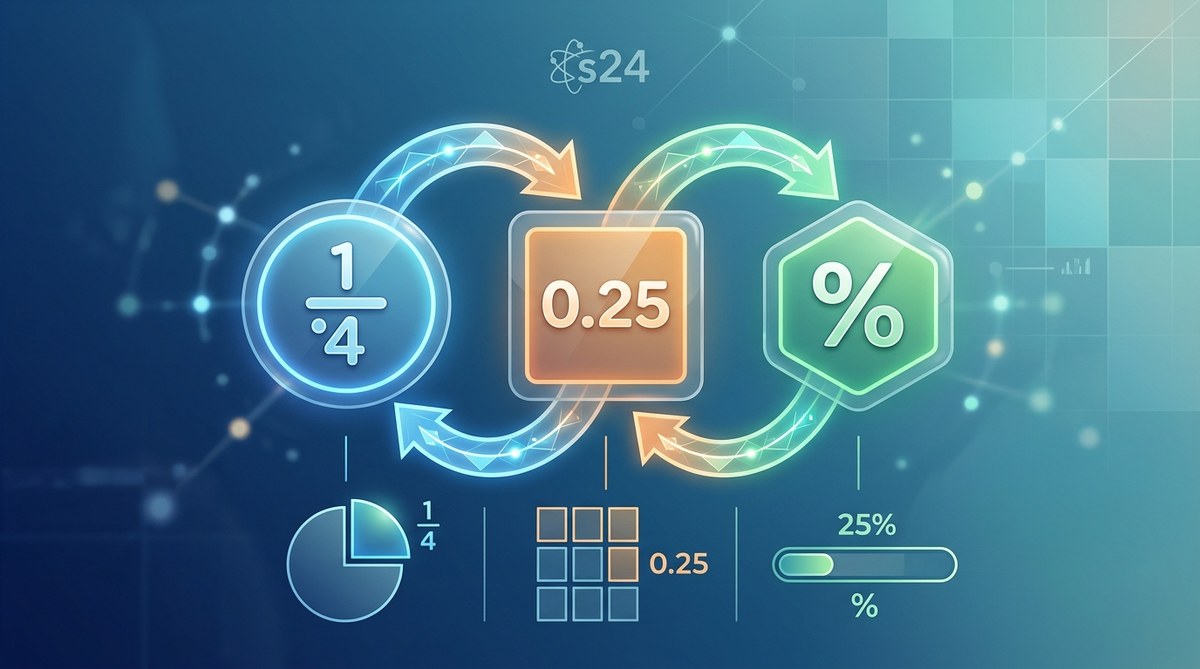
You can think of the conversion as moving along a three-stop path. At each stop, you either divide or multiply by 100. Here is the pattern:
- Fraction to Decimal: Divide the top number (numerator) by the bottom number (denominator).
- Decimal to Percent: Multiply the decimal by 100 (or move the decimal point two places to the right).
- Percent to Decimal: Divide the percent by 100 (or move the decimal point two places to the left).
- Decimal to Fraction: Write the decimal as a fraction over the correct power of 10, then simplify.
- Percent to Fraction: Write the percent over 100, then simplify.
- Fraction to Percent: First convert the fraction to a decimal, then multiply by 100.
That is really all there is. Let us see how it works with concrete numbers.
Step-by-Step: How to Convert Fractions, Decimals, and Percents
Follow these numbered steps for each situation. You can bookmark this list to use as a reference.
-
Fraction to decimal: Take the numerator and divide it by the denominator. For 3/4, do 3 divided by 4 equals 0.75. For 5/8, do 5 divided by 8 equals 0.625. Use long division or a calculator if you need to.
-
Decimal to percent: Multiply the decimal by 100. So 0.75 becomes 75, then add the percent sign (75%). 0.125 becomes 12.5%. If the decimal has more than two digits, just move the decimal point two places to the right: 0.1234 becomes 12.34%.
-
Percent to decimal: Divide the percent number by 100. 75% becomes 0.75. 12.5% becomes 0.125. You can just move the decimal point two places to the left.
-
Decimal to fraction: Look at how many digits are after the decimal point. For 0.75, there are two digits, so place it over 100: 75/100. Then simplify by dividing top and bottom by 25 to get 3/4. For 0.625, three digits means over 1000: 625/1000 simplifies to 5/8.
-
Percent to fraction: Write the percent over 100 and simplify. 80% becomes 80/100 = 4/5. 37.5% becomes 37.5/100, but you do not want a decimal in a fraction. Multiply numerator and denominator by 10 to get 375/1000, then simplify to 3/8.
-
Fraction to percent: Convert the fraction to a decimal first (step 1), then follow step 2. For 1/4: 1 divided by 4 = 0.25, then 0.25 x 100 = 25%.
Common Conversions at a Glance
A table can help you memorize the most frequent conversions. Print it or save it to your phone.
| Fraction | Decimal | Percent |
|---|---|---|
| 1/2 | 0.5 | 50% |
| 1/3 | 0.333… | 33.33…% |
| 1/4 | 0.25 | 25% |
| 1/5 | 0.2 | 20% |
| 1/8 | 0.125 | 12.5% |
| 1/10 | 0.1 | 10% |
| 2/5 | 0.4 | 40% |
| 3/4 | 0.75 | 75% |
| 3/8 | 0.375 | 37.5% |
| 5/8 | 0.625 | 62.5% |
Notice the repeating decimal for 1/3. That is okay. For most everyday uses, you can round to 33.3% or 0.333.
Expert Advice: Watch Out for These Pitfalls
Even confident math students make small errors when they rush. Here is advice from a middle school math teacher who has helped hundreds of students.
“The most common mistake I see is forgetting to divide when going from a fraction to a decimal. Students try to multiply instead. Remember: a fraction line means division. The second common error is moving the decimal point the wrong direction when converting between decimals and percents. If you are turning a decimal into a percent, the number gets bigger, so the decimal point moves right. If you are turning a percent into a decimal, the number gets smaller, so the decimal point moves left.” — Mrs. Rivera, 6th grade math teacher, Chicago
Keep that advice in mind. It is easy to slip up, but a quick check (does the number get larger or smaller?) will catch most mistakes.
Common Mistakes and How to Fix Them
Here is a bulleted list of mistakes you can avoid:
- Mixing up the direction of the decimal point shift. Remember: decimal to percent = move right. Percent to decimal = move left.
- Forgetting to simplify fractions. A fraction like 50/100 is correct, but 1/2 is cleaner and easier to use.
- Rounding too early. If you round a decimal before converting to a percent, you lose accuracy. Keep at least three or four decimal places until the final answer.
- Using the wrong denominator for decimals. For a decimal like 0.2, only one digit means denominator 10. For 0.25, denominator 100. For 0.125, denominator 1000.
- Confusing “percent” with “decimal.” 0.5 is not 0.5%. That is a huge difference. 0.5% is actually 0.005.
How to Check Your Work Instantly
You do not need a teacher to tell you if your conversion is right. Use this simple check. Pick any value and run it through two conversions. For example, start with 2/5. Convert to decimal: 2/5 = 0.4. Then convert that decimal to percent: 0.4 = 40%. Now go backward: 40% to decimal = 0.4, and 0.4 to fraction = 2/5. If you end up where you started, you did it correctly.
This round-trip method is a great way to build confidence. You can apply it to any problem. Try it with 3/8, 7/10, or even tricky ones like 7/12.
Real-World Examples You Can Practice Today
Let us look at situations you might face this week.
Example 1: Shopping sale. A jacket is marked 30% off the original price of $50. What is 30% as a decimal? 30% = 0.30. Multiply 0.30 x 50 = $15 off. The sale price is $35. Now, you also might see a sign that says “1/3 off.” 1/3 as a decimal is about 0.333. For a $60 item, that discount is $20.
Example 2: Recipe adjustments. A pancake recipe calls for 0.75 cups of milk. You lost the measuring cup but have a 1/4 cup measure. How many quarter cups equal 0.75? Since 0.75 = 3/4, you need three of your quarter cups.
Example 3: Test score. You scored 21 out of 30 on a quiz. That is 21/30. Simplify to 7/10. As a decimal, 7/10 = 0.7. Multiply by 100 to get 70%. Now you know you earned a C.
These examples show how the conversion skill is not just for school. It is for daily decision making.
Why Percents Can Have Decimals (and That Is Normal)
You might see a percent like 12.5% or 66.666%. This is fine. A percent does not have to be a whole number. If you ever get a repeating decimal from a fraction, just round to a sensible number of decimal places. For instance, 1/3 is 33.33% if you round to two decimal places. In many tests, they accept the repeating bar or the rounded form.
To convert a percent with a decimal back to a fraction, you can multiply the numerator and denominator by 10 or 100 to eliminate the decimal point, as we did earlier with 37.5%.
Using Mental Math to Speed Up Conversions
You do not always need paper. With practice, you can do many conversions in your head. Start with the easy ones like 1/2, 1/4, 3/4, 1/5, and 1/10. Then build up to 3/8 and 5/8. If you want to sharpen your mental arithmetic further, check out 7 Mental Math Tricks That Will Transform Your Calculation Speed. Those tricks will make converting fractions and decimals even faster.
For example, to find 3/5 as a percent, you know 1/5 is 20%, so 3/5 is 60%. To find 0.45 as a fraction, you can think 45/100 simplifies to 9/20.
When You Encounter Mixed Numbers and Improper Fractions
Sometimes a fraction is bigger than 1, like 7/4 or 1 3/4. The same rules apply. Convert 7/4 by dividing 7 by 4 to get 1.75. Then 1.75 as a percent is 175%. That makes sense because 7/4 is more than a whole. To convert a mixed number, turn it into an improper fraction first: 1 3/4 = 7/4. Then proceed as usual.
Do not let mixed numbers scare you. The method is identical.
A Quick Reference for Parents Helping with Homework
If you are a parent working with a child in grades 5 through 8, here is a simple script you can use. Ask the child: “Is this number a fraction, a decimal, or a percent?” Once they identify it, remind them of the rule. For fraction to decimal: divide top by bottom. For decimal to percent: multiply by 100, move decimal two right. For percent to decimal: divide by 100, move two left. Practice with the table above together for five minutes a day. Consistency builds mastery.
For more foundational math help, you might also be interested in 10 Common Algebra Mistakes and How to Avoid Them. Many algebra errors start with weak number sense, and this guide can help prevent those later on.
Why This Skill Is Important for Standardized Tests
On exams like the SAT, ACT, or state assessments, you will see problems that mix these forms. A question might give you a fraction and ask for an equivalent percent. Another might list three numbers in different forms and ask which one is largest. If you cannot convert quickly, you lose time and points.
Practicing these conversions until they become automatic will save you stress. Start with the table above. Then try converting random numbers you see in daily life: gas prices (like $3.499 per gallon as a fraction), interest rates (like 4.25% as a decimal), or sports statistics (like a batting average of 0.300 as a fraction).
Your Turn to Practice Without Panic
You now have a complete toolkit. The pattern is simple: divide or multiply by 100. Use the step list as your go-to guide. The table gives you a cheat sheet for the most common values. The expert tip keeps you from moving the decimal the wrong way.
Take one example from your own life today. A sale, a grade, a recipe, or a statistic. Write it down as a fraction, then convert it to a decimal and a percent. Do the round trip check to verify. Repeat this for a week, and you will wonder why you ever found it confusing.
If you want to strengthen other math foundations, you can also read Understanding Imaginary Numbers Without the Confusion or What Makes Prime Numbers So Special in Mathematics?. But for now, focus on fractions, decimals, and percents. Master these, and you unlock a huge part of everyday math.
You have everything you need right here. Go ahead and try the next conversion you see. You will get it right.