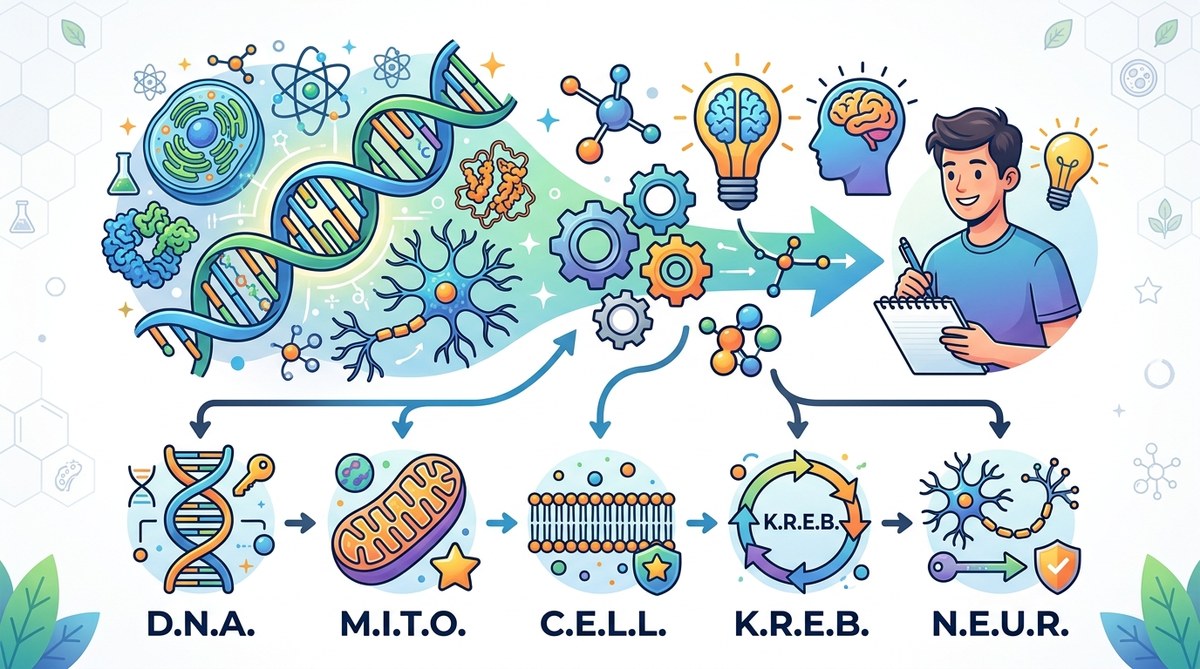
Biology demands a lot from your memory. From the stages of mitosis to the names of every bone in the hand, the sheer volume of terms can feel overwhelming. You sit down to study, review your notes, and within hours the details start to blur. You are not alone. Every pre-med and biology student hits this wall. The secret is not studying more hours. The secret is changing how you store the information in the first place.
Biology mnemonics turn abstract science terms into memorable stories, images, and patterns. By attaching new information to something your brain already knows, you cut study time and boost recall during exams. This guide covers proven mnemonic techniques, common mistakes to avoid, and ready-to-use examples for topics like cellular respiration, taxonomy, and the cranial nerves. Start using these memory tools today and watch your biology grades improve.
Why Your Brain Needs Biology Mnemonics
Your brain is wired to remember stories, not random lists. When you learn a sequence like “prophase, metaphase, anaphase, telophase,” each word is an isolated chunk of data. Without a hook, that chunk slips away. A mnemonic creates a hook. It links the new term to a vivid image, a silly sentence, or a familiar pattern.
Think of it like this. You have a mental filing cabinet. Biology mnemonics give each fact a labeled folder. When exam time comes, your brain opens the folder instead of searching the entire cabinet. This is especially useful for high school and undergraduate students juggling multiple science subjects at once. If you are also prepping for the MCAT or AP Biology, memory efficiency is your best friend.
The Five Pillars of a Strong Biology Mnemonic
Not every mnemonic works equally well. The best ones share five characteristics. Check your memory aids against this list.
- Vividness. The more outrageous or colorful the image, the easier it sticks. A boring sentence like “Peter eats meat” is weak. Replace it with something funny or weird.
- Personal relevance. A reference to your own life, a movie you love, or an inside joke with a friend is stronger than a generic phrase.
- Sound and rhythm. Rhymes and alliteration help. Words that bounce in your mouth are harder to forget.
- Chunking. Break long sequences into small groups. Your working memory holds about four items at once. Mnemonics that respect that limit perform better.
- Visual association. Pair the mnemonic with a simple drawing or mental image. Biology is a visual subject. Use that.
Ready-to-Use Biology Mnemonics for the Most Common Topics
You can apply the principles above to almost any biology concept. Here are some of the most popular and effective mnemonics used by students across the United States in 2026. Use them as they are, or adapt them to fit your own style.
Taxonomy: The Eight Levels of Classification
The taxonomic hierarchy from domain down to species is a classic memorization challenge. The sentence most students learn is:
“Dear King Philip Came Over For Good Soup.”
Each first letter matches a level: Domain, Kingdom, Phylum, Class, Order, Family, Genus, Species. But you can customize this. If you prefer something funnier, try “Dumb King Philip Chews On Fat Green Snakes.” The weirder version will stick longer.
The Phases of Mitosis
Mitosis is central to cell biology. The four main stages are prophase, metaphase, anaphase, and telophase. One solid mnemonic is:
“Polish My Apple Tree.”
Each underlined letter starts with the correct stage. You can add a visual: picture yourself polishing a giant apple tree before an exam. The action of polishing ties to the word prophase, and the tree stands for telophase. This kind of layered mnemonic is very effective.
The Cranial Nerves
Pre-med students face twelve cranial nerves. Their names and order are a rite of passage. Try this sentence:
“Old Opie Occasionally Tries Trigonometry And Feels Very Gloomy, Vague, And Hypoactive.”
That maps to: Olfactory, Optic, Oculomotor, Trochlear, Trigeminal, Abducens, Facial, Vestibulocochlear, Glossopharyngeal, Vagus, Accessory, Hypoglossal. The sentence is long, but it breaks the list into a story about a character named Opie. Story format beats raw repetition every time.
The Steps of Cellular Respiration
Glycolysis, the Krebs cycle, and the electron transport chain. Students often mix up the order. Use this one:
“Grandma Kicks Everyone Tomorrow.”
Grandma = Glycolysis, Kicks = Krebs cycle, Everyone = Electron transport chain, Tomorrow = Total ATP production. The phrase is short and absurd. Add a mental image of a grandmother kicking people at the finish line of a race. That is the kind of picture that stays in your head during a test.
DNA Base Pairing
Adenine pairs with thymine. Cytosine pairs with guanine. A simple trick is to think of the letters. A and T are both made of straight lines. C and G are both curvy letters. Another popular mnemonic is “Apple in the Tree, Car in the Garage.” Apples grow on trees, so A goes with T. Cars park in garages, so C goes with G.
Comparing Mnemonic Techniques: What Works Best
Different topics call for different memory tools. The table below breaks down the main techniques and where they shine.
| Technique | How It Works | Best For | Example |
|---|---|---|---|
| Acronym | First letters form a word or phrase | Sequences and ordered lists | PEMDAS for enzyme function order (not biology, but the pattern applies) |
| Rhyme | Rhyming words create a sound pattern | Paired facts or rules | “In 1492, Columbus sailed the ocean blue” type structure |
| Story Chain | A short narrative ties steps together | Processes with many stages | The Opie story for cranial nerves |
| Visual Image | A mental picture links to the term | Single terms or small sets | “Apple in the Tree” for DNA base pairs |
| Peg System | Pre-memorized “pegs” that you attach items to | Long lists you need in order | Peg 1 = bun, peg 2 = shoe, etc. |
Each technique works best when you practice active recall. Do not just read the mnemonic. Close your eyes and say it out loud. Draw the image. Teach it to a classmate. The act of retrieval strengthens the memory.
Common Mistakes Students Make With Biology Mnemonics
Even good mnemonics can backfire if you use them the wrong way. Watch out for these traps.
- Relying on the mnemonic without understanding the concept. A memory aid is a tool, not a replacement for learning. You still need to know what metaphase means, not just that “M” comes third.
- Using a mnemonic that is harder to remember than the original information. If the sentence itself is confusing, scrap it. Simplicity wins.
- Never reviewing the mnemonic. Creating it once is not enough. Review it the same way you review flashcards. Spaced repetition applies here too. Check out how to use spaced repetition to master STEM exam material in 2026 for a deeper look.
- Ignoring visual elements. Biology is full of structures. A purely verbal mnemonic misses half the power. Pair it with a sketch.
“The strongest memory techniques combine two or more senses. A student who says the mnemonic out loud while tracing a diagram builds multiple neural pathways. That student will outperform the one who just reads silently.” – Dr. Maya Torres, cognitive science researcher and STEM education consultant
How to Build Your Own Biology Mnemonics in 3 Steps
You can use all the classic examples above. But the most powerful mnemonics are the ones you create yourself. Here is a simple process to make your own for any biology term or process.
- Identify the hard part. Look at your study material. What keeps slipping out of your head? Focus on that single fact or sequence. Do not try to memorize everything at once.
- Find a familiar hook. What does the term sound like? What does it remind you of? Maybe “lysosome” sounds like “lyso-some” which you can imagine as a “somewhat loose” bag of enzymes that digests waste. The connection does not have to be scientifically exact. It just has to work for you.
- Add action and emotion. A hook is stronger when it involves movement or feeling. Picture the lysosome as a sloppy janitor who breaks down trash in the cell. The janitor is clumsy and spills enzymes everywhere. That image includes action, emotion, and a little humor. It will stick.
Integrating Mnemonics Into Your Study Routine
Mnemonics are not a standalone strategy. They work best as part of a complete study system. Pair them with active recall, practice tests, and regular review sessions.
For example, if you are studying the differences between plant and animal cells, first understand the core structures. Then build a mnemonic for the key differences. Finally, test yourself using a blank diagram. This layered approach is how you build deep, lasting knowledge. If you want to compare the structures themselves, read our guide on comparing plant and animal cells: 5 key structural differences that matter.
You should also cycle through your biology mnemonics during short study sessions. Spend five minutes reviewing three or four mnemonics. Then move on to another topic. Return to the same mnemonics the next day. Spaced repetition makes them permanent.
When Mnemonics Are Not Enough
There are moments in biology where a mnemonic alone will not cut it. Complex processes like the nitrogen cycle or the mechanism of enzyme catalysis require understanding relationships, not just memorizing a list. In those cases, use mnemonics to anchor the key terms, but invest your main study time in drawing flowcharts and explaining the process out loud. For a deeper understanding of enzymes, read what makes enzymes such powerful biological catalysts.
Think of mnemonics as the scaffolding. They hold up the structure while you build the real knowledge underneath. Once the knowledge is solid, you can remove the scaffolding. But many students keep their mnemonics forever because they still help during review.
Build a Personal Mnemonic Library
Start collecting your biology mnemonics in one place. A simple notebook, a digital document, or a set of flashcards works well. Every time you create a mnemonic that works, write it down. Over a semester, you will build a personalized memory toolkit. This library becomes invaluable during final exam week.
Here is a bulleted list of tips to make your library effective.
- Keep each entry short. One line plus a quick sketch.
- Date it. You want to know how long you have been using it.
- Review it on a schedule. Weekly is best.
- Share it with a study partner. Teaching reinforces memory.
- Update it if you find a better mnemonic later.
Your Turn to Apply Biology Mnemonics
You now have the tools. The question is not whether mnemonics work. The question is whether you will use them. Start small. Pick one biology topic that gives you trouble. Maybe it is the stages of meiosis or the names of the organic functional groups. Create one mnemonic using the three-step process above. Test it tomorrow. If it works, add another one.
The best time to start using biology mnemonics is today. The second best time is the day before your exam, but do not wait that long. Begin now. Your brain will thank you, and your grades will reflect the effort. For more ways to sharpen your memory and study skills, take a look at 7 mental math tricks that will transform your calculation speed. The principles cross over nicely into STEM learning.
Transforming Study Stress Into Study Success
Biology does not have to be a mountain of unrelated facts. With the right mnemonics, you can turn that mountain into a series of small, climbable steps. Each mnemonic is a foothold. Each review session is a push upward. Before you know it, you are at the top, looking back at a subject that once felt impossible.
Start with one mnemonic today. Write it down, say it out loud, and draw a silly picture to go with it. You are building a skill that will serve you through high school, college, med school, and beyond. Mnemonics are not cheating. They are smart biology. Use them.