You just finished a tough set of bicep curls. Your arms feel like jelly. You look in the mirror and think, “Is anything actually happening in there?” The answer is yes. A lot. And most of it happens when you least expect it.
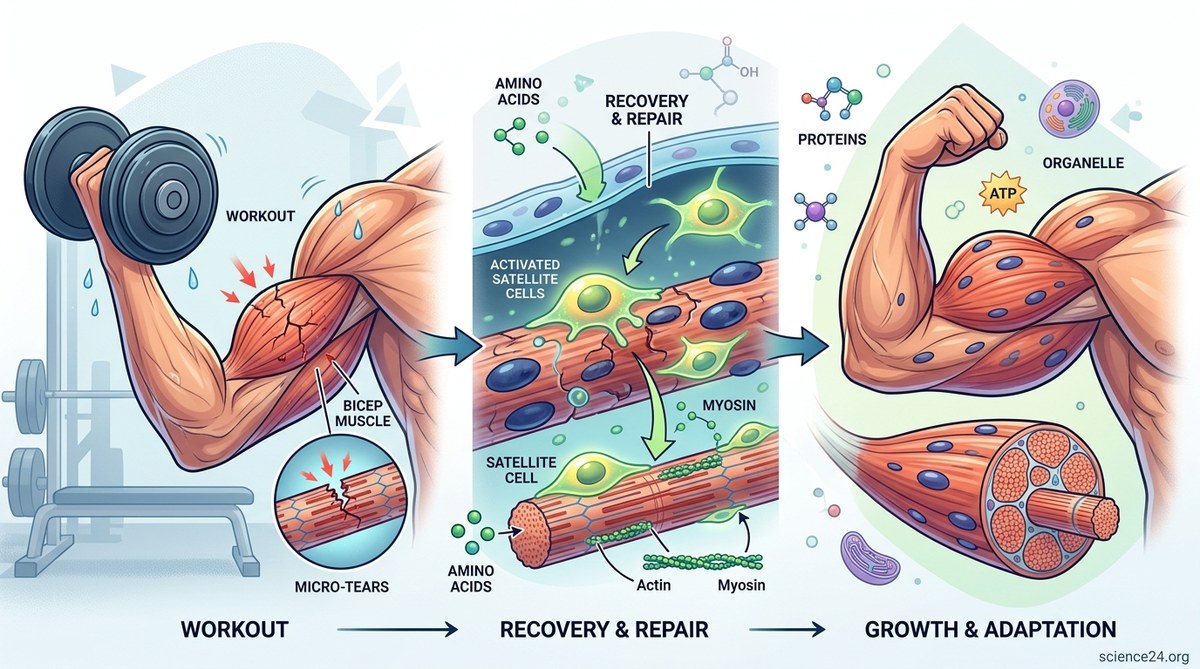
Muscle growth called hypertrophy happens when your body repairs microscopic tears in muscle fibers caused by resistance training. After you lift, satellite cells activate, travel to damaged sites, and fuse to existing fibers. They donate nuclei that help synthesize new proteins. This process peaks 24 to 48 hours post workout and requires adequate protein intake, quality sleep, and recovery between sessions. Without these elements, growth slows or stops entirely. Consistency matters more than intensity alone.
The Cellular Foundation of Muscle Growth
Your muscles are made of long, threadlike cells called muscle fibers. Each one contains smaller units called myofibrils, which are the parts that actually contract when you lift a weight. Think of a muscle fiber as a bundle of rubber bands. When you train with enough resistance, those rubber bands experience tension. Some of them will develop tiny cracks or tears at the microscopic level.
This might sound bad, but it is the starting point for growth.
The scientific term for muscle growth is hypertrophy. Hypertrophy happens when your body responds to that micro damage by adding more protein to the damaged fibers. The fibers get thicker. They get stronger. Over time, your entire muscle becomes larger and more capable of producing force.
For this process to happen consistently, your body needs three things: mechanical tension, metabolic stress, and muscle damage. All three show up in a well designed strength training session. Without them, your muscles have no reason to adapt and grow.
The Three Phase Process of Muscle Repair
How muscles grow after a workout follows a predictable sequence. Your body does not build new tissue while you are actually lifting. That happens afterward, during recovery. Here is the step by step process your muscles go through after you finish your last rep.
-
The micro tear phase. During your workout, the mechanical load causes small ruptures in the myofibrils inside your muscle fibers. The hardest working fibers, especially the type II fast twitch fibers, take the most damage. This damage triggers an immediate response from your immune system.
-
The inflammatory and cleanup phase. Within a few hours after your workout, immune cells called neutrophils and macrophages rush to the damaged area. They clear out the cellular debris and release signaling molecules called cytokines. These signals tell your body that repair work is needed. You might feel soreness during this phase, especially 24 to 48 hours later. That soreness is a sign that the cleanup crew is doing its job.
-
The rebuilding phase. This is where the actual growth happens. Satellite cells, which are specialized stem cells that live on the surface of your muscle fibers, become activated. They multiply and fuse to the damaged fibers. Each fusion adds new nuclei to the muscle fiber. More nuclei mean the fiber can produce more proteins. Over the next several days, your body builds new contractile proteins and adds them to the fiber. The fiber gets thicker and your muscle gets bigger.
This entire cycle takes about 72 to 96 hours for most muscle groups. That is why training the same muscle too often can interrupt the process before it finishes.
Satellite Cells and the Architects of New Muscle
Satellite cells are the unsung heroes of muscle growth. These cells sit dormant on the outer surface of your muscle fibers until a signal wakes them up. That signal comes from the mechanical stress of lifting and from chemical messengers released during inflammation.
Once activated, satellite cells start dividing. This process of cell division is similar to what happens in other tissues throughout your body. If you want to understand the mechanics of how cells replicate and divide, check out our guide on what happens during mitosis. The same basic principles apply when satellite cells multiply before fusing to your damaged fibers.
After dividing, the satellite cells fuse to the existing muscle fiber. They donate their nuclei, which increases the fiber’s ability to produce protein. This is a critical step. Without enough nuclei, the fiber cannot synthesize enough protein to grow. Some studies suggest that the number of nuclei in a muscle fiber is the main limit on how much that fiber can grow. More nuclei equal more growth potential.
This is also why muscle memory is real. Once you gain nuclei through training, they do not go away easily, even if you stop working out for a while. Your muscles keep those extra nuclei, so when you start training again, growth happens faster than it did the first time.
Protein Synthesis: The Fuel for Growth
Muscle protein synthesis is the biological process where your cells build new proteins. It is the direct opposite of muscle protein breakdown, which happens naturally throughout the day. For your muscles to grow, synthesis must exceed breakdown over time.
Your body is always balancing these two processes. After a workout, your rate of protein synthesis increases for about 24 to 48 hours. During that window, your body is primed to use amino acids from dietary protein to repair and build tissue.
Several factors influence how much protein synthesis occurs after a workout.
-
Protein intake. Consuming 20 to 40 grams of high quality protein after a workout provides the amino acids needed for repair. Leucine, an amino acid found in whey, eggs, and meat, is especially important because it directly activates the signaling pathway that turns on protein synthesis.
-
Total daily calories. You cannot build tissue if you are in a large calorie deficit. Your body needs energy from food to power the repair process. Even if you eat enough protein, a serious calorie shortage will limit growth.
-
Training volume and intensity. A minimum threshold of mechanical tension is needed to trigger hypertrophy. Light weights that do not challenge your muscles will not produce enough damage or metabolic stress to start the process.
-
Insulin sensitivity. Insulin helps shuttle amino acids into muscle cells. People with better insulin sensitivity tend to respond more efficiently to protein intake after training.
-
Age and hormone levels. Younger individuals generally have a more robust anabolic response. Testosterone, growth hormone, and insulin like growth factor all play supporting roles in muscle protein synthesis.
All of these factors work together. Improving just one of them can help, but addressing all of them produces the best results.
Common Myths and What Science Actually Shows
A lot of fitness advice floats around the internet that sounds logical but does not hold up under scrutiny. Here is a look at some common beliefs versus what the research actually says.
| Common Belief | What Science Shows | Why It Matters |
|---|---|---|
| You need to lift heavy weights for growth | Moderate weights with higher reps also build muscle as long as sets are taken close to failure | Total tension and metabolic stress matter more than absolute load |
| Eating protein within 30 minutes is critical | The anabolic window lasts several hours, not minutes | Total daily protein intake is more important than timing alone |
| Soreness means you built muscle | Soreness indicates inflammation, not necessarily growth | You can build muscle without feeling sore |
| You must feel a burn to grow | The burn comes from metabolic stress, which is only one part of hypertrophy | Mechanical tension is the primary driver of growth |
| Cardio kills gains | Moderate cardio does not interfere with hypertrophy when calories are adequate | Excessive cardio with low calorie intake can limit recovery |
The table above shows that many common gym sayings are oversimplified. The truth is more nuanced. You do not need to chase extreme soreness or live by a strict protein clock. Focus on progressive overload, adequate nutrition, and consistent recovery.
Recovery Is Where Growth Really Happens
Too many people in the gym treat recovery as an afterthought. They train hard six or seven days a week and wonder why progress stalls. But the science is clear. Your muscles do not grow during training. They grow between sessions.
“The growth response to resistance training is not a product of the workout itself. It is a product of the recovery that follows. Sleep, nutrition, and rest days are not optional extras. They are the conditions that allow hypertrophy to occur.”
Dr. Brad Schoenfeld, researcher in muscle hypertrophy and author of “Science and Development of Muscle Hypertrophy”
Sleep deserves special attention. Your body releases most of its growth hormone during deep sleep stages. This hormone is a key signal for tissue repair. If you sleep less than seven hours per night, your body produces less growth hormone and your muscle protein synthesis rates drop.
Recovery also depends on your overall health. Chronic inflammation, poor gut health, and high stress levels can all interfere with the signaling pathways that trigger hypertrophy. For example, your gut bacteria play a role in how well your body absorbs amino acids and manages inflammation. You can read more about this connection in our article on how gut bacteria shape your health and mood in 2026. Everything in your body is connected, and your recovery is only as strong as your weakest link.
Active recovery strategies can also help. Light walking, stretching, and mobility work increase blood flow to your muscles without causing additional damage. The extra circulation helps deliver nutrients and remove waste products from the repair process.
Practical Steps to Apply the Science
Knowing how muscles grow after a workout is one thing. Applying that knowledge is another. Here are the most direct steps you can take based on the biology we just covered.
First, train each muscle group two to three times per week. Spreading volume across multiple sessions produces more consistent growth than training a muscle once per week with very high volume. The repair cycle lasts about 72 hours for most people, so training a muscle again after two or three days keeps the process active without interrupting it.
Second, eat enough protein every day. Aim for about 0.7 to 1.0 grams of protein per pound of body weight. Spread that intake across three to four meals. Your body can only use about 30 to 40 grams of protein per meal for muscle building. The rest gets used for other purposes or excreted.
Third, prioritize sleep. Seven to nine hours per night is the target. If you struggle to get enough, focus on sleep hygiene. Keep your room cool and dark. Avoid screens for 30 minutes before bed. A consistent bedtime routine signals your body to release the hormones needed for repair.
Fourth, manage your total training volume. More is not always better. Once you exceed about 15 to 20 hard sets per muscle group per week, the additional benefits become very small. Extra volume just adds fatigue without extra growth. Find the minimum amount of work that produces progress and stick with it.
Fifth, be patient. Muscle growth is slow. A beginner might gain one to two pounds of muscle per month under ideal conditions. That number drops to half a pound or less per month for experienced lifters. The process takes time because each cycle of damage, repair, and growth takes days to complete.
Making the Science Work for Your Goals
The question of how muscles grow after a workout has a clear answer. It starts with mechanical tension during exercise. It continues with a carefully orchestrated cascade of cellular signals, satellite cell activation, and protein synthesis during recovery. And it depends heavily on your nutrition, sleep, and overall health.
You do not need to understand every molecular detail to benefit from this knowledge. What matters is recognizing that growth is not something you force. It is something you create the conditions for. You lift to start the process. Then you rest, eat, and sleep to finish it. The two halves of the equation are equally important.
Next time you finish a hard workout, remember that the real work is just beginning. Your muscles are about to enter a cycle of repair that will leave them stronger than before, provided you give them what they need. Trust the process. Give it time. The results will follow.