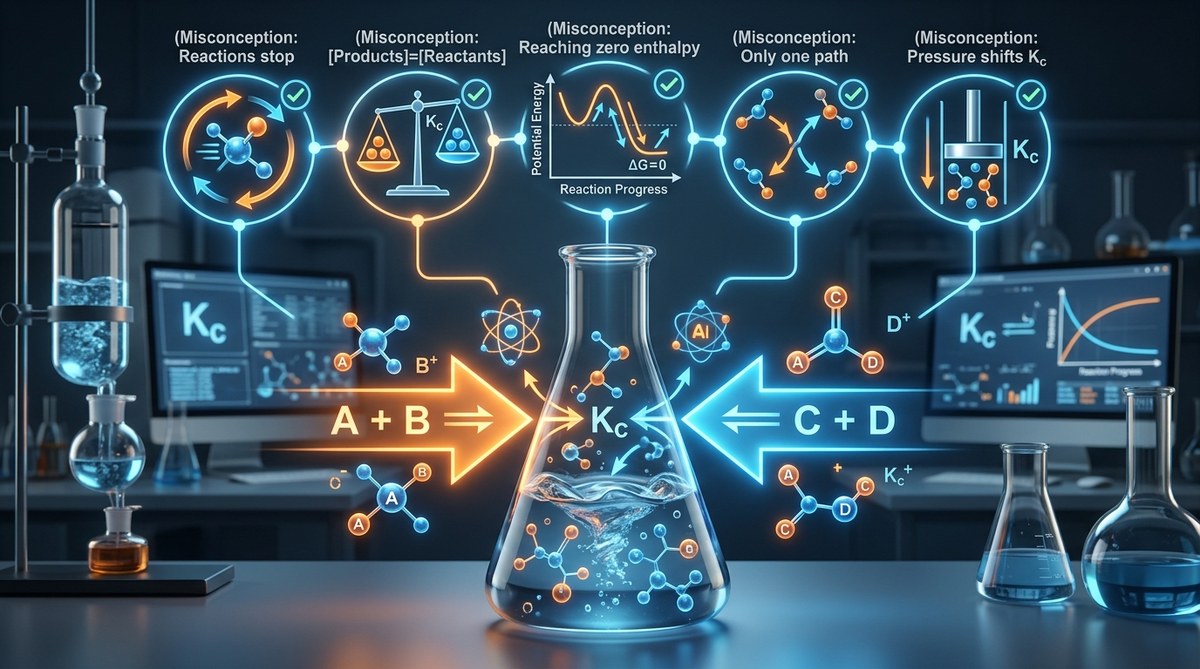
Chemical equilibrium is one of those topics that can feel like a moving target. You memorize the definition, plug numbers into the equilibrium expression, and then somehow still get tripped up on a test. If you have ever thought “the reaction stops at equilibrium” or “the concentrations of reactants and products are equal,” you are not alone. These ideas spread easily because they sound logical. But chemistry rarely works the way our intuition expects. In this article, we will walk through the five most common chemical equilibrium misconceptions and set the record straight. By the end, you will see why equilibrium is actually a dynamic balancing act, not a static endpoint.
Chemical equilibrium is often misunderstood. This guide clears up five major misconceptions: that the reaction stops, that concentrations are equal, that forward and reverse rates are just “balanced,” that adding a catalyst shifts the equilibrium, and that equilibrium is only for closed systems. Understanding these will boost your confidence in class and on exams.
What Makes Chemical Equilibrium So Confusing?
Part of the problem is that the word “equilibrium” sounds like “equal.” Many students assume that means equal amounts of everything. Another part is that we often visualize equilibrium as a calm, settled state, like a seesaw perfectly horizontal. In reality, the seesaw is moving constantly, but the two sides are moving at exactly the same speed. The reaction never stops. That is the core idea we need to hold onto.
Let’s address each misconception one by one. If you find yourself nodding along to any of these, do not worry. You are in good company, and the fix is simple.
Misconception 1: Equilibrium Means the Reaction Stops
This is probably the most widespread belief. You set up a reaction, watch it go, and eventually the concentrations stop changing. It feels natural to think the reaction has finished. But it has not finished. It has entered a state where the forward and reverse reactions are happening at the same rate. The system is dynamic, not static.
Think about a busy intersection during rush hour. Cars move in all directions, but the number of cars on each side of the intersection stays constant because the flow in equals the flow out. That is equilibrium. The reaction is still happening, but because the rates are equal, there is no net change in concentration.
Correct understanding: The forward and reverse reactions continue indefinitely. Macroscopic properties (color, pressure, concentration) appear constant, but at the molecular level, collisions and transformations never stop.
Misconception 2: The Concentrations of Reactants and Products Are Equal
This one comes straight from the word “equilibrium.” Students picture a balanced scale with the same mass on both sides. But equilibrium has nothing to do with equal concentrations. It is about the ratio of concentrations, as defined by the equilibrium constant, K.
For example, consider the reaction:
N₂(g) + 3H₂(g) ⇌ 2NH₃(g)
At room temperature, K is huge (around 10⁵). That means the equilibrium mixture contains mostly ammonia, with very little nitrogen and hydrogen left. The concentrations are wildly unequal, yet the system is at equilibrium. Conversely, a reaction with a tiny K will have mostly reactants at equilibrium.
A useful way to remember this is that K = products over reactants. If K is large, products dominate. If K is small, reactants dominate. Equality of concentration is not required.
Misconception 3: Forward and Reverse Rates Are Just “Balanced” in a Vague Way
Many textbooks say “the forward and reverse rates are equal at equilibrium.” That statement is true, but it often gets interpreted as “they are roughly the same” or “they cancel out.” In reality, the rates are exactly equal and not just in a hand-wavy sense. The numerical value of the forward rate equals the numerical value of the reverse rate at equilibrium.
Here is a common trap: students think that if you double the concentration of a reactant, the forward rate will double and the reverse rate will stay the same. That is true only until the system re-establishes equilibrium. Once equilibrium is restored, the forward and reverse rates are once again equal, but at new values. The rates themselves can change when conditions change, but at any given equilibrium state, they are identical.
Heads up: This misconception often leads to errors when using Le Chatelier’s principle. If you only think about “shifting” without remembering that the rates must re-equalize, you can mispredict the new equilibrium position.
Misconception 4: Adding a Catalyst Shifts Equilibrium
Catalysts are wonderful. They speed up both the forward and reverse reactions equally by lowering the activation energy. But they do not change the equilibrium constant, and they do not change the equilibrium position. A catalyst simply helps the system reach equilibrium faster.
Nevertheless, many students think a catalyst will favor the forward reaction (or the reverse) because they see it as “making the reaction go.” That is not correct. A catalyst does not add energy or push the reaction one way. It provides an alternative pathway that both forward and reverse reactions can use. The final equilibrium concentrations remain the same.
If you need to shift equilibrium, you must alter concentration, pressure, or temperature. A catalyst is not a lever you can pull to change the outcome; it is a gas pedal that gets you to the same destination sooner.
Misconception 5: Equilibrium Only Happens in Closed Systems
Yes, true chemical equilibrium requires a closed system where no matter enters or leaves. But the concept of dynamic equilibrium also applies to many open, steady-state processes in nature and industry.
Consider the carbon dioxide in your blood. Your body maintains a relatively constant concentration of CO₂ even though you breathe in and out. That is not true chemical equilibrium because the system is open, but the idea of balanced rates is similar. In industrial processes like the Haber process for ammonia, reactors operate at steady state where reactants are continuously fed and products removed. Although it is not a closed equilibrium, engineers use equilibrium calculations to design the conditions.
The misconception arises because textbooks often say “equilibrium only exists in a closed system.” That is technically correct for chemical equilibrium per the definition. But the underlying principle of equal rates and constant macroscopic properties appears in many real-world situations. Do not let the strict definition confuse you when you encounter these examples.
A Quick Reference Table: Misconception vs. Reality
| Misconception | Reality |
|---|---|
| The reaction stops at equilibrium. | Forward and reverse reactions continue at equal rates. |
| Reactant and product concentrations are equal. | The ratio of concentrations equals the equilibrium constant (K). |
| Forward and reverse rates are only roughly equal. | They are exactly equal numerically at equilibrium. |
| A catalyst changes the equilibrium position. | A catalyst speeds up both directions equally; no shift occurs. |
| Equilibrium only applies to closed systems. | True for chemical equilibrium, but the dynamic concept also describes many open systems. |
How to Test Your Understanding: 3 Practical Steps
If you want to check whether you have internalized these ideas, try this simple exercise:
- Write the equilibrium expression for any reaction. Do not look it up. Then compare with a friend or answer key. A mistake in the expression often reveals a deeper confusion about what equilibrium actually represents.
- Predict the effect of adding a catalyst to a system at equilibrium. If you say “it will produce more product,” you have fallen for misconception 4. Review the reason above.
- Explain to someone else why concentrations stop changing at equilibrium without using the word “stop.” Use terms like “equal rates” and “dynamic balance.” If you can do that clearly, you have mastered the biggest hurdle.
Common Signs You Might Still Hold a Misconception
Even after reading this, old habits can sneak back. Look out for these warning signs:
- You catch yourself saying “the reaction is over” instead of “the reaction is at equilibrium.”
- You automatically assume that a large K means the reaction goes “to completion.”
- You think a catalyst will “favor” the exothermic or endothermic direction.
- You believe that adding more reactant will “reverse” the reaction rather than simply shift the equilibrium position.
If any of these feel familiar, go back and re-read the relevant section. It takes practice to retrain your intuition.
Expert advice: “One of the best ways to internalize equilibrium is to model it physically. Use two cups of water and a spoon to simulate forward and reverse rates. When the water levels in both cups stop changing, that does not mean the spoon stopped moving. It means you are transferring water at exactly the same speed in both directions. Chemistry is no different.”
— Dr. Elena Marquez, professor of physical chemistry at a midwestern university
Moving Forward with a Clearer Picture
Now that you know the five most common chemical equilibrium misconceptions, you can approach your next problem set or exam with more confidence. Remember that equilibrium is a dynamic state, not a stop sign. Concentrations are not equal, rates are exactly equal, catalysts do not shift the balance, and the idea of balanced rates extends beyond the textbook closed system.
If you want to sharpen your skills further, check out our guide on common chemistry mistakes that cost you points on AP exams and see how these equilibrium pitfalls fit into a bigger picture. And if balancing chemical equations still trips you up, our article on 5 common mistakes when balancing chemical equations will help you get them right every time.
Chemistry is full of moments where what seems obvious is actually wrong. That is what makes it fascinating. By questioning the simple answers, you build a deeper, more accurate understanding. Keep asking “why,” and equilibrium will stop feeling like a mystery.