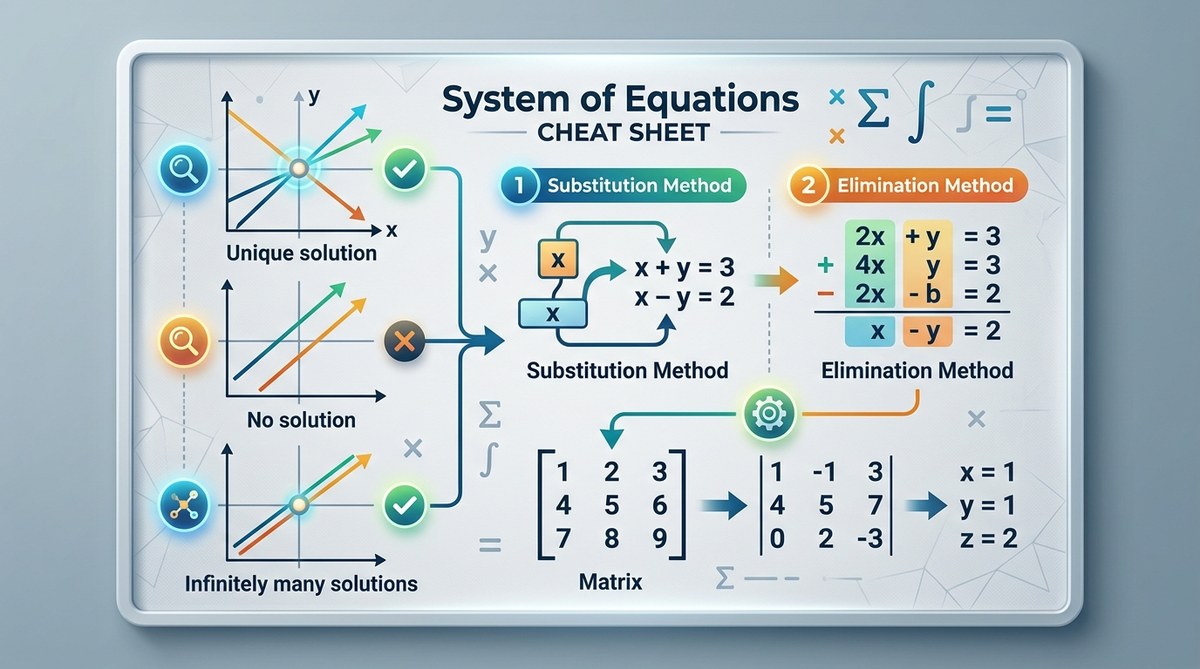
You are staring at two equations and they both have the same variables. Somewhere in that tangle of x and y lives a single point (or many points) that makes both equations true. Finding that point is the whole game. Systems of equations show up in algebra class, on the SAT, in economics, and even in programming. The good news is there are only a handful of reliable methods to crack them. This solving systems of equations cheat sheet gives you a clear path for each method, plus the traps to watch out for.
Three main methods solve systems of linear equations: substitution, elimination, and graphing. Substitution works best when one variable is already isolated. Elimination shines when coefficients line up neatly. Graphing gives a visual check but can be imprecise. Always verify your solution by plugging it back into the original equations. Watch for special cases like no solution or infinite solutions.
The Core Methods at a Glance
Think of each method as a tool in your belt. You would not use a sledgehammer to hang a picture, and you should not use elimination if substitution is quicker. Below is a breakdown of each approach, followed by a step-by-step process you can use right now.
Substitution
Substitution means you replace one variable with an expression from the other equation. This is the method to use when one equation is already solved for a variable (like y = 2x + 3) or when solving for a variable is simple.
Step-by-step process:
- Isolate one variable in one equation. Pick the one with the smallest coefficient.
- Substitute that expression into the other equation.
- Solve the resulting single-variable equation.
- Plug that value back into either original equation to find the other variable.
- Write your answer as an ordered pair (x, y).
Example:
Solve: y = 3x – 1 and 2x + y = 9
– Equation 1 is already solved for y.
– Substitute: 2x + (3x – 1) = 9
– Simplify: 5x – 1 = 9 → 5x = 10 → x = 2
– Substitute x = 2 into y = 3(2) – 1 = 5
– Solution: (2, 5)
Elimination
Elimination (also called addition) works by adding or subtracting the equations to cancel one variable. This is a strong choice when the coefficients of one variable are opposites or multiples.
Step-by-step process:
- Align the equations vertically (same variable under same variable).
- Multiply one or both equations by constants so that the coefficients of one variable are opposites.
- Add (or subtract) the equations to eliminate that variable.
- Solve for the remaining variable.
- Substitute that value back into either original equation to find the other variable.
- Write the solution as an ordered pair.
Example:
Solve: 3x + 2y = 7 and x – 2y = 1
– Notice 2y and -2y are opposites. Add the equations: 4x = 8 → x = 2
– Substitute: 3(2) + 2y = 7 → 6 + 2y = 7 → 2y = 1 → y = 0.5
– Solution: (2, 0.5)
Graphing
Graphing draws both lines on the same coordinate plane. The point where they cross is the solution. This method is helpful for estimating but can be inaccurate if the intersection is not at integer coordinates.
Step-by-step process:
- Rewrite each equation in slope-intercept form y = mx + b.
- Plot the y-intercept for each line.
- Use the slope to find another point for each line.
- Draw both lines carefully.
- Identify the intersection point. If the lines never cross, there is no solution. If they lie on top of each other, there are infinite solutions.
Tip: Always double-check your graph by plugging the intersection coordinates into both equations.
When to Use Each Method
Knowing which method to use saves time. Here is a bulleted list to guide your choice.
- Substitution when one variable already has a coefficient of 1 or -1, or when an equation is solved for a variable.
- Elimination when the coefficients of one variable are the same or opposites, or when you can easily multiply to make them match.
- Graphing when you need a visual check, when the solution seems to be integers, or when the problem asks for a graph.
- Solving by inspection (a special short cut) when the system is simple enough to guess the solution, like x + y = 5 and x – y = 1.
Common Mistakes and How to Fix Them
Even experienced students slip up. The table below pairs each technique with the most frequent error and a fix.
| Technique | Common Mistake | How to Avoid It |
|---|---|---|
| Substitution | Forgetting to distribute the substitution properly | Write parentheses around the substituted expression before simplifying. |
| Elimination | Adding when you should subtract (or vice versa) | Line up the equations, then check signs carefully before combining. |
| Graphing | Misreading the slope or y-intercept | Label each point and count rise over run twice. |
| Any method | Not checking the solution | Plug your ordered pair into both original equations. If it works in both, you are good. |
| Any method | Mixing up variables when substituting | Write x = something, then replace every x in the other equation. Double check. |
Expert advice: Before you commit to a method, look at the numbers. If you see fractions or decimals coming, elimination often keeps things cleaner. And always verify your answer. One wrong sign can send you down the wrong path. Trust me, everyone has been there.
Special Cases That Throw People Off
Not every system has one clean ordered pair. Some have no solution, and some have infinitely many.
No solution happens when the lines are parallel. In algebra, you will end up with a false statement like 0 = 5. If that occurs, write “no solution” or use the empty set symbol.
Infinite solutions happen when the equations represent the same line. You will get a true statement like 0 = 0. In that case, the solution set is all points on that line. You can describe it as “infinitely many solutions” or write the equation of the line.
Three variables? The same methods extend, but you will need three equations and more steps. For a deeper look, check out the https://science24.org/the-complete-method-for-solving-systems-of-equations-in-three-variables/ [The Complete Method for Solving Systems of Equations in Three Variables].
Putting It All Together for Exam Day
You have the tools. Now practice recognizing which method fits each problem. Start by scanning the equations. If a variable stands alone, substitution is your friend. If the coefficients are cooperative, go with elimination. If the problem says “solve graphically”, sketch carefully.
One of the trickiest places students stumble is with basic algebra errors. Reviewing https://science24.org/10-common-algebra-mistakes-and-how-to-avoid-them/ [10 Common Algebra Mistakes and How to Avoid Them] can save you on the next test. And if you ever need to convert a real-world situation into equations, the guide on https://science24.org/converting-word-problems-into-equations-a-step-by-step-system-for-standardized-tests/ [Converting Word Problems Into Equations] walks you through that process.
Your Cheat Sheet for Real Problem Solving
This cheat sheet is designed to live in your notebook (or on your phone) until solving systems becomes second nature. Print it, bookmark it, scribble on it. The goal is not to memorize every step but to know which method to grab and how to execute it cleanly.
Start with the next system you see. Identify the method. Work through the numbered steps. Check your answer. You will get faster each time. And if you ever feel stuck, remember that every system is just a puzzle waiting for the right tool. You have that tool now.