If you have ever pushed a heavy box across the floor or lifted a backpack onto a shelf, you have experienced work and power in action. But in physics, these words have very specific meanings that may not match how we use them in everyday life. Work is not just any effort. Power is not just strength. They are measurable quantities with exact formulas. Once you understand the core definitions, solving work and power problems becomes a straightforward process. This guide will walk you through every step so you can approach these problems with confidence.
In physics, work is done when a force moves an object over a distance. Power measures how quickly that work gets done. To calculate work, multiply force by displacement in the direction of the force. To calculate power, divide work by time. This guide breaks down both formulas with clear steps and real-world examples. It also covers common mistakes so you can solve any work and power problem with total confidence on your very next exam.
What Work Really Means in Physics
In everyday language, you might say you worked hard all day even if you never moved a thing. Physics demands more precision. Work in physics has a strict definition.
Work is done when a force causes an object to move in the direction of that force. If nothing moves, no work is done. If the force and the motion are perpendicular, no work is done either. This is why holding a heavy book at arm’s length feels tiring but involves zero physics work. The book is not moving, so no energy is transferred.
This distinction matters because it changes how you set up problems. When you see a work question on a test, your first job is to check whether displacement actually occurs and whether the force contributes to that displacement.
The Work Formula Made Simple
The formula for work is clean and memorable.
Work = Force x Displacement x cos(theta)
Here is what each symbol means.
- W is work, measured in joules (J).
- F is the applied force, measured in newtons (N).
- d is the displacement, measured in meters (m).
- theta is the angle between the force vector and the displacement vector.
The cosine term handles situations where the force is applied at an angle. When force points exactly in the direction of motion, theta is zero degrees and cos(0) equals 1. That simplifies the formula to W = F x d. When force is perpendicular to motion, theta is 90 degrees and cos(90) equals 0. No work is done.
If you need a refresher on working with angles and trigonometric functions, check out our guide on how to master trigonometric identities in 5 simple steps.
How to Calculate Work in 3 Steps
Follow this process to solve any work problem on your homework or exam.
Step 1: Identify the force and the displacement.
Read the problem carefully. Find the value of the applied force and the distance the object moves. Make sure you use the force that is actually doing the work. If a person pushes a crate, use the pushing force. If gravity lifts a falling object, use the weight.
Step 2: Find the angle between the force and displacement.
Draw a simple diagram. Place the force arrow and the displacement arrow starting from the same point. Measure the smaller angle between them. This angle is theta. When force and motion are in the same direction, theta is zero. When force is horizontal and the object moves horizontally, you are in the zero degree case.
Step 3: Plug values into the formula.
Multiply force by displacement. Multiply that result by the cosine of your angle. Write your answer in joules. Check that your units are consistent. Force should be in newtons and displacement in meters.
That is all there is to it. Three steps and you are done.
Power: The Rate of Doing Work
Power tells you how fast work is done. It answers the question: does this machine transfer energy slowly or rapidly?
The formula for power is even simpler than the work formula.
Power = Work / Time
P is power, measured in watts (W). One watt equals one joule per second. W is work in joules. t is time in seconds.
A light bulb rated at 60 watts uses 60 joules of electrical energy every second. A car engine rated at 200 kilowatts does 200,000 joules of work each second. Higher power means work happens faster.
You can also express power in terms of force and velocity when the force is constant and in the direction of motion.
Power = Force x Velocity
This version is useful when you know how fast an object moves but do not know the time directly.
A Complete Worked Example
Let us tie these ideas together with a problem you might see in a physics class.
A student pulls a sled across a flat field. The sled has a mass of 20 kilograms. The student applies a force of 80 newtons at an angle of 30 degrees above the horizontal. The sled moves 15 meters. How much work does the student do? What is the power output if the sled covers that distance in 6 seconds?
Start with work. Force is 80 newtons. Displacement is 15 meters. The angle between the force and the horizontal displacement is 30 degrees.
W = 80 N x 15 m x cos(30 degrees)
cos(30) is about 0.866.
W = 80 x 15 x 0.866
W = 1039.2 joules
That is the work done by the student.
Now for power. Work is 1039.2 joules. Time is 6 seconds.
P = 1039.2 J / 6 s
P = 173.2 watts
The student produces about 173 watts of power. For reference, that is roughly the same as a small household appliance. Not bad for pulling a sled.
Common Mistakes to Avoid
Even experienced students slip up on certain details. Here is a table of frequent errors and how to steer clear of them.
| Mistake | Why It Happens | How to Fix It |
|---|---|---|
| Using the wrong angle for theta | Students often use the angle of the ramp or the slope instead of the angle between force and displacement | Always draw the force vector and displacement vector from the same point. Measure the angle between them. |
| Forgetting to convert units | Problems give force in kilonewtons or distance in centimeters | Convert everything to base SI units before calculating. Newtons, meters, seconds. |
| Using distance traveled instead of displacement | Work depends on net change in position, not total path length | Check whether the object returns to its starting point. If so, displacement is zero. |
| Calculating power without converting time to seconds | Time is given in minutes or hours | Always convert time to seconds before using P = W / t. |
| Adding work from multiple forces without checking direction | Some forces may do negative work | Work can be positive or negative. Sum the values carefully with their signs. |
For a broader look at calculation errors that show up across science subjects, read our article on 10 common algebra mistakes and how to avoid them.
Tips for Solving Work and Power Problems
Use these strategies to stay organized and reduce errors during exams.
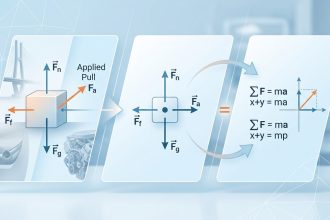
- Draw a free body diagram for every problem. A simple sketch shows all forces and their directions.
- Label the angle between each force and the displacement. This prevents theta confusion.
- Write the formula before plugging in numbers. Seeing the equation helps you catch missing variables.
- Check the sign of work. Force in the same direction as motion gives positive work. Force opposite to motion gives negative work.
- For power, ask yourself whether the problem gives time directly or gives velocity. Use P = W / t for the first case and P = F x v for the second.
- Circle your final answer with units. Professors love seeing correct units.
“The single best habit you can build for physics problems is drawing a diagram. Even a rough sketch forces you to identify forces, angles, and directions before you do any math. Most mistakes in work and power problems come from skipping this step.” — Dr. Miguel Torres, Physics Educator
Mastering Work and Power Through Practice
The formulas for work and power are simple, but applying them correctly takes practice. Start with problems where force and displacement are in the same direction. Once those feel comfortable, add angled forces. Then move to problems that involve multiple forces or friction.
Every work and power question follows the same logical structure. Identify the force. Find the displacement. Determine the angle. Calculate work. If the problem asks for power, divide work by time or multiply force by velocity. That pattern repeats across every textbook and every exam.
When you approach your next physics assignment, remember that work is not about effort in the general sense. It is about force causing motion. And power is simply the speed at which that motion happens. Keep those definitions clear, and the math will follow naturally.
Start with one problem tonight. Draw the diagram. Write the formula. Calculate the answer. Then try another. Each repetition strengthens your understanding until solving work and power problems becomes automatic. You have the tools. Now go apply them.