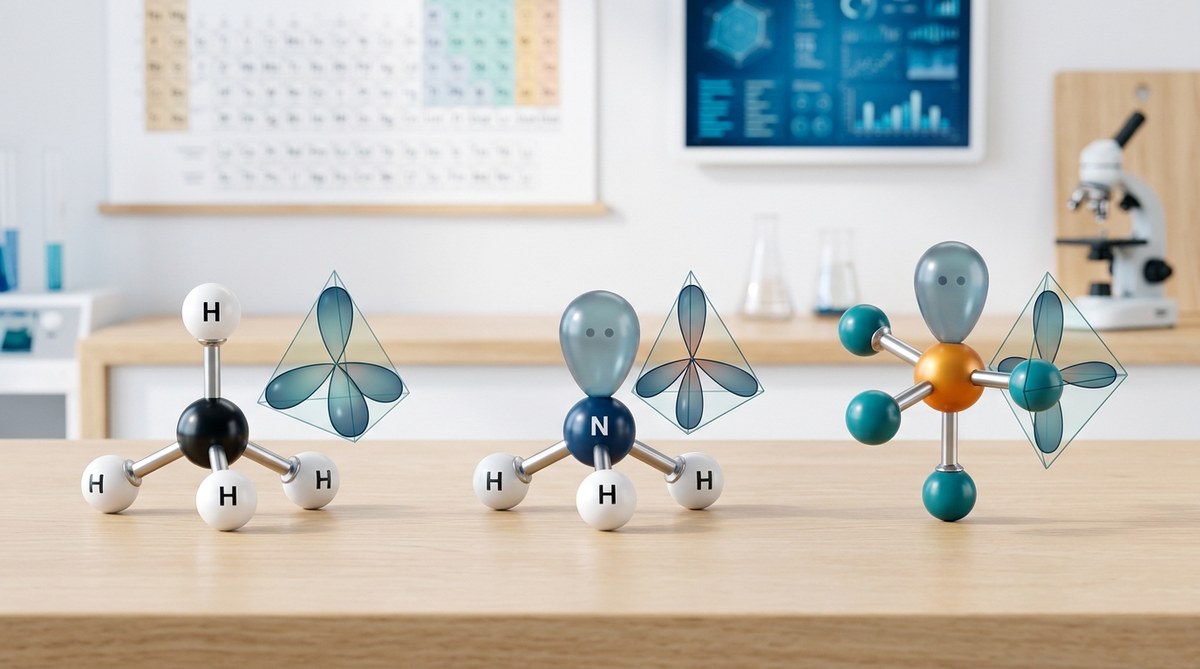
You have a molecule, and you need to know its shape. Maybe it’s for a homework assignment, maybe it’s for an exam question that’s worth a few points. Either way, staring at a chemical formula and trying to picture a three‑dimensional shape can feel impossible. That’s where VSEPR theory steps in. VSEPR stands for Valence Shell Electron Pair Repulsion, and it’s the most reliable tool chemists have for predicting molecular geometry. The idea is simple: electron pairs around a central atom repel each other, so they arrange themselves as far apart as possible. Once you understand that, you can predict the shape of almost any molecule in just a few minutes.
VSEPR theory predicts molecular shapes by counting electron groups around a central atom. Three steps: draw the Lewis structure, count electron groups (bonding pairs and lone pairs), then assign the shape based on the total number of groups and lone pairs. The geometry is determined by making electron groups as far apart as possible. This method works for most main‑group molecules and is essential for mastering molecular geometry in chemistry.
What Is VSEPR Theory and Why Does It Work?
VSEPR theory was developed in the mid‑20th century by chemists Ronald Gillespie and Ronald Nyholm. Their key insight: electrons are negatively charged and repel each other. So the electron groups (whether they are bonding pairs, lone pairs, or multiple bonds) around a central atom will try to get as far from one another as possible. The resulting arrangement of atoms is the molecular shape.
The theory works best for molecules with a central atom from Groups 1–18 (main group elements). It does a great job explaining why water is bent (104.5°) and why carbon dioxide is linear. Without VSEPR, students would have to memorize dozens of shapes. With VSEPR, you only need to remember a handful of electron‑group geometries and then apply a simple logic.
The 3 Step Process to Predict Any Molecular Shape
Follow these three steps every time. They work for all common molecules in your textbook.
-
Draw the Lewis structure of the molecule. Write the correct skeleton (central atom usually has the lowest electronegativity), count total valence electrons, place bonds, and add lone pairs to satisfy the octet rule (or duet for hydrogen). Double and triple bonds count as one electron group. If you need a refresher on drawing Lewis structures, check out our guide on understanding chemical bonding from scratch.
-
Count the number of electron groups around the central atom. An electron group can be a single bond, a double bond, a triple bond, or a lone pair. Each counts as exactly one group. For example, in CO₂, the central carbon has two double bonds → two electron groups. In NH₃, the nitrogen has three single bonds and one lone pair → four electron groups.
-
Determine the shape using the VSEPR table. Use the total number of electron groups and the number of lone pairs to find the molecular geometry. The table below shows the most common combinations.
VSEPR Geometry Reference Table
| Total Electron Groups | Lone Pairs | Electron‑Group Geometry | Molecular Shape | Angle | Example |
|---|---|---|---|---|---|
| 2 | 0 | Linear | Linear | 180° | CO₂ |
| 3 | 0 | Trigonal planar | Trigonal planar | 120° | BF₃ |
| 3 | 1 | Trigonal planar | Bent | <120° | SO₂ |
| 4 | 0 | Tetrahedral | Tetrahedral | 109.5° | CH₄ |
| 4 | 1 | Tetrahedral | Trigonal pyramidal | <109.5° | NH₃ |
| 4 | 2 | Tetrahedral | Bent | <109.5° | H₂O |
| 5 | 0 | Trigonal bipyramidal | Trigonal bipyramidal | 90°, 120° | PCl₅ |
| 5 | 1 | Trigonal bipyramidal | Seesaw | <90°, <120° | SF₄ |
| 5 | 2 | Trigonal bipyramidal | T‑shaped | <90° | ClF₃ |
| 5 | 3 | Trigonal bipyramidal | Linear | 180° | XeF₂ |
| 6 | 0 | Octahedral | Octahedral | 90° | SF₆ |
| 6 | 1 | Octahedral | Square pyramidal | <90° | BrF₅ |
| 6 | 2 | Octahedral | Square planar | 90° | XeF₄ |
Memorize the first several rows. The 5‑ and 6‑group geometries appear less often in introductory courses, but they are still fair game for AP Chemistry or first‑year college exams.
Common Mistakes and How to Avoid Them
Even experienced students slip up on VSEPR. Here are the three most common errors to watch for.
- Counting lone pairs as separate from bonding pairs incorrectly. Both are electron groups. A lone pair is still a group that repels other groups. Always include them.
- Forgetting that multiple bonds are only one group. A double bond occupies more space than a single bond, but it still counts as one group for geometry. For example, in formaldehyde (H₂CO), the carbon has a double bond to oxygen and two single bonds to hydrogen → three electron groups.
- Ignoring the effect of lone pairs on bond angles. Lone pairs repel more strongly than bonding pairs. That’s why ammonia has a bond angle of about 107° instead of the perfect tetrahedral 109.5°. Water is even smaller (104.5°) because it has two lone pairs.
Expert tip: When you draw your VSEPR prediction, always place lone pairs in equatorial positions if you have a 5‑group geometry. They cause less steric strain there. For octahedral, lone pairs sit opposite each other if there’s more than one. This minimizes repulsion and matches experimental data.
Use the table above as your cheat sheet. Practice with a few molecules every day, and the patterns will stick.
Let’s Work Through a Full Example
Take sulfur tetrafluoride (SF₄). Step 1: Draw the Lewis structure. Sulfur has 6 valence electrons, each fluorine has 7. Total = 6 + 4×7 = 34 electrons. Sulfur is central, four single bonds to fluorine use 8 electrons. That leaves 26 electrons, which become 13 lone pairs. Place 3 lone pairs on each fluorine (12 pairs) and one lone pair on sulfur. So sulfur has 4 bonding groups and 1 lone pair → 5 electron groups.
Step 2: 5 electron groups → trigonal bipyramidal electron‑group geometry. Step 3: One lone pair → molecular shape is seesaw. Bond angles: the axial F–S–F angle is a little less than 180° because the lone pair pushes them. The equatorial F–S–F angle is less than 120°. This matches reality.
If you’re studying for an upcoming exam, you might also benefit from our guide on common chemistry mistakes that cost you points on AP exams. It covers VSEPR pitfalls in detail.
When VSEPR Theory Fails (and What to Do)
VSEPR is not perfect. It struggles with:
- Transition metal complexes (use crystal field theory instead).
- Molecules with very electronegative atoms that distort bond angles (e.g., OF₂ has a smaller angle than H₂O because of fluorine’s strong pull).
- Radicals or molecules with unpaired electrons (they often follow different rules).
For most organic and inorganic molecules in your textbook, VSEPR works. If you run into an exception, trust the experimental data. Your teacher or exam will likely stick to the standard cases.
Putting It All Together for Exam Day
The best way to get comfortable is to practice. Grab a list of common molecules: CH₄, NH₃, H₂O, CO₂, SO₂, BF₃, PCl₅, SF₆, XeF₄. Draw the Lewis structure, count groups, and predict the shape. Check your answers against the table. Do this five times, and you’ll start to see the pattern instantly.
For a deeper understanding of atomic structure that supports VSEPR, read our beginner’s guide to reading the periodic table like a pro. It will help you understand why certain atoms behave as central atoms.
Mastering Molecular Shapes Starts Here
VSEPR theory is one of those topics that clicks once you practice the three steps. Don’t try to memorize every shape individually. Instead, learn the logic: electron groups repel, lone pairs push harder, and the geometry follows from the count. With that foundation, you can predict the shape of any molecule you encounter.
Try it right now. Take a molecule from your textbook, run through the steps, and see if you get the correct geometry. The more you practice, the faster you’ll become. And when exam day comes, you won’t be guessing — you’ll know.