Picture yourself staring at a chemical equation on your homework. You see a lone metal standing next to a compound, and you know a single displacement reaction is supposed to happen. But will it? And if it does, what actually forms? This is exactly where the activity series of metals becomes your best friend in chemistry. This simple ranking system tells you which metals are strong enough to kick others out of a compound. Once you understand how to read it, you can predict reaction products with confidence and stop guessing on exams.
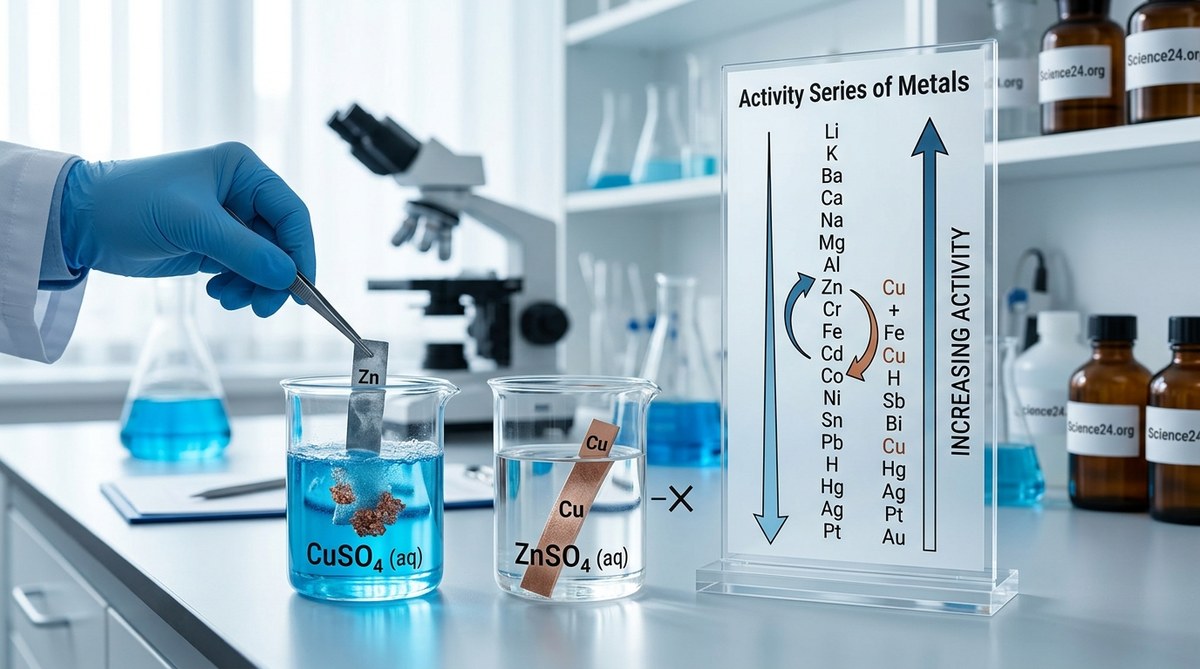
The activity series of metals ranks elements from most reactive (lithium) to least reactive (gold). To predict if a single displacement reaction will occur, check if the free metal is above the metal in the compound on the series. If it is, the reaction happens and the free metal replaces the compound metal. If not, no reaction occurs.
What the Activity Series Actually Tells You
The activity series is not a random list. It is an ordered ranking based on how easily a metal loses electrons to form positive ions. Metals at the top, like lithium, potassium, and calcium, give up electrons very willingly. They react violently with water and air. Metals at the bottom, like gold and platinum, hold onto their electrons tightly. They are called noble metals because they resist reacting.
This ranking directly controls single displacement reactions. In these reactions, a pure metal (A) reacts with an aqueous compound containing a different metal ion (BC). The general form looks like this:
A + BC → AC + B
For the reaction to happen, metal A must be more reactive than metal B. If A is less reactive, nothing changes. No reaction occurs.
How to Predict Reaction Products in 3 Steps
Follow this numbered process every time you face a single displacement problem. It works for homework, lab reports, and exam questions.
-
Identify the free metal and the metal in the compound. Look at the reactants. One element is by itself (the free metal). The other is bonded to a nonmetal or polyatomic ion inside a compound. Write down both metal symbols.
-
Locate both metals on the activity series. Find the position of the free metal. Then find the position of the metal from the compound. If you do not have a printed series, memorize the general order of common metals: lithium, potassium, calcium, sodium, magnesium, aluminum, zinc, iron, tin, lead, (hydrogen), copper, silver, gold.
-
Compare their positions. If the free metal is higher on the list, the reaction will happen. Write the products by swapping the metals. If the free metal is lower, write “no reaction” (NR) as the answer.
Example 1: Zinc plus Copper(II) Sulfate
Zinc (Zn) is placed into a solution of copper(II) sulfate (CuSO₄). Zinc is above copper on the activity series. Therefore, zinc replaces copper. The products are zinc sulfate (ZnSO₄) and solid copper (Cu). The balanced equation is:
Zn + CuSO₄ → ZnSO₄ + Cu
Example 2: Silver plus Magnesium Nitrate
Silver (Ag) is added to magnesium nitrate (Mg(NO₃)₂). Silver is far below magnesium on the activity series. Silver cannot displace magnesium. The answer is no reaction (NR).
Common Mistakes and How to Avoid Them
Even experienced students slip up on certain details. The table below shows the most frequent errors and the correct approach.
| Mistake | Why It Happens | How to Fix It |
|---|---|---|
| Forgetting hydrogen is included | Students think hydrogen is only a nonmetal. The series includes hydrogen as a reference point. Metals above H can displace H from acids. | Always check hydrogen’s position. If your free metal is above hydrogen, it will react with an acid to produce H₂ gas. |
| Assuming all metals react with water | Only the most reactive metals (Group 1 and some Group 2) react with cold water. Others need steam or acid. | Look at the top of the series. If the free metal is lithium, sodium, or potassium, expect a vigorous water reaction. |
| Writing the wrong formula for the product | Students forget to balance charges when swapping metals. | After swapping, write the new compound using the correct oxidation states. Then balance the equation. |
| Thinking a reaction always happens | Some students assume every single displacement works. The series proves otherwise. | Always compare positions first. If the free metal is lower, stop. Write NR. |
Expert advice from a veteran chemistry instructor: “The most powerful trick you can learn is to memorize just the top six and bottom four metals on the activity series. The middle metals will fall into place during an exam. Focus on lithium, potassium, calcium, sodium, magnesium, and aluminum at the top. Then copper, silver, gold, and platinum at the bottom. Everything else sits in between.”
Special Cases That Confuse Students
Metals Reacting with Water
Not all metals behave the same way with water. The activity series helps here too. Metals at the very top, like sodium and potassium, react violently with cold water. They produce hydrogen gas and a metal hydroxide. Metals like magnesium and calcium react slowly with hot water or steam. Metals below magnesium generally do not react with water at all. They need a strong acid instead.
Metals Reacting with Acids
Acids provide hydrogen ions (H⁺). If your free metal is above hydrogen on the activity series, it will displace hydrogen from the acid. The products are a salt and hydrogen gas. For example, magnesium reacts with hydrochloric acid:
Mg + 2HCl → MgCl₂ + H₂
If the free metal is below hydrogen, like copper, no reaction occurs with a typical acid.
A Handy Reference Table for the Activity Series
Use this table to quickly check the relative reactivity of common metals. The most reactive metals appear at the top.
| Metal | Symbol | Reactivity Level |
|---|---|---|
| Lithium | Li | Very high (reacts with water) |
| Potassium | K | Very high (reacts with water) |
| Calcium | Ca | High (reacts with water) |
| Sodium | Na | Very high (reacts with water) |
| Magnesium | Mg | High (reacts with steam) |
| Aluminum | Al | Moderate |
| Zinc | Zn | Moderate |
| Iron | Fe | Moderate |
| Tin | Sn | Low |
| Lead | Pb | Low |
| Hydrogen | H | Reference point |
| Copper | Cu | Very low |
| Silver | Ag | Very low |
| Gold | Au | Extremely low (noble) |
Memorizing this order will cover the vast majority of problems you see in high school and introductory college chemistry.
Putting Your Knowledge to the Test
Try these practice problems on your own. Cover the answers with your hand and work through each one.
- Problem 1: Will iron (Fe) displace copper from copper(II) chloride (CuCl₂)?
-
Answer: Yes. Iron is above copper on the series. Products are iron(II) chloride (FeCl₂) and copper (Cu).
-
Problem 2: Will gold (Au) displace zinc from zinc nitrate (Zn(NO₃)₂)?
-
Answer: No. Gold is far below zinc. No reaction occurs.
-
Problem 3: Will calcium (Ca) react with water?
- Answer: Yes. Calcium is high on the series. It reacts with water to produce calcium hydroxide and hydrogen gas.
If you got these right, you are ready for exam questions. If you missed one, go back to the three-step process and check your comparison.
Connecting the Activity Series to Other Chemistry Concepts
The activity series does not exist in isolation. It connects directly to how atoms form bonds and how electrons move during reactions. If you want to understand the deeper reasons why some metals are more reactive, check out our guide on how electronegativity determines molecule behavior and bond types. The tendency to lose electrons is tied to electronegativity values.
You can also strengthen your equation writing skills by reviewing 5 common mistakes when balancing chemical equations and how to avoid them. Many students lose points not because they misread the activity series, but because they write unbalanced products.
Your Action Plan for Exam Success
Now you have a reliable method for using the activity series of metals to predict reaction products. The next time you see a single displacement problem, do not freeze. Identify the free metal. Find both metals on the series. Compare their positions. Write the products or state no reaction. Practice with ten problems from your textbook tonight. By tomorrow, the process will feel automatic. You have got this.