A standard soccer ball is a familiar object. You have probably kicked one, juggled one, or watched one sail across a field during a World Cup match. But have you ever stopped to consider why it looks the way it does? Why does a soccer ball have exactly 12 pentagons and 20 hexagons? This is not a random design choice. It is a direct result of a beautiful piece of mathematics called Euler’s formula. This formula connects the number of faces, edges, and vertices on any convex polyhedron. For a math enthusiast, student, or educator, the soccer ball offers a perfect, hands-on example of how abstract geometry governs the real world.
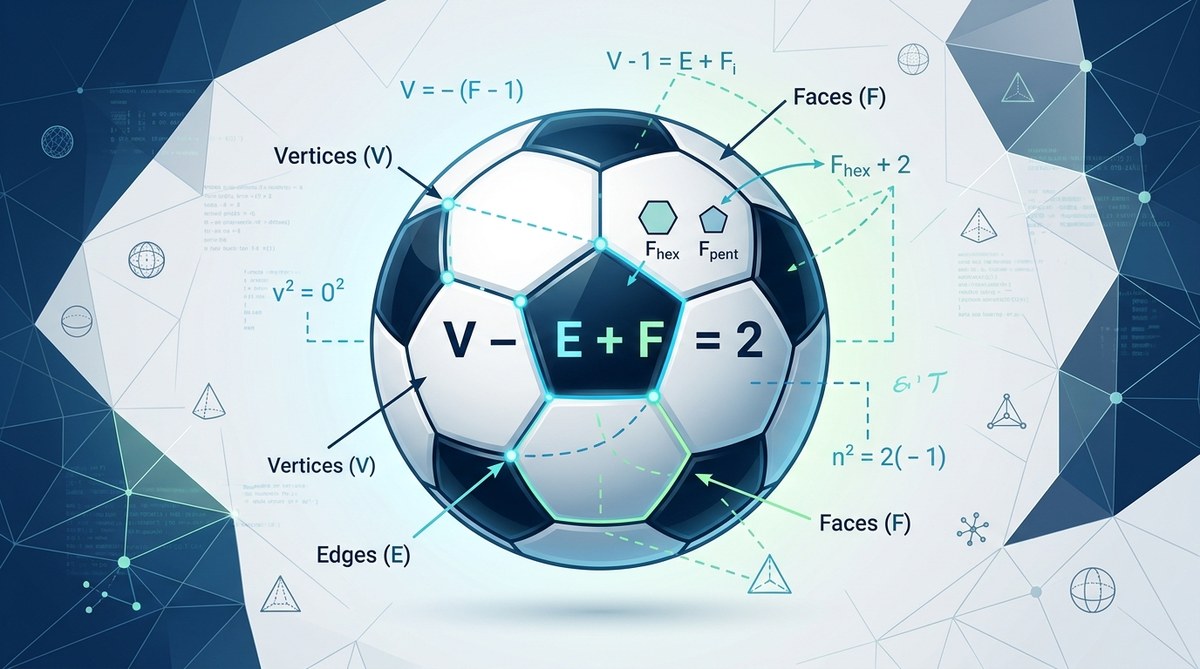
A soccer ball is a truncated icosahedron, a shape that uses 12 pentagons and 20 hexagons. Euler’s formula, V – E + F = 2, proves why this specific mix of shapes is necessary to create a closed, spherical surface. Understanding this connection shows how a simple equation can explain the structure of a sports icon.
The Classic Shape You Know
The black and white pattern of a soccer ball is iconic. The black patches are pentagons. The white patches are hexagons. Every black pentagon is surrounded by five white hexagons. Every white hexagon is surrounded by a mix of three black pentagons and three white hexagons. This arrangement is not just for looks. It creates a shape that is very close to a perfect sphere. This makes the ball roll predictably during a game.
The official name for this geometric solid is the truncated icosahedron. To understand it, we need to start with a simpler shape: the icosahedron. An icosahedron has 20 triangular faces. If you cut off, or truncate, each corner of the icosahedron, you get the soccer ball shape. Each corner becomes a pentagon. Each original triangle becomes a hexagon. This transformation is where the math gets interesting.
Euler’s Formula: The Unbreakable Rule
Leonhard Euler discovered a simple relationship that applies to all convex polyhedra. A convex polyhedron is a solid shape with flat faces and straight edges, like a cube or a pyramid. Euler’s formula states:
V – E + F = 2
Here, V stands for the number of vertices (corners), E stands for the number of edges, and F stands for the number of faces. This formula is a fundamental truth in topology. It does not matter how complex the shape is. As long as it is a convex polyhedron, the result will always be 2.
Let us test it on a cube. A cube has 8 vertices, 12 edges, and 6 faces. Plugging those numbers in: 8 – 12 + 6 = 2. It works. Now, we can use this formula to prove the exact number of pentagons and hexagons on a soccer ball.
Proving the Pentagon and Hexagon Count
We know a soccer ball has F faces total. Let P be the number of pentagons and H be the number of hexagons. So, F = P + H. We also know the total number of edges, E, and vertices, V. Each pentagon has 5 edges. Each hexagon has 6 edges. If we add up the edges from all faces, we get 5P + 6H. But this counts every edge twice, because each edge belongs to two faces. So, the true number of edges is:
E = (5P + 6H) / 2
We can do the same for vertices. Each pentagon has 5 vertices. Each hexagon has 6 vertices. Adding them gives 5P + 6H. On a soccer ball, exactly three faces meet at every vertex. This is a key fact. So, each vertex is counted three times. The true number of vertices is:
V = (5P + 6H) / 3
Now we have expressions for V, E, and F. We can plug them into Euler’s formula:
V – E + F = 2
[(5P + 6H) / 3] – [(5P + 6H) / 2] + (P + H) = 2
This looks messy, but it simplifies beautifully. To get rid of the fractions, multiply every term by 6:
2(5P + 6H) – 3(5P + 6H) + 6(P + H) = 12
Now expand and simplify:
(10P + 12H) – (15P + 18H) + (6P + 6H) = 12
Combine like terms:
(10P – 15P + 6P) + (12H – 18H + 6H) = 12
(1P) + (0H) = 12
P = 12
The hexagons cancel out completely. This proves that any shape made of pentagons and hexagons where three faces meet at each vertex must have exactly 12 pentagons. The number of hexagons is not fixed by this equation alone. But we can find it using another fact. Every edge of a pentagon is shared with a hexagon. This means the total number of pentagon edges (5 * 12 = 60) must equal the number of hexagon edges that touch pentagons. Since each hexagon shares three of its six edges with pentagons, we can set up: 60 = 3H. This gives H = 20.
So, the classic soccer ball has 12 pentagons and 20 hexagons. The math is not just a coincidence. It is a requirement of geometry.
A Step-by-Step Breakdown of the Proof
If you want to work through this logic on your own, follow these steps:
- Define your variables. Let P equal the number of pentagons and H equal the number of hexagons.
- Count the edges. Multiply each face by its edges, add them, and divide by 2 because each edge is shared.
- Count the vertices. Multiply each face by its vertices, add them, and divide by 3 because three faces meet at each vertex.
- Apply Euler’s formula. Substitute your expressions for V, E, and F into V – E + F = 2.
- Simplify the equation. The hexagons will drop out, leaving P = 12.
- Find the hexagons. Use the edge-sharing rule to solve for H.
Common Mistakes When Applying Euler’s Formula
Students and enthusiasts sometimes trip up on a few points. Here is a table that clarifies the typical errors and how to avoid them.
| Mistake | Why It Happens | How to Fix It |
|---|---|---|
| Counting edges or vertices only once | Forgetting that each edge belongs to two faces and each vertex belongs to three faces. | Always divide the total edge count by 2 and the total vertex count by 3 for this specific shape. |
| Assuming hexagons are regular | The hexagons on a soccer ball are not perfect regular hexagons. They are slightly distorted to fit the curve. | Remember that Euler’s formula works for any arrangement of faces, even if they are not perfectly regular. |
| Using the wrong formula | Mixing up Euler’s formula with other geometric formulas. | Stick to V – E + F = 2. It is the only one that applies to all convex polyhedra. |
| Forgetting to check the degree of each vertex | Assuming a different number of faces meet at a vertex. | On a soccer ball, it is always three. This fact is critical for the proof. |
Expert advice: When you are learning a new geometric proof, always draw a diagram. Label the faces, edges, and vertices. Visualizing the shape helps you see why each edge and vertex must be counted multiple times. This simple habit can prevent the most common mistakes.
Why This Geometry Matters Beyond the Field
The soccer ball is a perfect teaching tool for several reasons. It connects a recreational object to deep mathematical principles. It shows that math is not just about numbers on a page. It is about the structure of the world around us.
This same geometric logic appears in other places. For example, the structure of certain carbon molecules, called fullerenes or buckyballs, follows similar rules. A C60 molecule has 60 carbon atoms arranged in a pattern of 12 pentagons and 20 hexagons. It is the same shape as a soccer ball at the molecular level. Understanding the geometry of a soccer ball helps you understand the geometry of a Nobel Prize-winning discovery.
If you are a student preparing for a math exam, this example is a powerful one. It demonstrates how to use algebra to solve a geometric puzzle. It also shows the value of systems of equations. You can read more about how to solve systems of linear equations using graphs to build on these skills. For those who want to see another surprising pattern in numbers, check out what makes prime numbers so special in mathematics.
A Deeper Look at the Truncated Icosahedron
The process of truncation is central to this shape. Imagine you have an icosahedron, which has 20 triangular faces. Each vertex of the icosahedron has 5 triangles meeting. When you cut off a vertex, you create a new pentagonal face. The original triangular faces become hexagons because each corner of the triangle was cut off.
Here are the key properties of a truncated icosahedron:
- It has 60 vertices.
- It has 90 edges.
- It has 32 faces (12 pentagons and 20 hexagons).
- It is an Archimedean solid. This means it is a convex shape made of two or more types of regular polygons, and every vertex is identical.
- It is vertex-transitive. This means you can move any vertex to any other vertex and the shape looks the same.
This symmetry is why the ball feels balanced. Every pentagon is in the same position relative to the rest of the shape. Every hexagon is, too. This uniformity is essential for a ball used in sports. It ensures that the weight is distributed evenly and the bounce is predictable.
How This Connects to Other Math Topics
Euler’s formula is a gateway to topology. Topology is the study of shapes that can be stretched and deformed. In topology, the exact lengths and angles do not matter. Only the number of holes and the connectivity matter. Euler’s formula is a topological invariant. This means it stays the same even if you stretch the shape.
For a sphere, the Euler characteristic is 2. For a donut shape (a torus), it is 0. This difference is fundamental. The soccer ball is topologically equivalent to a sphere. That is why Euler’s formula applies.
If you want to improve your general math skills, studying this proof is a great exercise. It combines algebra, geometry, and logic. It is also a great example of how to avoid common pitfalls. You can learn more about 10 common algebra mistakes and how to avoid them to sharpen your problem-solving.
The Mathematics of a Perfect Kick
The next time you watch a soccer match, look at the ball. You will see the black pentagons and white hexagons. You now know that this pattern is not an accident. It is a direct consequence of Euler’s formula. The 12 pentagons are required by the math. The 20 hexagons fill the remaining space.
This knowledge adds a new layer of appreciation for the game. It is a reminder that math is everywhere, even on the pitch. Whether you are a student trying to understand geometry or an educator looking for a compelling example, the soccer ball is a fantastic place to start. Take a look at a ball, count the pentagons, and see the formula in action. It is a small, satisfying way to connect a playful object with a profound mathematical truth.