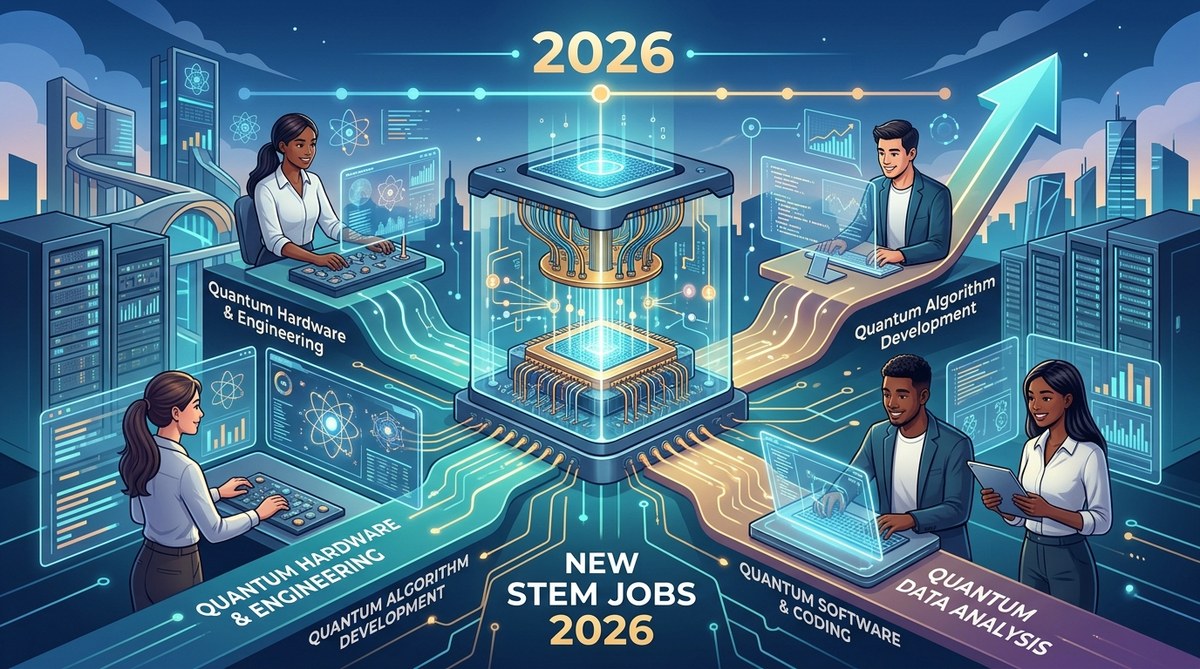
In 2026, the quantum computing industry is no longer just a theoretical playground for physicists. It has become a real, fast-growing job market. Major tech companies, government labs, and startups are all racing to build useful quantum machines. This race creates a huge demand for new talent. If you are a student or a professional in a STEM field, you might be wondering how to get involved. The good news is that you do not always need a PhD to land a role. The industry needs software engineers, hardware technicians, and even technical writers. This guide covers the top quantum computing jobs in 2026, what they pay, and the exact steps you can take to start your career today.
Quantum computing jobs in 2026 span software, hardware, and cryptography. Salaries range from $80,000 to over $200,000. You can enter the field with a bachelor’s degree in computer science, physics, or math. Focus on linear algebra, Python, and quantum mechanics basics. Build practical experience through open-source projects and internships.
The Top Quantum Computing Roles and Their Salaries
The quantum job market has matured. Companies now hire for specific, well-defined roles. Here are the most common positions you will find in 2026, along with typical salary ranges for the United States.
| Role | Average Salary (USD) | Key Skills |
|---|---|---|
| Quantum Software Engineer | $120,000 – $160,000 | Python, Qiskit, Cirq, error correction |
| Quantum Hardware Engineer | $130,000 – $180,000 | Cryogenics, microwave engineering, FPGA |
| Quantum Algorithm Researcher | $150,000 – $200,000+ | Linear algebra, quantum information theory |
| Post-Quantum Cryptography Specialist | $110,000 – $150,000 | Number theory, lattice-based cryptography |
| Quantum Machine Learning Engineer | $130,000 – $170,000 | Tensor methods, variational circuits |
| Quantum Applications Scientist | $100,000 – $140,000 | Domain expertise (chemistry, finance) |
| Quantum Technical Writer | $80,000 – $110,000 | Clear writing, basic quantum concepts |
These numbers come from job boards and industry reports from early 2026. Salaries vary by location, with hubs in California, Colorado, and New York offering higher pay.
How to Break Into Quantum Computing Without a PhD
Many people assume you need a doctorate to work in this field. That is not true for most roles. A bachelor’s or master’s degree in a relevant STEM field is enough for many positions. Here is a practical process to follow.
- Build your math and programming foundation. Focus on linear algebra, probability, and Python. Quantum computing relies heavily on matrix operations and complex numbers. If you need a refresher, check out our guide on understanding imaginary numbers without the confusion.
- Learn a quantum computing framework. Start with open-source tools like Qiskit or Cirq. These libraries let you write and simulate quantum circuits on your laptop. No quantum hardware required.
- Contribute to open-source quantum projects. This is the fastest way to build a portfolio. Projects like Qiskit, Cirq, and PennyLane welcome contributors. Fixing a bug or writing documentation shows employers you can work with real code.
- Apply for internships at quantum companies. Companies like IBM Quantum, Google Quantum AI, and IonQ offer internships for undergraduates. These positions often convert to full-time roles.
- Network at quantum conferences and online communities. Join the Quantum Computing Stack Exchange or the Unitary Fund Discord server. Attend events like Q2B or the IEEE Quantum Week. Meeting people in the field helps you learn about job openings before they are posted.
Skills That Employers Value Most in 2026
Hiring managers care about practical skills, not just degrees. Here is what they look for.
- Python and software engineering best practices. You should know how to use Git, write tests, and manage dependencies.
- Linear algebra and probability. These are the mathematical foundations of quantum algorithms.
- Understanding of quantum error correction. Real quantum computers are noisy. Error correction is a massive area of hiring.
- Familiarity with cryogenics and microwave engineering. This applies mostly to hardware roles. If you enjoy working with physical systems, this path is for you.
- Ability to communicate complex ideas clearly. Quantum is hard. Teams need people who can explain results to non-experts.
“The biggest skill gap we see is not in quantum theory, but in software engineering. We can teach a good Python developer the basics of quantum computing in a few months. It is much harder to teach someone good coding habits.” – Engineering manager at a quantum startup, 2026
Common Mistakes to Avoid When Applying for Quantum Jobs
The hiring process is competitive. Avoid these common errors to stand out.
| Mistake | Why It Hurts You | What to Do Instead |
|---|---|---|
| Focusing only on theory | Most roles need practical coding skills | Build a project on GitHub |
| Ignoring classical computing | Quantum computers work with classical ones | Master data structures and algorithms |
| Applying without a portfolio | Employers want proof of your skills | Contribute to an open-source quantum library |
| Not learning the math | You will struggle with quantum algorithms | Review linear algebra and probability |
| Overlooking communication skills | Teams need to share results | Practice writing clear technical explanations |
Which Path Matches Your Background?
Your current degree or job experience can guide your entry point.
- Computer science majors should target quantum software engineering or quantum machine learning roles. Your coding skills are directly transferable.
- Physics and math majors are a natural fit for quantum algorithm research or applications science. Your mathematical maturity is a huge asset.
- Electrical engineering majors should look at quantum hardware engineering. Skills in microwave engineering, cryogenics, and FPGA design are in high demand.
- Chemistry and materials science majors can work as quantum applications scientists. Many quantum computers are built to simulate molecules for drug discovery and battery design.
Preparing for the Quantum Job Market in 2026
The field is still young, but it is growing fast. The number of open quantum computing jobs in 2026 is significantly higher than it was just two years ago. If you start building skills now, you position yourself ahead of the curve.
Consider pairing your quantum learning with strong fundamentals. For example, understanding what makes prime numbers so special in mathematics helps with post-quantum cryptography. A solid grasp of the laws of thermodynamics is useful for cryogenic hardware work. And if you are a student, learning how to use spaced repetition to master STEM exam material can help you retain the new concepts faster.
Your Next Steps Toward a Quantum Career
Quantum computing is not a distant future technology. It is hiring right now. The industry needs people who can write clean code, understand linear algebra, and communicate clearly. You do not need to be a genius. You need to be consistent. Start with the basics. Build a small project. Join a community. Apply for that internship. The wave of quantum computing jobs in 2026 is real. With the right preparation, you can ride it into a rewarding career.