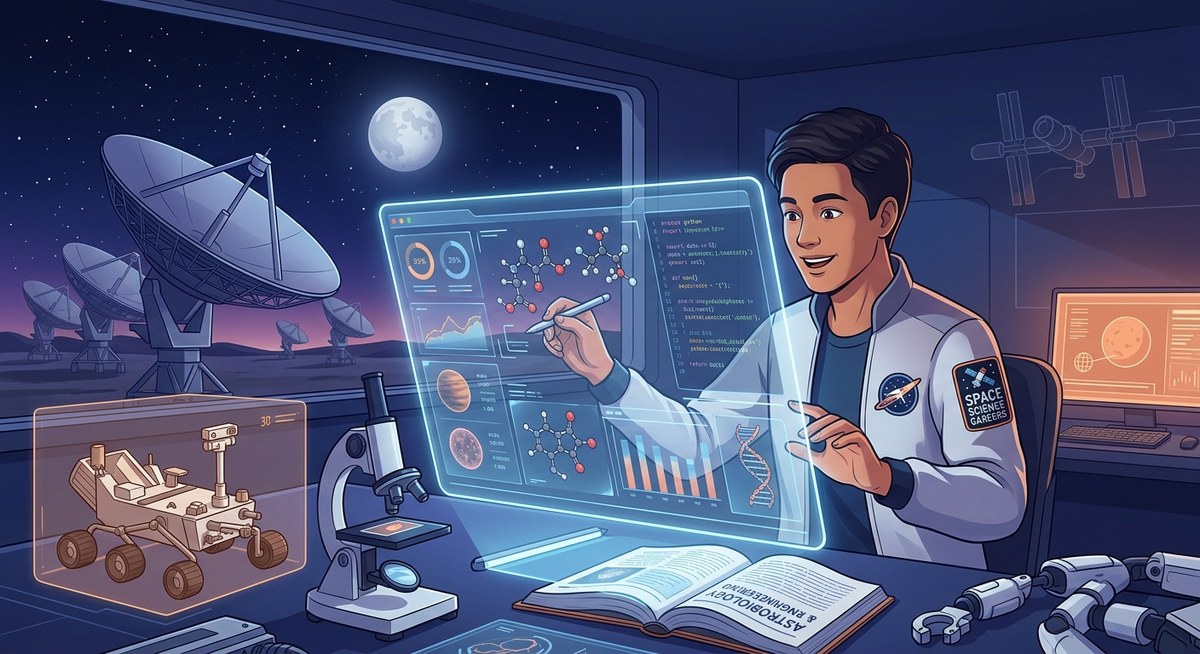
You love space. You follow every rocket launch, and you can name all the moons of Saturn. But when you look at job postings from NASA, SpaceX, or Blue Origin, they seem to demand a physics degree you don't have. That feeling of being locked out is frustrating.
Here is the good news: the space industry in 2026 needs more than just physicists. It needs software engineers, data analysts, mechanical designers, science communicators, and policy experts. Your non-physics background may actually be your secret weapon. This guide shows you exactly which space science jobs are within reach and how to land them without a physics degree.
You can build a rewarding space science career without a physics degree by leveraging skills in software, engineering design, data analysis, policy, or communication. Focus on building a portfolio of relevant projects, obtaining industry certifications, and networking with space professionals. Many roles value practical experience over a specific major.
The Myth of the Unbreakable Physics Barrier
A common belief says you need a physics degree to work in space science. That is not true for a wide range of roles. While becoming an astrophysicist or a propulsion engineer typically requires deep physics knowledge, many other space careers draw from different fields. The space industry is a giant team effort. Someone has to write the code that controls the rover, design the solar panels that keep it alive, analyze the data it sends back, and explain the findings to the public. Most of those people did not major in physics.
Even NASA's own workforce data shows that engineers, computer scientists, and business professionals outnumber pure physicists in many divisions. The demand for talent in 2026 is so high that employers care more about what you can do than what your diploma says. If you can build, code, analyze, communicate, or manage, you have a place in space.
High-Demand Space Science Jobs Without a Physics Degree
Here are some of the most accessible roles for people with backgrounds in engineering, computer science, or liberal arts. Each entry includes the typical degree path and the key skills needed.
1. Space Software Engineer
Spacecraft run on software. Every satellite, lander, and rover needs code for navigation, communication, and data handling. Companies like Relativity Space and Planet Labs hire tons of software engineers. A computer science degree is the most common entry point. You need to know languages like Python, C++, or Rust. Experience with embedded systems or real-time operating systems is a big plus. If you can write a script that talks to a sensor, you can contribute to a space mission.
2. Satellite Systems Engineer
Systems engineering is about making sure all the parts of a satellite work together. It requires a broad understanding of electronics, mechanics, and thermal dynamics, but not necessarily a physics degree. An aerospace or electrical engineering background works well. Many systems engineers come from mechanical engineering or even industrial engineering. You need strong problem-solving skills and the ability to read technical documents across disciplines.
3. Space Data Analyst
Planetary science generates massive datasets. Someone has to process images from Mars rovers, analyze spectra from exoplanet atmospheres, or track space debris. Data analysts and data scientists with strong statistical skills are in high demand. A degree in statistics, mathematics, or computer science works fine. You need proficiency in SQL, Python (pandas, numpy), and data visualization tools. If you enjoy patterns and numbers, this is a great fit. Check out our guide on how to break into data science without a computer science degree for more details.
4. Aerospace Mechanical Designer
Building the physical hardware of rockets and spacecraft requires mechanical engineers, not physicists. Roles like structures engineer, thermal analyst, or propulsion test engineer are open to mechanical or materials engineering majors. You need to understand stress analysis, CAD software (SolidWorks, CATIA), and manufacturing processes. A physics degree is rarely required; a solid grasp of statics and dynamics from engineering coursework is enough.
5. Space Policy Analyst
The space sector is heavily regulated. Government agencies, private companies, and international bodies need people who understand law, policy, and economics. If you have a liberal arts background in political science, international relations, or law, you can work as a space policy analyst. You will research treaties, advise on licensing, and help shape rules for lunar mining, satellite constellations, or orbital debris mitigation. Writing and analytical skills matter more than physics here.
6. Science Communicator and Educator
Someone has to make space science exciting and understandable. Science communicators write articles, produce videos, manage museum exhibits, and run social media for space organizations. Journalism, English, communications, or education degrees can lead to these roles. You need to translate complex technical ideas into clear, engaging stories. Strong writing and public speaking skills are essential. For example, the team behind NASA's social media accounts includes writers with backgrounds in art and history.
7. Mission Operations Specialist
Once a spacecraft is in orbit, someone has to monitor it 24/7. Mission operators keep an eye on telemetry, send commands, and respond to anomalies. This role often requires an associate's or bachelor's degree in a technical field, but not necessarily physics. Many operators have degrees in electronics, computer networking, or even general engineering. Training is often provided on the job. The key skills are attention to detail, calmness under pressure, and basic technical troubleshooting.
Skills You Already Have That Space Employers Want
Your background already gave you valuable abilities. Here is a list of transferable skills that space companies actively seek.
- Programming and scripting: Even if you are not a CS major, if you can write Python or MATLAB for data analysis or automation, you are useful.
- Data analysis and statistics: Any role that involves interpreting test results or mission data requires this.
- Project management: The ability to plan, budget, and coordinate across teams is gold. Engineering and business degrees teach this.
- Technical writing: Documentation, proposals, and user manuals are crucial for safety and compliance.
- Systems thinking: Understanding how components interact is huge. This is a core skill in any engineering discipline.
If any of these feel weak, you can strengthen them through online courses and personal projects. Building a small satellite tracker app or writing a blog about Mars weather can demonstrate your abilities.
How to Build Your Space Career Portfolio Without a Physics Degree
A degree is just one piece of the puzzle. Experience and demonstrated skills often outweigh it. Use this numbered list as your roadmap.
- Identify your entry point: Look at job descriptions for roles that match your current degree. For example, if you are a computer science student, search for "software engineer space" or "embedded systems engineer space".
- Build a portfolio project: Create something tangible. Write a Python script that downloads and plots real satellite positions from public APIs. Design a simple CubeSat structure in CAD. Write a sample space policy brief on Artemis Accords.
- Get relevant certifications: Consider earning a cloud computing certificate (AWS, Azure) for data roles, or a PLM certification for engineering. Some universities offer short online courses in space systems engineering.
- Network intentionally: Join the American Institute of Aeronautics and Astronautics (AIAA) or the Space Generation Advisory Council. Attend virtual conferences. Follow space company employees on LinkedIn and engage with their posts.
- Apply to internships: Even if you are a career switcher, internships exist for non-traditional students. Companies like SpaceX, Blue Origin, and Rocket Lab offer internships in business, communications, and HR alongside technical roles.
- Customize your resume: Use keywords from the job description. Emphasize your relevant projects and any teamwork, even if they are from non-space contexts. Show how your skills transfer.
Common Mistakes When Pursuing Space Science Jobs Without a Physics Degree
Many people trip over the same pitfalls. The table below shows what to avoid and what to do instead.
| Mistake | What to Do Instead |
|---|---|
| Assuming you need a physics degree for every space job | Research specific job titles and their actual degree requirements. Many list "or related field". |
| Focusing only on NASA | Private companies (SpaceX, Blue Origin, Rocket Lab, Planet, Spire) and international agencies also hire widely. |
| Ignoring the importance of technical skills | Even policy and communication roles benefit from basic understanding of orbital mechanics or remote sensing. Take a free online course. |
| Not tailoring your resume | Generic resumes get lost. Customize each application to match the job description. |
| Giving up after a few rejections | The space industry turnaround varies. Keep applying and improving your skills. |
"The space industry in 2026 is desperate for software talent. I have seen biology majors become lead satellite software engineers because they learned to code and built projects. A physics degree is a nice-to-have, not a must-have." -- Senior software engineer at a New Space company (anonymous)
Strengthen the Math and Science Foundations You Already Have
Even without a physics degree, you will need a solid grasp of some math and science concepts. For example, understanding orbital mechanics requires algebra and some trigonometry. Learning to calculate delta-v uses a bit of calculus. But you do not need to be a physics expert. Many of these topics are covered in our other guides, like how to master trigonometric identities in 5 simple steps or breaking down derivatives for complete beginners. Use these resources to fill gaps without taking a full physics course.
Your Next Step to Launch a Space Career
The idea that space science jobs are only for physics majors is outdated. The industry is growing so fast in 2026 that companies are actively recruiting people with diverse backgrounds. The most important thing is to start now. Pick one role from the list above that fits your current degree and interests. Do a small project over the weekend that relates to that role. Update your LinkedIn profile to include space-related keywords. Apply to one job this week.
The path to space is not a straight line. It is a network of launchpads, and yours does not need to begin in a physics classroom. Take that first step today.