Your body is a demolition site. Every single day, billions of your cells receive a message that sounds terrifying: it is time to die. They shrink. They break apart. They get packaged into neat little bundles and carried away by cleanup crews. This process is called apoptosis, or programmed cell death. If you are a biology student, a health enthusiast, or just someone who wants to understand how your body really works, you need to know about apoptosis. It is not a mistake. It is not a tragedy. It is one of the most important, life-giving processes in your body. Without it, you could not have formed your fingers in the womb. Without it, you would be riddled with tumors. Without it, your brain would be a tangled mess of useless neurons. Let us look at the surprising benefits of apoptosis and why your cells are heroes for choosing to die.
Apoptosis is a controlled, programmed cell death that is essential for health. It sculpts your body during development, eliminates damaged DNA to prevent cancer, balances your immune system, and clears out old cells to make room for new ones. Without apoptosis, your body would not function. It is a natural cleanup and defense mechanism that keeps you alive.
What Actually Happens During Apoptosis
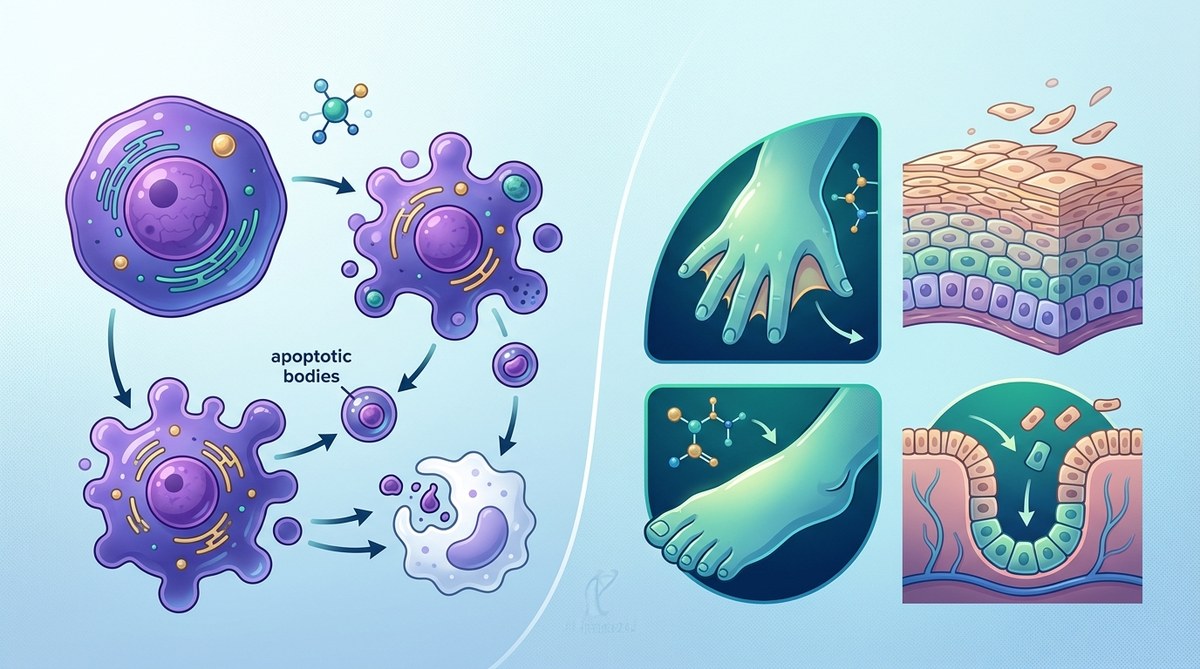
Apoptosis is not the same as necrosis, which is the messy, accidental death of a cell from injury. Necrosis is like a building collapsing in a storm. Apoptosis is like a building being carefully demolished by a professional crew. The process is clean and orderly. Here is how it works.
- The signal arrives. A cell receives a signal that it is time to die. This signal can come from inside the cell (like damaged DNA) or from outside (like a command from a neighboring cell).
- The cell shrinks. The cell starts to condense. It pulls away from its neighbors.
- The nucleus breaks down. The DNA inside the nucleus is chopped into neat pieces.
- The cell blebs. The cell membrane forms small bubbles, called blebs, that pinch off.
- The cell is eaten. These small bubbles, now called apoptotic bodies, are swallowed up by scavenger cells called macrophages. There is no inflammation. There is no mess. The whole process is silent and efficient.
This is the exact opposite of what happens when a cell dies from an injury. When a cell bursts from trauma, it spills its contents everywhere. That spill triggers inflammation and can damage nearby tissue. Apoptosis avoids all of that. It is a death that serves the whole body.
How Apoptosis Shapes Your Body
Think about your hands. You have five fingers on each hand. But when you were a tiny embryo, your hands looked more like paddles. They were blocks of tissue. So how did you get separate fingers? Apoptosis. The cells between your fingers received a death signal. They died, and the webbing disappeared. This is one of the most dramatic examples of the benefits of apoptosis in development.
The same thing happens in your brain. Your brain produces far more neurons than it needs. The ones that do not form strong connections are eliminated through apoptosis. This pruning process is critical for a healthy, efficient brain. If it does not happen correctly, it can lead to developmental disorders. Apoptosis is the sculptor that carves a functional body out of a lump of cells.
The Number One Defense Against Cancer
Every day, the DNA in your cells gets damaged. It happens from sunlight, from chemicals in your food, from random copying errors during cell division. Most of the time, your cells can repair this damage. But sometimes, the damage is too severe. If that damaged cell kept dividing, it could become a tumor.
This is where apoptosis becomes a superhero. When a cell detects that its DNA is too damaged to fix, it triggers its own death. It commits suicide so that you do not get cancer. This is the most critical benefit of apoptosis for your long term health. Scientists call this tumor suppression.
If apoptosis fails and a damaged cell survives, that cell can start to divide uncontrollably. That is the first step toward cancer. Many chemotherapy drugs work by forcing cancer cells to restart the apoptosis process. The drugs trick the cancer cells into killing themselves. Understanding how to reactivate apoptosis in cancer cells is a major area of research in 2026. For a deeper look at how cells manage their internal energy and processes, check out our guide on why do cells need ATP.
Keeping Your Immune System Balanced
Your immune system is an army. It has to be strong enough to fight off infections, but it also has to know when to stand down. If your immune cells attack your own body, you get autoimmune diseases like rheumatoid arthritis or lupus. Apoptosis is the tool your body uses to keep the army in check.
Here is how it works. When you fight off a cold, your body produces millions of white blood cells to fight the virus. Once the virus is gone, you do not need those cells anymore. They would clog your blood and cause inflammation. So they die by apoptosis. This is called the contraction phase of an immune response. Without it, your immune system would stay on high alert forever.
Apoptosis also gets rid of immune cells that attack your own body. During development, any immune cell that attacks your own tissues is marked for death. This process is called central tolerance. It is a brutal but necessary culling. If apoptosis fails during this stage, those self-attacking cells survive and can cause autoimmune problems later in life.
Replacing Old and Worn-Out Cells
Your body is constantly renewing itself. Your skin cells die and flake off. Your gut lining is replaced every few days. Your red blood cells only live for about 120 days. How does your body get rid of the old cells to make room for the new ones? You guessed it: apoptosis.
When a red blood cell gets old and worn out, it triggers apoptosis. It is then broken down in your spleen and liver. The iron from the old cell is recycled to make new hemoglobin. This is a beautiful example of efficiency. Nothing is wasted. The old cell dies so that a fresh, strong cell can take its place. This constant turnover keeps your tissues young and functional.
There is a downside when apoptosis does not work correctly. If too many cells die, you get degenerative diseases. If too few die, you get cancer or buildup. The balance is everything. To understand how cells divide and reproduce to replace the ones that die, you can read about what happens during mitosis.
Apoptosis vs. Necrosis: A Side-by-Side Comparison
It helps to see the difference between the two types of cell death laid out clearly. This table shows why apoptosis is so much better for your health.
| Feature | Apoptosis (Programmed Death) | Necrosis (Accidental Death) |
|---|---|---|
| Cause | Internal or external signals, DNA damage, development | Injury, trauma, lack of oxygen, toxins |
| Process | Controlled, orderly, cell shrinks and breaks into pieces | Uncontrolled, cell swells and bursts |
| Inflammation | None. Clean and silent. | High. Spills contents and attracts immune cells. |
| Energy | Requires energy (ATP) to execute. | Does not require energy. It is a passive failure. |
| Outcome | Removes unwanted cells, prevents cancer, shapes organs. | Damages surrounding tissue, causes scarring. |
What Happens When Apoptosis Goes Wrong
When the benefits of apoptosis are missing, the results can be devastating. Here are some key problems that arise when apoptosis is either too active or not active enough.
- Too little apoptosis: This is a hallmark of cancer. Cells that should die keep dividing. It also allows viral infections to persist because infected cells do not kill themselves.
- Too much apoptosis: This leads to tissue wasting. In neurodegenerative diseases like Alzheimer’s and Parkinson’s, neurons die off too quickly. This is also what happens after a stroke, where brain cells that were not directly damaged still die by apoptosis.
- Faulty signaling: Sometimes the signal to start apoptosis gets crossed. This can lead to autoimmune diseases where healthy cells are mistakenly targeted for death.
For a look at another biological process that relies on precise timing and balance, see our breakdown of how photosynthesis actually works.
Expert Insight: “Apoptosis is not a failure of the cell. It is a decision. The cell is acting in the best interest of the whole organism. When you understand apoptosis, you start to see the body not as a collection of selfish cells, but as a cooperative society where cells will sacrifice themselves for the greater good.” — Dr. Sarah Chen, Cell Biologist at Stanford University.
Why Your Body Needs This Cellular Suicide
The idea of cells committing suicide sounds dark. But once you see the benefits of apoptosis, you realize it is one of the most generous things a cell can do. It is a sacrifice that keeps the entire system healthy. Here is a summary of the key roles apoptosis plays.
- Sculpting the body: It removes webbing between fingers and prunes excess neurons in the brain.
- Preventing cancer: It destroys cells with damaged DNA before they can become tumors.
- Balancing the immune system: It kills off spent immune cells and self-attacking cells.
- Renewing tissues: It clears out old cells so new, healthy cells can take over.
The Big Picture of Cell Life and Death
Apoptosis is not a bug. It is a feature. It is a feature that has been fine-tuned over millions of years of evolution. Every time you peel off dead skin, every time you recover from a cold, every time you avoid cancer, you are witnessing the benefits of apoptosis in action.
So the next time you hear about cell death, do not think of it as the end. Think of it as a beginning. It is the beginning of renewal. It is the beginning of protection. It is the beginning of a healthier, more balanced body. Your cells are not just living for themselves. They are living for you. And sometimes, the most heroic thing a cell can do is die. To keep learning about the fundamental processes that keep you alive, consider reading about what makes enzymes such powerful biological catalysts. Your body is a masterpiece of biological engineering, and apoptosis is one of its most vital tools. Appreciate the cleanup crew. They are working hard to keep you healthy today.