Plants turn sunlight into food. That simple fact powers nearly all life on Earth. But the process behind this transformation is anything but simple. Photosynthesis involves two distinct stages, dozens of molecular players, and a series of reactions that scientists spent centuries unraveling. Understanding how photosynthesis works means understanding how energy flows through ecosystems and how plants sustain themselves and everything that depends on them.
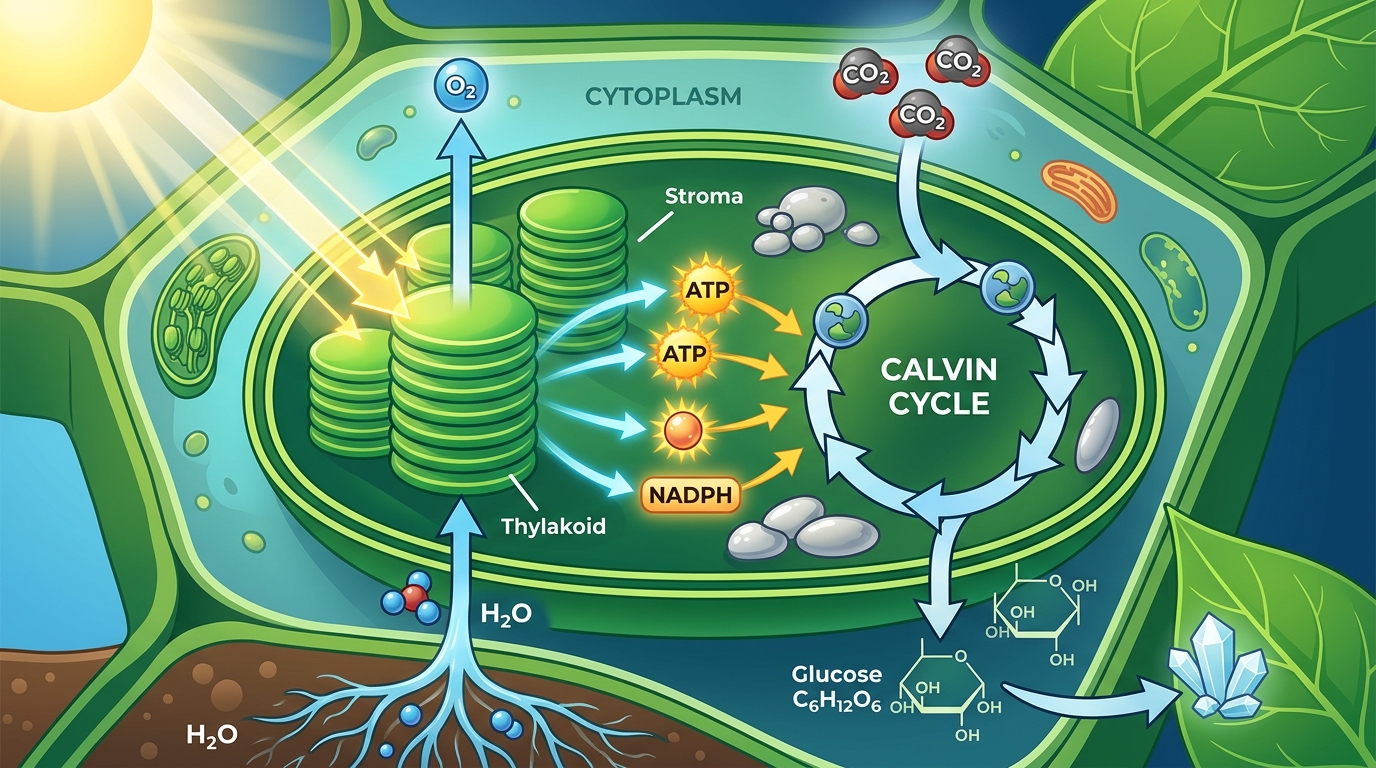
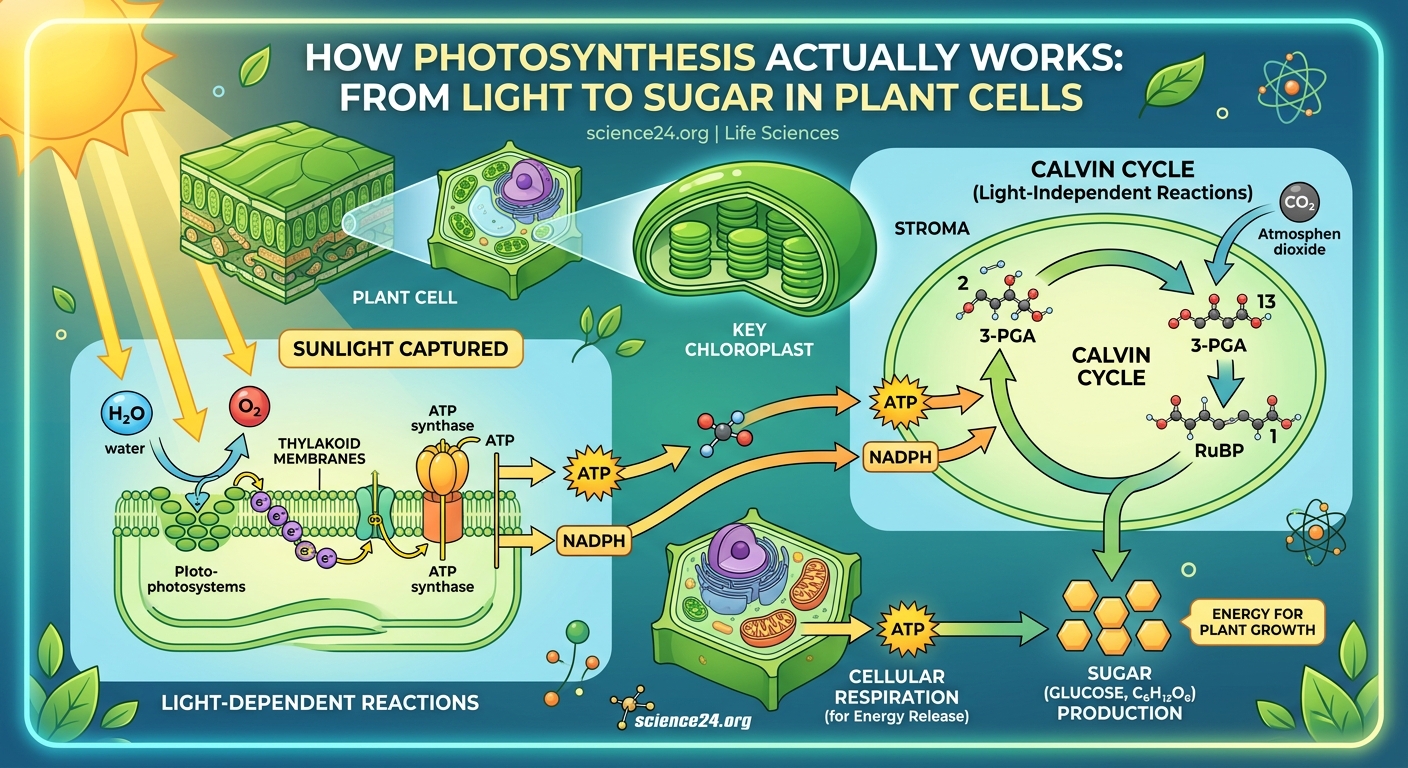
Photosynthesis converts light energy into chemical energy through two main stages. The light-dependent reactions capture sunlight and produce ATP and NADPH in the thylakoid membranes. The light-independent reactions (Calvin cycle) use those energy carriers to build glucose from carbon dioxide in the stroma. This process releases oxygen as a byproduct and forms the foundation of most food chains.
Where Photosynthesis Happens in Plant Cells
Photosynthesis takes place inside chloroplasts, specialized organelles found in plant cells and some algae. These structures contain their own DNA and double membranes, suggesting they evolved from ancient bacteria that formed partnerships with early plant ancestors.
Inside each chloroplast, you’ll find stacks of disc-shaped structures called thylakoids. These stacks, known as grana, are where the light-dependent reactions occur. The fluid surrounding the thylakoids is called the stroma, where the light-independent reactions happen.
Chlorophyll molecules embedded in the thylakoid membranes give plants their green color. These pigments absorb red and blue light wavelengths while reflecting green light. That’s why leaves appear green to our eyes.
The Light-Dependent Reactions Capture Solar Energy
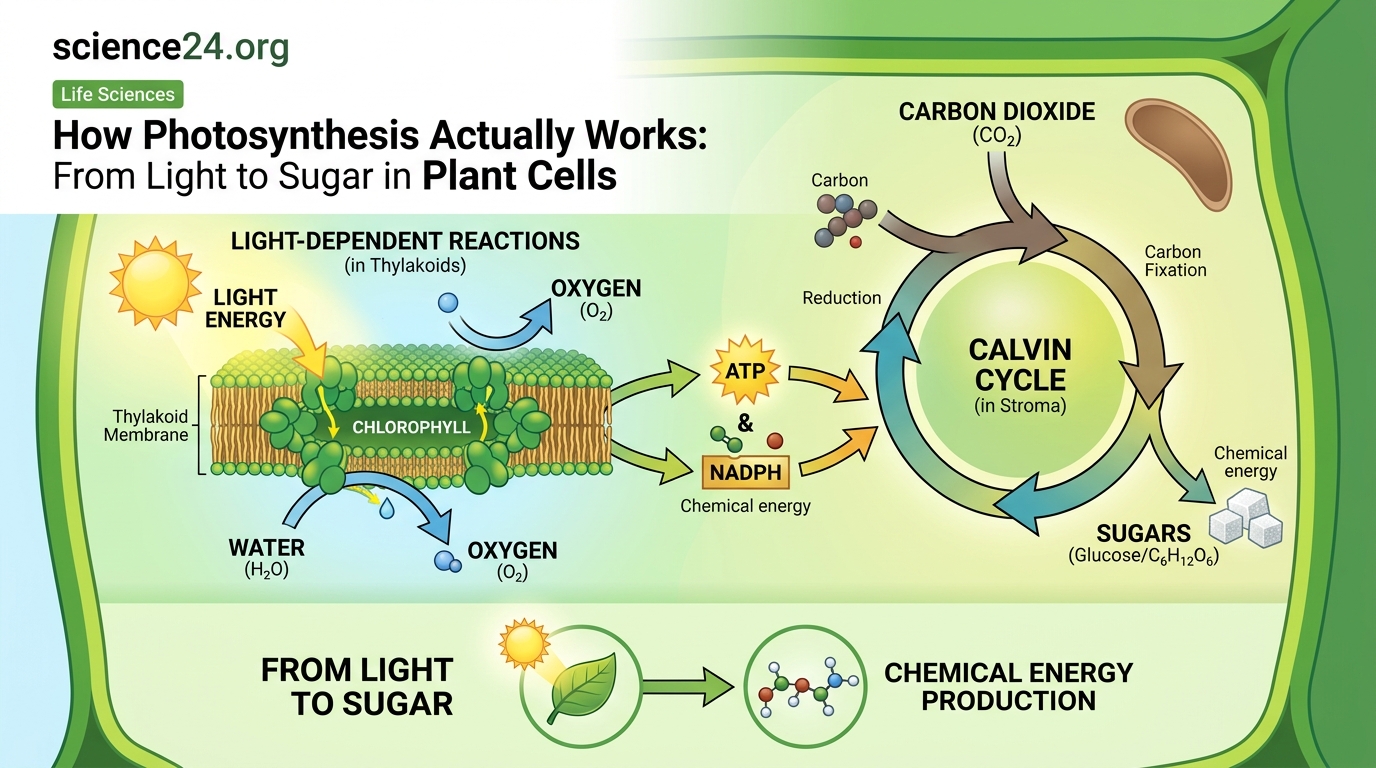
The first stage of photosynthesis requires light. When photons strike chlorophyll molecules, they excite electrons to higher energy states. This energy gets channeled through two protein complexes called Photosystem II and Photosystem I.
Here’s how the process unfolds:
- Photosystem II absorbs light energy and splits water molecules into hydrogen ions, electrons, and oxygen gas.
- The excited electrons travel through an electron transport chain, pumping hydrogen ions into the thylakoid space.
- Photosystem I absorbs additional light energy and re-energizes the electrons.
- The electrons combine with hydrogen ions and NADP+ to form NADPH, an energy carrier molecule.
- The concentration gradient of hydrogen ions powers ATP synthase, which produces ATP from ADP and phosphate.
The oxygen released during water splitting is the oxygen we breathe. Plants produce it as a waste product, but for animals, it’s essential for survival.
“The splitting of water during photosynthesis is one of the most important chemical reactions on Earth. It provides the electrons needed to drive the entire process while releasing the oxygen that makes complex life possible.” – Biochemistry textbook excerpt
The Calvin Cycle Builds Sugar Molecules
The second stage of photosynthesis doesn’t require direct light, though it depends on products from the light-dependent reactions. Scientists call this the Calvin cycle or light-independent reactions.
This cycle occurs in three phases:
Carbon fixation happens first. An enzyme called RuBisCO (the most abundant protein on Earth) attaches carbon dioxide molecules to a five-carbon sugar called ribulose bisphosphate. This creates an unstable six-carbon compound that immediately splits into two three-carbon molecules.
Reduction comes next. The three-carbon molecules receive energy from ATP and electrons from NADPH. This converts them into glyceraldehyde-3-phosphate (G3P), a simple sugar.
Regeneration completes the cycle. Most G3P molecules get recycled to regenerate ribulose bisphosphate, allowing the cycle to continue. For every six carbon dioxide molecules that enter the cycle, one G3P molecule exits to build glucose.
The cycle must turn six times to produce one glucose molecule. That requires 18 ATP molecules and 12 NADPH molecules, all generated during the light-dependent reactions.
Key Molecules and Their Roles
Understanding photosynthesis means knowing what each molecule does. This table breaks down the major players:
| Molecule | Location | Function |
|---|---|---|
| Chlorophyll | Thylakoid membrane | Absorbs light energy and excites electrons |
| Water | Thylakoid space | Provides electrons and releases oxygen |
| NADP+/NADPH | Stroma | Carries high-energy electrons to Calvin cycle |
| ADP/ATP | Throughout chloroplast | Stores and transfers chemical energy |
| Carbon dioxide | Stroma | Provides carbon atoms for sugar synthesis |
| RuBisCO | Stroma | Catalyzes carbon fixation reaction |
| G3P | Stroma | Three-carbon sugar that builds glucose |
Factors That Affect Photosynthesis Rate
Several environmental conditions influence how fast photosynthesis occurs. Light intensity matters most. As light increases, the rate of photosynthesis rises until other factors become limiting.
Carbon dioxide concentration also plays a role. Plants typically work with about 0.04% CO2 in the atmosphere. Increasing this concentration can boost photosynthesis rates, which is why some greenhouse operators add extra CO2.
Temperature affects enzyme activity. Most plants photosynthesize best between 25°C and 35°C. Too cold, and enzymes work slowly. Too hot, and proteins denature.
Water availability impacts the process indirectly. When plants face drought stress, they close their stomata to prevent water loss. This also blocks CO2 intake, slowing photosynthesis even if plenty of light is available.
Common Misconceptions About Photosynthesis
Many students think plants only photosynthesize during the day and respire at night. Actually, plants respire continuously, breaking down sugars to release energy for cellular processes. Photosynthesis only happens during daylight hours when light is available.
Another misconception involves where plants get their mass. Some people assume plants absorb nutrients from soil to build their structures. In reality, most plant mass comes from carbon dioxide in the air. The carbon atoms from CO2 become the building blocks for cellulose, starch, and other organic compounds.
People often confuse the light-independent reactions with processes that occur in darkness. These reactions can happen in light or dark conditions. They’re called light-independent because they don’t directly require photons, not because they only function at night.
Different Types of Photosynthesis
Not all plants use the same photosynthetic pathway. C3 plants, which include most trees and crops like wheat and rice, follow the standard Calvin cycle described above. They’re called C3 because the first stable compound formed has three carbon atoms.
C4 plants evolved a modification that helps them thrive in hot, dry environments. Corn, sugarcane, and many tropical grasses use this pathway. They fix carbon dioxide twice, first in mesophyll cells and again in bundle sheath cells. This adaptation minimizes a wasteful process called photorespiration.
CAM plants, including cacti and pineapples, take a different approach. They open their stomata at night to collect CO2, storing it as an organic acid. During the day, they close their stomata to conserve water and release the stored CO2 for the Calvin cycle. This strategy helps them survive in extremely arid conditions.
The Connection Between Photosynthesis and Cellular Respiration
Photosynthesis and cellular respiration form a cycle that sustains life. Photosynthesis captures light energy and stores it in glucose molecules. Cellular respiration breaks down those glucose molecules to release the stored energy.
The chemical equations mirror each other. Photosynthesis combines carbon dioxide and water to produce glucose and oxygen. Respiration combines glucose and oxygen to produce carbon dioxide and water, similar to how energy changes during chemical reactions follow predictable patterns.
This complementary relationship creates a continuous exchange. Plants produce oxygen that animals breathe. Animals produce carbon dioxide that plants need. The glucose made by plants feeds herbivores, which feed carnivores, distributing solar energy throughout food webs.
Measuring Photosynthesis in the Lab
Scientists measure photosynthesis rates using several methods. The simplest tracks oxygen production. Since plants release one oxygen molecule for every CO2 molecule they fix, counting oxygen bubbles from aquatic plants gives a rough measure of photosynthetic activity.
More precise methods use infrared gas analyzers to measure CO2 uptake. Researchers place leaves in sealed chambers and monitor how quickly carbon dioxide concentrations drop. This technique accounts for respiration occurring simultaneously with photosynthesis.
Chlorophyll fluorescence provides another measurement approach. When chlorophyll absorbs more light than it can use, it re-emits some energy as fluorescent light. Measuring this fluorescence reveals how efficiently the photosynthetic machinery operates under different conditions.
Photosynthesis in Earth’s History
Photosynthesis didn’t always work the way it does today. The first photosynthetic organisms, ancient bacteria, didn’t split water or produce oxygen. They used hydrogen sulfide or other molecules as electron sources instead.
About 2.4 billion years ago, cyanobacteria evolved the ability to split water molecules. This innovation flooded Earth’s atmosphere with oxygen, transforming the planet’s chemistry and climate. The oxygen accumulated over hundreds of millions of years, eventually reaching levels that could support complex animal life.
Today’s plants inherited their photosynthetic machinery from these ancient cyanobacteria. When early plant ancestors engulfed cyanobacteria, the bacteria became chloroplasts through a process called endosymbiosis. The same process gave rise to mitochondria, which explains why both organelles have their own DNA.
Why This Process Matters for Your Studies
Photosynthesis appears in biology courses from middle school through college. High school biology classes cover the basic overview, including inputs, outputs, and general location within the cell. Advanced placement and college courses expect you to know the detailed mechanisms, including specific molecules and reaction sequences.
Test questions often ask you to:
- Identify which stage produces oxygen or consumes carbon dioxide
- Calculate how many ATP or NADPH molecules are needed for a given amount of glucose
- Predict how changing environmental conditions would affect photosynthesis rates
- Compare C3, C4, and CAM pathways and explain their adaptive advantages
- Trace the path of carbon atoms from CO2 through glucose formation
Understanding the process deeply helps you answer application questions, not just recall facts. When you grasp how the light and dark reactions connect, you can reason through problems even if you forget specific details.
Practical Applications of Photosynthesis Research
Scientists study photosynthesis to improve crop yields. By understanding limiting factors, researchers develop plants that use water more efficiently or capture carbon dioxide more effectively. Some projects aim to engineer C4 photosynthesis into C3 crops like rice, potentially increasing productivity by 50%.
Biofuel research relies on photosynthesis knowledge. Algae can produce oils through photosynthesis much faster than traditional crops. Engineers optimize growing conditions and genetic traits to maximize oil production for conversion into biodiesel.
Artificial photosynthesis represents another frontier. Researchers design catalysts and systems that mimic natural photosynthesis to produce hydrogen fuel or reduce carbon dioxide into useful chemicals. These technologies could help address climate change while generating clean energy.
From Sunlight to the Food on Your Plate
Every calorie you consume traces back to photosynthesis. Whether you eat plants directly or consume animals that ate plants, the energy in your food originated as sunlight captured by chlorophyll. A wheat plant converts solar energy into starch stored in grain. That grain becomes bread on your table. The chemical bonds holding that bread together contain the same energy that started as photons striking a leaf.
The oxygen filling your lungs right now came from photosynthesis too. Each breath you take connects you to plants splitting water molecules in their chloroplasts. That oxygen accepts electrons at the end of your cellular respiration pathway, allowing you to extract energy from food.
Understanding how photosynthesis works reveals your connection to the sun, the air, and every plant around you. The process might involve complex chemistry and unfamiliar molecules, but the result is simple and profound. Light becomes life, powering the biological world one photon at a time.