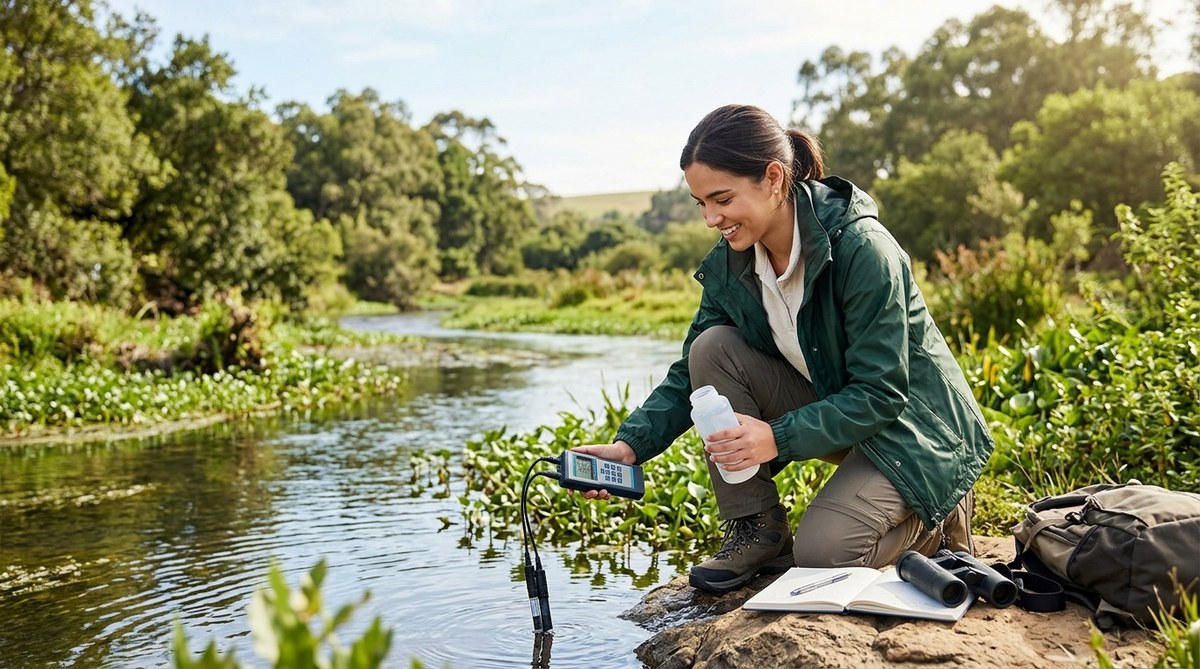
You spent years in the lab dissecting organisms, memorizing metabolic pathways, and running PCR tests. Now you are ready for the real world, but you want to apply that knowledge to something bigger: protecting the planet. The good news is that a biology degree is one of the most versatile foundations for an environmental science career. Whether you care about climate change, conservation, pollution control, or renewable energy, your background in life sciences gives you a head start. This guide walks through exactly how to make the switch from biology student to environmental professional in 2026.
Your biology degree already covers core environmental concepts like ecology, evolution, and molecular biology. To launch an environmental science career, focus on building applied skills in GIS, data analysis, field sampling, and policy understanding. Gaining certifications, networking with professionals, and targeting entry-level roles in government agencies, nonprofits, or private consulting firms will accelerate your transition. With the global green economy growing fast, 2026 offers abundant opportunities for biology graduates ready to make a tangible impact on our environment.
Why Your Biology Degree Is Already a Fit
If you studied biology, you have already covered ecology, population dynamics, and the basics of ecosystem function. You understand how organisms interact with their surroundings, which is the heart of environmental science. You probably also took courses in chemistry, geology, or statistics. Those are all directly applicable.
Many biology graduates feel they lack the “environmental” label, but employers in this field value the analytical and research skills you developed in your degree. The ability to design experiments, analyze data, and communicate scientific findings is exactly what environmental consulting firms and regulatory agencies hire for.
The Core Skills You Already Have
Here are some of the most marketable abilities your biology degree has given you, directly usable in environmental roles:
- Field sampling and observation techniques from ecology or marine biology labs
- Laboratory expertise in water quality testing, soil analysis, or microbial culturing
- Statistical analysis using tools like R, Python, or Excel
- Scientific writing and report preparation
- An understanding of biodiversity, food webs, and nutrient cycles
These skills form the foundation. Now you need to layer on environmental-specific knowledge to stand out.
Building Your Environmental Science Toolkit
The following numbered steps outline a practical process to transition from biology graduate to employed environmental scientist in 2026.
-
Identify your environmental niche. Environmental science is broad. Do you want to work on climate adaptation, water resources, wildlife conservation, environmental policy, or renewable energy? Picking a focus early helps target your learning and job search. For example, if you love field biology, consider ecological restoration or wetland science. If you prefer data, look into environmental modeling or sustainability analytics.
-
Acquire one or two key certifications or credentials. A biology degree is not enough on its own. Adding a certification shows employers you have specialized training. Consider these popular options:
- GIS (Geographic Information Systems) certificate from a community college or online platform like Esri
- Certified Environmental Scientist (CES) through organizations like the National Registry of Environmental Professionals
- OSHA 40-hour HAZWOPER certification for hazardous waste work
- Wetland delineation training from the U.S. Army Corps of Engineers
-
Enroll in a short online course in environmental law or policy to complement your science background
-
Gain practical experience before graduation or soon after. Volunteer, intern, or take a paid field technician role. Many state and federal agencies hire seasonal workers for wildlife monitoring, water sampling, or invasive species removal. Programs like the Student Conservation Association or AmeriCorps can also get you field experience.
-
Network with professionals in the environmental sector. Attend local chapter meetings of the Ecological Society of America or the Society of Environmental Toxicology and Chemistry. Use LinkedIn to connect with environmental scientists at firms like Tetra Tech, AECOM, or local environmental consulting companies. Ask for informational interviews, not jobs. Learn what they wish they had known as new graduates.
-
Tailor your resume and portfolio. Translate your biology lab experience into environmental language. Instead of “performed PCR,” write “conducted genetic analysis for species identification in water samples.” Create a portfolio of any field surveys, GIS maps, or data analyses you have completed. If you have none, make one by analyzing public environmental datasets (e.g., from the EPA or USGS).
“The best environmental scientists I hire are the ones who can think like biologists but also understand the regulatory and policy side. If you can speak both science and policy, you become indispensable.”
* Senior Environmental Consultant at a mid-size firm, 2026
Common Mistakes to Avoid and How to Fix Them
| Mistake | Why It Hurts | How to Avoid It |
|---|---|---|
| Relying only on coursework | Employers want applied skills, not just knowledge | Seek internships, volunteer work, or independent projects |
| Ignoring GIS and data analysis | Most environmental jobs require spatial skills or coding | Take an online GIS course and practice with real data |
| Applying without a focus | Generic applications get lost | Tailor each resume to the specific environmental niche |
| Not networking until you need a job | Build connections before you are desperate | Attend one industry event per month, even if virtual |
| Underestimating soft skills | Communication and teamwork matter as much as science | Practice writing plain‑language summaries of complex findings |
Career Paths That Fit a Biology Background
The environmental field offers diverse roles. Here are several that align well with a biology degree and have strong demand in 2026:
- Environmental Scientist / Specialist (state or federal agencies, consulting firms)
- Conservation Biologist (nonprofits, land trusts, state wildlife agencies)
- Water Quality Technician (utilities, environmental labs, regulatory bodies)
- Climate Change Analyst (think tanks, government, corporate sustainability)
- Environmental Educator or Outreach Coordinator (nature centers, parks, NGOs)
- Regulatory Compliance Officer (EPA, state departments of environmental quality)
Many of these roles require additional training or certification, but the biology degree gets you in the door. For example, if you want to work in renewable energy, your understanding of ecosystem impacts and environmental impact assessments is directly applicable. Check out the Top Emerging Careers in Renewable Energy Science for more ideas.
Additionally, if you are considering a path that emphasizes data and technology, you might find the guide on How to Break Into Data Science Without a Computer Science Degree helpful because environmental data analysis is a growing subspecialty.
Your Next Steps Start Now
You do not need to start over. Your biology degree is a powerful springboard into environmental science. The key is to proactively bridge the gap between general biology and applied environmental work. Pick one niche, earn a certification, get some field or data experience, and start talking to people already in the field. The world needs science graduates who can connect ecosystem health with human activity. In 2026, that combination is more valuable than ever.
Take one concrete action today: identify three environmental organizations in your area and research their job openings. Even if you are not ready to apply, reading the descriptions will show you exactly what skills to develop next. You have the foundation. Now build on it.