If you have made it to calculus, you already know how to take a derivative. You can handle a simple power rule like d/dx of x^5 equals 5x^4. You know that the derivative of sin(x) is cos(x). Then your textbook throws something like d/dx of sin(3x^2 + 2) at you, and everything freezes. The problem is not that you forgot how to differentiate. The problem is that you have a function living inside another function. That is the whole reason we need the chain rule.
The chain rule is the most used differentiation technique in calculus I and II. It appears in every subsequent chapter, from related rates to integration by substitution. Once you understand the pattern, it actually becomes the easiest rule to apply. Let us strip away the confusing notation and look at what is really happening.
The chain rule says to take the derivative of the outside function first, leaving the inside part completely alone. Then multiply by the derivative of the inside function. Think of it as peeling an onion: you handle the outer layer, then the next layer, then the next. This simple two-step process works for any composition of functions, no matter how messy they look.
What the Chain Rule Actually Says
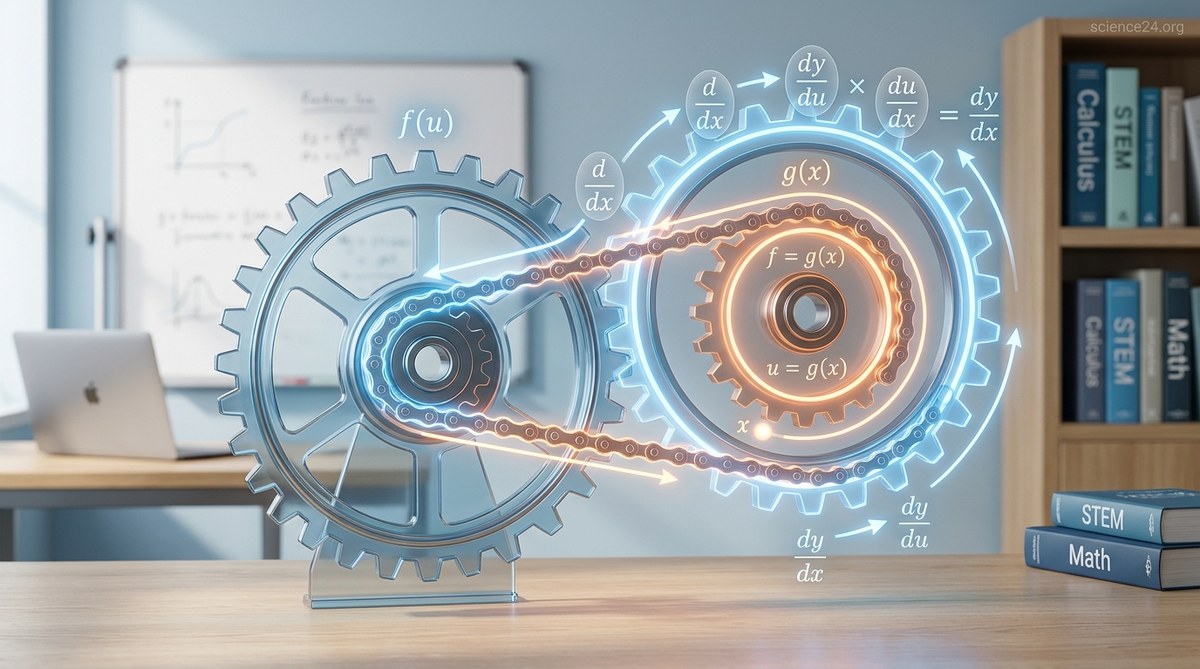
The formal definition looks scary, but it does not have to be. If you have a composite function f(g(x)), the derivative is f'(g(x)) multiplied by g'(x).
Here is that same idea in plain English:
- Find the derivative of the outer function.
- Keep the inner function exactly as it is (do not change it yet).
- Multiply by the derivative of the inner function.
That is it. The chain rule is just a multiplication step that accounts for the fact that the inside part is changing too.
Why the Inner Function Matters
Imagine you are driving a car and your friend is controlling the gas pedal. Your speed depends on how far your friend pushes the pedal. But your friend’s push depends on how much pressure their foot applies. The chain rule handles this chain of dependencies.
In calculus terms, if y depends on u, and u depends on x, then the rate of change of y with respect to x is the product of those two rates. This idea shows up everywhere, not just in math class. If you want to understand how breaking down derivatives for complete beginners works, the chain rule is the bridge that connects simple derivatives to complex ones.
The Three-Step Method That Never Fails
When you see a chain rule problem, follow this numbered list. It works for every single case.
-
Identify the outer function and the inner function. Look for the “outside” operation. If you see sin(3x), the outer is sine and the inner is 3x. If you see (5x^2 + 1)^7, the outer is something raised to the seventh power and the inner is 5x^2 + 1.
-
Take the derivative of the outer function. Pretend the inner part is a single variable. For (5x^2 + 1)^7, the derivative of u^7 is 7u^6. Write down 7(5x^2 + 1)^6.
-
Multiply by the derivative of the inner function. The derivative of 5x^2 + 1 is 10x. So your final answer is 7(5x^2 + 1)^6 times 10x, which simplifies to 70x(5x^2 + 1)^6.
Let us test this method on a few examples.
Example 1: A Polynomial Inside a Power Function
Find the derivative of h(x) = (4x^3 – 2x)^5.
- Outer function: u^5
- Inner function: 4x^3 – 2x
- Derivative of outer: 5u^4 becomes 5(4x^3 – 2x)^4
- Derivative of inner: 12x^2 – 2
- Multiply: 5(4x^3 – 2x)^4 * (12x^2 – 2)
You can factor out a 2 from the inner derivative to get 10(4x^3 – 2x)^4 * (6x^2 – 1), but leaving it as 5(4x^3 – 2x)^4(12x^2 – 2) is perfectly acceptable.
Example 2: A Trigonometric Function
Find the derivative of y = cos(7x).
- Outer: cos(u)
- Inner: 7x
- Derivative of outer: -sin(u) becomes -sin(7x)
- Derivative of inner: 7
- Final answer: -7 sin(7x)
Notice that the argument 7x stayed completely unchanged while you took the derivative of cosine. That is the most common place where students slip up. They try to modify the inside while taking the outer derivative. Do not do that. Leave the inside alone until step three.
Example 3: A Nested Radical
Find the derivative of f(x) = sqrt(2x^2 + 5). Remember that sqrt is the same as raising to the 1/2 power.
- Outer: u^(1/2)
- Inner: 2x^2 + 5
- Derivative of outer: (1/2)u^(-1/2) becomes (1/2)(2x^2 + 5)^(-1/2)
- Derivative of inner: 4x
- Multiply: (1/2)(2x^2 + 5)^(-1/2) * 4x = 2x(2x^2 + 5)^(-1/2)
You can rewrite that as 2x divided by sqrt(2x^2 + 5). Many textbooks prefer that form because it has no negative exponent.
Common Mistakes and How to Fix Them
The table below shows the most frequent errors students make with the chain rule and the corrections.
| Mistake | Wrong Calculation | Right Calculation |
|---|---|---|
| Forgetting to multiply by the inner derivative | d/dx of (x^2+1)^3 = 3(x^2+1)^2 | 3(x^2+1)^2 * 2x = 6x(x^2+1)^2 |
| Changing the inside during the outer derivative | d/dx of sin(x^3) = cos(3x^2) | cos(x^3) * 3x^2 |
| Applying power rule to the inside separately | d/dx of (5x)^4 = 4(5x)^3 * 5 (this is actually correct here, but the reasoning is often wrong) | Correct, but only because inner derivative is 5 |
| Stopping after the outer derivative | d/dx of e^(2x) = e^(2x) | e^(2x) * 2 |
The third row is tricky. Some students get the right answer by accident because they think the chain rule is optional. It is not. For (5x)^4, the chain rule gives 4(5x)^3 * 5, which equals 20(5x)^3. If you expand (5x)^4 to 625x^4 and take the derivative directly, you also get 2500x^3. Both answers are the same because 20(5x)^3 equals 2500x^3. The chain rule is just more efficient.
When You Need the Chain Rule More Than Once
Some functions have three or more layers. For example, h(x) = sin^3(4x) means sin(4x) raised to the third power. You have to peel the onion multiple times.
- Outer: u^3
- Middle: sin(v)
- Inner: 4x
Start from the outside. Derivative of u^3 is 3u^2, so you get 3 sin^2(4x). Now multiply by the derivative of sin(v), which is cos(v). That gives 3 sin^2(4x) * cos(4x). Finally multiply by the derivative of 4x, which is 4. The answer is 12 sin^2(4x) cos(4x).
Expert tip: Write down each step on a separate line. Do not try to do everything in your head. The chain rule is mechanical. If you write it out, you will catch your own mistakes before they cost you points on an exam.
The Chain Rule with Exponential and Logarithmic Functions
Exponential functions follow the same pattern. The derivative of e^(u) is e^(u) times du/dx. That is why the derivative of e^(5x) is 5e^(5x). The exponential function is special because its derivative is itself, but you still must multiply by the derivative of the exponent.
Logarithms work similarly. The derivative of ln(u) is (1/u) times du/dx. So the derivative of ln(3x^2 + 1) is (1/(3x^2 + 1)) times 6x, which simplifies to 6x/(3x^2 + 1).
If you feel shaky on logarithms, review mastering logarithms: essential techniques for beginners and beyond before tackling these problems.
A Bulleted List of Chain Rule Red Flags
Watch for these signals that tell you the chain rule is needed.
- The function has parentheses with something more than just x inside
- You see a power, trig function, exponential, or log applied to an expression
- The function is a composition like f(g(x)) where g(x) is not simply x
- You are taking a derivative of a derivative (second derivatives of composite functions)
- The problem involves related rates or implicit differentiation
Every time you see one of these, the chain rule is involved. It is not optional.
How to Check Your Work
After you finish a derivative, you can verify it by doing a quick sanity check. Pick a simple value for x, like x = 0 or x = 1, and evaluate both the original function and your derivative at that point. Use a calculator or a graphing tool to see if the slope matches. This will not catch every error, but it will catch the big ones like forgetting the inner derivative entirely.
Another method is to expand the original function if it is a polynomial raised to a power. For example, (x+1)^2 expands to x^2 + 2x + 1. The derivative is 2x + 2. The chain rule gives 2(x+1)*1, which is also 2x + 2. When the expansion is simple, use it to double check.
Why This Rule Matters for the Rest of Calculus
The chain rule is not just a topic you learn and forget. It is the foundation for integration by substitution, which is the chain rule in reverse. It shows up in every related rates problem you will ever solve. It is essential for finding derivatives of inverse functions. If you are planning to take physics or engineering courses, you will use the chain rule constantly.
Students who struggle with the chain rule often struggle with everything that comes after it. That is why it is worth spending extra time now to get it right. For a deeper look at related concepts, check out essential tips for mastering limits and continuity in calculus and how to tackle calculus optimization problems without getting stuck.
Your Next Step Toward Mastery
The chain rule is a skill, not a fact. You cannot learn it by reading alone. You have to do problems. Start with simple ones like (2x+1)^3 and sin(5x). Work your way up to nested functions like e^(sin(x^2)). Do ten problems today. Do ten more tomorrow. By the end of the week, the chain rule will feel automatic.
When you sit down for your next exam, you will see a composite function and your hand will already know what to do. Identify the outer. Take its derivative. Leave the inside alone. Multiply by the derivative of the inside. That is the entire chain rule. You have got this.