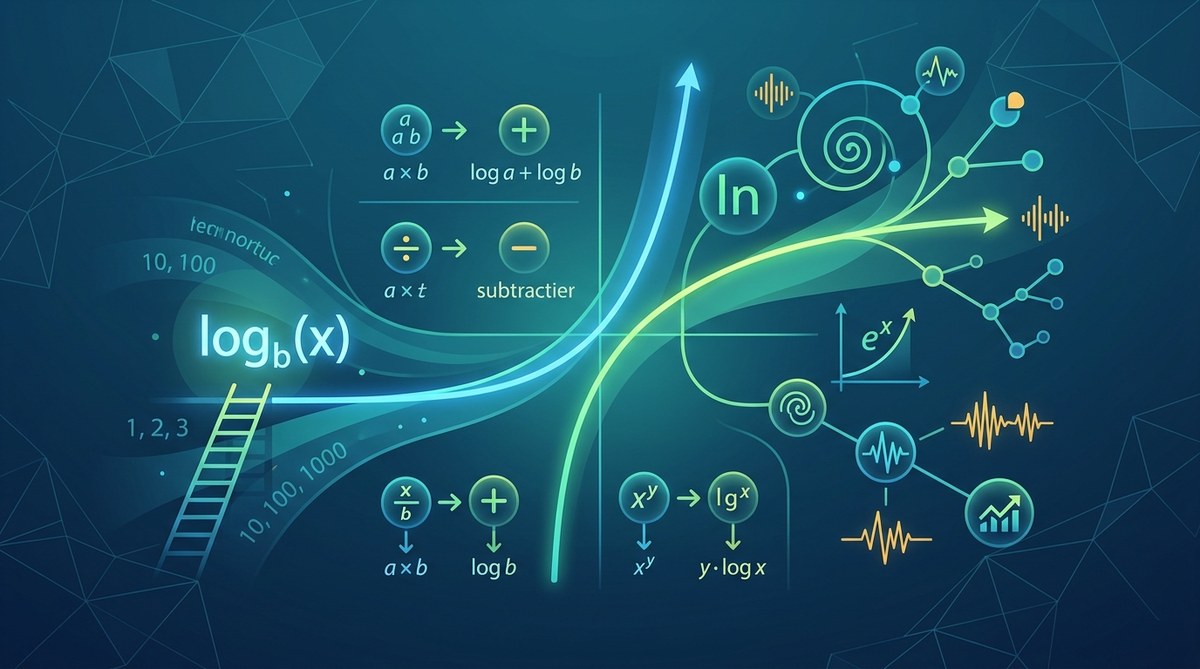
Starting to work with logarithms can feel intimidating at first. The good news is that with the right techniques, anyone can master the concepts. Logarithms are vital in many areas of science and mathematics, from solving exponential equations to analyzing data. Whether you’re just beginning or looking to strengthen your skills, understanding effective logarithm techniques opens the door to advanced topics and academic success.
Mastering logarithm techniques involves understanding properties like product, quotient, and power rules, converting between exponential and logarithmic forms, and practicing problem-solving strategies. These skills simplify complex problems and build a solid foundation for more advanced math and science topics. Consistent practice and clear explanations help make logarithms accessible for all learners.
Understanding the Basics of Logarithms
Logarithms are the inverse of exponents. When you see an expression like log base 2 of 8, it asks, “To what power must 2 be raised to get 8?” The answer is 3 because 2 raised to the 3rd power equals 8. This relationship forms the core of logarithmic techniques.
Key properties of logarithms
- Product rule: log base b of (xy) equals log base b of x plus log base b of y.
- Quotient rule: log base b of (x divided by y) equals log base b of x minus log base b of y.
- Power rule: log base b of x raised to the n equals n times log base b of x.
These properties allow you to manipulate logarithmic expressions confidently. They are essential for simplifying complex problems.
Converting between exponential and logarithmic forms
Knowing how to switch forms is a critical technique. For example:
– Exponential form: b^x = y
– Logarithmic form: log base b of y equals x
This conversion makes it easier to solve equations depending on the context.
Step-by-step Techniques for Solving Logarithmic Equations
When tackling logarithmic problems, following a systematic process can save time and reduce mistakes.
1. Convert all logarithmic expressions to a common form
Identify all logs in the problem. Convert any exponential expressions to logs or vice versa using the properties discussed.
2. Apply logarithmic properties to simplify
Use product, quotient, and power rules to combine or break apart logarithms. Simplification often reveals the solution more clearly.
3. Isolate the logarithmic expression
Get the logarithm alone on one side of the equation. This step might involve algebraic operations like addition, subtraction, or applying exponents.
4. Solve the resulting exponential equation
Once the logarithmic part is isolated, rewrite it as an exponential equation and solve for the variable.
5. Check solutions for extraneous roots
Logarithmic equations can sometimes produce invalid solutions (like taking the log of a negative number). Always verify your answers in the original equation.
Practical Tips to Master Logarithm Techniques
- Practice rewriting problems: Convert between exponential and logarithmic forms regularly.
- Use a table of properties: Keep a quick reference for properties to speed up problem-solving.
- Work through examples: Practice problems with varying complexity to build confidence.
- Avoid common mistakes: Be cautious with negative inputs inside logs and remember that logs are undefined for zero or negative numbers.
Common mistakes to avoid
| Mistake | Explanation | How to prevent it |
|---|---|---|
| Taking the log of a negative number | Logarithms are undefined for negatives | Always check the domain before solving |
| Forgetting to apply the power rule correctly | Misapplication leads to wrong results | Revisit properties regularly and verify steps |
| Ignoring extraneous solutions | They can appear after algebraic manipulation | Test solutions in the original equation |
Visualizing Logarithms with Examples
“Understanding how logs relate to exponents is key. For instance, rewriting 8 as 2^3 helps see that log base 2 of 8 equals 3. Visualizing problems like this clarifies the process and reduces errors.”
Let’s consider a simple problem: Solve for x in log base 3 of (x minus 2) equals 2.
Solution process:
- Convert to exponential form: 3^2 = x – 2
- Simplify: 9 = x – 2
- Solve for x: x = 11
- Verify: x must be greater than 2 for the log to be valid. Since 11 is greater, it’s acceptable.
This straightforward example illustrates how converting forms simplifies the process.
Advanced Techniques for Complex Logarithmic Problems
As you gain confidence, you can explore more advanced methods such as:
- Change of base formula: log base b of x equals log x divided by log b. Useful for calculators that only handle common or natural logs.
- Using substitution: Simplify nested logs by substituting parts of the expression.
- Applying logarithmic inequalities: To solve inequalities, understand how to manipulate logs carefully, considering their domains.
Handling tricky problems
- Break down complex expressions into manageable parts.
- Use substitution to replace complicated logs with simpler variables.
- Always check the domain restrictions.
Final Words on Logarithm Techniques for Beginners
Mastering logarithm techniques requires patience and practice. Focus on understanding properties and conversions, and work through various examples. As you become more comfortable, you’ll find that logarithms are powerful tools for solving a wide array of problems in mathematics and science. Keep practicing, and don’t hesitate to revisit foundational concepts whenever needed.
Embracing Logarithms as a Mathematical Tool
Getting comfortable with logarithms transforms your approach to exponential and scientific problems. Remember, every complex problem becomes manageable when broken down into steps. With consistent effort, logarithm techniques will soon feel natural, opening up new opportunities for learning and discovery.
“The key to mastering logarithms is to see them as the inverse of exponents. Think of logs as the question, ‘To what power must I raise this base to get this number?’ Practice makes this relationship second nature.”
Start applying these techniques to your homework or practice problems. Over time, you’ll solve logarithmic equations with confidence and clarity.