You squeeze a blob of clear gel into your palm, rub your hands together for a few seconds, and within moments it feels like it vanished. Hand sanitizer does not soak into your skin. It disappears into thin air. That vanishing act happens because the alcohol molecules inside it are eager to leave the liquid state and become a gas. This process is called evaporation, and hand sanitizer is a textbook example of how volatility and intermolecular forces control whether a liquid lingers or leaps away.
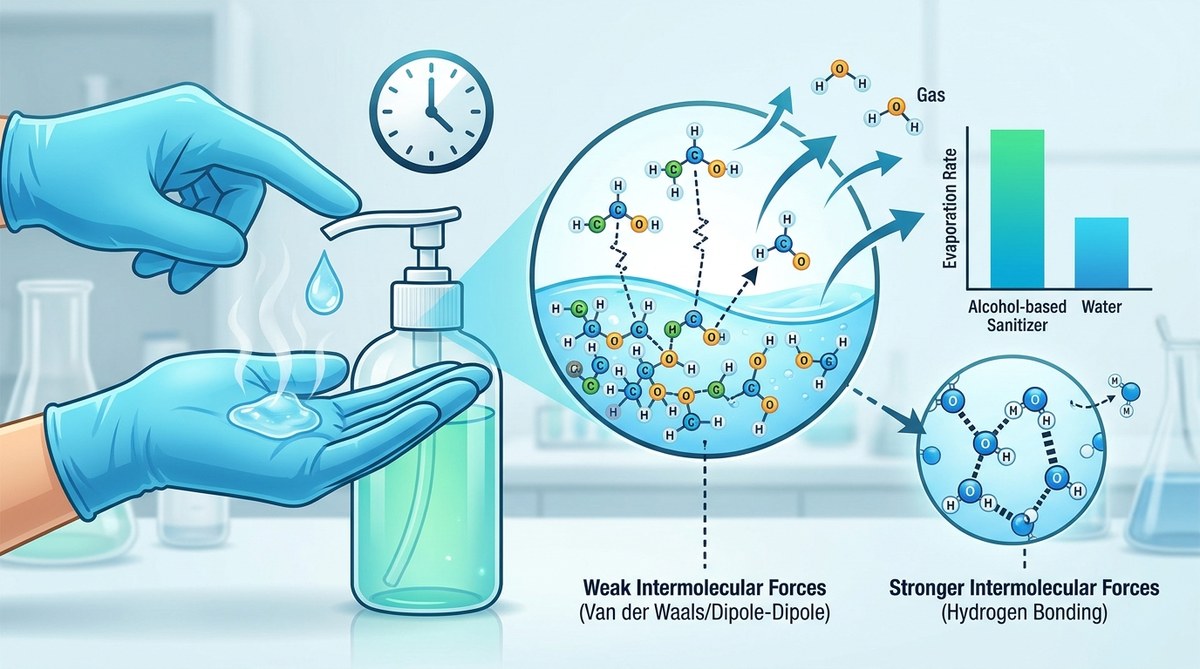
Hand sanitizer evaporates quickly because its main active ingredient, ethanol or isopropyl alcohol, has a low boiling point and weak intermolecular forces (specifically hydrogen bonding that is weaker than water’s network). These molecules gain enough kinetic energy from your skin’s warmth to break free from the liquid surface, turning into a vapor in seconds.
What Makes a Liquid Volatile?
Volatility describes how easily a substance changes from a liquid to a gas. A highly volatile liquid evaporates at room temperature without needing a hot stove. Gasoline, nail polish remover (acetone), and rubbing alcohol are all volatile. Water, by comparison, is not very volatile. Leave a glass of water out for an hour and it barely changes. Leave a puddle of hand sanitizer out and it dries almost instantly.
The key is boiling point. Liquids with low boiling points are more volatile. Ethanol, the alcohol in most hand sanitizers, boils at 78.4 degrees Celsius (173 degrees Fahrenheit). Isopropyl alcohol, the other common choice, boils at 82.6 degrees Celsius (180 degrees Fahrenheit). Water boils at 100 degrees Celsius (212 degrees Fahrenheit). That difference of roughly 20 degrees Celsius matters a lot at room temperature. A liquid does not need to reach its boiling point to evaporate. It just needs enough energy at the surface to let molecules escape. The closer a liquid is to its boiling point, the faster it evaporates. Ethanol sits much closer to its boiling point at room temperature than water does, so its molecules escape far more easily.
The Role of Intermolecular Forces
Evaporation is a battle between two things. Kinetic energy wants to send molecules flying into the air. Intermolecular forces try to hold them together in the liquid. Think of it like a tug of war. If the rope (intermolecular forces) is weak, the molecules win their freedom easily.
Every molecule of ethanol or isopropyl alcohol has a small polar region that can form hydrogen bonds. Hydrogen bonds are the strongest type of intermolecular force, but they are still weak compared to the bonds inside a molecule. Water, however, can form a more extensive hydrogen bonding network. Each water molecule can hydrogen bond with up to four neighbors. Ethanol can only hydrogen bond with about two or three neighbors because its nonpolar ethyl group gets in the way. That nonpolar tail does not participate in hydrogen bonding at all.
This difference means water molecules are more tightly tethered to each other. They need more energy to break free. Ethanol molecules have fewer tethers, so they escape more easily. The same logic applies to isopropyl alcohol. Its larger nonpolar section further weakens the overall intermolecular attraction.
To see this clearly, compare the three common household liquids:
| Liquid | Boiling Point (°C) | Hydrogen Bonding Strength | Evaporation Rate (Relative) |
|---|---|---|---|
| Water | 100 | Strong, extensive network | Slow |
| Ethanol | 78.4 | Moderate, limited network | Fast |
| Isopropyl alcohol | 82.6 | Moderate, more nonpolar bulk | Very fast |
Hand sanitizer is mostly ethanol or isopropyl alcohol, so it inherits those properties. The small amount of water and gel thickeners in the formula do slow evaporation slightly, but the alcohol dominates the behavior.
How Your Body Heat Speeds Things Up
Your skin is warm. A typical hand surface temperature is around 33 degrees Celsius (91 degrees Fahrenheit). That warmth transfers energy directly into the thin layer of sanitizer spread across your palm. More energy means more molecules reach the activation threshold needed to escape the liquid.
This is why the same sanitizer evaporates slower on a cold metal countertop but nearly disappears on your hands. You are providing the thermal boost that turns a volatile liquid into a vapor.
The process follows a simple sequence:
- You dispense the sanitizer as a thin film across your skin.
- The alcohol molecules at the surface absorb thermal energy from your hand.
- Those molecules gain enough kinetic energy to overcome the hydrogen bonds holding them in the liquid.
- They escape as a gas, mixing into the air around you.
- Molecules from deeper in the film rise to the surface, and the cycle repeats until the liquid is gone.
This whole chain can finish in 15 to 30 seconds, depending on the alcohol concentration and the temperature of your skin.
Why 60% Alcohol Evaporates Differently Than 90%
Not all hand sanitizers are the same. The CDC recommends at least 60% alcohol for effective germ killing, but many products range from 60% to 95% alcohol. The concentration changes the evaporation rate.
A higher alcohol content means fewer water molecules are present to slow things down. Water acts as a brake on evaporation because it forms strong hydrogen bonds and has a higher boiling point. A 90% ethanol sanitizer evaporates noticeably faster than a 60% one. You might feel like the 60% version stays wet on your hands a bit longer. That extra contact time is actually beneficial for killing germs, but it can feel less satisfying because the product does not vanish as quickly.
Manufacturers sometimes add moisturizers like glycerin or aloe vera to reduce the drying effect on skin. These additives have very low volatility and remain on your skin after the alcohol evaporates. They do not speed up or slow down the alcohol evaporation much, but they leave a slight residue that can make the product feel different.
Common Misconceptions About Hand Sanitizer Evaporation
Students often assume that sanitizer evaporates because it “dries out” like water soaking into a paper towel. That is not correct. The alcohol does not absorb into your skin. It turns into a gas and floats away. Your skin might feel dry afterward because the alcohol strips away some of the natural oils on the surface, but the liquid itself did not go into your pores.
Another misunderstanding involves the gel texture. Some people think the gel evaporates as a whole. In reality, the gel is mostly a thickener (often carbomer or a similar polymer) suspended in the alcohol and water mixture. The alcohol and water evaporate, leaving behind a thin invisible layer of the gel ingredients. That is why your hands can feel slightly tacky for a moment after the sanitizer seems gone.
“Many students assume that hand sanitizer disappears because it is absorbed by the skin. In reality, the alcohol component evaporates into the air. The thin film of liquid on your hand simply changes phase from liquid to gas.” – Dr. Rachel Harmon, Chemistry Professor at Stanford University
Why This Matters for Germ Killing
The fast evaporation of hand sanitizer is not just a curiosity. It directly affects how well the product works. For alcohol to kill bacteria and viruses, it needs to denature their proteins and disrupt their lipid membranes. That process requires the alcohol to stay in contact with the germs long enough to do damage.
If the sanitizer evaporates too fast, it might not kill everything. That is why you should rub the sanitizer over all surfaces of your hands until it feels dry, which usually takes about 20 seconds. If it dries in 10 seconds, you probably used too little product. If it stays wet for 30 seconds, you might have used a lower concentration formula or your hands were unusually cold.
The ideal balance is a product with at least 60% alcohol that gives you roughly 20 seconds of wet contact time before the volatile alcohol molecules finish their escape into the air.
A Practical Look at Evaporation Factors
Several variables control how fast your hand sanitizer evaporates on any given day:
- Temperature of your skin: Warmer hands speed evaporation.
- Room temperature: Hot summer days make sanitizer vanish faster than cold winter mornings.
- Humidity: High humidity slows evaporation because the air already holds a lot of water vapor, which reduces the concentration gradient that drives evaporation.
- Surface area: A thin layer spread across both palms evaporates faster than a thick blob sitting in one spot.
- Air movement: A breeze or a fan carries away vapor molecules, making room for more liquid to evaporate.
If you want to slow the evaporation to get more contact time, you can use a slightly larger amount of product or choose a formulation with 60% alcohol instead of 90%. If you want it to evaporate faster (for example, before handling food), use a smaller amount and rub vigorously to increase air exposure.
Connecting Volatility to Other Chemistry Concepts
The same principles that explain hand sanitizer evaporation also explain why acetone removes nail polish, why gasoline fumes are so strong at the pump, and why a puddle of water lingers after a rainstorm while a puddle of rubbing alcohol disappears. Volatility and intermolecular forces are universal concepts in chemistry.
If you are studying for an exam, try this mental exercise. Compare the evaporation rates of water, ethanol, and hexane. Hexane is a nonpolar hydrocarbon with only weak London dispersion forces holding its molecules together. It evaporates even faster than ethanol. Water, with its extensive hydrogen bonding, is the slowest. Ethanol sits in the middle. This ranking directly follows the strength of intermolecular forces: stronger forces mean slower evaporation.
You can take this knowledge and apply it to any liquid you encounter. Look at the molecular structure. Does it have polar groups that can hydrogen bond? Does it have a long nonpolar tail that weakens those bonds? What is its boiling point? Answer those questions and you can predict whether the liquid will linger or vanish.
Making the Chemistry Stick for Your Next Assignment
Hand sanitizer is a perfect real world example to use in a lab report or study guide. It connects abstract concepts like hydrogen bonding and vapor pressure to something you experience every day. When a teacher asks why some liquids evaporate faster than others, you can point to the molecular structure, the boiling point, and the competition between kinetic energy and intermolecular forces.
For deeper background on how molecules interact, check out our guide on why atoms form bonds. To understand how energy flows during these changes, read about what happens during an exothermic reaction. And if you want to avoid common pitfalls in your chemistry problem sets, our article on common chemistry mistakes that cost you points on AP exams might save your grade.
The Big Picture of a Small Disappearing Act
The next time you use hand sanitizer, take a second to notice how fast it disappears. That brief moment is a full demonstration of volatility, hydrogen bonding, and phase changes all happening in real time on your skin. What looks like magic is just chemistry following the rules of intermolecular forces. Ethanol molecules, held loosely by a few hydrogen bonds, grab enough energy from your warm hand and launch themselves into the air. The gel is gone. The germs are dead. And you just witnessed one of the cleanest examples of evaporation in action.
Keep that mental image when you study for your next chemistry test. Think of the sanitizer on your palm. Think of the weak hydrogen bonds. Think of the warmth. It will help the concepts stick far better than any textbook diagram.