You are watching the Winter Olympics, and a figure skater glides into a spin. She starts with her arms stretched wide, turning at a moderate speed. Then she pulls her arms in tight against her chest. Suddenly, she becomes a blur. The spin accelerates dramatically, and the audience gasps. Why does this happen? The answer lies in a fundamental law of physics that governs everything from spinning ice skaters to orbiting planets. It is called the conservation of angular momentum, and once you understand it, you will see it everywhere.
An ice skater spins faster when she pulls her arms in because of the conservation of angular momentum. Angular momentum depends on both spin speed and the distribution of mass. When the skater brings her arms closer to her body, she reduces her moment of inertia. To keep the total angular momentum constant, her rotational speed must increase. This same principle explains why a spinning figure skater or a diver tucking into a ball rotates faster.
The Secret Behind the Spin
The short answer is that an ice skater spins faster when she pulls her arms in because of angular momentum conservation. Angular momentum is a measure of how much rotation an object has. It depends on two things: how fast something is spinning and how its mass is arranged relative to the axis of rotation.
Think of it like this. Imagine you are sitting on a spinning office chair. If you hold a heavy textbook in each hand and stretch your arms out, you will spin at a certain speed. Now pull those textbooks in against your chest. Without touching the floor, you will start spinning faster. Your body did not add any extra energy to the spin, but the speed changed anyway.
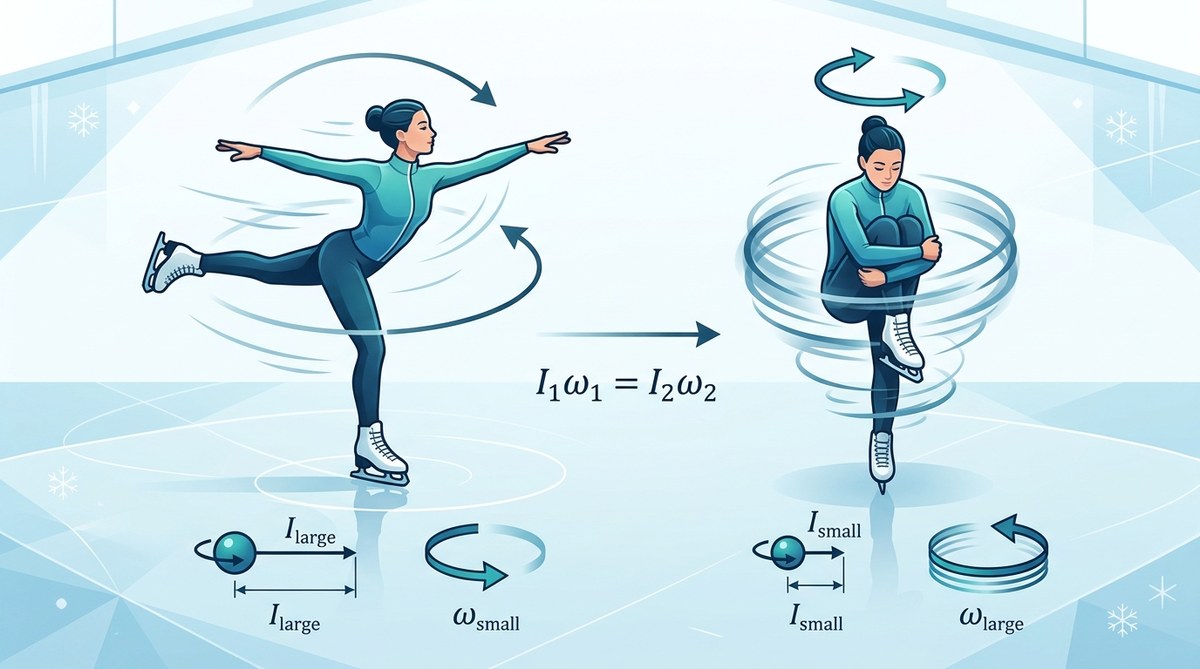
That is exactly what happens to a figure skater. She uses the ice to start a slow spin with her arms extended. When she pulls her arms inward, her mass moves closer to her spin axis. The total angular momentum of her body cannot change unless an outside force acts on her. Since the ice provides very little friction against her spin, her angular momentum stays the same. To keep that balance, her spin speed must increase.
What Is Angular Momentum Exactly?
To get a solid handle on this, we need to define two key terms: moment of inertia and angular velocity.
- Angular velocity is just a fancy name for spin speed. It tells you how many degrees or radians the skater rotates through per second.
- Moment of inertia is a measure of how difficult it is to change an object’s rotation. It depends on the mass of the object and how far that mass is from the axis of rotation. The farther the mass is from the axis, the higher the moment of inertia.
The formula for angular momentum (L) is:
L = I * ω
Here, I stands for moment of inertia, and ω (the Greek letter omega) stands for angular velocity. If L must stay constant, then when I goes down, ω must go up. When the skater pulls her arms in, she reduces her moment of inertia. Her angular velocity increases to compensate.
This is not a magic trick. It is a direct consequence of the law of conservation of angular momentum, which states that the total angular momentum of a system remains constant unless acted upon by an external torque. The ice exerts very little torque on the spinning skater, so her angular momentum is nearly conserved.
How Skaters Control Their Spin Speed
Elite figure skaters use this principle to perform stunning routines. They do not just randomly fling their arms. They carefully control their body position to manage their spin speed.
Here is a simple numbered breakdown of how a skater executes a fast spin:
- Start with a wide stance. The skater pushes off the ice with one foot, beginning to rotate with her arms and one leg extended. This gives her a high moment of inertia and a slow, controllable spin.
- Pull the arms inward. Once she has enough rotational speed, she brings her arms close to her chest. This reduces her moment of inertia. Her spin speed increases automatically.
- Pull the free leg in. To spin even faster, she also brings her free leg in against her standing leg. This further reduces the moment of inertia and increases the angular velocity.
- Extend to slow down. When she wants to stop or slow the spin, she extends her arms and free leg outward again. This increases her moment of inertia and decreases her spin speed.
Common Mistakes People Make When Explaining This
Many people get the basic idea right but slip up on the details. Here is a table that clarifies some common techniques and the mistakes that go with them.
| Technique | What Actually Happens | Common Mistake |
|---|---|---|
| Pulling arms inward | Reduces moment of inertia, increases spin speed | Thinking the skater adds energy to spin faster |
| Extending arms outward | Increases moment of inertia, decreases spin speed | Believing the skater loses angular momentum |
| Tucking into a ball | Minimizes moment of inertia for maximum speed | Assuming the mass of the skater changes |
| Using a free leg | Further reduces moment of inertia | Forgetting that the leg also contributes to mass distribution |
The biggest mistake is thinking that the skater somehow creates new energy to spin faster. She does not. The rotational kinetic energy can actually increase because she does work by pulling her arms inward against centrifugal force. But the angular momentum stays constant.
Real-World Examples Beyond the Ice Rink
This principle is not limited to figure skating. You see it in many places.
- Divers and gymnasts. A diver leaps off a board and tucks into a ball to spin rapidly. By pulling their knees to their chest, they reduce their moment of inertia and increase their rotation speed. Just before entering the water, they extend their body to slow the spin for a clean entry.
- Ice skaters in pairs. When a male skater holds his partner and spins, he can change the spin speed by moving her closer or farther from his body.
- Planetary motion. As a cloud of gas and dust collapses to form a star, it spins faster and faster. This is why our Sun and most stars rotate. The conservation of angular momentum caused the collapsing material to speed up.
- A spinning top. As a top slows down, its axis starts to wobble. The angular momentum vector tries to stay aligned, but gravity provides a torque that causes precession.
Why the Ice Is So Important
The ice plays a critical role in this demonstration. Friction between the skate blade and the ice is very low. This means that the external torque acting on the skater is almost zero. If the skater were on a rough surface, friction would quickly slow her down and change her angular momentum.
The sharp edge of the blade digs into the ice just enough to allow the skater to push off and start spinning. But once she is rotating, the blade offers very little resistance to the spin itself. This low-friction environment is what makes the conservation of angular momentum so visible.
“The conservation of angular momentum is one of the most powerful tools in physics. It allows us to predict the behavior of rotating systems without needing to know the details of the internal forces.” – Dr. Sarah Chen, Professor of Physics at Stanford University
Applying This to Your Own Physics Problems
If you are a student studying for a physics exam, understanding angular momentum conservation can help you solve many problems. Here is a bulleted list of tips to keep in mind:
- Always identify the axis of rotation first.
- Determine whether any external torque acts on the system.
- If no external torque exists, set the initial angular momentum equal to the final angular momentum.
- Remember that moment of inertia depends on the square of the distance from the axis. Even a small change in distance can have a big effect.
- Practice with simple objects like a spinning stool or a bicycle wheel before tackling complex systems.
For a deeper look at related concepts, check out our guide on how to calculate centripetal force in circular motion problems. You might also find our article on what is torque and how does it make objects spin helpful for building a complete picture.
Seeing Physics in Action
The next time you watch a figure skating competition, pay close attention to the transitions. Watch how the skater’s body position changes right before the spin accelerates. You will notice that the fastest spins always happen when the skater is most compact.
This is not just a neat party trick. It is a perfect demonstration of one of the most fundamental laws of the universe. The same rule that governs a skater on ice also governs the motion of galaxies. That is the beauty of physics. A simple, elegant principle explains phenomena at every scale, from the microscopic to the cosmic.
So the next time someone asks you why ice skaters spin faster when they pull their arms in, you can give them a clear answer. It is all about angular momentum. And you can even show them by spinning in your own office chair with a couple of heavy books. Try it yourself. You will feel the physics in action.