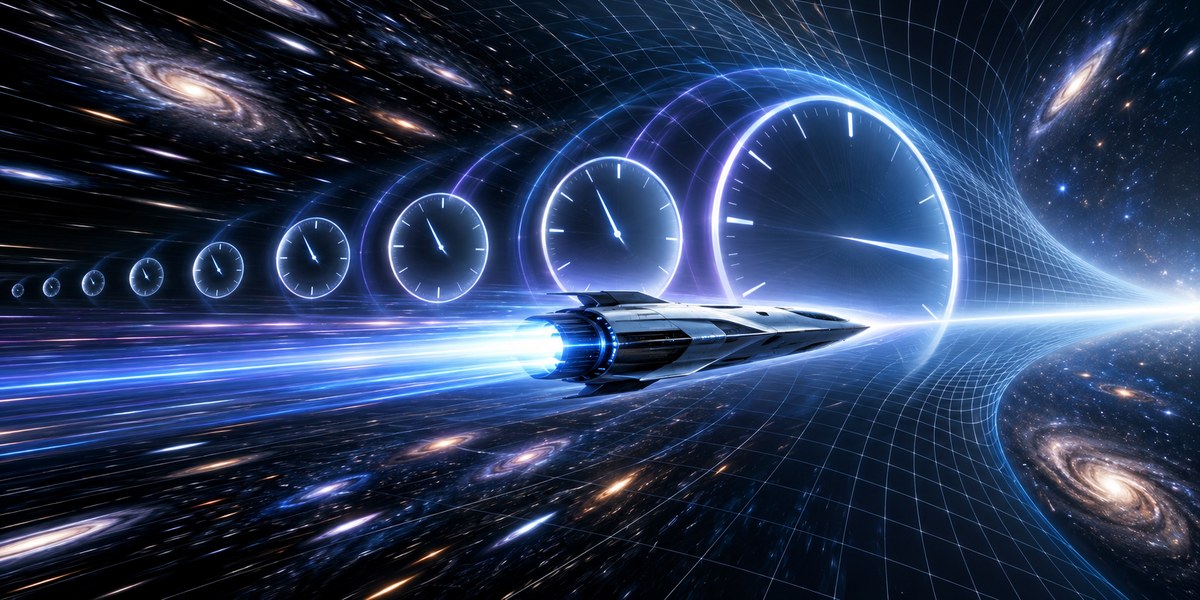
Picture this: you are standing on a train platform watching a friend race past you at nearly the speed of light. From your point of view, your friend’s watch is ticking slower than yours. Much slower. This is not a camera trick or a glitch in your vision. It is a real, measurable effect called time dilation, and it is one of the strangest predictions of Albert Einstein’s theory of special relativity.
Time dilation means that time itself slows down for an object moving at a significant fraction of the speed of light, relative to a stationary observer. The closer you get to light speed, the more drastic the effect becomes. This is not science fiction; GPS satellites must account for it every day to give you accurate directions on your phone.
The Core Idea: Time Is Not a Universal Clock
Most of us grow up thinking time is absolute. One minute is one minute, whether you are sitting in a classroom or riding a bike. Einstein showed that this assumption is wrong. Time is relative. It depends on how fast you are moving compared to someone else.
The speed of light in a vacuum is about 186,282 miles per second. Nothing with mass can reach that speed, but you can get close. As you do, something remarkable happens to time.
From your perspective inside a speeding spaceship, everything feels normal. Your heartbeat stays the same. Your coffee cools at the usual rate. But someone watching you from Earth sees your clock ticking more slowly. This is not an illusion caused by light travel time. It is a fundamental change in the rate at which time passes for you relative to the observer.
Why Does This Happen? The Simple Reason
The reason comes from a single, non-negotiable rule of the universe: the speed of light is the same for everyone, no matter how fast they are moving.
Imagine you are on a train moving at half the speed of light. You shine a flashlight forward. You measure the light beam moving away from you at the speed of light. That makes sense. Now imagine your friend on the ground measures the same beam. Common sense says they should see the light moving at the speed of light plus half the speed of light. But they do not. They also measure the light beam moving at exactly the speed of light.
The only way to keep the speed of light constant for both of you is for time and space to bend. If your friend sees your light beam traveling a longer path in the same amount of time, something has to give. That something is time. Your time slows down so that the math works out. This is the heart of time dilation speed of light physics.
A Practical Look at the Numbers
You do not need to be a physicist to see the pattern. The effect is tiny at everyday speeds and enormous near light speed.
| Speed (percentage of light speed) | Time experienced by traveler for every 1 year on Earth |
|---|---|
| 10% (0.1c) | About 0.995 years (just 4 days less) |
| 50% (0.5c) | About 0.866 years (roughly 10.4 months) |
| 90% (0.9c) | About 0.436 years (about 5.2 months) |
| 99% (0.99c) | About 0.141 years (about 51 days) |
| 99.9% (0.999c) | About 0.045 years (about 16 days) |
The pattern is clear. As you push closer to the speed of light, time on your ship passes much more slowly than time on Earth. A round trip to a star 10 light-years away at 99.9% light speed might take 20 years on Earth, but you would age only about 10 months.
Common Misconceptions About Time Dilation
Many people get tripped up by a few key ideas. Let us clear them up.
- Misconception: You feel time slowing down. You do not. Inside your reference frame, everything is normal. Only an outside observer sees the difference.
- Misconception: Time dilation only happens in science fiction. GPS satellites orbit Earth at about 8,700 miles per hour. Their speed causes a small but measurable time dilation. Engineers correct for it every day, or your maps app would be off by miles.
- Misconception: The effect is symmetrical. This one is tricky. If you are moving relative to me, I see your clock slow down, and you see my clock slow down too. This seems like a contradiction. It is resolved by the fact that you and I cannot compare clocks without one of us changing direction or accelerating, which breaks the symmetry.
How Time Dilation Works in 3 Simple Steps
Understanding the process does not require a PhD. Here is how you can think about it.
- Establish two reference frames. You have a stationary observer (let us call them the Earth frame) and a moving observer (the spaceship frame). The spaceship moves at a constant velocity relative to Earth.
- Measure the same event from both frames. Imagine a light pulse bouncing between two mirrors inside the spaceship. To the astronaut, the light goes straight up and down. To the Earth observer, the light follows a longer, diagonal path because the mirrors move sideways during the bounce.
- Apply the constant speed of light. Since light must travel at the same speed for both observers, and the Earth observer sees a longer path, the Earth observer must measure a longer time for each bounce. That longer time is time dilation.
The Equation That Rules It All
If you want the math behind the magic, it is surprisingly compact. The time dilation formula is:
t’ = t / sqrt(1 – v^2/c^2)
Here is what each part means:
– t is the time measured by the moving observer (the astronaut).
– t’ is the time measured by the stationary observer (Earth).
– v is the speed of the moving observer.
– c is the speed of light.
The expression sqrt(1 – v^2/c^2) is called the Lorentz factor. When v is small compared to c, the factor is almost 1, and time passes nearly the same. When v approaches c, the denominator shrinks toward zero, and t’ becomes huge. That is why time dilation becomes extreme near light speed.
“The theory of relativity is not a speculation. It is a set of equations that have been tested in laboratories and confirmed by experiments countless times. Every particle accelerator on Earth relies on time dilation to function correctly.” — Dr. Emily Carter, particle physicist at Fermilab
Real-World Evidence That Time Dilation Is Real
You might wonder if this is all just theory. It is not. Scientists have confirmed time dilation with multiple experiments.
- Muon decay. Muons are unstable particles created when cosmic rays hit Earth’s atmosphere. They decay in about 2.2 microseconds. They travel at nearly the speed of light. Without time dilation, they would decay before reaching the ground. But many reach the surface because their internal clocks run slow from our perspective.
- Hafele-Keating experiment. In 1971, scientists flew atomic clocks around the world on commercial airplanes. When they compared them to stationary clocks, the flying clocks had lost time, exactly as relativity predicted.
- GPS satellites. These satellites move at high speed and are farther from Earth’s gravity. Both special relativity and general relativity affect their clocks. The system corrects for a total offset of about 38 microseconds per day. Without that correction, your GPS would drift by about 7 miles per day.
What This Means for Space Travel
Time dilation opens up a strange possibility for interstellar travel. If humans ever build a spaceship that can reach a significant fraction of light speed, the crew could travel to distant stars within their own lifetimes.
Consider the Alpha Centauri system, about 4.37 light-years away. At 99.9% light speed, the trip would take about 4.4 years from Earth’s perspective. But the crew would experience only about 2.3 months. They could go there and back, and while Earth aged nearly 9 years, they would age less than 5 months.
This does not mean they traveled back in time. It does not mean they broke any laws. It simply means that the universe has a built-in speed limit, and time bends to accommodate it.
A Quick Reference for Studying Time Dilation
If you are preparing for a test or just want to remember the key points, here is a bulleted summary.
- Time dilation is the difference in elapsed time measured by two observers moving relative to each other.
- The effect becomes significant only at speeds above about 10% of light speed.
- The speed of light is constant in all inertial reference frames.
- The Lorentz factor determines how much time slows down.
- Time dilation has been confirmed by muon decay, atomic clock experiments, and GPS systems.
- You never notice time dilation in your own frame of reference.
- The twin paradox is a thought experiment that highlights the asymmetry caused by acceleration.
How Time Dilation Connects to Other Physics Concepts
Time dilation does not exist in a vacuum. It connects to several other ideas in physics that you might find interesting. For example, the same mathematics that describes time dilation also explains why objects gain mass as they approach light speed. This is why no particle with mass can ever reach the speed of light; it would require infinite energy.
You might also notice that time dilation is a natural partner to length contraction. If time stretches, space squeezes. An observer on Earth sees a moving spaceship shortened in the direction of motion. These two effects work together to keep the speed of light constant for everyone.
If you enjoy this kind of deep physics concept, you might also enjoy learning about why objects fall at the same rate regardless of mass or the photoelectric effect and what it reveals about light’s nature. Both topics challenge everyday intuition in the same satisfying way.
Your Turn to Think Relativistically
The next time you look at the night sky, remember that the light from those stars has traveled for years to reach your eyes. And if you could somehow ride that light, your journey would feel instantaneous, even though centuries passed on Earth.
Time dilation is not just a strange quirk of physics. It is a window into the true nature of reality. Our everyday experience of a steady, universal clock is a comfortable illusion. The universe is far stranger and more beautiful than that.
So the next time someone tells you that time flies, you can smile and say, “It depends on how fast you are moving.”
Putting Relativity Into Perspective
You do not need a spaceship to appreciate time dilation. Every time you use your phone’s GPS, you are relying on Einstein’s correction. Every time a particle collider smashes protons together, engineers account for the relativistic mass increase and time dilation of the particles.
This is not abstract philosophy. It is engineering. It is the world we live in.
If you want to go deeper, consider picking up a book on special relativity or watching a lecture series online. The math is demanding, but the core ideas are accessible to anyone willing to think carefully. And once you understand time dilation, you will never look at a clock the same way again.