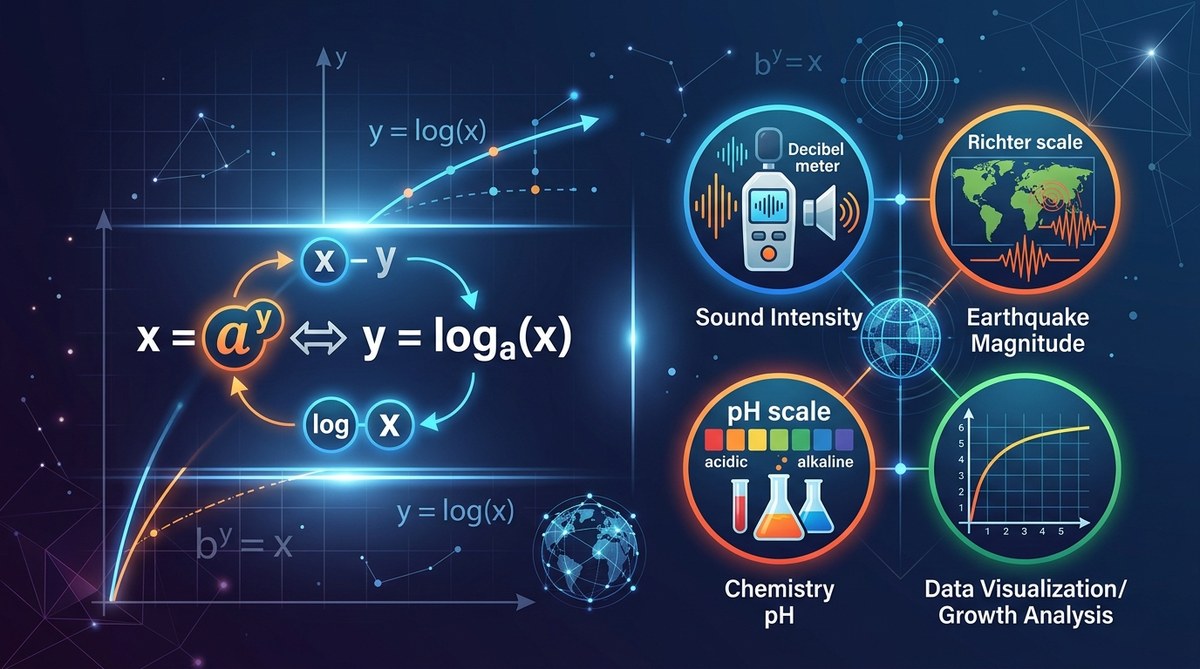
You have probably seen a logarithm before. It looks like a strange little function with a subscript and an argument: log₂(8). Maybe you memorized the rules in algebra class and then forgot them. That is okay. Logarithms are often taught in a way that makes them feel abstract and disconnected from real life. But the truth is that logarithms are one of the most powerful and practical tools in mathematics. They help us measure earthquakes, understand sound volume, calculate compound interest, and even make sense of how your brain perceives brightness. If you want to understand what a logarithm actually is and when you should use it, you are in the right place.
A logarithm answers the question: what exponent do I need to raise a given base to in order to get a specific number? In plain language, logarithms are the inverse of exponentiation. They turn multiplication into addition and make huge numbers manageable. You use them whenever you need to measure things that grow exponentially, like sound intensity, pH levels, or the brightness of stars.
The Simple Idea Behind Logarithms
Let us start with something familiar: exponents. You know that 2³ = 8. The base is 2, the exponent is 3, and the result is 8. A logarithm flips that around. Instead of asking “what is 2 raised to the 3rd power?”, a logarithm asks “to what power must I raise 2 to get 8?” The answer is 3. So we write log₂(8) = 3.
Read that out loud: “log base 2 of 8 equals 3.”
Every logarithm has a base and an argument. The base is the small number written below the “log”. The argument is the number inside the parentheses. The result is always an exponent.
Here is the same idea written as a formula:
If bˣ = y, then log_b(y) = x.
This is the single most important thing to remember. If you understand that relationship, you already understand the core of what a logarithm is.
Why This Matters Right Now
You might be thinking: “Okay, I get that it is the inverse of exponentiation. But why does that matter?” The reason is that logarithms make hard math easier. They allow you to work with very large or very small numbers without drowning in zeros. They also reveal patterns that are hidden when you look at raw numbers.
For example, the Richter scale for earthquakes is logarithmic. A magnitude 6 earthquake is not just a little stronger than a magnitude 5. It is ten times stronger. That is because the scale uses base-10 logarithms. Each whole number increase represents a tenfold increase in amplitude.
Common Bases You Will Encounter
Not all logarithms use the same base. Three bases show up most often in math, science, and programming.
| Base | Notation | Common Name | Typical Use Case |
|---|---|---|---|
| 10 | log(x) or log₁₀(x) | Common logarithm | Earthquakes, pH, sound intensity |
| e (about 2.718) | ln(x) | Natural logarithm | Calculus, compound interest, population growth |
| 2 | log₂(x) | Binary logarithm | Computer science, data structures, algorithms |
The natural logarithm uses the special number e. Do not let that scare you. e is just a constant, like pi. It appears naturally in formulas involving continuous growth. For example, if you invest money with continuously compounded interest, the natural logarithm is the tool you need to solve for time.
How to Read and Evaluate Logarithms
When you see a logarithm expression, follow these steps to find its value.
- Identify the base. This is the small number below the “log”. If no base is written, it is usually base 10 in science classes and base e in advanced math contexts.
- Ask yourself: what exponent applied to this base gives me the argument?
- Rewrite the logarithm as an exponential equation: base^(result) = argument.
- Solve for the result using mental math, a calculator, or a computer.
Let us walk through an example. Evaluate log₃(81).
Step 1: The base is 3.
Step 2: What power of 3 equals 81?
Step 3: 3⁴ = 81.
Step 4: The answer is 4. So log₃(81) = 4.
Some logarithms do not produce whole numbers. For instance, log₂(10) is about 3.32 because 2³·³² is roughly 10. That is fine. You can use a calculator for those.
Where Logarithms Show Up in Real Life
Logarithms are not just for math tests. They appear in many fields. Here are a few places you have probably encountered them without realizing it.
- Sound and Decibels: Your ears perceive loudness on a logarithmic scale. A sound at 80 decibels is not twice as loud as a sound at 40 decibels. It is about 10,000 times more intense. The decibel formula uses base-10 logarithms to map huge ranges of sound pressure into a small, usable scale.
- Acidity and pH: The pH scale measures how acidic or basic a solution is. It is a logarithmic scale based on the concentration of hydrogen ions. A pH of 3 is ten times more acidic than a pH of 4.
- Computer Algorithms: In programming, you often need to know how many steps an algorithm takes. Binary search, one of the most efficient search methods, runs in log₂(n) time. If you have a sorted list of 1,000 items, it takes at most about 10 comparisons to find any item. That is the power of logarithms.
- Finance: When you want to calculate how long it takes for an investment to double, you use the natural logarithm. The rule of 72 is a shortcut, but the exact formula uses ln(2) divided by the interest rate.
If you are curious about how these concepts connect to other areas of math, you might enjoy reading about why objects fall at the same rate regardless of mass. The same kind of inverse relationship thinking applies.
Common Mistakes and How to Avoid Them
Even after you understand the basic idea, a few pitfalls can trip you up. Here is a table of common errors and the correct way to think about each one.
| Mistake | Why It Happens | Correct Approach |
|---|---|---|
| Thinking log(x) means “log times x” | The notation looks like a function but is often misread as multiplication. | Remember that log is a function name, not a variable. Treat it like sin(x) or f(x). |
| Confusing log(xy) with log(x) * log(y) | It is tempting to distribute the logarithm. | The correct rule is log(xy) = log(x) + log(y). Addition, not multiplication. |
| Forgetting that log(0) is undefined | There is no exponent that gives a result of zero for a positive base. | Check that your argument is positive before evaluating. |
| Mixing up log(x/y) and log(x) / log(y) | Division inside the log looks similar to division of logs. | The correct rule is log(x/y) = log(x) – log(y). |
Another big mistake is trying to solve logarithmic equations without first rewriting them in exponential form. If you get stuck, go back to the definition. It will almost always help.
When Should You Actually Use a Logarithm?
You should reach for a logarithm whenever you are dealing with data that spans many orders of magnitude. That is a fancy way of saying “numbers that get very big or very small very fast.”
Here are specific situations where logarithms are the right tool.
- You want to compare values that grow exponentially, like population sizes or virus spread.
- You need to solve for an exponent in an equation. For example, if 2ⁿ = 1024, you can use log₂(1024) to find n.
- You are working with a formula that already includes a logarithm, such as the decibel formula or the pH formula.
- You want to visualize data that has a long tail. Plotting the logarithm of the values can reveal patterns that are invisible on a linear scale.
- You are analyzing algorithm efficiency in computer science. The big O notation often uses logarithms to describe how runtime grows with input size.
For a deeper look at how to handle logarithmic equations step by step, check out our guide on solving logarithmic equations a visual step by step strategy.
A Practical Example: Doubling Your Money
Let us put this into action. Suppose you invest $1,000 in an account that earns 5% annual interest, compounded continuously. You want to know how long it will take for your money to double.
The formula for continuous compounding is A = P * e^(rt). Here A is the final amount, P is the principal, r is the interest rate as a decimal, and t is time in years.
You want A = 2000 and P = 1000. So 2000 = 1000 * e^(0.05t). Divide both sides by 1000 to get 2 = e^(0.05t).
Now take the natural logarithm of both sides: ln(2) = 0.05t.
Solve for t: t = ln(2) / 0.05.
Using a calculator, ln(2) is about 0.693. Divide that by 0.05, and you get about 13.86 years.
That is the exact answer. Without logarithms, you would have no way to solve for t in that equation.
Logarithms and Mental Math
Here is a bonus trick. Logarithms can help you estimate large multiplications in your head. If you know that log₁₀(2) is about 0.301, you can approximate log₁₀(8) as 3 * 0.301 = 0.903. That tells you 8 is close to 10^0.903, which is roughly 8. This is not something you will do every day, but it shows how logarithms turn multiplication into addition. If you want to sharpen your mental calculation skills, you might find our article on 7 mental math tricks that will transform your calculation speed helpful.
Logarithms Are Your Friend
Logarithms can feel intimidating at first. They have a weird name and a notation that looks nothing like the rest of algebra. But once you see them as the answer to “what exponent do I need?”, they become much simpler. They are not a punishment. They are a tool that lets you handle huge numbers, solve exponential equations, and understand the world around you more clearly.
The next time you see a logarithm in a textbook, on a calculator, or in a line of code, do not panic. Take a breath. Identify the base. Ask what exponent gives you the argument. And remember that you are using one of the most elegant ideas in all of mathematics.
Putting This Knowledge to Work
The best way to get comfortable with logarithms is to practice with real examples. Look up the pH of common household items and calculate how much more acidic lemon juice is than coffee. Find the decibel level of a normal conversation and compare it to a rock concert. Or write a small program that uses log₂ to measure how many steps a binary search takes on a list of 10,000 items.
Each time you do this, the concept will feel more natural. You will start to see logarithms everywhere. And one day, you will realize that they are not confusing at all. They are just the other side of the exponent coin.
Keep a calculator handy. Keep this article bookmarked. And the next time someone asks you what a logarithm is, you can tell them with confidence: it is the exponent you need to get from a base to a number. Nothing more, nothing less.