You hear an ambulance siren change pitch as it speeds past you. That familiar, sliding tone isn’t just a sound, it is a perfect demonstration of the Doppler effect. This phenomenon happens whenever a wave source moves relative to an observer. It affects sound waves, light waves, and even water waves. The most interesting part is that you have experienced it thousands of times without realizing it. So let’s break down what the Doppler effect really means, and then look at seven concrete doppler effect examples that happen in your daily life.
The Doppler effect describes the change in frequency of a wave when the source and observer are moving relative to each other. You hear it when a siren passes by, see it in the red-shift of stars, and rely on it in radar guns and medical ultrasound. This guide covers seven everyday applications so you can recognize physics at work wherever you go.
Understanding the Doppler Effect in Simple Terms
The core idea is straightforward. When a source of waves moves toward you, the waves get compressed. That means each wave crest arrives sooner, so the frequency you perceive goes up. When the source moves away, the waves stretch out, and the frequency drops. The same thing happens if you move toward or away from a stationary source. The relative motion is all that matters.
For sound waves, a higher frequency sounds higher in pitch. For light waves, a higher frequency shifts the color toward blue, and a lower frequency shifts it toward red. Astronomers call this redshift. The basic formula for the observed frequency (f’) is:
f’ = f * (v + v_o) / (v – v_s)
Here v is the speed of the wave in the medium, v_o is the speed of the observer relative to the medium, and v_s is the speed of the source. But you don’t need the math to notice the effect in action.
Seven Everyday Doppler Effect Examples
Each of these examples shows the Doppler effect working in a different context. Some are obvious, others less so. All of them happen around you regularly.
1. Ambulance and Police Sirens
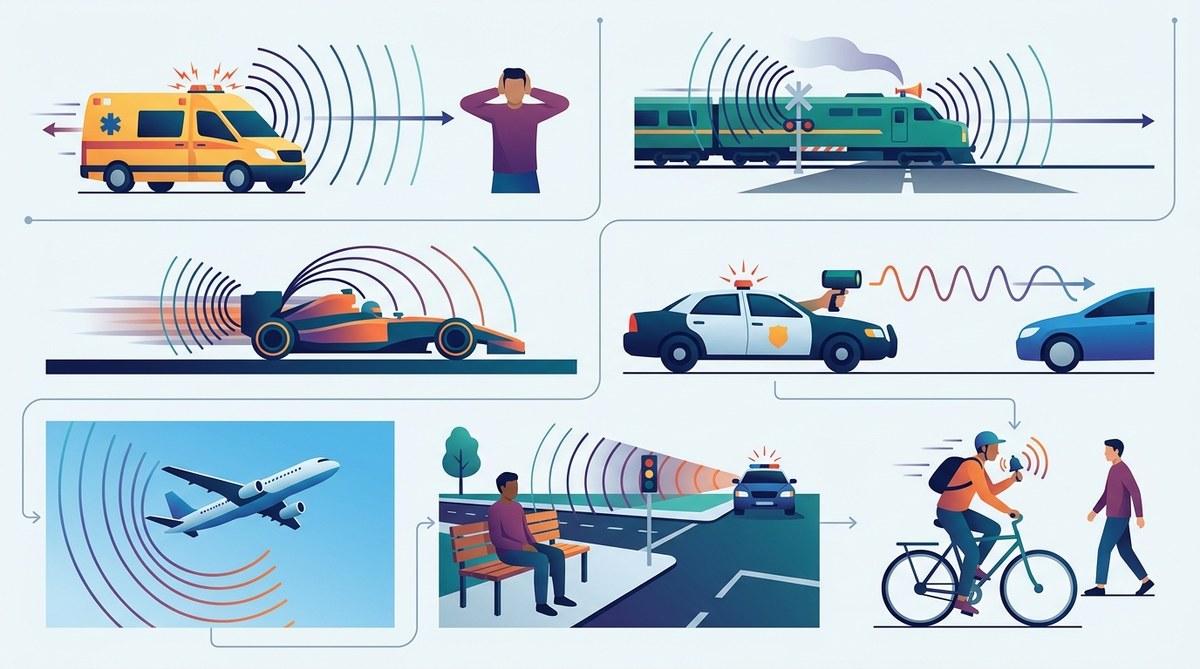
This is the classic example. A siren emits a constant pitch. As the vehicle races toward you, the sound waves bunch up, making the pitch sound higher. As it passes and moves away, the waves stretch, and the pitch drops. You can notice the exact moment the pitch shifts. The change is smooth, not abrupt, because the relative speed changes continuously.
If the vehicle is moving at 50 mph (about 22 m/s) and the siren’s frequency is 700 Hz, the approaching pitch might sound like 770 Hz, and the receding pitch like 640 Hz. That difference of more than 100 Hz is very noticeable to the human ear.
2. Police Radar Speed Guns
Police radar guns use the Doppler effect with radio waves instead of sound. They send out a microwave beam at a known frequency. The waves bounce off a moving car and return to the gun. Because the car is moving, the reflected waves have a shifted frequency. The radar gun measures that shift and calculates the car’s speed.
The equation is simple: Δf = (2v / c) * f0, where v is the car’s speed, c is the speed of light, and f0 is the original frequency. Modern radar guns can measure speed within 0.1 mph. So when you see a police car parked on the highway, you are looking at Doppler technology in action.
3. Weather Radar and Doppler Radar
Weather forecasters rely on Doppler radar to track storms. The radar station sends out pulses of microwave energy. Those pulses bounce off raindrops, snow, or hail. By measuring the frequency shift of the returning signal, meteorologists can determine how fast the precipitation is moving toward or away from the station.
This information lets them predict where a storm will be in the next hour. It also helps detect rotation inside a thundercloud, which can indicate a tornado. Without the Doppler effect, we would have much less warning about severe weather.
4. Medical Ultrasound Imaging (Doppler Echocardiogram)
In medicine, the Doppler effect helps doctors see blood flow. An ultrasound machine sends high-frequency sound waves into the body. The waves reflect off moving red blood cells. The shift in frequency tells the machine how fast the blood is moving and in which direction.
This technique, called Doppler echocardiography, is used to check for blocked arteries, leaky heart valves, and abnormal blood flow patterns. It is completely noninvasive and painless. Every time someone gets an ultrasound of their heart, the Doppler effect is doing the hard work behind the scenes.
5. Redshift and Blueshift in Astronomy
When we look at distant stars and galaxies, we see the Doppler effect at cosmic scales. If a star is moving away from Earth, its light waves stretch, shifting toward the red end of the spectrum. That is called redshift. If a star is moving toward Earth, its light compresses, shifting toward blue.
Edwin Hubble discovered that almost all distant galaxies are redshifted. That means they are moving away from us, which led to the theory of an expanding universe. Astronomers use the amount of redshift to calculate how far away a galaxy is and how fast it recedes. Even the cosmic microwave background radiation shows a tiny Doppler shift caused by Earth’s motion through space.
6. Flow and Level Sensors in Industry
Many industrial sensors use the Doppler effect to measure the flow of liquids or gases in pipes. A sensor sends an ultrasonic signal into the pipe. Particles or bubbles in the fluid reflect the signal. The frequency shift of the reflected wave reveals the fluid’s velocity.
This same principle is used in open-channel flow meters for rivers and wastewater treatment plants. It allows engineers to monitor flow rates without inserting any mechanical parts into the pipe. That means less maintenance and fewer breakdowns.
7. Speakers and Sound Systems (Doppler Distortion)
High-end audio engineers have to account for a subtle effect called Doppler distortion. When a large speaker cone moves back and forth, it acts like a moving source of sound. The cone’s motion adds a tiny frequency shift to the sound it produces. If the cone moves very fast, the shift can cause audible distortion, especially at low frequencies.
This is why many professional speakers use separate woofers, midrange drivers, and tweeters. Each driver handles a narrower range of frequencies, so the cone doesn’t have to move too far or too fast. Without this design, the Doppler effect would muddy the sound.
A Handy Comparison Table of Doppler Effect Examples
| Example | Wave Type | What Moves | Typical Application |
|---|---|---|---|
| Ambulance siren | Sound | Source toward/away from observer | Everyday experience |
| Police radar gun | Radio (microwave) | Target car moves | Law enforcement speed measurement |
| Weather radar | Radio (microwave) | Raindrops move | Storm prediction and tornado detection |
| Medical ultrasound | Sound (ultrasound) | Red blood cells move | Blood flow and heart function assessment |
| Astronomical redshift | Light | Star or galaxy moves | Measuring distance and universe expansion |
| Industrial flow sensor | Sound (ultrasonic) | Particles in fluid move | Process control and environmental monitoring |
| Speaker distortion | Sound | Speaker cone moves | Audio equipment design |
Common Mistakes Students Make with Doppler Effect Problems
Many students confuse the direction of the frequency shift. Here is a checklist to keep you on track:
- If source and observer move toward each other, frequency increases.
- If they move apart, frequency decreases.
- The formula uses the speed of the wave in the medium, not the speed of the source or observer alone.
- For sound, the medium (air) is stationary in most problems. For light, there is no medium, so the formula simplifies.
One common error is forgetting to add or subtract speeds correctly. Always draw a quick diagram showing who is moving and in which direction.
“The Doppler effect is one of the most intuitive physics concepts once you hear it in action. My students always remember the siren example better than any equation.” Dr. Sarah Kim, physics professor at a U.S. university
How to Practice Recognizing the Doppler Effect in Your Own Life
You don’t need a lab to study the Doppler effect. Here is a simple three-step method you can use today:
- Find a busy street where cars or trucks pass regularly. Stand safely on the sidewalk.
- Listen to the sound of a vehicle as it approaches and then recedes. Focus on the pitch change.
- Try to notice the exact moment when the pitch sounds highest. That is the moment when the vehicle is closest to you.
If you live near a train crossing, you can hear it even more clearly. Trains are long and produce a continuous horn sound. The pitch drops noticeably after the train passes.
You can also observe the Doppler effect with light by watching a distant car’s headlights at night. The shift is tiny because the speed of light is so huge, but you might notice a slight color change when the car is moving very fast. This is more of a thought experiment than a practical observation, but it shows that the same rules apply to all waves.
Beyond the Basics: How the Doppler Effect Connects to Other Physics Topics
Understanding the Doppler effect opens the door to many other concepts. For example, the same relativistic Doppler formula explains how GPS satellites adjust their signals for time dilation. If you want to see related ideas, check out our guide on The Doppler effect also plays a role in radar astronomy and the search for exoplanets, which ties into
For students preparing for standardized tests, the Doppler effect frequently appears on the AP Physics 1 and SAT Subject Test exams. Reviewing these examples can help you solve multiple-choice questions more confidently. You might also find our article on https://science24.org/5-common-mistakes-students-make-when-balancing-chemical-equations/ helpful for avoiding test day errors in a different subject area.
Seeing the World Through the Lens of Wave Physics
The Doppler effect is more than a textbook concept. It is a tool that helps us measure speed, diagnose disease, forecast weather, and understand the universe. Every time you hear a siren, see a weather map, or feel your heart being imaged with ultrasound, remember that you are experiencing physics in action.
Try the listening exercise today. Notice the siren, the train horn, the roar of a race car. Once you start paying attention, you will see the Doppler effect everywhere. And that is the best way to learn science: by noticing it in the world around you. If you want to go deeper, our article on https://science24.org/understanding-heat-transfer-through-conduction-convection-and-radiation/ shows another way physics shapes your daily experience. Keep observing, keep asking questions, and let the waves guide you.