Chemical reactions are everywhere around us. They are the invisible processes that keep our world moving in subtle yet powerful ways. From the baking of bread to the rusting of metal, chemical reactions influence many parts of daily life. Recognizing these reactions helps us appreciate how science impacts everything we do. Whether you are a student, educator, or simply curious, understanding chemical reactions in everyday life opens a window into the fascinating chemistry behind familiar activities and environments.
How chemical reactions shape daily routines
Chemical reactions are at the core of many common activities. They often happen without us noticing, but they are essential for life, health, and convenience. Let us look at some everyday processes where chemical reactions play a key role.
Practical processes involving chemical reactions
-
Cooking and food preparation
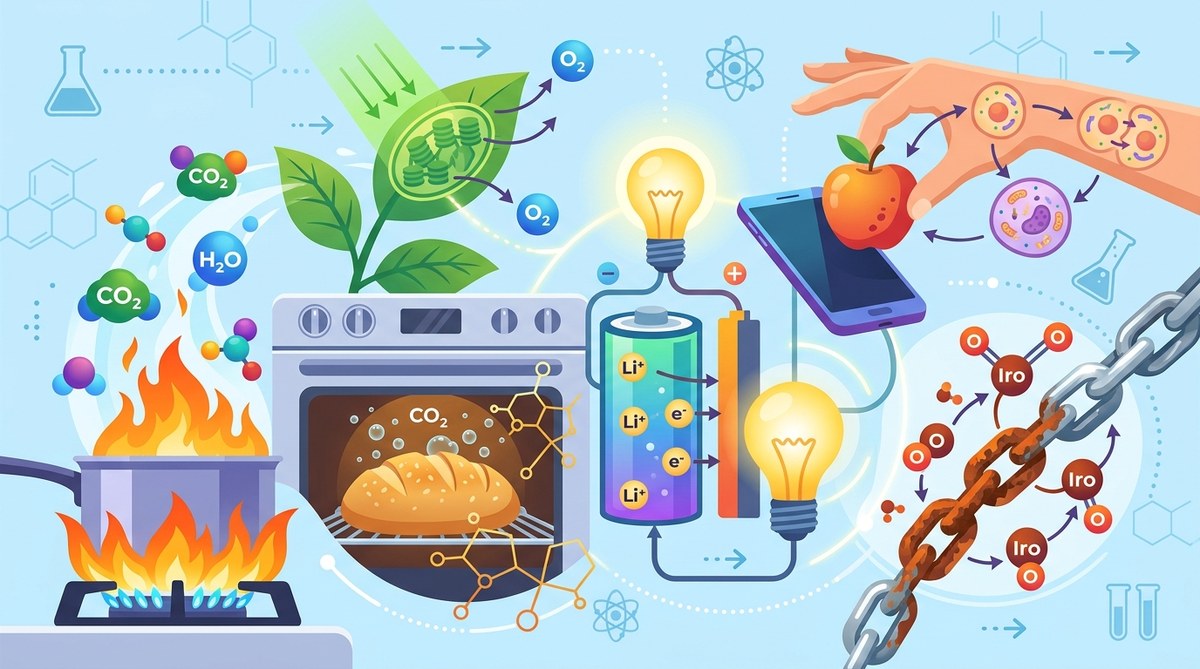
Cooking involves numerous chemical reactions that transform raw ingredients into delicious meals. For example, when baking bread, yeast ferments sugars through a process called fermentation, producing carbon dioxide that makes the dough rise. The Maillard reaction, which occurs when you toast bread, creates complex flavors and browning by combining amino acids and sugars at high temperatures. These reactions give your food its taste, texture, and appearance. -
Cleaning and disinfection
Many cleaning products rely on chemical reactions to eliminate dirt, bacteria, and viruses. Bleach, which contains sodium hypochlorite, reacts with organic matter and microbial cells, breaking down their structures. Similarly, acids like vinegar react with mineral deposits such as lime scale in sinks, dissolving them away. These reactions make cleaning effective and safe by breaking down unwanted substances. -
Energy production in batteries
Batteries power our devices through redox reactions, where electrons are transferred between chemical species. In a typical alkaline battery, zinc reacts with manganese dioxide, releasing energy that powers your flashlight or smartphone. Understanding these reactions helps improve battery technology and energy efficiency.
Other instances where chemical reactions influence daily life
- Rusting of metals: When iron reacts with oxygen and moisture, it forms rust, a chemical change that weakens metal structures.
- Photosynthesis: Plants convert sunlight, water, and carbon dioxide into glucose and oxygen through a series of chemical reactions, providing the oxygen we breathe and the food we eat.
- Metabolism: Our bodies constantly carry out chemical reactions, breaking down food into energy and building new tissues.
Recognizing the science behind common activities
Understanding how chemical reactions work in everyday activities can make science more engaging. For example, knowing that vinegar reacts with baking soda to produce carbon dioxide gas can turn simple experiments into fun learning experiences. Additionally, recognizing the role of chemical reactions in cleaning products or energy sources can help us make smarter choices for health and sustainability.
Techniques to identify chemical reactions
- Color change: A noticeable change in color indicates a chemical transformation, like when iron turns reddish-brown as it rusts.
- Gas evolution: The release of bubbles or fumes, such as during baking or vinegar reacting with baking soda.
- Precipitate formation: The appearance of solids from a solution, like soap reacting with dirt.
- Temperature change: Reactions that release or absorb heat, seen in instant hand warmers or cold packs.
| Technique | What it reveals | Common mistake |
|---|---|---|
| Color change | Indicates a chemical change | Assuming physical mixing causes color change |
| Gas evolution | Gas production during reaction | Confusing bubbling with boiling |
| Precipitate formation | Formation of insoluble solids | Overlooking precipitate as dirt |
| Temperature change | Exothermic or endothermic reactions | Misinterpreting heat absorption as cooling |
“Many everyday chemical reactions are safe and beneficial, but understanding their mechanisms can help you handle materials wisely and avoid accidents.”
Simplifying complex reactions
While some reactions are straightforward, others involve intricate steps. For students or educators, breaking down these reactions into stages can clarify the process. For example, in photosynthesis, splitting the process into light absorption, water splitting, and sugar formation makes the concept easier to grasp.
The science of chemical reactions in environmental contexts
Chemical reactions also influence the environment in significant ways. Pollution, acid rain, and climate change all involve chemical changes. For instance, burning fossil fuels releases carbon dioxide, a greenhouse gas that traps heat in the atmosphere. Understanding these reactions enables us to develop better strategies for sustainability.
Common environmental reactions
- Ozone formation and depletion: Chemical reactions in the atmosphere create a protective ozone layer but also cause thinning due to pollutants.
- Water treatment: Chlorine reacts with contaminants to disinfect drinking water, making it safe for consumption.
- Soil chemistry: Fertilizer reactions affect plant growth and soil health.
Applying knowledge of chemical reactions for academic success
Knowing how to analyze reactions helps students excel in exams and lab work. Practice solving problems related to reaction types, balancing equations, and predicting products. Familiarity with reaction mechanisms can also boost confidence in science courses.
Study tips
- Focus on understanding reaction types like synthesis, decomposition, single and double replacement, and combustion.
- Practice balancing equations regularly to develop intuition.
- Visualize reactions with diagrams or models to improve comprehension.
Common pitfalls and how to avoid them
| Mistake | How to avoid it |
|---|---|
| Assuming all color changes are chemical | Verify with additional evidence like precipitates or gas evolution |
| Overlooking reaction conditions | Always consider temperature, pressure, and catalysts |
| Misidentifying reaction types | Study examples and practice classifying reactions |
Final thoughts: chemistry in your hands
Recognizing the presence and importance of chemical reactions in daily life enriches your understanding of the world. Whether you’re cooking, cleaning, or simply observing nature, chemistry is at work behind the scenes. By learning to identify and analyze these reactions, you gain skills that benefit your academic journey and everyday decision-making.
Connecting everyday activities with the chemistry that powers them
Applying your knowledge of chemical reactions can lead to smarter choices and a deeper appreciation for the science around you. Keep experimenting, stay curious, and see how chemistry shapes your world in ways you never imagined.