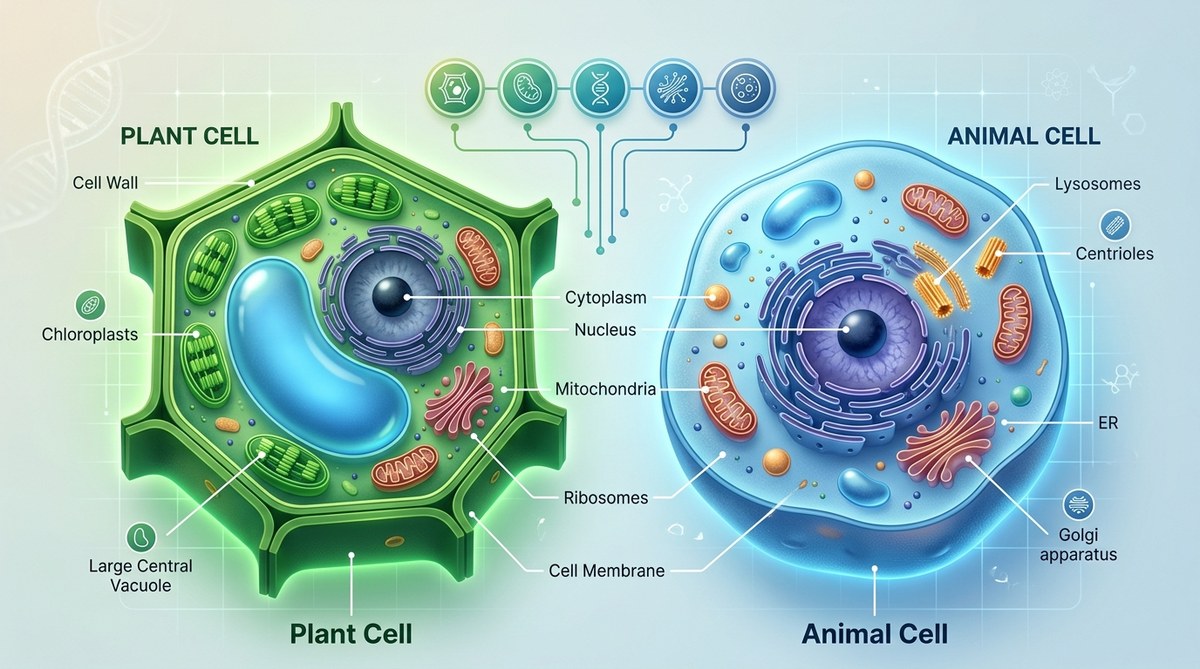
Looking at cells under a microscope reveals an invisible world of tiny structures working together to keep organisms alive. Both plant and animal cells share many features, but key differences set them apart in ways that affect how each type of organism functions and survives.
Plant and animal cells share basic structures like the nucleus, mitochondria, and cell membrane, but differ in five major ways. Plant cells have rigid cell walls, chloroplasts for photosynthesis, and large central vacuoles. Animal cells contain lysosomes for breaking down waste and centrioles for cell division. These differences reflect how plants make their own food while animals must consume nutrients from other sources.
What Makes Plant and Animal Cells Similar
Before jumping into their differences, understanding what plant and animal cells have in common helps frame the bigger picture.
Both cell types are eukaryotic. This means they contain a nucleus that houses genetic material. The nucleus acts like a control center, directing all cellular activities through DNA instructions.
Both also contain mitochondria, often called the powerhouse of the cell. These organelles convert nutrients into usable energy through cellular respiration. Without mitochondria, neither plant nor animal cells could function.
The cell membrane surrounds both types of cells. This thin barrier controls what enters and exits, maintaining the right internal environment. Think of it as a security checkpoint that keeps harmful substances out while letting necessary materials in.
Ribosomes appear in both cell types too. These tiny structures build proteins based on instructions from the nucleus. Proteins perform countless jobs, from building cell structures to speeding up chemical reactions.
The endoplasmic reticulum and Golgi apparatus also exist in both. These organelles work together to manufacture, modify, and transport proteins and lipids throughout the cell.
The Five Major Structural Differences
Now for the distinctions that matter most when comparing these cell types.
Cell Walls Provide Rigid Structure in Plants
Plant cells have a tough cell wall made primarily of cellulose. This rigid layer sits outside the cell membrane, providing structural support and protection.
The cell wall gives plants their firm texture. When you bite into a crisp apple or snap a celery stalk, you’re experiencing the strength of cell walls.
Animal cells lack this structure entirely. They rely only on their flexible cell membrane, which allows for greater movement and shape changes. This flexibility helps animal cells squeeze through tight spaces and change form as needed.
The absence of a cell wall in animal cells explains why animals need skeletons or exoskeletons for support. Plants get their structural integrity from millions of cell walls working together.
Chloroplasts Enable Photosynthesis in Plant Cells
Chloroplasts are perhaps the most significant difference between plant and animal cells. These green organelles contain chlorophyll, the pigment that captures light energy from the sun.
Inside chloroplasts, photosynthesis converts light energy, carbon dioxide, and water into glucose and oxygen. This process allows plants to manufacture their own food. How photosynthesis actually works involves complex chemical reactions that sustain most life on Earth.
Animal cells completely lack chloroplasts. Animals must consume other organisms to obtain energy, making them dependent on plants or other animals for survival.
The presence of chloroplasts explains why leaves appear green. Chlorophyll reflects green wavelengths of light while absorbing red and blue wavelengths for photosynthesis.
Central Vacuoles Store Water and Nutrients in Plants
Plant cells contain a large central vacuole that can occupy up to 90% of the cell’s volume. This fluid-filled sac stores water, nutrients, and waste products.
The central vacuole maintains turgor pressure, which keeps plant cells firm and rigid. When plants don’t get enough water, the vacuole shrinks, causing wilting. Give the plant water, and the vacuole refills, restoring the plant’s upright structure.
Animal cells have vacuoles too, but they’re much smaller and more numerous. These tiny vacuoles serve temporary storage purposes rather than maintaining cell structure.
The size difference reflects different survival strategies. Plants stay rooted in one spot and need efficient water storage for dry periods. Animals move to find water, so large storage vacuoles aren’t necessary.
Lysosomes Break Down Waste in Animal Cells
Animal cells contain lysosomes, specialized organelles filled with digestive enzymes. These structures break down worn-out cell parts, bacteria, and other waste materials.
Think of lysosomes as the cell’s recycling center and garbage disposal combined. They keep the cell clean and recycle useful materials from broken-down components.
Plant cells typically lack true lysosomes. Instead, the central vacuole performs similar waste-disposal functions, though through different mechanisms.
This difference relates to cell structure. Animal cells need dedicated waste-processing units because they don’t have large central vacuoles. Plant cells handle waste management through their existing vacuole system.
Centrioles Organize Cell Division in Animals
Animal cells contain centrioles, cylindrical structures made of microtubules. These organelles play a crucial role during cell division by organizing spindle fibers that separate chromosomes.
During mitosis, centrioles move to opposite ends of the cell and help pull duplicated chromosomes apart. This ensures each new cell receives the correct genetic information.
Most plant cells lack centrioles entirely. They still divide successfully using other mechanisms to organize their spindle fibers. Scientists aren’t completely sure how plants manage this, but they clearly don’t need centrioles for normal cell division.
Lower plant forms like mosses and ferns do have centrioles, suggesting that higher plants lost them during evolution. The loss didn’t hurt their survival, proving that multiple solutions exist for the same biological problem.
Comparing Key Structures Side by Side
| Structure | Plant Cells | Animal Cells | Main Function |
|---|---|---|---|
| Cell Wall | Present (cellulose) | Absent | Provides rigid support and protection |
| Chloroplasts | Present | Absent | Performs photosynthesis to make food |
| Central Vacuole | Large (up to 90% of cell) | Small and numerous | Stores water, maintains turgor pressure |
| Lysosomes | Absent or rare | Present | Breaks down waste and worn-out parts |
| Centrioles | Absent in higher plants | Present | Organizes spindle fibers during cell division |
| Cell Shape | Fixed and rectangular | Variable and round | Reflects presence or absence of cell wall |
How These Differences Affect Function
The structural differences between plant and animal cells directly impact how each organism lives and survives.
Plants produce their own food through photosynthesis. This ability makes them autotrophs, or self-feeders. The chloroplasts and large vacuoles support this lifestyle by capturing energy and storing resources.
Animals must hunt, graze, or scavenge for food. This makes them heterotrophs, or other-feeders. Their flexible cell membranes and efficient waste-disposal systems support an active lifestyle of movement and consumption.
Plant cells maintain rigid shapes that stack together like bricks. This arrangement creates strong tissues that support tall trees and sturdy stems without requiring bones or cartilage.
Animal cells can change shape and move independently. This flexibility allows white blood cells to chase bacteria, muscle cells to contract, and nerve cells to extend long branches throughout the body.
Understanding cell structure helps explain why plants and animals behave so differently. The microscopic differences in their cells scale up to create the massive diversity of life we see every day.
Common Mistakes When Studying Cell Differences
Students often mix up these concepts when studying for tests. Here are the most frequent errors and how to avoid them.
Mistake 1: Thinking plant cells don’t have cell membranes
Plant cells have both a cell wall and a cell membrane. The wall sits outside the membrane, providing extra protection. The membrane still controls what enters and exits the cell.
Mistake 2: Assuming all vacuoles are the same
Both cell types have vacuoles, but plant vacuoles are much larger and serve different primary functions. Animal cell vacuoles are small and temporary. Plant cell vacuoles are permanent and essential for structure.
Mistake 3: Forgetting that plant cells have mitochondria
Because plant cells have chloroplasts, students sometimes think they don’t need mitochondria. Wrong. Plants use mitochondria to convert glucose from photosynthesis into usable energy, just like animals do.
Mistake 4: Confusing which cell has lysosomes
Remember that animal cells have lysosomes. The word “lysosome” sounds aggressive, and animals are often more active and aggressive than plants. This memory trick helps many students.
Mistake 5: Not understanding why these differences exist
The differences aren’t random. They reflect fundamental differences in how plants and animals obtain energy and interact with their environment. Plants stay put and make food. Animals move around and find food.
Practical Ways to Remember the Differences
Memorizing cell structures becomes easier with the right techniques.
-
Draw both cell types from memory. Sketch a plant cell and an animal cell without looking at your notes. Label all the structures. Compare your drawings to accurate diagrams and fix any mistakes. Repeat this process until you can draw both perfectly.
-
Create a mnemonic device. For plant-specific structures, try “Plants Can’t Chase Lunch” (Plant cell wall, Chloroplasts, Central vacuole, no Lysosomes needed). For animal-specific structures, try “Animals Love Chasing” (Animals have Lysosomes and Centrioles).
-
Use physical models. Build cell models using household items. Use a shoebox for the cell wall, green beads for chloroplasts, a water balloon for the central vacuole. Physical construction reinforces memory better than just reading.
-
Teach someone else. Explain the differences to a friend, parent, or sibling. Teaching forces you to organize information clearly and reveals gaps in your understanding.
-
Make comparison flashcards. Put a structure name on one side and details about it in both cell types on the other. Quiz yourself regularly, focusing on the cards you miss most often.
Real-World Applications of Cell Knowledge
Understanding plant and animal cells differences matters beyond just passing biology tests.
Plant scientists use this knowledge to develop crops that survive droughts better. By understanding how the central vacuole stores water, researchers can breed plants with more efficient water-retention systems.
Medical researchers study animal cell lysosomes to understand diseases. Some genetic disorders occur when lysosomes don’t function properly, causing waste to build up inside cells. Treatments target these specific cellular problems.
Food scientists consider cell structure when developing products. The crunch of fresh vegetables comes from water-filled vacuoles maintaining turgor pressure. When cooking breaks down cell walls, vegetables become soft.
Biotechnology companies engineer plant cells to produce medicines and useful chemicals. Understanding chloroplasts and cell walls helps them modify plants to manufacture specific compounds efficiently.
Environmental scientists track how plants and animals respond to pollution by examining their cells. Damaged chloroplasts indicate environmental stress in plants. Changes in animal cell membranes reveal toxic exposures.
Study Tips for Test Success
- Focus on the five major differences: cell wall, chloroplasts, central vacuole, lysosomes, and centrioles
- Know which structures appear in both cell types: nucleus, mitochondria, cell membrane, ribosomes, endoplasmic reticulum, Golgi apparatus
- Understand the function of each structure, not just its presence or absence
- Practice labeling blank cell diagrams until you can identify every structure instantly
- Connect structures to their functions: chloroplasts make food, cell walls provide support, lysosomes clean up waste
- Review comparison tables regularly to reinforce the differences
- Use practice questions that ask you to explain why differences exist, not just list them
Spotting Cells Under a Microscope
When viewing cells through a microscope in lab, certain features help you identify whether you’re looking at plant or animal cells.
Plant cells appear rectangular or square with clear boundaries. The rigid cell wall maintains these defined shapes. You’ll often see green chloroplasts scattered throughout the cell, and a large clear area representing the central vacuole.
Animal cells look rounder and more irregular. Without a cell wall, their shapes vary based on cell type and surrounding pressure. The nucleus usually appears as a dark circle, and you won’t see any green chloroplasts.
Onion cells make excellent plant cell specimens because their cell walls and nuclei show up clearly. Cheek cells work well for animal cell observation because they’re easy to collect and view.
The magnification level matters too. At lower magnification, you’ll see overall cell shape and arrangement. Higher magnification reveals internal structures like nuclei, chloroplasts, and vacuoles.
Why These Cells Evolved Differently
The differences between plant and animal cells reflect millions of years of evolution solving different survival challenges.
Early organisms that could harness sunlight energy gained a huge advantage. They didn’t need to hunt or compete for food. This evolutionary path led to modern plants with chloroplasts and structures supporting a stationary lifestyle.
Other organisms specialized in movement and consumption. They developed flexible cells that could change shape, efficient waste disposal systems, and structures supporting active metabolism. This path led to modern animals.
Both strategies work incredibly well. Plants cover the planet and produce most of Earth’s oxygen. Animals display amazing diversity and adaptability. The cellular differences that started billions of years ago still define how these organisms live today.
Understanding these evolutionary pressures helps explain why each cell type has its specific structures. The differences aren’t arbitrary. They’re solutions to fundamental biological problems.
Putting Cell Knowledge to Work
The next time you look at a leaf or think about your own body, remember the microscopic differences making everything possible. Plant cells with their walls, chloroplasts, and vacuoles create the green world around us. Animal cells with their flexibility, lysosomes, and centrioles power your thoughts, movements, and growth.
These five key structural differences explain why plants stay rooted while animals roam, why leaves are green while skin isn’t, and why vegetables crunch while meat doesn’t. The microscopic world of cells shapes the visible world we experience every day.
Master these concepts and you’ll ace your next biology test. More importantly, you’ll understand the fundamental differences that make plants and animals work in their own unique ways.